- Bomberman Series Introduction / Bomberman (1983)
- 3-D Bomberman
- Bomberman (1985)
- RoboWarrior
- Atomic Punk
- Bomberman (1990)
- Atomic Punk (Arcade)
- Bomberman II
- New Atomic Punk: Global Quest
- Bomberman ’93
- Super Bomberman
- Hi-Ten Bomberman / Hi-Ten Chara Bomb
- Bomberman ’94 / Mega Bomberman
- Super Bomberman 2
- Super Bomberman 3
- Wario Blast: Featuring Bomberman
- Bomberman GB 2
- Bomberman: Panic Bomber
- Super Bomberman 4
- Saturn Bomberman
- Bomberman GB 3
- Bomberman B-Daman
- Super Bomberman 5
- Atomic Bomberman
- Neo Bomberman
- Amazing Bomberman
- Bomberman 64
- Saturn Bomberman Fight!!
- Pocket Bomberman
- Bomberman Fantasy Race
- Bomberman World
- Bomberman Wars
- Bomberman: Misobon Roulette
- Super Bomberman R
- Super Bomberman R Online
- Super Bomberman R2
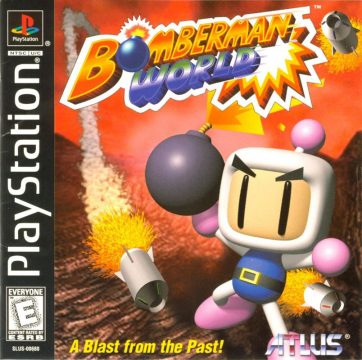
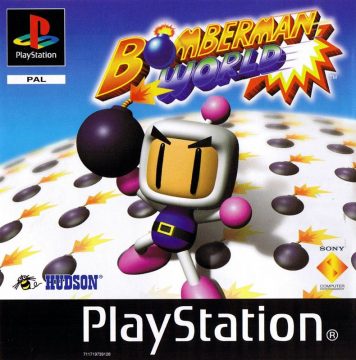
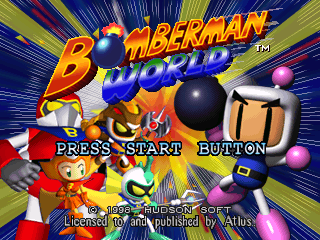
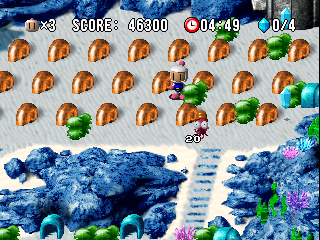
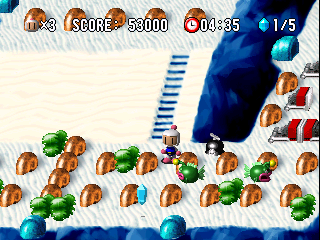
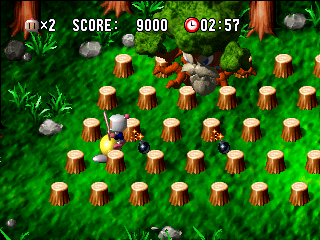
With all the innovation happening on the Game Boy and Sega Saturn, you’d think that Bomberman’s PlayStation debut would be similarly bold. However, Bomberman World reins things in, resulting in an experience that feels closer to where the series was years ago with Super Bomberman 2 and 3. Rather than going for full 3D environments like Bomberman 64, World adapts the isometric 3D perspective of Saturn Bomberman Fight!! to the classic maze gameplay, establishing a format that’s tricky to get used to, but still looks great if this era of 3D is something you’re fond of.
In a vacuum, World‘s plot is typical Bomberman fare. You’ve got Bagura once again and he comes with another group of villains called the Dark Force Bombers. Every character is fully voiced and the English dub is particularly cheesy thanks to things like Bomberman’s tendency to say “Yeehaw!” at the end of every stage. As a fun aside, the Japanese voice cast actually includes some very notable actors, such as Ichiro Nagai, Banjo Ginga, and Shigeru Chiba. What makes World a little more interesting is that it’s actually a sequel to a game that hadn’t yet been released, Bomberman Wars. In that game, King Bomber and his teammates (some of which are playable in this game’s multiplayer) fight against the Dark Force Bombers and ultimately seal them away in crystals which they then break out of in Bomberman World. Wars would go on to release just three months after World in Japan, serving as the last game in the fantasy-themed trilogy started by Pocket Bomberman.
The Dark Force Bombers are accompanied by unique mounts as well, such as the rabbit-like Deebo and the cat Nyanjirou. These mounts take hits for you and grant unique abilities like multi-bomb tossing, but they can only be used for the boss fights against the Dark Force Bombers’ mechs. It’s a half-baked twist on Louies, which can be attributed to the idea’s roots in the canceled Virtual Bomberman. Virtual Bomberman was announced in 1995 and shown at that year’s Famicom Space World event with a planned release date of February 29th, 1996 that ultimately didn’t pan out. Some fliers and magazine scans were preserved that provide enough information on the game to get an idea of what it would have been like. Collecting crystals to clear stages, the 3D visuals, and the return of Bomberman GB 3’s Challenge Mode are additional things that were planned for Virtual Bomberman that instead appeared in World.
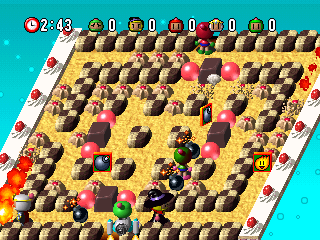
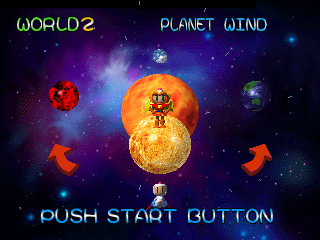
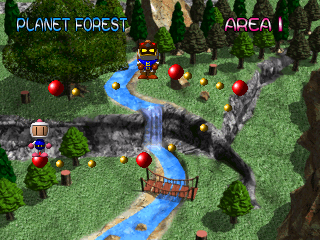
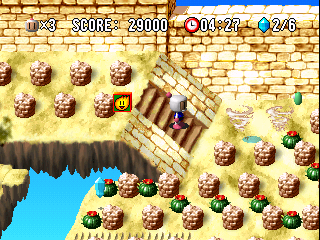
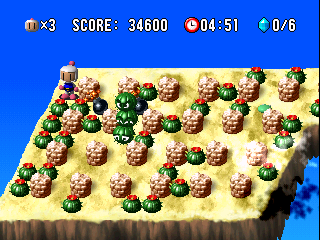
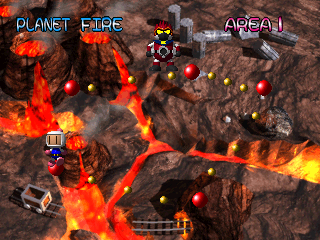
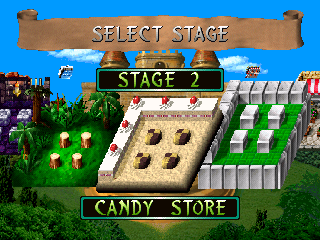
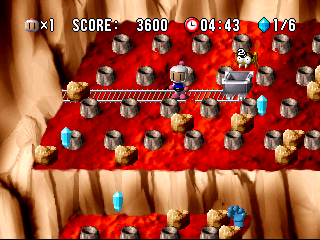
The single player story mode offers the standard suite of worlds and hazards. It begins with a simple forest planet that offers little of note besides trees that can be knocked down, cow heads that attempt to ram you, and monkeys who like to throw bananas at you. Planet Wind combines tornadoes with a desert theme and also introduces platforms that’ll carry you to other parts of a level. The fire planet is exactly what you’d expect from the series at this point with its volcanoes and minecarts. Planet #4 is a mostly simple water area, but it at least has a level where a crane will attempt to grab you and bring you back to the start of the level. Planet Black, the finale, uses a similar idea with magnetic satellites that’ll lift Bomberman up by his head. These levels are competent if a bit simple, but this game’s particularly short length betrays their potential. Since the boss fights take up two of the five levels that make up each planet, that only leaves three stages to attempt to express a planet’s themes.
Thankfully, the aforementioned Challenge mode from Bomberman GB 3 is much more fleshed out here with a scoring system that incentivizes very particular play. You get a 2-minute and 5-minute version of the mode (both have the same boss), each of which offer three power-up configurations alongside different enemy and block arrangements. Scoring this time around relies on quickly defeating as many enemies as possible within one chain of explosions, but to make that objective more interesting, you also have to incorporate the destruction of electric pillars into said chains. These pillars won’t harm you, but they’re completely invincible when producing electricity, so you have to account for that in order to prevent your chains from going to waste. However, you can also utilize this quirk to destroy soft blocks without having to worry about destroying the pillars before your chain is ready. To accommodate this increased depth, the ranking hierarchy is much more expansive and challenging to climb, so much so that the highest possible rank requires a combination of perfect play and a little bit of luck.
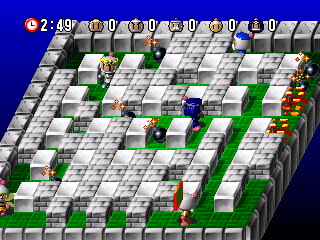
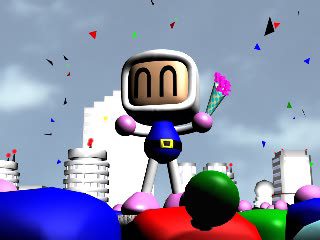
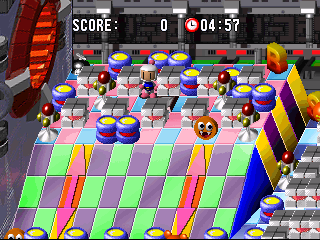
Bomberman World’s overall presentation is by far its standout element and the one that feels the most creatively inspired. The character models look excellent and are some of the largest and most detailed the series has seen, full of the expressiveness you’d expect without any of the rougher edges that 3D games of the era sometimes have. The environments, while generic in their theming and hazards, make use of elevated surfaces and ramps to create spaces with depth that also challenge Bomberman in unusual ways. Not only will you have to contend with the occasional moving platform, some arenas can be difficult to read when it comes to placing your bombs correctly, adding a slight and likely unintentional element of challenge for those who would otherwise sleepwalk through this entry. Jun Chikuma is credited for the music once again, but her credit sits alongside Hironao Yamamoto, who did a phenomenal job injecting life into the game with an era-appropriate soundtrack that combines drum and bass, breakbeat, and EDM. Most of the soundtrack is extremely energetic, especially when it comes to the final boss, but it also knows when to chill out and provide tracks you can groove to, the planet select screen being an exceptional example of this. Even the classic battle theme has received an arrangement that offers enough divergences to keep it fresh after all these years.
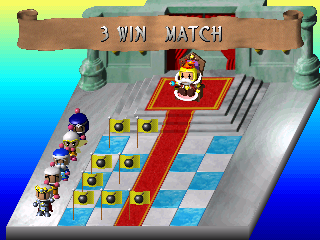
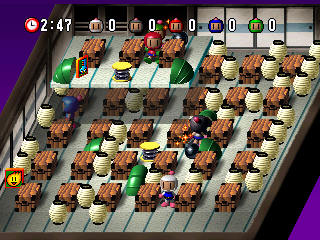
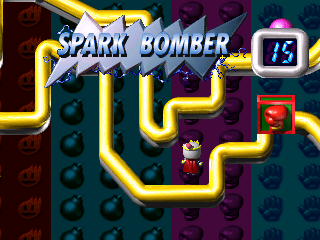
Battle mode in this installment consists of almost entirely familiar elements, but the ones brought back are very much welcome. Each character has different habits when controlled by the CPU, much like Bomberman ‘94, Maniac mode from Super Bomberman 4 returns for some welcome flexibility, and options like Bad Bomber and battle groups are here as well. The biggest twist on the battle mode formula is the addition of a second battlefield to most of the maps. Players will either start on or can warp to a floating platform that moves back and forth above the upper half of the battlefield. This platform is extremely small, making it very risky to fight on, but it can also offer safety from preoccupied opponents or the sudden death blocks as they fall during the last minute. It’s a good idea on paper, offering a level of arena complexity not previously seen, but the platforms are placed in such a way that they obscure the top half of the ground level, resulting in a lot of cheap shots and power-ups going uncollected because of the players’ inability to see that part of the screen. The post-victory minigame this time around is Spark Bomber, which is based on the Japanese game show UcchanNanchan no Honō no Challenger: Kore ga Dekitara 100 Man En and has you navigating your Bomber through narrow corridors without touching the walls. The further you get, the better power-up you’ll receive, and getting to the end to obtain a heart definitely requires practice.
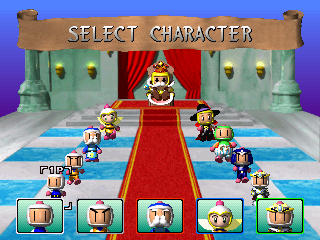
The only port Bomberman World ever received was on PC as part of the Bomberman Collection. It’s a straight port of the game with customizable controls being the only addition, so at this point in time, it’s not really worth the fuss of getting it to work on modern machines. Indie developer Orion_ (of OrionSoft) created a port of the game for the GamePark 32 handheld console, but due to the game’s contents being copyrighted, they never went through with releasing it in a public capacity. They do have a brief video of it running on their Youtube channel, though, so it’s at least viewable as a curiosity and an example of what could have been.
Bomberman World is one of the most gently iterative entries the series has seen in some time and the reception at the time reflected this. Contemporary outlets reviewed it well enough, but even with the most positive of reviews, there was a constant through line of seeing the single player modes as expendable and the multiplayer as the only highlight of the package. This is a commonly held stance for many who loved the 2D entries, but such a stigma sure didn’t stop the series from trying new single player ideas. After this humble start on the PS1, things would go in a very different direction on the platform. 1998 was such an eventful year for the series with five more games after this being released (three of which were on Playstation) and to give you an idea of what’s to come, only one other game aside from World offers the standard Bomberman experience!
Links
https://www.youtube.com/watch?v=cSUOBZa89sk – Video of the GP32 port
https://randomhoohaas.flyingomelette.com/bomb/vb-1/ – Page on Ragey’s Totally Bombastic Bomberman Shrine Place that compiles all the available information on Virtual Bomberman (with credit to Planet Virtual Boy as well)