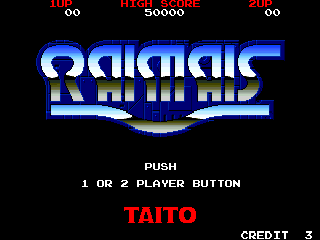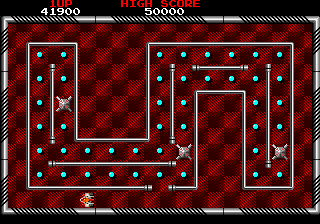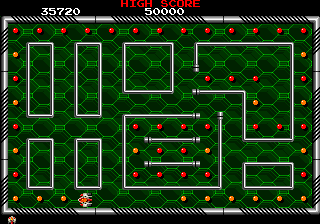
Taito’s 1986 Arkanoid was an update of Atari’s brick-breaker Breakout, adding elements like power-ups and enemies. The designer, Akira Fujita, looked to continue theme but turn toward the dot-eater genre – popularized by Namco’s Pac-Man, but technically started by Sega/Gremlin’s Head-On – and evolved it with the 1988 arcade title Raimais (pronounced “ray maze”).
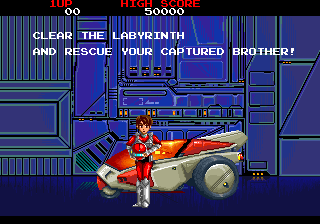
Raimais takes place 100 years in the future, where illegal street races are held in holographic labyrinths. The game stars Rika Midorikawa, a member of the gang Estrous Cats, who ventures into these mazes to rescue her brother Makoto. She rides a bike called an Organizer, which looks a whole lot like the Light Cycles from Tron, contributing to the sleek sci-fi aesthetic.
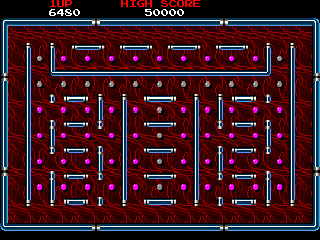
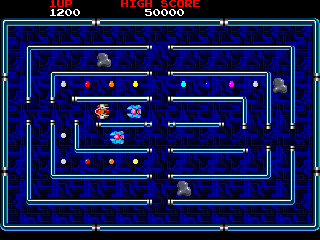
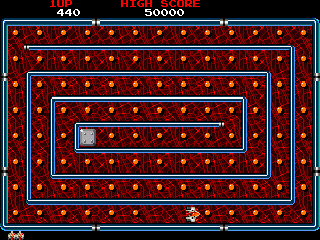
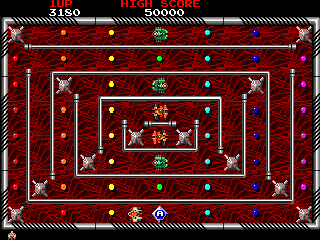
At its core, Raimais is a lot like other maze games, where you collect dots while avoiding enemies. but it differentiates itself with several features. The game uses two buttons – one to accelerate, and the other to use any equipped power-ups. The Organizer is in constant motion, unable to stop unless you lose a life. Most dots (called “energy plates”) can be collected by driving over them, but there are also grey dots that require two or more passes to pick up. Additionally, some levels have mines, which become armed when you drive over them and explode about a second later, destroying anything it touches.
The standard labyrinth enemies are a mix of characters primarily rooted in variations of insects, other vehicles and colored blobs. Like Pac-Man, each enemy has its own characteristics that a player will quickly learn as they encounter them more and more. Pink ships will follow the player at high speed, green bugs will jump around the maze walls, and one particularly devious enemy mirrors your movements while dropping more dots to pick up.
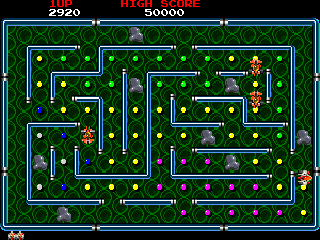
Power-ups also appear randomly beneath collected dots, with eight types in total. “S” slows enemy speed, an important pickup, while “B” (“break”) provides a quick exit, opening doors in one direction of the map. As you progress, find the red “L” laser that you can use to destroy enemies, and blue “A” (“Arm”) shield (providing up to four levels of protection for the Organizer). Other power-ups appear less frequently but are more powerful. The “C” (“Crash”) power-up instantly clears any uncollected energy plates from the board, “P” (Player Extend) provides an extra life and the “R” (Rainbow) provides a random effect, granting powerful armor, clearing the entire level, or some other form of temporary overpowered boost.
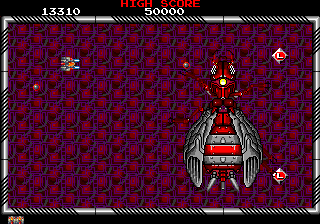
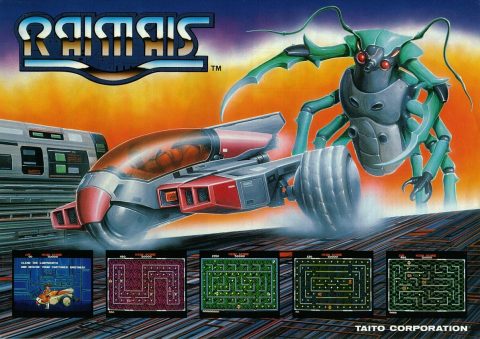
The “O” power-up stands for “Other Route” and creates entrances to boss battles called “Reverse Rounds”, where you fight one of four insect-like mecha. There are no dots to pick up here, and instead there are just Laser power-ups, with the sole goal being to destroy the boss. These baddies take up a huge part of the screen, plus they shoot projectiles at you, with the whole thing made more difficult by the fact that you’re in constant motion. It’s certainly much more difficult than a typical shooting game!
Beyond the power-ups and boss fights, the other main distinction of Raimais is its level branching. Once the stage is cleared, then eight gates open up on the sides of the level, providing access to the next level. The direction you take determines the next stage, each assigned one of four different colors – Red, Blue, Green, and Gray. As you move from level to level, the screen scrolls into the next scene with a stylish transition that shows the surrounding world, which looks like part-skyscraper, part circuit board. There are 125 different boards in total (the first stage, and four colored variations of the next 31 stages) though in a regular game, you’ll only play 32 of them max.
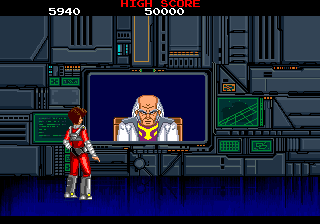
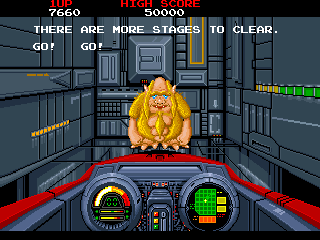
Every once in a while, you’ll be treated to brief cutscenes. In these, Rika encounters a monitor showing the visage of the evil mastermind. Dr. Molto. He’ll taunt you in digitized Japanese speech, with his monologues changing depending on your performance, which is pretty impressive for a game from 1988. If you cross past certain stage thresholds without dying, you’ll also warp forward four stages. When completing Reverse Rounds, you’ll meet Gum Can, an ape-like creature with a goofy sense of humor who gives vague hints and sometimes some power-ups.
There are also a few different endings. You’re supposed to find the Light Mirror item in the Reverse Round in stage 23 blue. Once you reach Mr. Molto’s lair at the end, you’ll find him brandishing a pistol. Here, a life meter appears on the bottom of the screen, and you need to dodge his shots with directional inputs. If you found the mirror, then you can reflect the final shot back at Mr. Molto and kill him. If not, Makoto will jump out and take the bullet for you. Alternatively, if you fail to dodge enough of the laser shots then Rika will simply die and then it’s game over, with no way to continue.
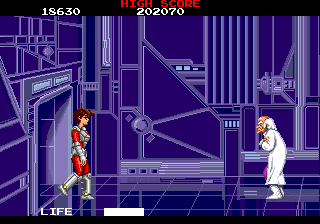
Furthermore, there’s a secret ending that’s so hidden that it went undiscovered for more than thirty years. You need to complete the game without dying, as well as obtain the Reflect Mirror, but the kicker is that you’re supposed to make it to the end completing less than 17 stages. However, even when taking the warps into account, this is impossible during regular gameplay, so the stage requirement may have been a bug. You can change this requirement with a MAME hack, plus there’s also an option included in the Arcade Archives release that makes this ending obtainable. This ending’s a bit of a bummer though, since it reveals that Makoto is actually the mastermind. He’ll try to attack too, but the mirror will protect Rika and send Makoto to an unfortunate end.
Furthermore, the cutscenes and endings only apply to the Japanese version. The international version cuts nearly all of these out, leaving only a single ending showing a burning building.
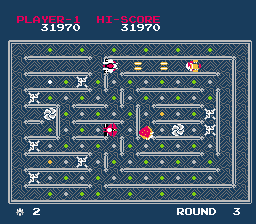
Famicom Disk System
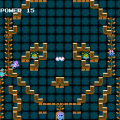
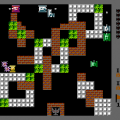
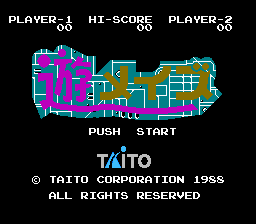
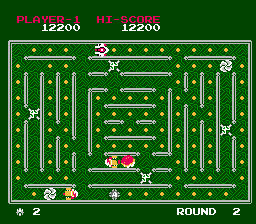
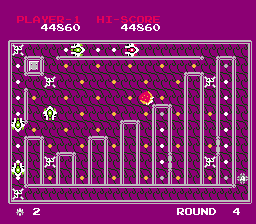
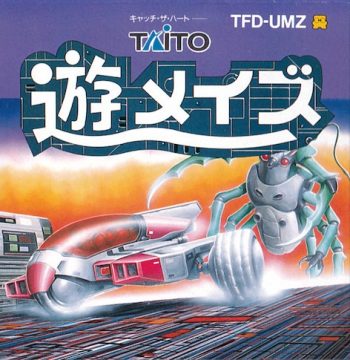
The only contemporary port of Raimais was released for the Famicom Disk System, where it was renamed Youmais (sometimes spelled “Yuu Maze”). There are a number of changes, primarily in the way your cycle controls. In the arcade game, there’s no way to stop it, but here you can speed up and slow down as you please. The acceleration speed is also slower, as it takes a few moments to reach top speed. The stage designs are different, and there are only two exits per level instead of four, though you need to play a whopping 50 stages rather than 32 to reach the end. Many of the cinema scenes are gone, too. There’s no mirror to find, with the ending contingent on whether you can protect Makoto from Mr. Molto’s laser blast in the finale. The boss fights in the arcade game have been removed as well, replaced with timed challenges where you need to collect a certain number of dots or defeat a certain number of enemies. The giant insect robots are shown on the cover art, but do not actually appear Youmais.
The graphics in the original Raimais were a little basic, but it had some cool style and some catchy music. Youmais maintains none of this, as it looks ugly and the music is badly converted. Despite the lower screen resolution, the levels are actually slightly larger and often more complicated in ways that make navigating them tedious. Newly added are warp tiles, which will warp you around the screen. Altogether, while it’s not unplayable, it’s certainly missing something, and not the ideal way to experience Raimais. At least there’s a level editor that allows you to save your constructions to disk.
Raimais was included in the Taito Legends 2 for the PlayStation 2 (Taito Memories Vol. I in Japan) released in 2006. These are straight emulations, though the North American/European version is stuck with the cutscene-less international version. A better emulation appears on Hamster’s Arcade Archives series, released in 2021.
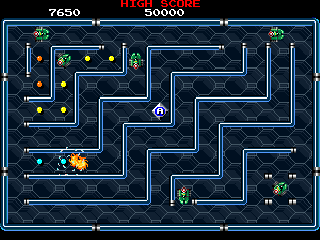
Even at the time of its release in 1988, dot-eaters were a little old fashioned, leaving Raimais feeling a little quaint. But it still maintains a sense of speed and rhythm that makes it engaging, and it contains plenty of strange personality and odd secrets that Taito was known for, creating an eccentric classic.
The story of Raimais is continued (sort of) in a few of the endings of Syvalion, another Taito game released in the arcades in the same year. There are 100 possible endings in this game, three of which reference the fates of the characters. In these, it’s revealed that the dragon is being piloted by Makoto, who’s attempting to rescue Rika. Alas, Rika dies in two of these endings, an unfortunate fate indeed.
Links:
Gaming.moe – Pretty much the most comprehensive resource for Raimais out there.
The Cutting Room Floor – Details the endings.
Sudden-Desu – The hacker who uncovered the hidden ending, and how to enable it in MAME.
Screenshot Comparisons
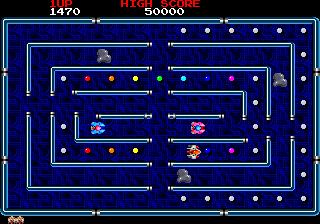
Arcade
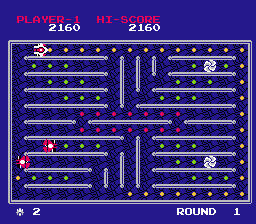
FDS