|
Page 1:
Introduction
Prince of Persia
|
Page 2:
The Shadow & The Flame
Arabian Nights
Harem Adventures
|
Page 3:
The Sands of Time
Warrior Within
|
Page 4:
The Two Thrones
Battles of Prince of Persia
|
Page 5:
Prince of Persia 2008
The Fallen King
|
Page 6:
The Forgotten Sands
|
Page 7:
The Graphic Novel
Before the Sandstorm
The Sands of Time (Movie)
|
|
|
Back to the Index
|
Prince of Persia: The Sands of Time / Prince of Persia: Jikan no Suna (プリンス・オブ・ペルシャ~時間の砂~) - PlayStation 2, Xbox, Gamecube, Windows (2003), PlayStation 3 (2010)

American Xbox Cover
|

European Xbox Cover
|

Japanese PS2 Cover
|
|
After the relative disaster of Prince of Persia 3D, it seemed a bit odd that someone still wanted to make another 3D version of the game. Except this time, it was created by UbiSoft Montreal, and they actually turned it into an amazing game by essentially starting the franchise from scratch. The creative director of The Sands of Time was Patrice Désilets, who later created the Assassin's Creed franchise, while Jordan Mechner contributed the story and stood by the team as an advisor.
The hero is an entirely different prince from the old games - here he's following his father into invading another kingdom. During the battle, he seizes a mysterious artifact known as the Dagger of Time, and in the process, releases an evil that turns nearly everyone in the castle into sand demons. This dagger allows him to control time - this allows for a whole bunch of nifty powers, but mostly importantly, you can turn back time to undo any of your mistakes.
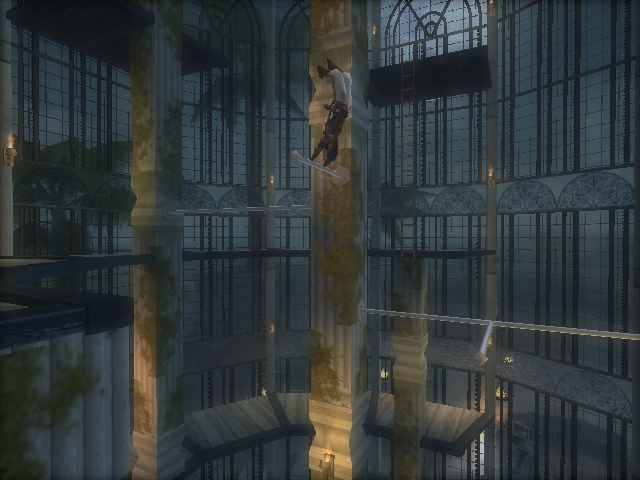
As if that innovation alone wasn't awesome enough, UbiSoft went ahead and rewrote all the rules of platforming - it's rare that you actually have to jump from platform to platform. Instead, you're given a prince that has all of the swift moves of a ninja. Each room is a puzzle of crazy architecture that you solve by running along walls, swinging on poles or climbing up columns. It gives the same sense of spiraling vertigo that the old games did fifteen years prior, but with less frustration. The incredible fluidity of the Prince's movements are what makes this a true sequel to the original Prince of Persia.
As for the moves, the team was inspired by Hong-Kong action movies such as Crouching Tiger, Hidden Dragon and the Jet Li action films. We also watched several Capoiera documentaries – it’s a Brazilian fighting style that intricately melds martial arts with stylized dance. -Yannis Malat, producer
The castle as a whole is a grand masterpiece, perhaps only rivaled by the architecture in Ico, and it comes as no surprise that Fumito Ueda's creation had a direct influence on the visual direction for The Sands of Time. The camera alternates between the behind-the-back and fixed camera angles, so there's rarely a problem in judging distances. Each location also has a scenic view you can switch to via button press. There are also a few puzzles, which mostly consist of pulling levers and pushing boxes.
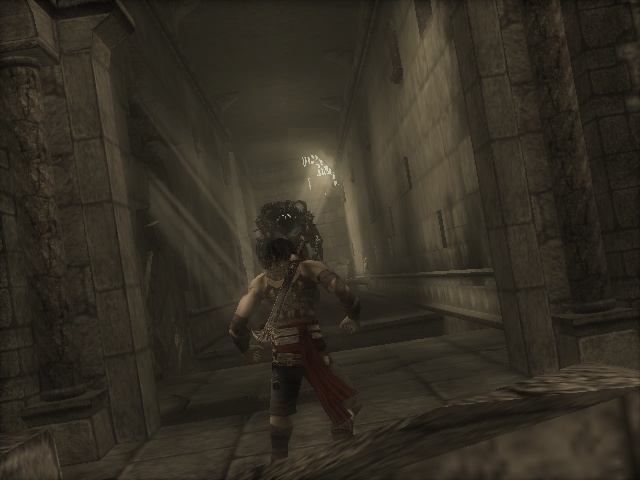
While a majority of the game is spent crawling up ledges, running through the usual series of dangerous traps and dashing up walls, you do spend a fair amount of time fighting monsters. The combat system feels a bit sluggish at first, but the Prince has a fair number of moves that allow him to block, react and attack enemies swiftly. His most impressive move is when he strikes enemies while leaping over their heads, for which the game likes to switch to a particularly cinematic camera angle. All enemies have to be finished off with the Dagger of Time, lest they stand right up again. The Dagger can also be used to turn enemies into sand statues, which leaves them open to be cut in half. The only real challenge is that the game tosses a ton of enemies at you at one time, often for a period of several minutes before you get to move onto the next segment. The battles are still fun, but they're really just intermissions between the real meat of the game.

The Prince
|

Farah
|
The Prince narrates the tale through the game, and while he's an arrogant, unlikable bastard (with a slightly lame visual design), it's easier to find sympathy for his counterpart is Farah, the bow-wielding princess of India. Since the Prince belongs to the army that invaded her country, she's sceptical towards him at the beginning, but soon the two recognize they have to work together as the only two human beings left. She acts as your guide and helps you solve puzzles, and also provides backup in combat from a distance. Surprisingly, the love/hate banter between the two is actually very well done, and actually adds a little bit of emotion to the plotline.
The Progenitor of Farah is not the princess in Prince of Persia 1, but the mouse. The little white mouse that, when the Prince gets himself stuck at a certain point, (...) comes through the bars of the gate, steps on the pressure plate and allows him to continue. -Jordan Mechner, Interview with Gamespot
Everything about this game is so extraordinarily well done, that the only thing lacking is the anticlimactic boss fight (against the evil vizier, naturally, who schemed this all from the beginning) but even that is nullified by the awesome ending. It's not hard to see why many publications awarded this the Best Game of 2003.
The Sands of Time came out for the PC, Gamecube, PS2 and Xbox. Gameplay and graphics-wise, the different versions are all about the same, although the Gamecube suffers from slightly muffled audio. They have slightly different bonuses too - the Gamecube versions links up with the GBA Sands of Time to unlock new levels in that game, as well as the original Mac version of Prince of Persia on the Gamecube. You can also unlock the first game in the PS2 and Xbox versions, although you get them by triggering a hidden switch in the game. The Xbox version also has Prince of Persia 2 hidden as well (but only in the North American version). In an amusing nod to the series' roots, if you enter a code after beating the game, you can play a 3D model of the first level in the original Prince of Persia, even though it's missing a lot of the hidden areas. The enemy won't spawn, either, so you can go directly to the exit, which leads to a room full of beer and a huge poster of the development staff.
The PC version is available DRM free at GOG.com.
In 2010, UbiSoft decided to give The Sands of Time and its two sequels, Warrior Within and The Two Thrones, a thorough facelift. Released as Prince of Persia Trilogy HD for the PS3, these new versions polish up many of the textures to make the game look better in HD resolutions. Although the 3D models are mostly the same, the change is very noticeable, as can be seen on the screens below. Since this compilation is a PS3 exclusive, a big bullet point for its marketing was the support of 3D hardware.
MP3s:
1st Fight
Time Only Knows - End Credits Vocal
|

The Sands of Time (Xbox)

The Sands of Time (Xbox)

The Sands of Time (Xbox)

The Sands of Time (Xbox)

The Sands of Time (Xbox)

The Sands of Time (Xbox)

The Sands of Time (Xbox)

The Sands of Time (Xbox)
|
Screenshot Comparison:
|

SD (Xbox)
|

HD (PS3)
|
|

SD (Xbox)
|

HD (PS3)
|
Prince of Persia: The Sands of Time - Game Boy Advance (2003)

American Cover
|

The Sands of Time (GBA)
|

The Sands of Time (GBA)
|
Since UbiSoft loves to create portable versions of their games to mirror their console big brothers, they created a tiny version of Sands of Time. Although being 2D, it ditches the play mechanics of the old games entirely. The movement is a lot like Aladdin for the Genesis, although the combat feels a little awkward. The game tries to trick you into thinking its an RPG with a few elements reminiscent of the GBA Castlevania games (hit point numbers popping out of enemies, relics to collect) although it's mostly straightforward.
Just like the console versions, you can rewind time, although not very far. The Prince lacks some of the crazier acrobatics of the 3D game (like being able to run up walls), which is a little saddening. It does have some features missing from its big brother - namely, some boss battles with a Griffon that was meant to be in the console versions, but excised for lack of development time. Some segments even let you play as Farah, who can use her bow to hit switches from a distance, but the end result is that you just have to play through most segments twice, once with each character. All of these co-op "puzzles" simply revolve around hitting switches, which are hardly in the realm of, say, The Lost Vikings.
While the tight controls make this far more accessible than the old games, it also ditches what make the earlier games more interesting - you're no longer making precision jumps, but rather just running, slashing, and trying not to fall into spikes. It ends up feeling like just a regular platformer, and a relatively competent one at that, but it's also a little on the bland side.
|

The Sands of Time (GBA)

The Sands of Time (GBA)
|
Prince of Persia: The Sands of Time - Mobile (2004)
After their first original game, Gameloft started to program mobile versions for every major series entry UbiSoft put out. Sands of Time's even smaller counterpart is a more straightforward platformer than the vaguely Metroidvania-esque GBA game, but you still unlock the prince's powers during the game, most importantly the wall run and wall jump. There are no time powers in this game (funny, with the game being titled The Sands of Time and all), however you still have to stab enemies with the dagger after they fall to dispose of them permanently. Many situations require a bit of puzzling. Most of the time the prince just has to move crates or hitt back archers' arrows, though.
At first the game is good simple fun, but towards the end it gets quite frustrating, as the controls are not exactly as responsive as they should be. Especially passages that force you to do tenfold wall jumps are extremely aggravating, as it simply doesn't work that reliably. Alas, the game is rather short, so the joy doesn't last long before one gets to these frustrating passages.
There are also screenshots of this game around that show a different interface and different levels than the game reviewed, which may either originate from another version or an unreleased beta. It's hard to make sure with these mobile releases that differ a bit on every other device.

The Sands of Time (beta?)
|

The Sands of Time (beta?)
|
|

The Sands of Time (Mobile)

The Sands of Time (Mobile)
|
Screenshot Comparison:
Prince of Persia: Warrior Within / Prince of Persia: Revelations / Prince of Persia: Kenshin no Kokoro (プリンス・オブ・ペルシャ~ケンシノココロ~) - PlayStation 2, Xbox, Gamecube, Windows (2004), PSP (2005), PlayStation 3, iOS (2010)

American PS2 Cover
|

Warrior Within (Xbox)
|

Warrior Within (Xbox)
|
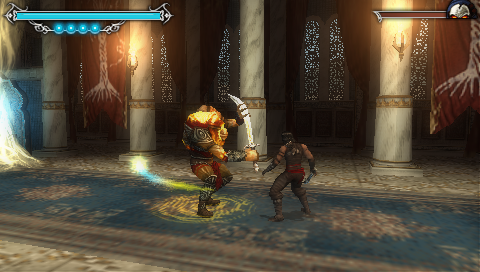
While Sands of Time was a critical success, the game didn't sell quite as well as Ubisoft had hoped. Furthermore, Warrior Within would also be the first game in the series with no involvement of creator Jordan Mechner whatsoever, which might have motivated the developers to put their own stamp on the series with an entirely new tone for the next game. At any rate, they decided to give Prince of Persia a darker, more mature edge in hopes of snagging more mainstream gamers. The Dreamworks-cartoon-reject Prince of the first game has become a dark, ferocious warrior, given that he's constantly stalked by Death for screwing with fate in the The Sands of Time. His only chance for survival is to find the Empress of Time to make her lift the curse called upon him by fate. All the while, he's stalked by a scantily glad figure called Shahdee, more affectionately known as "The Time Bitch" amongst gamers. Along the way, the Prince further meets Kaileena, also scantily clad, who decides to give him a helping hand.
Although Warrior Within does lose some of the fairy tale charm (and cute romance) found in The Sands of Time, the darker approach isn't necessarily a bad thing. Many fans have lambasted this decision, claiming it's "too angsty" and "filled with generic rage", and accused UbiSoft of selling out to the masses. For the most part, the changes in tone suit the game, although at times they go overboard with the bland heavy metal guitar riffs and cheesy battle taunts. (The changes did pay off, however - Warrior Within sold much better than Sands of Time.)

Mature Gaming!
|

Even More Mature Gaming!
|
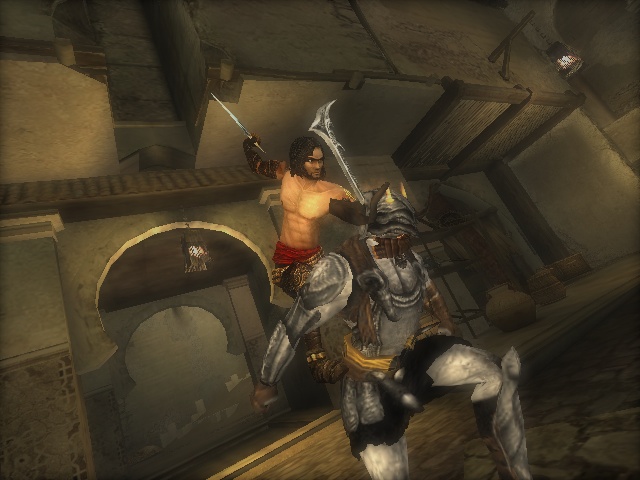
The biggest complaint with Sands of Time—the battle system—has been given an overhaul. In addition to your primary sword, you can pick up weapons from slain enemies or elsewhere, which can then be used in melee combat or thrown. The fighting is much deeper and allows for combos and some stilysh acrobatic tricks - you can jump off enemies, thrown them, or propel yourself off walls, cutting anything in your way. Attacks can be charged to do more damage, and the Prince learns powerful, Sands-fueled special attacks during the course of the game. In keeping with the tone, it's also much bloodier. The pacing has been changed a little as well - instead of long encounters of continuously respawning enemies, you face more frequent but shorter battles. While the improvements are welcome, combat still feels a little sluggish and lacks a lot of the punch found in titles like Ninja Gaiden and Rygar.
The coolest parts come when you're being chased by the Dahaka, the physical incarnation of Death. The screen goes black and white, and all you can do is run. If you lollygag or merely jump too late, the Dahaka will catch up and shove the unfortunate Prince into his gaping jaws of unpleasantness. It's similar to the Nemesis from Resident Evil 3, although the concept is better executed here.

Warrior Within (Xbox)
Warrior Within is also somewhat harder than the original, both in the battles and in the platforming. The jumping puzzles maintain the same genius as its predecessor, although the environments have been revamped to look even better. The Prince must climb his way through a mechanical tower and a garden environment, lending an atmosphere similar to Castlevania. The only real problem stems from the overwhelmingly confusing plot, which involves jumping back and forth in time through portals. There's more exploration and backtracking compared to the linear Sands of Time, but your map is almost entirely useless, so it's very easy to wander off in the wrong direction. Extensive backtracking is rewarded with silly weapons like a teddy bear, and also required to get most health upgrades. Only after getting all of the latter before beating the final boss, one gets to see the "good," canon ending.
The game is also somewhat buggy, filled with graphical glitches and other snafus, across all three initial platforms. The Xbox version contained additional time attack and survival modes for Xbox Live, before the old Xbox network has been shut off. The game was also released on the PSP under the title Prince of Persia: Revelations, which features a few new (quite tough) areas, but has lots of load times and even more bugs. Plus it doesn't exactly control well with the PSP. The same goes for the iPhone/iPod touch port by Gameloft, only worse.
As long as you can look past the more superficial alterations in tone, Warrior Within as a whole is a more than competent sequel to an already great game.

Revelations (PSP)
|

Warrior Within (Xbox)

Warrior Within (Xbox)

Warrior Within (Xbox)

Warrior Within (Xbox)

Warrior Within (Xbox)

Warrior Within (iPhone)
|
View all "Prince of Persia: Warrior Within" items on eBay
Screenshot Comparison:
|

SD (Xbox)
|

HD (PS3)
|
Additional Screenshots:
Prince of Persia: Warrior Within - Mobile (2004)

Warrior Within (Mobile)
|

Warrior Within (Mobile)
|

Warrior Within (Mobile)
|
The mobile version of Warrior Within follows the "big" game in its revised battle system. Now the acrobatic moves are all available from the beginning, but new combos, special moves and finishers are learned with each level. The aggravating wall jump is gone, in its place comes a lot of swinging on chains, which is much more fun.
In a nod to the original game, most traps are instant kills, but the game is very generous with chekpoints. Only towards the end the game demands a bit more precision as the platform warrants, just like the predecessor. For the first time on mobile phones the sands of time are there to stop enemy (and trap) movement, but it they are severely underused.
Warrior Within is the first game to bring some gore effects to your cell phone, and it marks also Gameloft's return to form regarding teh sexy, with several images of scantily clad women that appear quite out of context. The rest of the graphics are not so exciting, especially since almost all enemies look the same - no sight of the impressive Dahaka.
|

Warrior Within (Mobile)
|
Screenshot Comparison:
Page 1:
Introduction
Prince of Persia
|
Page 2:
The Shadow & The Flame
Arabian Nights
Harem Adventures
|
Page 3:
The Sands of Time
Warrior Within
|
Page 4:
The Two Thrones
Battles of Prince of Persia
|
Page 5:
Prince of Persia 2008
The Fallen King
|
Page 6:
The Forgotten Sands
|
Page 7:
The Graphic Novel
Before the Sandstorm
The Sands of Time (Movie)
|
|
|
Back to the Index
|
|