- Dragon Quest (Introduction)
- Dragon Quest
- Dragon Quest II
- Dragon Quest III
- Dragon Quest IV: The Chapters of the Chosen
- Dragon Quest V: Hand of the Heavenly Bride
- Dragon Quest VI: Realms of Revelation
- Dragon Quest VII: Fragments of the Forgotten Past
- Dragon Warrior VIII: Journey of the Cursed King
- Dragon Quest XI: Echoes of an Elusive Age
- Slime Mori Mori Dragon Quest
- Dragon Quest Heroes: Rocket Slime
- Slime Mori Mori Dragon Quest 3
- Dragon Quest Heroes
- Dragon Quest Heroes II
- Dragon Quest Wars
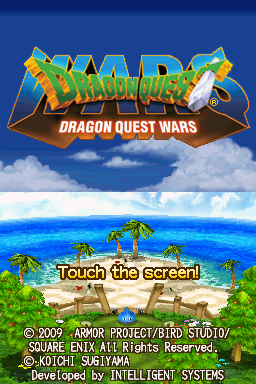
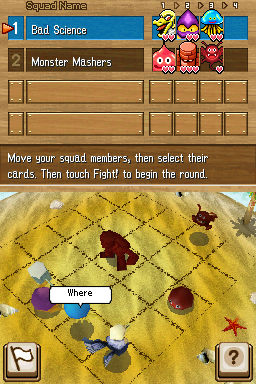
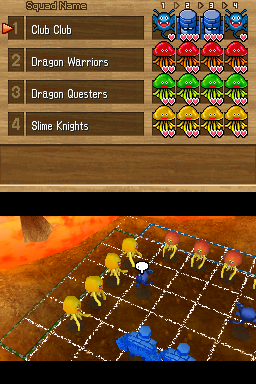
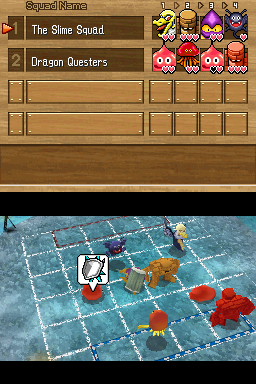
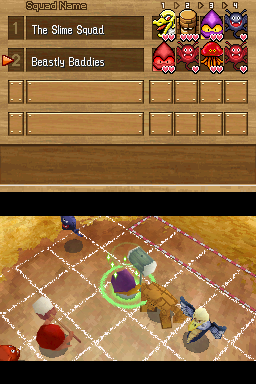
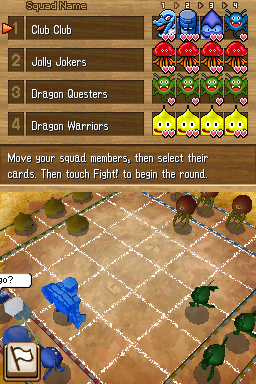
In a long-running series known for its sense of familiarity, Dragon Quest Wars stands out as a curious and unexpected moment in its history. Not only was it the first game in the series to try its hand at the strategy genre, it also has the distinction of being the only original entry developed by Intelligent Systems, albeit not exclusively since Tose was involved as well. Dragon Quest Wars was supposedly meant to be the first game of six to be developed for Nintendo’s DSiWare service via a partnership between Square Enix and Intelligent Systems. However, those plans never materialized and Dragon Quest Wars ultimately finds itself the odd man out in more ways than one. As a result of its circumstances, it’s a bite-sized offering that won’t hold your attention for long, but there’s something to be said for how unusual and fascinating it is within the context of the franchise.
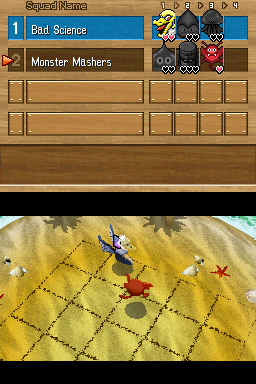
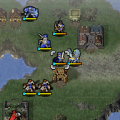
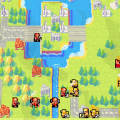
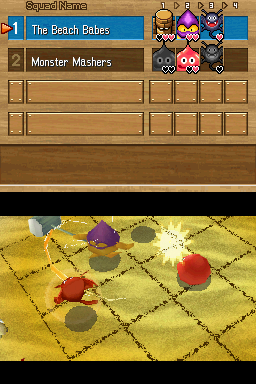
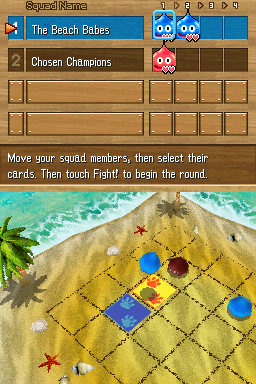
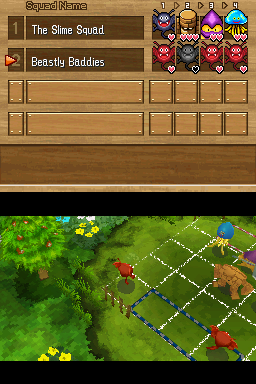
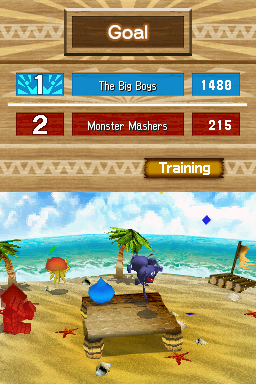
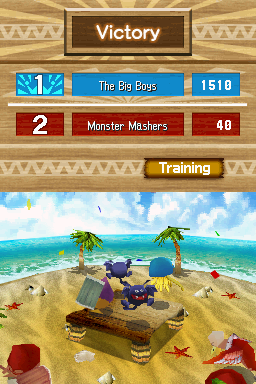
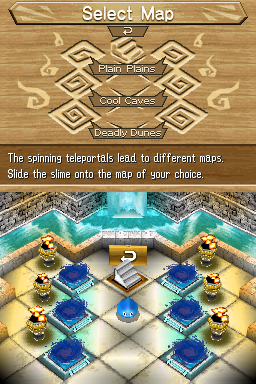
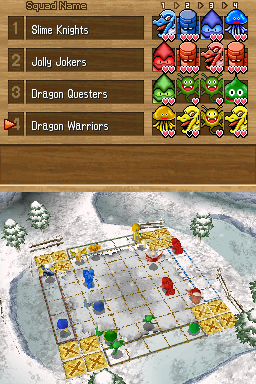
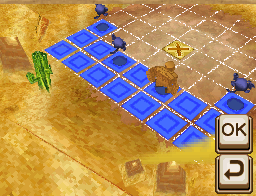
Rather than providing any kind of story, Dragon Quest Wars simply gives you ten training missions to go through. Each one gradually teaches you the ropes and increases the difficulty ever so slightly until you have a full range of options to work with. You’ll begin with learning how to move along the field and set up attacks and end with defeating an opponent under standard conditions. Once you’ve completed all ten, you unlock the ability to battle people online (which no longer works due to the closure of DS online services) as well as locally if they have a copy of the game. You can also do free battles against the AI and customize them to your liking. You can select from a small range of maps, decide what units each player has, and opt for two player or four player battles. Depending on the number of players, you’ll get different maps, but aside from their appearance, some changes in size and a few blocked off tiles, they lack meaningful gameplay features.
Winning a game of Dragon Quest Wars can be done in a few ways. First and most obviously, you can use your team of four monsters to eliminate the opponent’s team of four. Secondly, if you can move a monster over to the opponent’s base panels, you’ll win the game instantly. In four player battles, each player needs to aim specifically for the base directly across and furthest away from theirs if they want to win this way. Lastly, Dragon Quest Wars keeps track of a score for all players while also giving each battle a limited number of turns, so if you can rack up enough points through attacks and other actions, you can win without having to eliminate your opponent’s team.
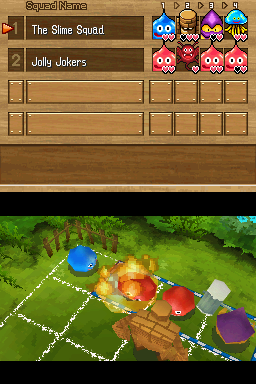
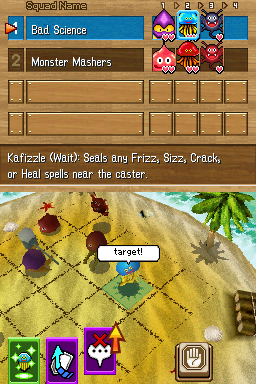
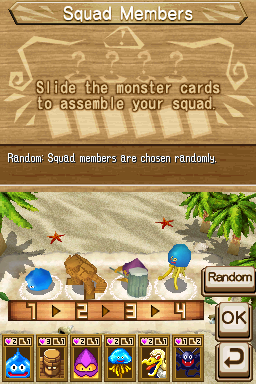
There are six monsters to choose from and each one has unique things to offer. The Slime is a jack of all trades, able to attack physically, use Sizz magic, and defend against attacks sent its way. Dracky is the only unit that can move two spaces (every other unit can only move one space per turn) and it also gets a diverse pool of options, including an attack that shoves enemies, Crack magic that hits diagonally, and Oomph to power up allies. Its one weakness is that it’ll get OHKOed by any attack thanks to its lone point of health. Healslime is a support character dedicated to increasing defense with Buff, shutting down magic attacks with Kafizzle, and patching up wounds, but it’s so dedicated to this cause that it’s unable to attack at all. Hammerhood can use its weapon of choice to hit up to three targets simultaneously (including its own allies if they’re in range!) and it can stay in the fray through a protective counterattack and self-healing option. The Wyvern can attack two spaces in front of it, reflect the magic attacks of other monsters back at them, and dodge physical attacks sent its way, making it a disruptive force in the right hands. Lastly, there’s the Golem, who has the highest HP total, the ability to take damage in the place of allies, and the strongest attack in the game, albeit at the cost of one of its own HP each time it’s used.
A lot of thought clearly went into how each monster interacts with one another in battle and it’s theory crafting with those relationships that serves as the most interesting part of Dragon Quest Wars. A monster like Dracky is vulnerable at all times, but with the use of a Healslime, it’s possible to keep one alive for longer. Hammerhood’s attack can be easily nullified by a Healslime’s Buff spell, but if a Drackyboosts it with Oomph first, it becomes threatening enough to pierce through Buff and even OHKO unprotected monsters. Golem’s strength might seem overwhelming at first, but with the use of abilities like Wyvern’s Dodge, it’s easier than you’d think to avoid its wrath. Blocking/countering maneuvers done by the Slime, Golem, or Hammerhood only apply to physical attacks, so if they give you trouble, a Dracky or Wyvern’s magic can bypass those abilities. Of course, if there’s a Healslime, it can use Kafizzle to prevent magic use entirely, though Kafizzle applies to all monsters and not just the Healslime’s enemies. In case it wasn’t clear by now, the Healslime can be the backbone of many team compositions and single handedly lends the game much of its tactical potential.
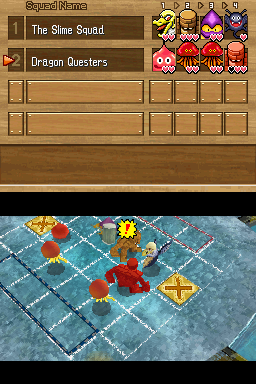
If there’s one problem with the balance of Dragon Quest Wars, it’s that it strongly encourages defense, often punishing attempts at offensive pushes. With almost every monster having a means of negating damage and no MP/cooldown system to limit their usage, it’s easy for players to waste turns trying to break through formations only for a Healslime or Chimera to reverse their efforts in an instant if they guessed wrong. This is not a fast-paced game with regards to animations and UI navigation, either, so fights can become deeply tedious when up to sixteen monsters have to go through their actions per turn. It’s possible to overwhelm defensive options if you can line up multiple attacks (since they only apply to the first attack done against the user), but the heavy restrictions on movement can make it tricky to set up dogpiles or Oomph combos without exposing the player to sustained risk. Beelining for the opponent’s base to secure a win that way is possible, but a defensive player can also just opt to keep their monsters on the four base spaces, forcing the attacker to try and break through. These problems are less likely to occur in four player battles since the sheer number of attacks from all sides makes defense harder to do, but the ideal scenario of humans playing locally is unlikely to be arranged now. The AI tends to play extremely defensively in free battles, so anyone who plays the game solo is bound to run into these scenarios.
Dragon Quest Wars is a great idea in search of a game large enough to properly flesh it out. Engaging in Dragon Quest combat in a board game-esque fashion seems like the kind of thing that should have paved the way for a new spin-off series, but with how little there is to offer, the concept struggles to convince players of its long-term worth. What’s here is also heavily constrained by an intended emphasis on simplicity, leaving little strategic variety to discover whether you’re comfortable with the genre or not. It’s all so limited, in fact, that even the delightful personality the series typically offers feels absent here outside of some silly team names you can select from. Dragon Quest Wars never received a direct sequel, but the smartphone mobile Dragon Quest Tact is the next closest thing, offering the same general idea but greatly expanded upon and in gacha form. Unfortunately, Tact’s global version was shut down in 2024.
Links
https://archive.ph/20111002121059/http://n-europe.com/news.php?nid=13196 – A news post from N-Europe that made the claim regarding the Square Enix + Intelligent Systems partnership
https://web.archive.org/web/20190418113403/https://www.siliconera.com/2009/10/21/taichi-inuzuka-details-dragon-quest-wars/ – Interview with producer TaichiInuzuka