- Quest for Glory I: So You Want To Be a Hero
- Quest for Glory II: Trial by Fire
- Quest for Glory III: Wages of War
- Quest for Glory: Shadows of Darkness
- Quest for Glory V: Dragon Fire
- Corey Cole (Interview)


The Quest for Glory series, designed by the husband and wife team of Lori and Corey Cole and initially published in 1990, is a bit of an oddball amongst Sierra’s adventure titles. Although similar in appearance, they’re less like point-and-click adventures and more like RPGs that happen to be dressed in adventure game clothing.
The main concept of Quest for Glory is evident through the subtitle of the first game: So You Want to be a Hero? In each of the five games you play a character whose job is to travel the world of Gloriana, saving the inhabitants from evil. Each of the five games takes place in a different part of the world: the first takes place in the Germanic land of Spielburg, with a bit of a traditional medieval flavor; the second is in the Middle Eastern land of Shapeir, with an Arabic flair; the third takes place in the Africa-like land of Tarna; the fourth in the Transylvania-esque land of Mordavia; and the fifth and final is in Silmaria, heavily resembling Ancient Greece. It’s clear that the Coles had a vague overarching plan for the series from the get-go, which strengthens the ties between installments. It’s amazing that they were actually able to finish their plans, given how many other gaming series get cut short.

There were originally four games planned – So You Want to Be a Hero, Trial by Fire, Shadows of Darkness, and Dragon Fire. However, after the second game, the Coles deviated from their initial plan to create another title, Wages of War. The series then continued as planned, and ended with the release of Dragon Fire in 1998. Each game was to represent one of the four cardinal directions, one of the four elements, and one of the four seasons, although this was somewhat thrown off with Wages of War. Each also has a unique setting, complete with interesting characters to meet, good and bad. Many real life folk tales and myths are also woven into the story. The main plots rarely go beyond the usual “find and conquer an evil demon”, but what makes them so interesting are the unique plights of the townspeople, and how you save them.

This epic feel, complemented with the fantastically designed game world, is largely what makes the Quest for Glory series so interesting. In the first game, you stay at an inn run by a group of cat people called Katta. In the second game you travel with them to their homeland of Shapeir. So whenever you see any of the Katta in the rest of the series, you can say, hey, I’ve seen where these guys come from! Many other elements remain consistent throughout all of the games too – nearly all of the lands have an Adventurer’s Guild, which acts as a starting point for each quest, and provides a place for training, as well as a logbook to sign. Each country you visit also has a different form of currency, so the first thing you need to do (at least in the first few games) is to hunt down a money exchanger so you can actually purchase some goods. One particularly important recurring theme is the presence of the great hero Erana, an elf who traveled the world many years before, and seems to have completely disappeared. In almost all of the games you’ll find an area blessed by her powers, which act as a safe haven for your hero to rest. All of these elements converge in Dragon Fire, where characters and events from the previous installments come together to form a rewarding finale.

Quest for Glory also has a distinctive sense of humor. Though not quite as off the wall as, say, Space Quest, the developers clearly have an affinity for goofy puns, pop culture references, and British humour, particularly Monty Python and Douglas Adams. Like most Sierra games, plenty of the death scenes have some pretty funny messages and are usually worth seeing, just for the chuckle. If you’re a Thief, you can type “pick nose” or use a lock pick – if you’re Lock Picking skill is high enough, you’ll actually gain some skill points (and clear your nasal passages), but if it’s too low, you’ll end up getting a brain hemorrhage and killing yourself. Oops.

The only consistent downside to the series is that they’ve often been very buggy. They’re much more complicated than the average Sierra adventure, featuring random elements and non-linear play, so some were released before being properly tested. You can find patches for all of the titles, some fan made, although they don’t necessarily fix all of the issues. Just save often!

The open worlds are reminiscent of the early King’s Quest games, with one main town center and a fairly large, non-linear world to explore. Your specific goals usually aren’t apparent when you first begin, but you’ll soon learn after talking to the townspeople, or checking out the local Adventurer’s Guild for people in need. Most of the main storylines involve conquering a number of trials before moving on to the final segment of the game. There are usually also additional subquests that can improve your stats, give you extra items or money, or even change the ending.

The biggest influence on how you play is determined by your character class. As a Fighter, you are more well suited to combat, and can simply choose brute force methods to conquer many of the puzzles. As a Thief, you’re a bit slyer, preferring a stealthy approach. As a Magician, you can just use your magic spells, provided you’ve learned the appropriate one. Starting with the third game, there’s also the “hidden” Paladin class, which is much like a Fighter but with extra abilities, and some additional subquests to conquer. You can also choose your character’s name, although his official title, per the authorized strategy guide, is Devon Aidendale.
Each problem usually has multiple solutions. If you need gold, as a Fighter, you might simply wander through the land and destroy enemies to take their cash. As a Thief, it might be better to just wait until night and break into some houses, or take on some jobs for the local Thieves Guild. As a Fighter, if you’re strong enough, you can break down doors. As a Thief, you can pick the lock. As a Magician, you can just cast an Open spell. The puzzles in Quest for Glory are quite different from other adventure games, because they’re usually pretty direct and logical. The most difficult element is hunting down or finding the items you’ll need, and you might not even need them, depending on your character’s skills. Additionally, while there are still death scenes, they aren’t as random and frustrating as other games. They’re usually because you died in combat or did something particularly stupid. There are also very few cases where the games can become unwinnable if you forget to grab a certain object (except for one easy-to-miss thing in Quest for Glory II).

It’s also possible to create hybrid characters. At the beginning of each game you can allocate a number of skill points to various statistics, including Strength (which determines your attacking power), Vitality (stamina), and Magic, as well as other skills like Climbing, Lock Picking, and Stealth. Normally you can increase these skills in five point increments, but you can also spend fifteen points to give your character a skill they might not normally have. This way, you can create a Fighter that can pick locks, or a Thief with magic skills. Some of the games still have specific paths for each character (for instance, you may not be able to use certain spells unless you’re a Magician, even if you’ve granted Magic skills to another character class), but it does allow you to diversify a bit. Once you’ve learned a skill, you can increase it simply by performing the action over and over. There aren’t technically any experience levels, but you gain Strength, Vitality, and Weapon Use stats by fighting in combat. You can also repeatedly throw stones to build up your Throwing stat, or repeatedly try to climb something to build up your Climbing skill. It’s a bit silly that you might need to stop for a few moments and repeat a single action over and over just so you can proceed, but it’s much less tedious than the level grinding found in other RPGs.

Each game has battle scenes, although you can mostly avoid them, depending on your character. Although the specific battle system changes from game to game, they’re usually one-on-one scenes fought in real time. They’re all pretty sloppy, and their outcome is more based on your statistics than mouse-clicking skills, but there’s rarely any situation where things get too difficult and you can’t just run off, to then gain some higher stats.
Once you finish any of the games, you can save your character and import them directly into any of the sequels, keeping all of their statistics. You can change their class if you wish, too. With each game, the default stats for the hero go up. In the first game, when you’re a newbie, the levels for most skills are pretty low, with about 10 or 20 points in each skill. By the time the fifth and final game rolls around, you average is around 300. If you play the entire series from scratch, in order, you see your hero start out as a rookie, slowly save land after land, gain a reputation, and become far more powerful than when you started.

The series was originally known as Hero’s Quest. However, once it was published, Sierra ran into some problems with Milton Bradley, who had already created a board game of the same name. Sierra then changed it to “Quest for Glory” and rereleased it. All subsequent games used the Quest for Glory moniker.
The first Quest for Glory begins in the land of Spielburg, a Germanic village in the middle of a lush forest. The town’s not in the best of shapes, given that their princess has been missing for years. Furthermore, the local brigands are causing trouble for travelers. And if those woes weren’t enough, the area is cursed by the vicious ogress Baba Yaga. Only you, a young hero fresh from the Famous Adventures Correspondence School, can save the day.

The town of Spielburg is fairly small, but it does have a castle, and a large maze-like forest to explore. The Thief is a particularly good class for rummaging through the shops, most of which are otherwise inaccessible. Ghouls and thieves wander the land, but there are kindly creatures too, like the weird little hermit who lives by the waterfall. One of the most important characters to meet is the addle-brained wizard Erasmus and his wise familiar (or is that the other way around?), a rat named Fenris. If you’re a Magician and you’ve found the right spells, you can challenge him in a minigame. You’ll also come across the mysterious Antwerp, a goofy, bouncing blob creature that seems harmless, but can cause quite the trouble if you bother it too much – it’ll launch itself into the sky and come plummeting down on top of you, killing you instantly. Also amusing is the mushroom garden, where taking too many will result in some nasty drug trips. Once you infiltrate the brigand hideout, you’ll find a few that suspiciously resemble The Three Stooges.

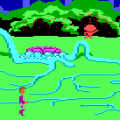
Like the first entries in many other Sierra series, Quest for Glory comes in two flavors: the original EGA version, released in 1990 using SCI0, or the enhanced VGA remake, released in 1992 using SCI1. Unlike Space Quest or Leisure Suit Larry, where the remakes looked vastly superior to the AGI originals, the gap between these two versions isn’t quite as big. SCI0 only supports 16 colors, but it uses the full 320×200 resolution, and still manages to look pretty decent given the hardware limitations. The mouse-based movement is a bit fussy, but this is one of the later revisions of the engine, which allows you to examine any object by pointing at it and right clicking, much better than typing “look at ____” then trying to figure out whatever noun the game has in mind.

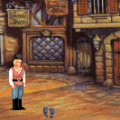
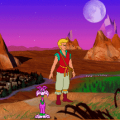
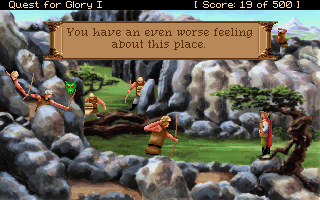
The VGA version features hand drawn backgrounds, which are generally quite faithful to the originals. Sometimes some effects are missing, like the fancy fireworks outside the magic store in the EGA version, but on the flip side, areas like the hedge garden are vastly more detailed in the VGA version. The VGA version also uses claymation for the combat sequences. While the animation is a bit jerky, they don’t look too bad. The same can’t be said about the character portraits, which look almost universally ugly. The music is slightly enhanced, although it’s largely the same, but the addition of digitized sound effects adds a bit to the remake, especially during combat. The VGA version does have an odd Easter egg where you’ll find a character from the early ‘80s TV show Dinosaurs wandering through the forest. The EGA version features a cameo by the submarine from Codename: Iceman, another Sierra game released around the same time.

There are also different curios from various Sierra games in Erasmus’ castle. In particular, you’ll find a sarcophagus – in the EGA version, it has a carving of Rosella from King’s Quest IV, but it’s tied with the Laura Bow series in the VGA version, a reference to one of Roberta Williams’ other games. The design of the Antwerp is also different between the games. In the EGA version, it has four eyes and a beard. In the VGA version, it only has two eyes and no beard, but you can kinda see its digestive system through its gooey flesh. The hero’s design changed between games too, with the EGA hero wearing blue armor, purple pants and a black cape, with the VGA hero wearing a brown and white shirt, with green pants and a red cape.

The VGA version features the usual “Walk”, “Use”, and “Talk” icons, but there’s also a “Magic” icon, and a miscellaneous function that will open up a submenu, allowing you to view your character sheet, check the time of day, rest, or run. However, the EGA version has funny little messages if you click on random items that don’t have any description written for them, like, “We’re sorry, but the pixel you clicked on is not in service at this time. Please check your mouse and click again.” Unfortunately, these are mostly removed from the VGA version – you’ll just get generic descriptions. On the other hand, there are some other silly messages you’ll get for clicking on things in the VGA version, particularly random trees. Although some may lament the lack of freedom due to the mouse parser, some of the multiple choice questions in the VGA version are pretty amusing. Before you enter Erasmus’ house, you need to answer three questions posed by the gargoyle guard, which should seem familiar to Monty Python fans. They’re randomly generated, but in the “WHAT IS YOUR QUEST?” part, you can answer “I want to be a pirate!”, the words spoken by the gleefully naive hero Guybrush Threepwood in LucasArts’ The Secret of Monkey Island.

The two major other revisions with the VGA version are with the conversation and battle systems. In the text parser driven EGA version, you need to “ask about” a variety of different topics, and keep guessing at different ones to see if you can dig any useful information out of whomever you’re questioning. The VGA remake simply presents you with a predetermined selection, making things much easier. On the combat side, the EGA version sticks the camera right above the hero’s head, giving a pseudo first-person look at the action. While immersive, the combat is extremely slow and clumsy. It seems like you’re constantly swiping at air, and damage seems to be randomly generated by your stats rather than your actions. As a result, it’s all too easy to get decimated by any random encounter in the early portions of the game. Furthermore, if you keep the game speed on high in order to quickly explore the land, you need to be quick and set it to default (with the = key) when you engage in combat or else you’ll end up fighting in fast forward.

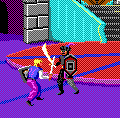
The VGA version fixes things up a bit. The camera has been switched to an over-the-shoulder angle, giving you a slightly better view of the action. A shield in the lower right corner shows all of the commands, including two types of sword attacks, as well as parries and dodges. You can also simply click the center to run away, or switch to the spell menu. While the combat is still based largely on your stats rather than your twitch skills, at least it’s far less difficult. One major snag is that if you run out of stamina when fighting, you’ll die immediately, which doesn’t happen in most other Quest for Glory titles.
The music in both versions is excellent, but the VGA version offers full sound and adds a lot of extra music. This game introduces two songs used in later games – the “Hero’s Theme”, as played in the intro, and rearranged as the town theme, and the “Battle Theme”. One of the best songs in the game is “Erana’s Peace”, played in her garden, which was later used in Quest for Glory IV. All three songs are featured in both versions.

Screenshot Comparisons

EGA

VGA

EGA

VGA

EGA

VGA

EGA

VGA

EGA

VGA

EGA

VGA

EGA

VGA

EGA

VGA