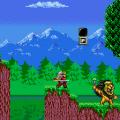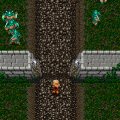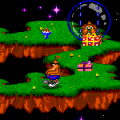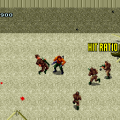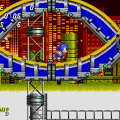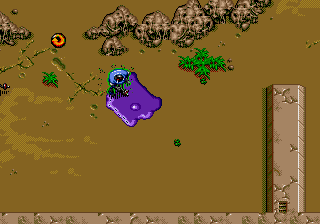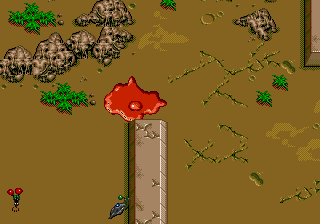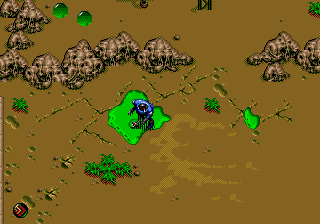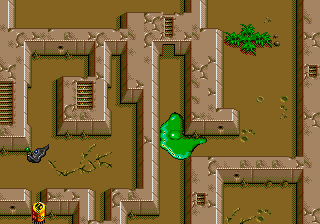
Sega Technical Institute (STI) was quite the weird beast of a studio. Founded in 1990 by Mark Cerny, its goal was to develop games meant for American tastes, the first being a Genesis game based on the Dick Tracy movie, and later the platformer Kid Chameleon. They then found themselves joined with a team of Japanese developers to create Sonic the Hedgehog 2. But development was rocky, and head programmer Yuji Naka would only agree to develop Sonic 3 if he could work with his team back in Japan.
After this, STI were left without any real direction. Their next title would be the quite average Sonic Spinball, made as a stopgap to fill the holiday hole left by the Sonic 3 delays. Many other projects never saw the light of day, among them a puzzle game starring Tails. The other two titles that would be greenlighted by the Sega execs were quite different from the platformers the team had been known for up until that point, both with more of an “mature” feeling – the beat-em-up Comix Zone. and the unusual The Ooze.
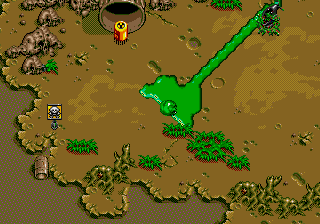
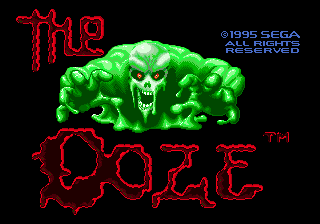
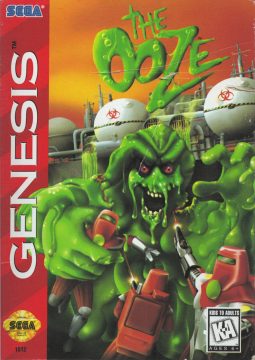
The Ooze was released in September of 1995 in North America and Europe, with concept/programming/design by Dave Sanner, plus the help of Stieg Hedlund (Diablo II) and Jason Kuo (producer for Shenmue and Yakuza). The game was slated to be the launch title for the Nomad, a full-on portable Sega Genesis console that came and went. While escaping that fate, unfortunately, it still was released to mostly average/negative reviews, with the Genesis at the end of its lifespan, The Ooze was mostly ignored by the public. The game has had a few re-releases, though, and can be found on Sonic Mega Collection Plus as a hidden unlockable title and on the Genesis/Mega Drive Mini 2.
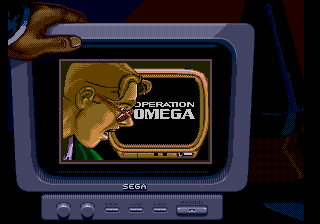
Remember the Toxic Avenger? While there have been games inspired by the Troma superhero, they seem to be, for the most part, pretty forgettable. The Ooze borrows a page from Troma and another from classic superhero movies. A scientist, Dr. Caine, wakes up one day to find out the corporation he’s working for has developed a deadly virus and a cure that is going to be sold at a high price. Operation Omega has begun. Who knew working at Microsoft was so fun? Poor guy has no time to sound the alarm, after being discovered by the evil director, he’s immediately turned into a mass of screaming green goo.
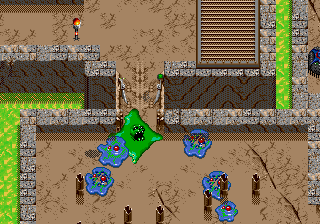
Our hero must, then, slowly crawl around as a puddle of nuclear waste to try and get his revenge while, perhaps, also finding a way to turn back into human form. To design the movement of a mass of green particles, the team actually set out to render everything as realistically as possible, spending quite some time to make the concept work, which led to delays as its release was originally planned for early 1995.
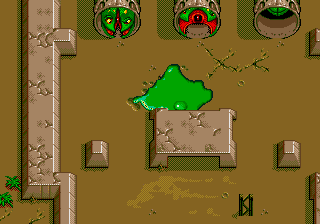
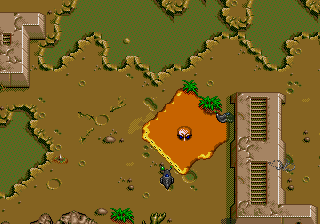
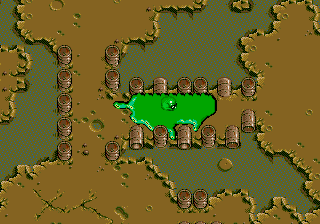
As far as the technology of the time allowed, the simulation of moving a liquid around is very realistic. The team apparently labored quite a bit over making it as realistic as possible, according to artist Craig Stitt. Great proof of their work is the fact that taking control of a mass of green goo is exactly as difficult as it might sound. Even though many reviewers at the time singled them out as the worst part of the game, they don’t seem to be that much of a problem. The main issue is that attacks are difficult to carry out with perfect precision. While it could be fun to experiment, the level design very much prevents that, as plenty of hard-to-see traps and small enemies make life pretty hard for our Ooze friend.
The normal attack is, ironically enough, the most difficult to control: the Ooze spreads its mass along a trajectory that can be influenced by the player with the D-pad. The attack, along with disposing of enemies, can be used to solve puzzles by activating buttons and levers. While its mass is spread around, our hero cannot move and remains vulnerable; thus, often, part of its mass ends up being cut off or lost in sewer holes. The secondary ranged attack, the “nuclear loogie”, is effective, but each shot costs health. Basically, much like in STI’s Comix Zone, the main character’s health also doubles as his stamina. Almost everything the player does can potentially hurt the Ooze.
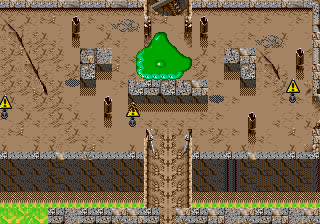
The team decided to do away with the idea of having any kind of interface, hence the only way to tell how much energy is left is by looking at how large the Ooze puddle is. A well-thought-out bit of design is how restoring health entails collecting molecules of green mass, but the more health Ooze has, the harder it becomes to maneuver around the nooks and crannies of the nuclear plant or laboratory. The player must, then, try to strike a balance between health and maneuverability. Along with health, several pickups can make the Ooze faster or deadlier to the touch.
The levels are designed to be long and hard mazes; a map would have been a much welcome addition since remembering which lever has been activated or button pressed soon becomes a bit of a pain in the neck. While not readily apparent after the first stage, The Ooze is definitely one merciless game: as soon as the first boss is defeated, the difficulty is quickly ramped up to eleven. More enemies, more puzzles. Secret levels are also available, with the Ooze going to consume rabbits as fast as possible, while they also try to drink its radioactive puddle. As rabbits do…?
If dealing with small enemies in tight spaces wasn’t enough, the good ending can only be unlocked by collecting fifty DNA helices. To make things even worse, these are not only spread throughout the levels, but are even hidden in secret levels. Fail to collect them and, in the “normal” ending, Caine defeats the director but remains a putrid pile of goo and, eventually, dies.
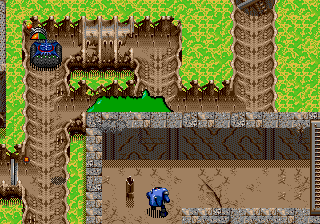
The Ooze is a clear case of design over substance, an intriguing concept translated into a game that marries the idea of controlling a liquid with rather merciless level design. STI was apparently very preoccupied with making games as hard as possible, ever since Kid Chameleon. In The Ooze, even attacking without taking damage becomes quite the difficult task. Perhaps the level design or the attacking had to be slightly tweaked to make the game a more palatable to a wider audience. Still, its style, marrying the comic book superhero narrative arc with overly dramatic tones a là Darkman, makes The Ooze quite a unique experience. Those looking for a solid action game for the Genesis, are probably better left looking elsewhere, but for your good dose of weird and style, this is one of the beter hidden gems on the Sega Genesis.
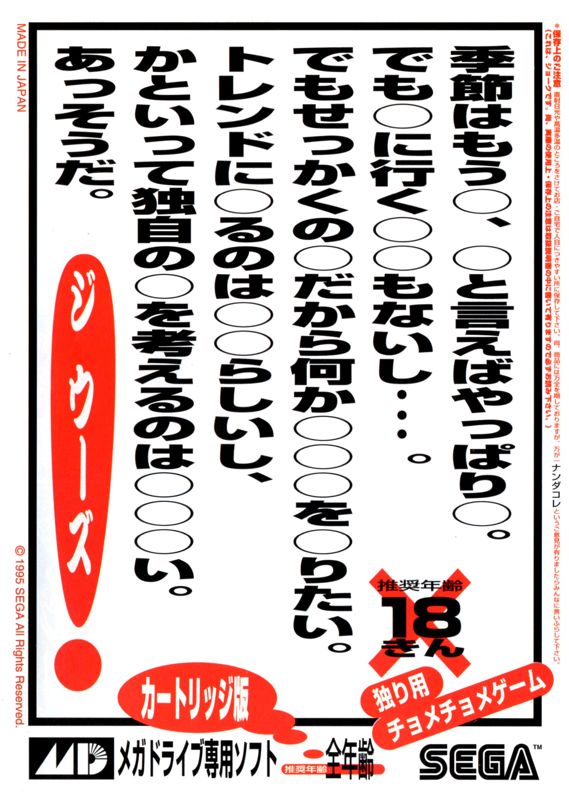
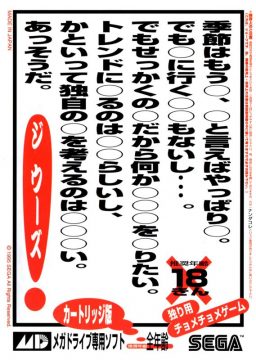
Japanese Cover
The Japanese version of the The Ooze has quite an unusual cover, showing lots of Japanese text against a white background, with some words censored and a “no under 18” logo, suggesting an adult product. An interview with product manager Takayuki Kawagoe (found in the Sega Consumer History book) clarifies how it ended up that way:
“About twice a year, we would be presented with overseas titles from SOA, and we would select the titles that received good reviews to release in Japan. One of those titles was The Ooze. Those around me were opposed to releasing it, but I pushed it through anyway (laughs). Since it was almost the last Mega Drive title to be released in Japan, we got away with doing whatever we wanted with it. By the way, the guy that made the cover was Mr. Tsukamoto, who currently owns game company Land Ho! (laughs). Since we didn’t have any advertising budget whatsoever, the cover was a last resort to somehow make it stand out.”
Since it was one of the last Mega Drive titles released in the country, the Japanese version of The Ooze is also extremely expensive in the aftermarket. In comparison, the American and European versions are not nearly as highly sought after.