- Vulgus
- Titan Warriors
Arcade Flyer
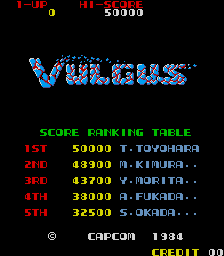
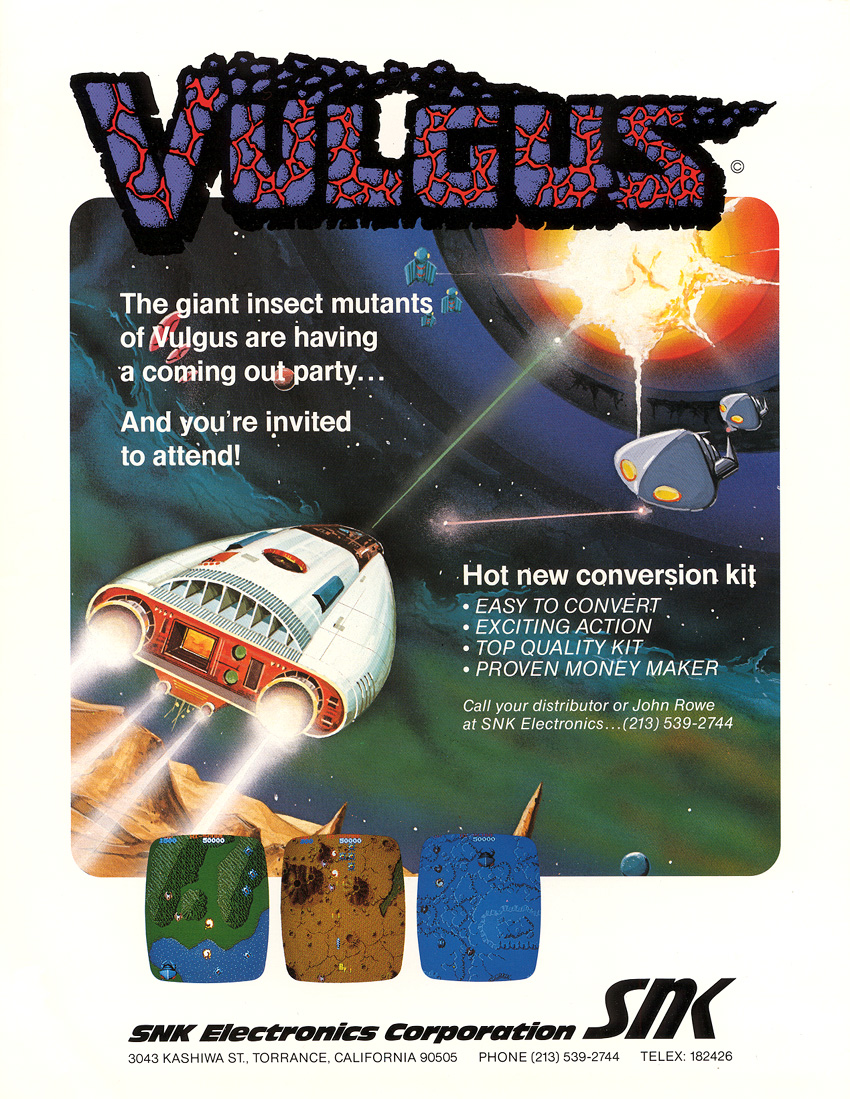
Nowadays, Capcom is a titan of the industry, so it’s interesting to see how humble their roots were in comparison. Founded in 1983 by Kenji Tsujimoto (formerly of Irem), Capcom got their start with simple coin-op games called Little League and Fever Chance, but once they opened their own arcade called Acty 24, they wanted something new and closer to what other companies were doing to draw players in. Capcom was smart enough to enlist the talents of former Konami employees Tokuro Fujiwara and Yoshiki Okamoto, who had helped to create games like Pooyan and Gyruss respectively and would both go on to define much of Capcom’s output throughout the 80s and 90s. Vulgus, as simple as it may be, manages to exhibit the essential elements that would propel many of Capcom’s future games towards success, namely the combination of challenging skill-based gameplay mixed with enough complexity to encourage players to optimize their scores. In an amusing twist of fate, Vulgus was distributed in North America as a conversion kit by a company called SNK, who Capcom would get to know very well in the coming years.
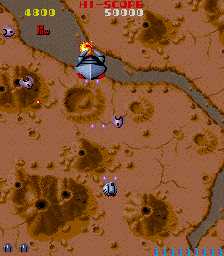
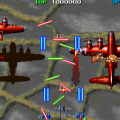
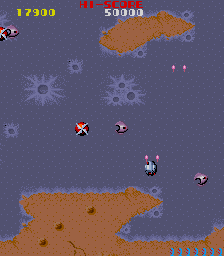
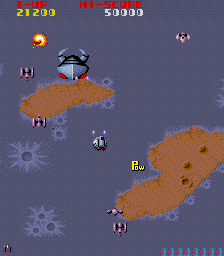
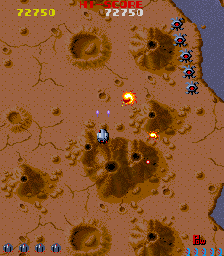
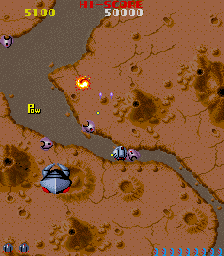
Despite coming out just a year after Xevious, Vulgus manages to do its own thing when it comes to play mechanics. Instead of a bomb that hits ground targets, you use ammunition for a piercing cannon shot that will wipe out enemies in one hit. You can stockpile ammo by picking up “POW” icons and if you’re willing to wait for an enemy formation that’s nicely lined up, hitting all of them with one shot will get you a healthy amount of bonus points. Consistently collecting POWs without missing any will also increase their spawn rate, allowing you to use the cannon more frequently. Choosing if and when to use missiles is a significant part of the ebb and flow of Vulgus and the option creates player-driven difficulty selection. Enemies are extremely numerous and aggressive, so being caught without enough missiles can spell doom while you’re getting acquainted with the game. The savviest players, however, will stick to their main guns as destroying formations with them builds up a bonus multiplier that ends up surpassing what cannon kills can give you so long as you don’t die. There are no continues or instant respawns, so earning enough points for extra lives is a vital part of doing well.
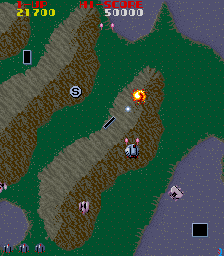
Along with the previously mentioned POW icons, there are also three different letter icons that temporarily adjusts enemy behavior. The “S” reduces their speed, the “B” reduces the speed of their bullets, and the “E” reduces enemy appearance rate. If you keep collecting these icons and stay alive long enough, you’ll eventually stumble upon a star icon called the Sakichi, which gives a massive score boost. This system is very novel for a 1984 release, essentially serving as a prototypal form of rank, but the effects of these items are subtle enough that some players may not even notice what’s going on. The Sakichi became something of a Capcom signature for a time, appearing in games like Exed Exes, 1943, and Side Arms. The iconic Yashichi makes its first appearance here as well, but instead of being a helpful item, it’s an enemy hellbent on destroying you!
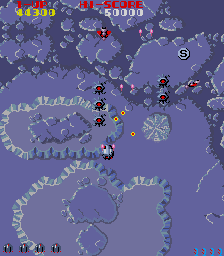
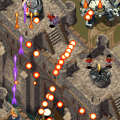
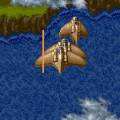
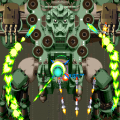
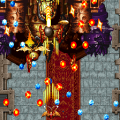
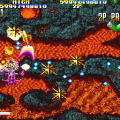
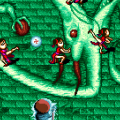
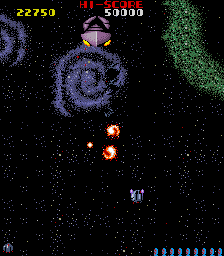
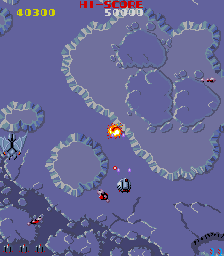
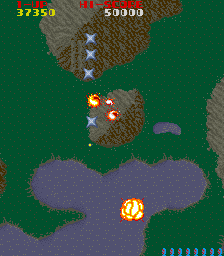
Vulgus is an endless game, but it cycles through a few environments per loop to keep things interesting. The first stretch takes place above a mountainous wasteland, the second part is over a green valley with water, and the third section is set atop an icy tundra. Each section is broken up with a brief excursion into space, which serves as a bonus round of sorts in that you’ll encounter nothing but passive enemy formations and bigger enemies that give generous amounts of points. If you can make it to the end of a loop, you’ll get to do battle with the titular menace, which attacks with a barrage of orbs that are difficult to overcome without a nice supply of missiles. Should you defeat it (and make it out of space alive), you’ll loop back to the first area with the difficulty noticeably cranked up. If you can make it to and defeat Vulgus without using missiles at all, you’ll get an extra 50,000 points for your trouble!
As Capcom’s video game origin story, the company has done a great job of keeping Vulgus available to anyone interested. Vulgus was first ported to the Playstation and Saturn via Capcom Generation 3, which also features some of their other 80s arcade games like SonSon and Pirate Ship Higemaru. This collection has quite a few bonuses, including tips, images of the game’s fliers, an enemy gallery, a sound test, remixed music, multiple display options, and the ability to tweak your starting lives. This collection wasn’t released outside of Japan, so it wouldn’t be until Capcom Coin-Op Collection Volume 1 was released for PC by SelectSoft in 2003 that Vulgus would be accessible in a retail capacity for North America. This collection features Vulgus and four other games, though they’re emulated through a modified instance of MAME as it was at the time, so this collection isn’t ideal nowadays. Capcom Classics Collection Vol. 1 on the PS2 and Xbox came next in 2005 (this time in both North America and Europe) and maintains several of the features of Capcom Generation 3 (minus the customizable settings and the remixed music), but it does make you unlock them by completing some challenges. Capcom Classics Collection Reloaded on the PSP contains this version of the game with the same unlockable bonuses.
The next port would be via Capcom Arcade Cabinet on the PS3 and 360 as a digital download in 2013. Vulgus’s place in this collection is odd, only being available as a bonus to those who shelled out $30 for all of the other games, but the port was done by M2 and the quality here is among the best of any option. You get access to many of the options seen in other compilations, but this is the first version to offer online functionality and there’s an exclusive “Casual Mode” that lets you tweak things like the number of lives, the game’s collision detection, your ship’s speed, and the difficulty of the enemies in your favor, making this the easiest way to tackle the game. The most recent port is part of Capcom Arcade Stadium, which offers a suite of features, plenty of display options, easy region swapping, online leaderboards, and the ability to tackle score challenges and even gimmicky challenges that flip the screen upside down. If you’re so inclined (and it’s in the current rotation), you can also play Vulgus through Street Fighter 6’s online hub.
Vulgus is a simple game that won’t blow anyone’s mind, but it’s a solid effort for 1984 that successfully set the stage for the future of Capcom. Subsequent games like 1942 and Exed Exes would take elements from Vulgus and iterate upon them to provide more comprehensive shoot-em-up experiences. The combination of simple mechanics with more complex scoring systems is something that several future Capcom games would end up doing as well to even greater success. Its frequent re-releases indicate that Capcom still remembers and respects the game and they even snuck a couple of direct references to it in other games. In the original Marvel vs. Capcom, Captain Commando will sometimes inform players of what Vulgus is upon winning, and in Marvel vs. Capcom 3, one of Deadpool’s victory quotes states his plans to petition Capcom for a Vulgus 2. It’s hard to imagine the Capcom of today ever going back to making shoot ‘em ups, but with other shoot-em-ups like Sonic Wings and Salamanderreceiving surprise sequels in 2025, perhaps anything is possible.