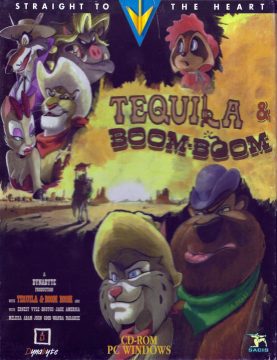
During the early 90s, Italian studio Dynabyte Software created various interesting games from point-and-clickers Nippon Safes Inc. and The Big Red Adventure, to genre experiments like Amiga fighter Tube Warriors and the salacious Late Night Sexy TV Show. But despite their youthful enthusiasm, they often seemed to run into issues with money and publishing, and this heavily impacted what ended up being their final work: the cartoon cowboy adventure Tequila & Boom Boom.
It has the potential to be a charming pastiche of spaghetti westerns, sporting an attractive art style and cute animal people in a story that lightly riffs on the films of Terence Hill and Bud Spencer. Unfortunately, a lack of funding and communication from their publisher SACIS resulted in a deeply unfinished game full of bugs and lacking in narrative or mechanical substance. It’s a miracle that it came out at all, but is no less difficult to recommend.
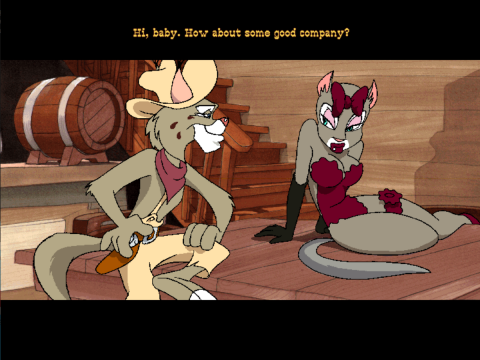
You play as Tequila, a gun-slinging trouble-making lynx who wanders into the nearly deserted Stinky Town, practically owned by the wealthy Mr. Vyle and his various goons. All that he doesn’t own are a sheep ranch run by the pretty but defenseless Melissa and an abandoned mine currently being prospected by Tequila’s strong but ill-tempered associate Boom Boom. There are rumors abound of sheep going missing and gold lurking in that mine, so what’s Tequila to do but poke his nose where it’s not wanted and see what happens.
Tequila & Boom Boom is a simple take on the point-and-click adventure style, where you use a cursor to move, talk to people, examine or interact with objects, and use items from your inventory to move the plot along. The left mouse click automatically performs the one action you’re able to do on any given object, while right clicking lets you examine your inventory (accessed with Tab) and very rarely examine characters. This allows for relatively smooth play, which is further assisted by double clicking the exit hotspot to instantly move between screens.
Where the game stands out is its occasional use of quick time event-type scenes, where you’ll have to click on a certain object in time. Whether you’re catching a glass of beer, shooting a coin in mid-air, or going down the right tunnels on a speeding minecart, it keeps things varied enough. But you’re never warned ahead of time, and although most of them allow you to try again with no penalty, it can be dull waiting through conversations and animations for another chance. Worse still, there’s one instance that you only get one shot at (pun intended) and you’ll be softlocked if you fail it.
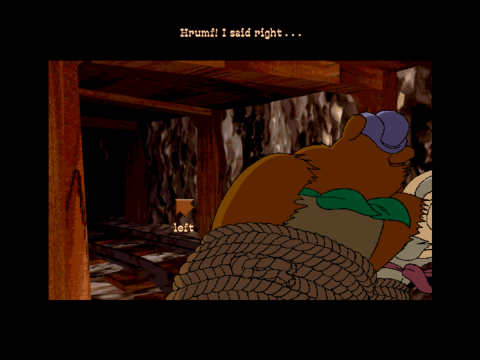
Beyond that, your interactivity with the world is quite limited. The handful of items you acquire have one specific use, there are various characters standing around that you can’t interact with, and the handful you can talk to only have a couple of conversation topics at most. This puts the focus on solving the dozen or so puzzles scattered throughout, and those are often quite simple with basic “use X on Y” solutions or choosing the right dialogue option.
This might be fine if they weren’t difficult to solve due to a lack of signposting. You’ll sometimes get a suggestion on what you’re meant to do, but frequently left without any further direction. Some puzzles have solutions that are never communicated, forcing you to dig around screens and do diabolically stingy pixel-hunting. The lack of interactivity really hurts since you can’t often examine anything that might give you ideas, leaving you stumbling in the dark.
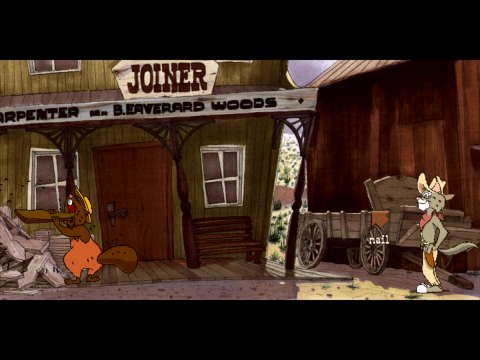
It plagues the overall story too, since you wander in and bumble across plot developments without much drive. While it fits the spaghetti western vibe of an enigmatic cowboy wandering into a strange new town, it also means you don’t have a goal driving you for much of the adventure beyond the very broad notion of getting into Melissa’s good graces. Things just happen, enough to form a coherent plot but with so little connective tissue to flesh anything out.
Most characters get one or two scenes to establish themselves, even major players like Melissa or Mr. Vyle’s top henchman Brutus, but never surpassing basic archetypes like “bartender”, “ranch owner” or “slimeball”. Tequila and Boom Boom themselves are clearly based on Terence Hill and Bud Spencer, pulling from the looks and personalities of their Trinity and Bambino characters from They Call Me Trinity (even including their insatiable appetite for beans as one of the major puzzles), but without the charismatic double-crossing that makes them a hoot to watch.
The lack of conveyance and shallow storyline is likely the result of a troubled development, where Dynabyte spent the last few months with very little money, because there’s a lot of technical issues. For a few examples, the dialogue gets interrupted randomly or uses the wrong voice clip, the subtitles don’t always line up with the spoken dialogue, cutscenes sometimes skip ahead, and the cursor fails to display when using certain items. Even more egregiously are the dialogue options that refuse to display in the final sections, along with unskippable crashes depending on your actions.
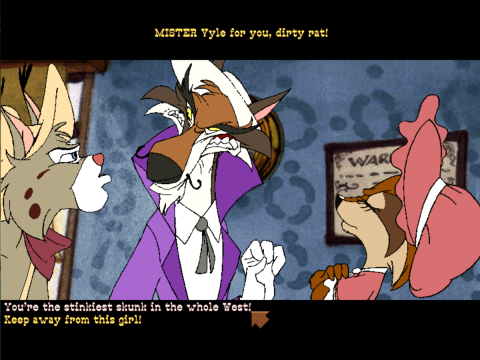
When even the act of completing the game seems as foolhardy as striking gold, it’s hard to recommend Tequila & Boom Boom. That’s a shame because there’s glimmers of something solid underneath. The game goes for an expressively animated look with hand-drawn characters and backgrounds that were then scanned. Some parts look a bit rough or loop oddly, but the result is an attractive interactive cartoon featuring a menagerie of cute anthropomorphic animals and a variety of colorful places that feel lived in. Considering the small dev team size, it’s a very impressive feat.
Marco Caprelli’s soundtrack does a decent job at providing some typical western vibes through ramshackle acoustic pieces and the odd bit of determined or suspenseful music, even utilizing some stereo mixing to create a fuller if bit-crushed soundscape. While a lot of the dialogue is unremarkable, a few absurdly bleak jokes and fourth-wall gags help to lend a little bit of character where it can. Despite its limited Italian release, the game comes with a complete English dub that delivers that dialogue convincingly enough.
Tequila & Boom Boom would end up being Dynabyte’s last commercially released game (although it seemed to receive an official Russian release in 1998), as its developers went their separate ways and achieved long-running careers in the gaming business. But there were plans to follow it up with another adventure game utilizing hand-drawn visuals and quick time events. That game ended up turning into the 3D action-adventure Blood & Lace: A Gothic Novel, released in 2001 by Giunti Multimedia and only retaining the plotline from its original conception.
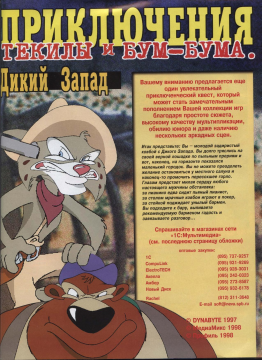
An advertisement for Tequila & Boom-Boom’s Russian release from the April 1998 issue of gaming magazine Game.EXE
LINKS:
A retrospective of Dynabyte’s short history, discussing their various projects including Tequila & Boom Boom – https://genesistemple.com/the-big-italian-adventure-the-history-of-dynabyte-software
Exclusive for Patreon donors, listen to our bonus episode podcast on Tequila & Boom Boom!
Special thanks to Bobinator for providing an alternate version of the game that allowed me to reach the game’s end without crashing.