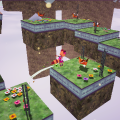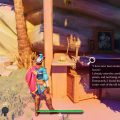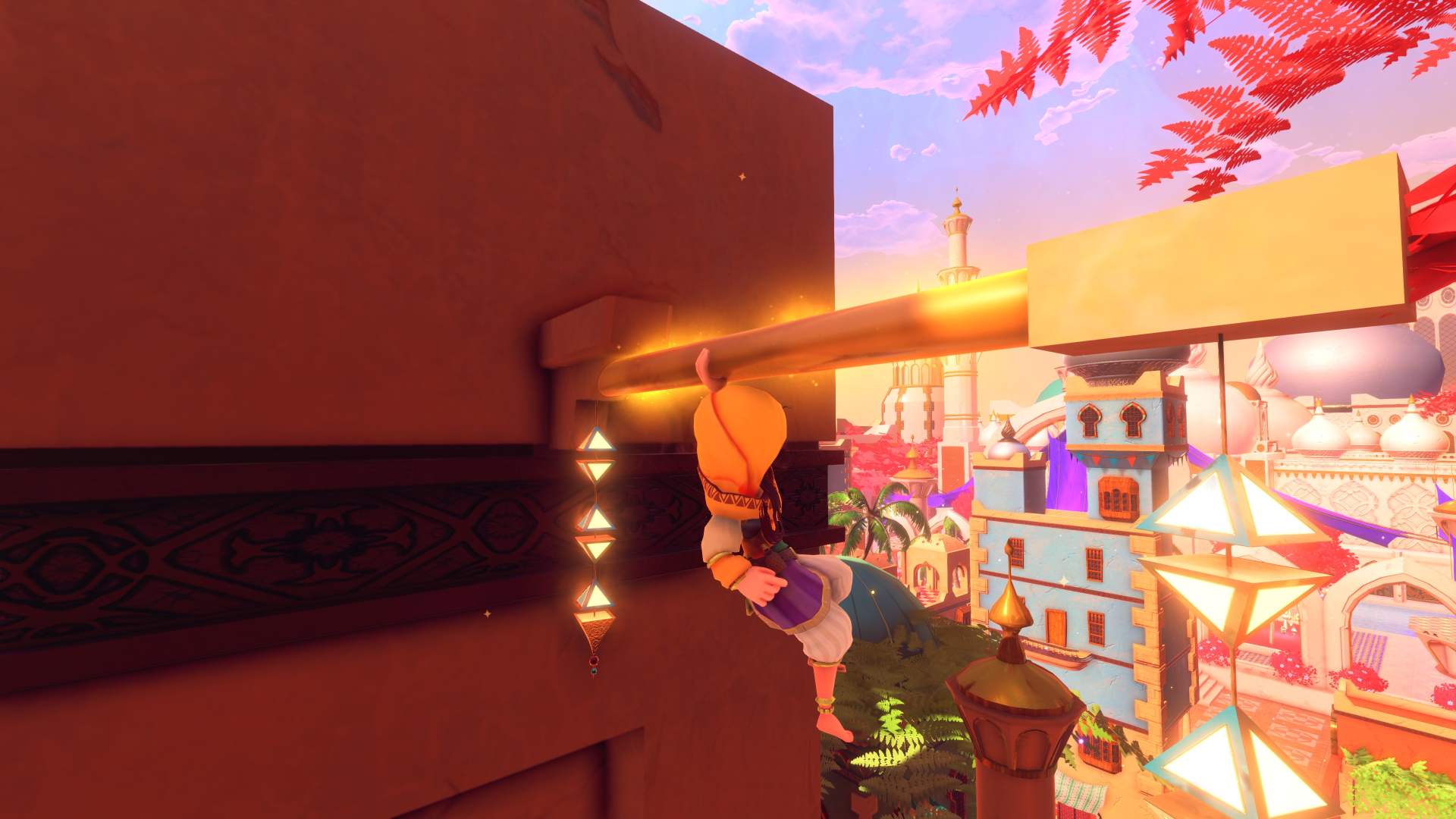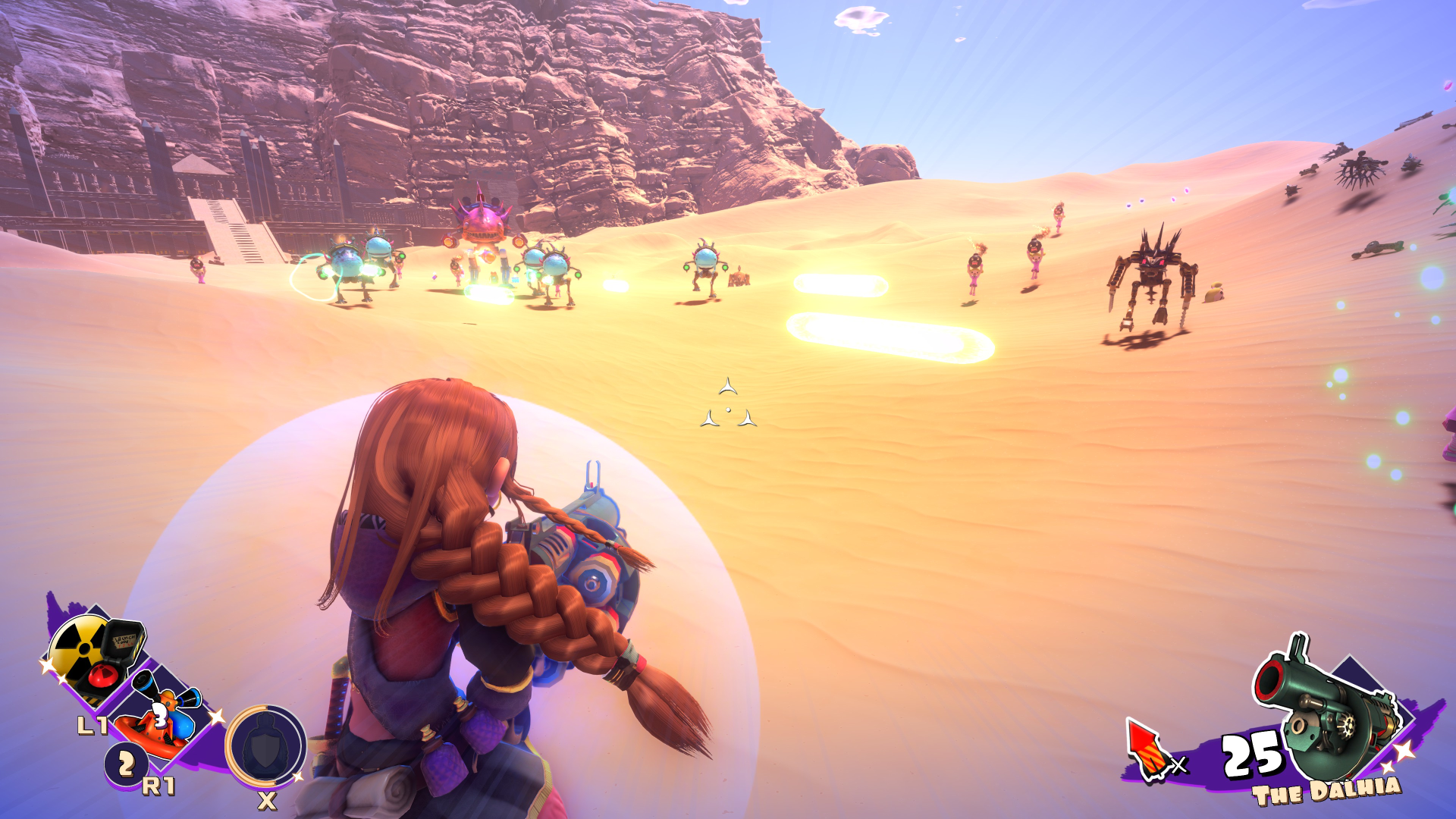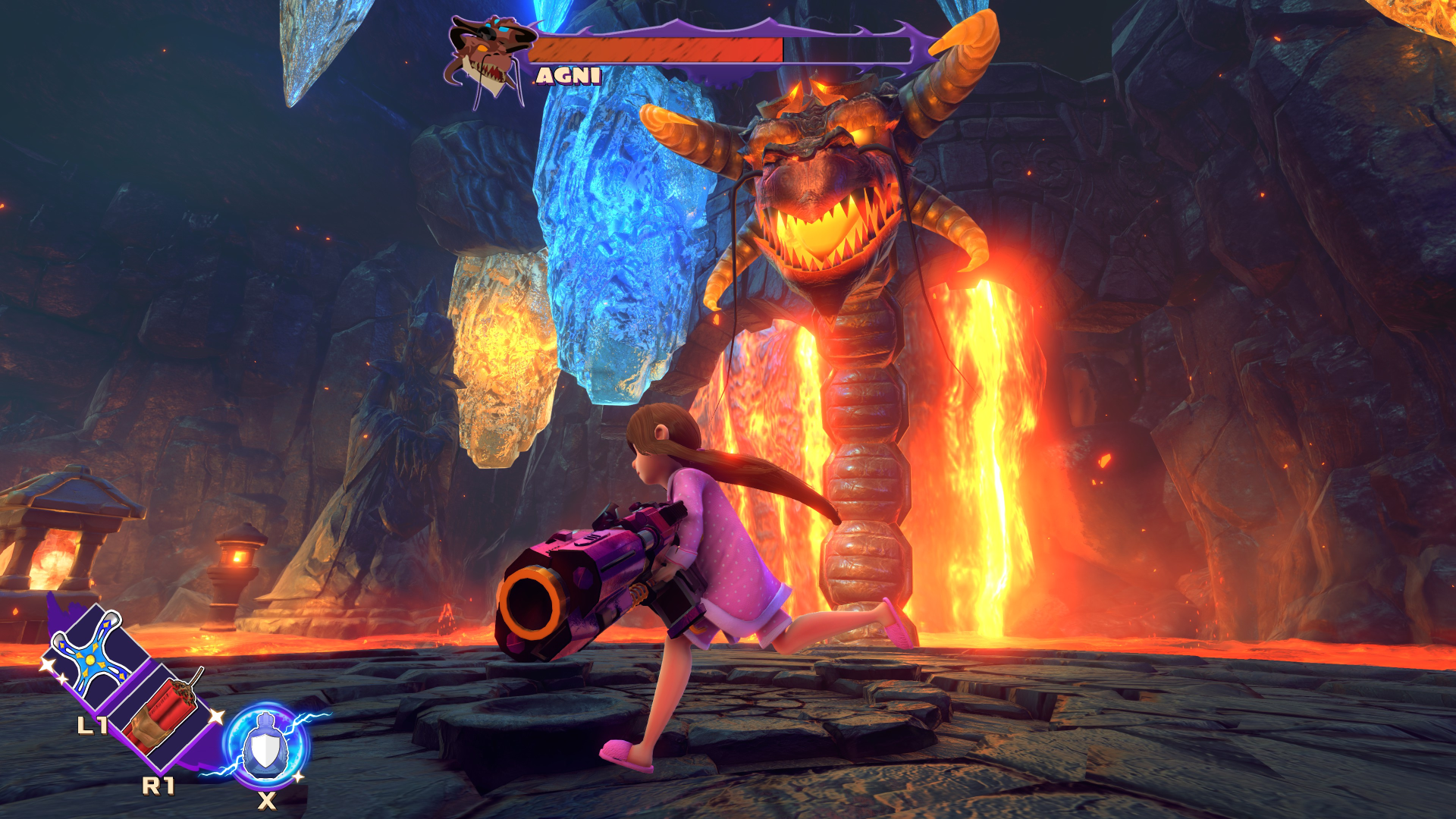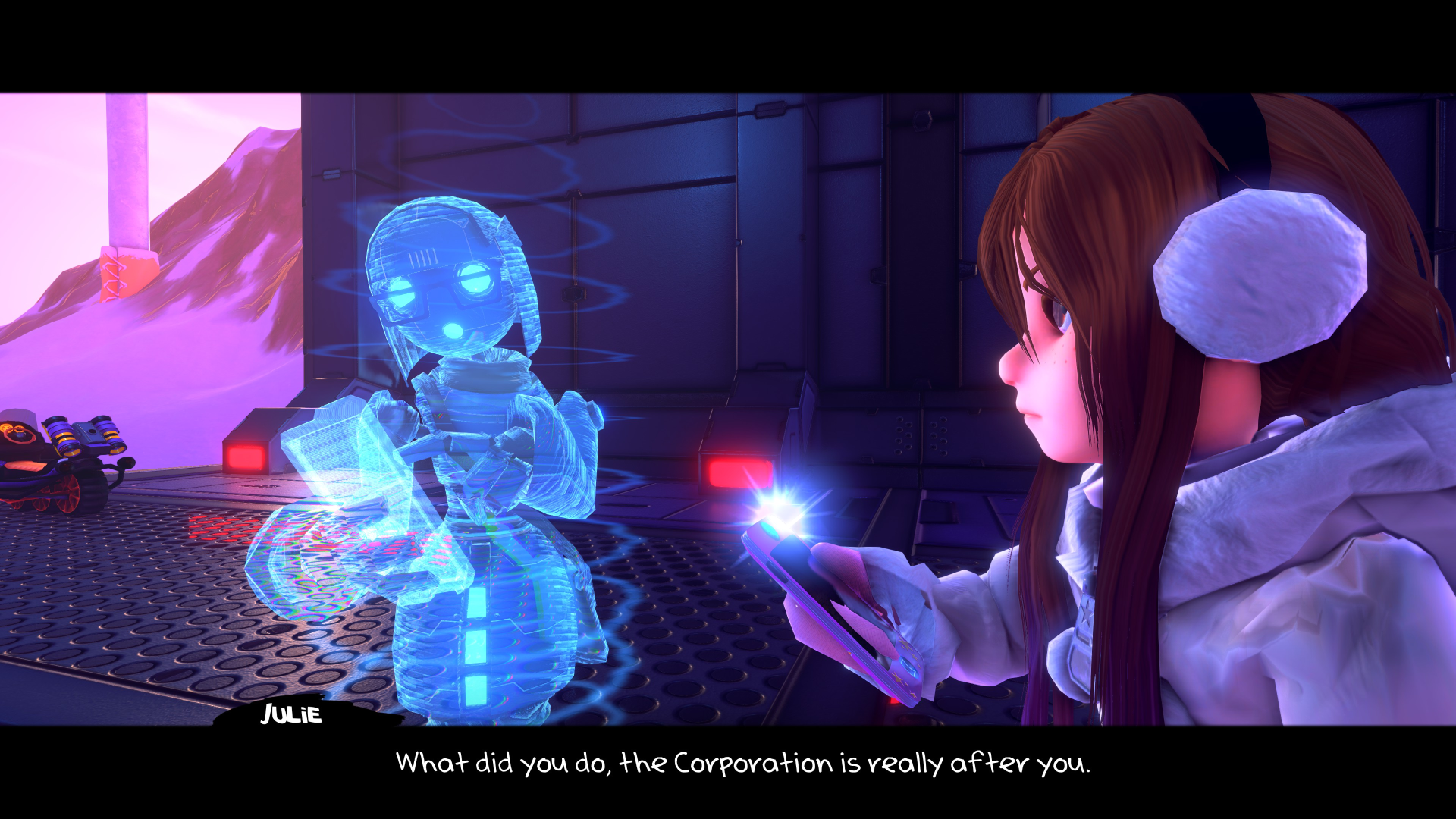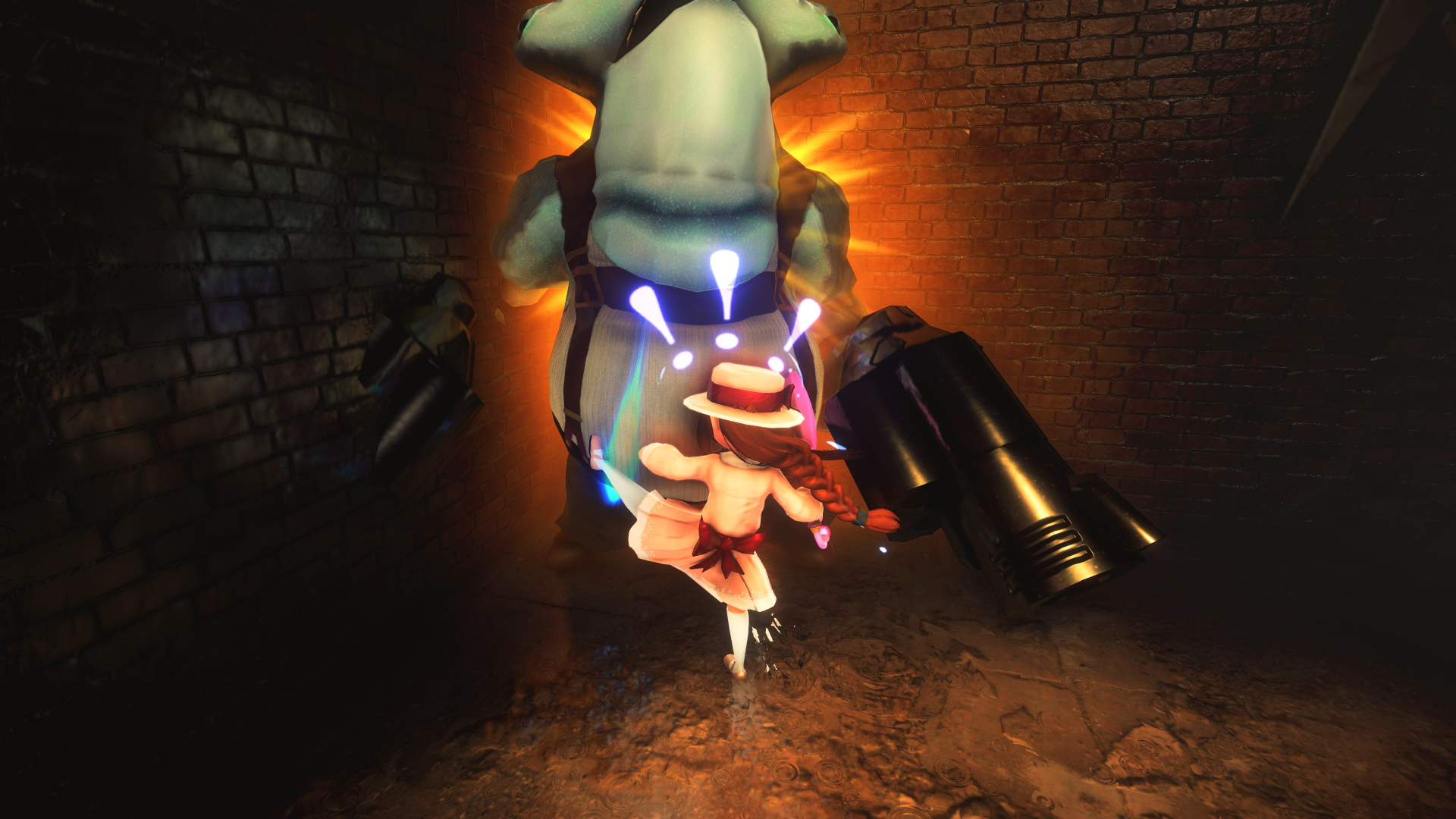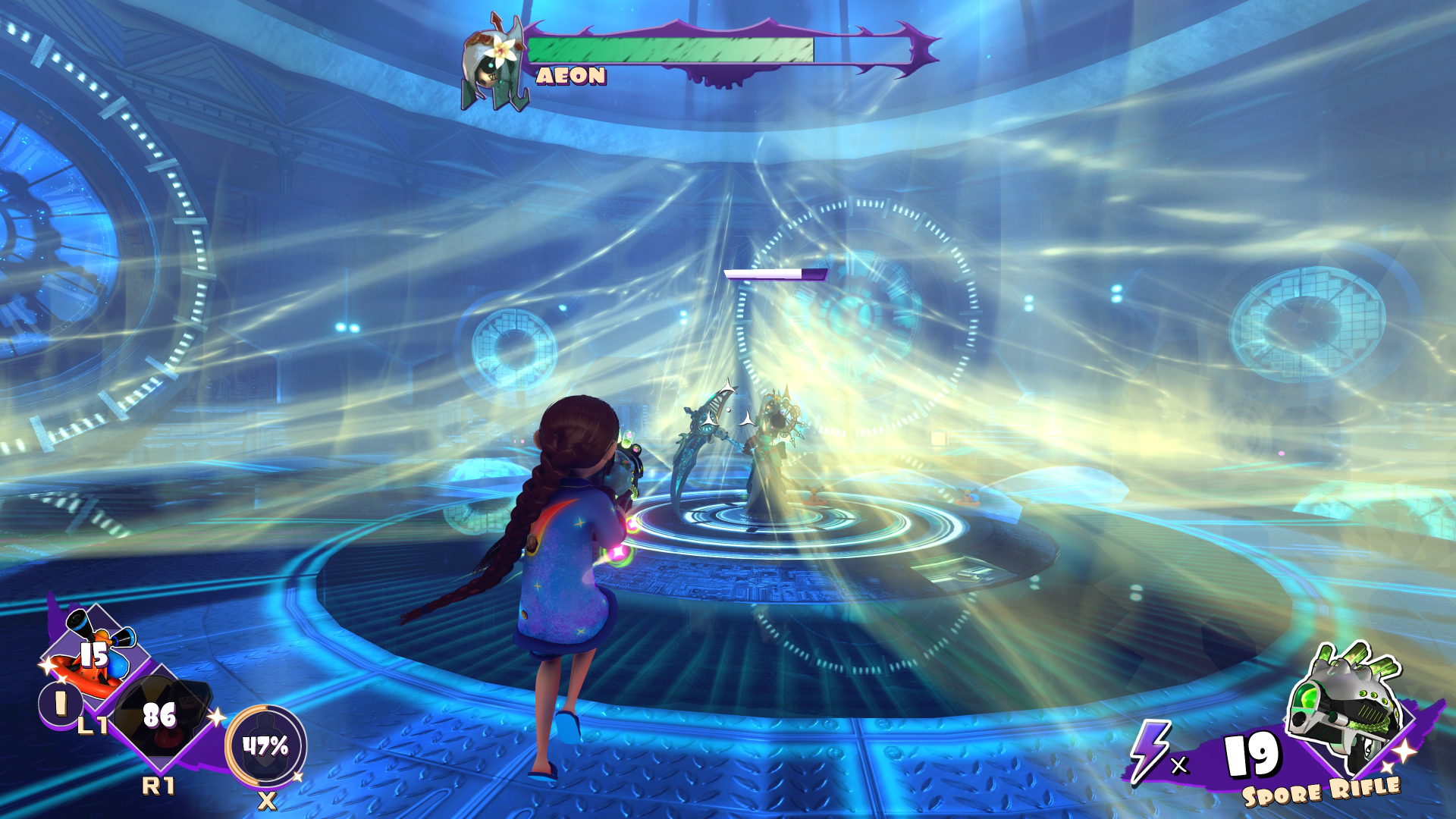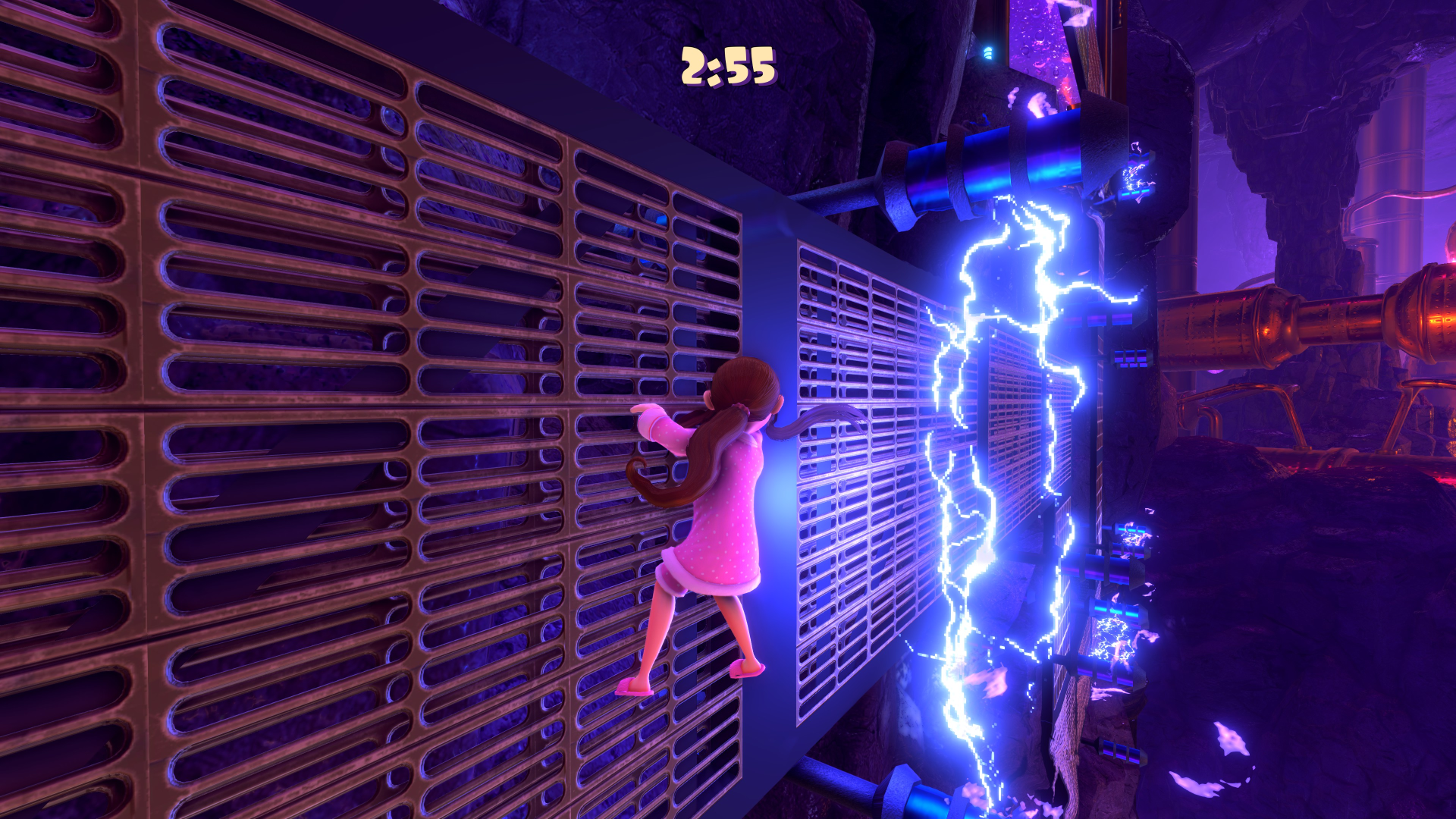
Onirism at first seems very easy to sum up: “Serious Sam and Ratchet and Clank, by way of Little Nemo.” Yet it evolves far beyond that simple X Meets Y description into something much bigger. It’s held back by some major design flaws, but its ambition also shines through, as this is one massive 3D action-adventure, dozens of hours long and packed with content and ideas.
Onirism – a misspelling of the words “oneirism” in English and “onirisme” in the game’s native French, which both mean “a dreamlike state experienced while awake” – starts off with a little girl named Carol lying in bed, when suddenly a being from another world warps in and steals her plush rabbit, Bunbun. Carol is literally not taking that lying down, as she grabs her umbrella and hairdryer and jumps into the portal, which takes her to a surreal, dream-like world known as Crearia. As the plot thickens, it becomes clear that there’s a lot more at stake than a plush toy.
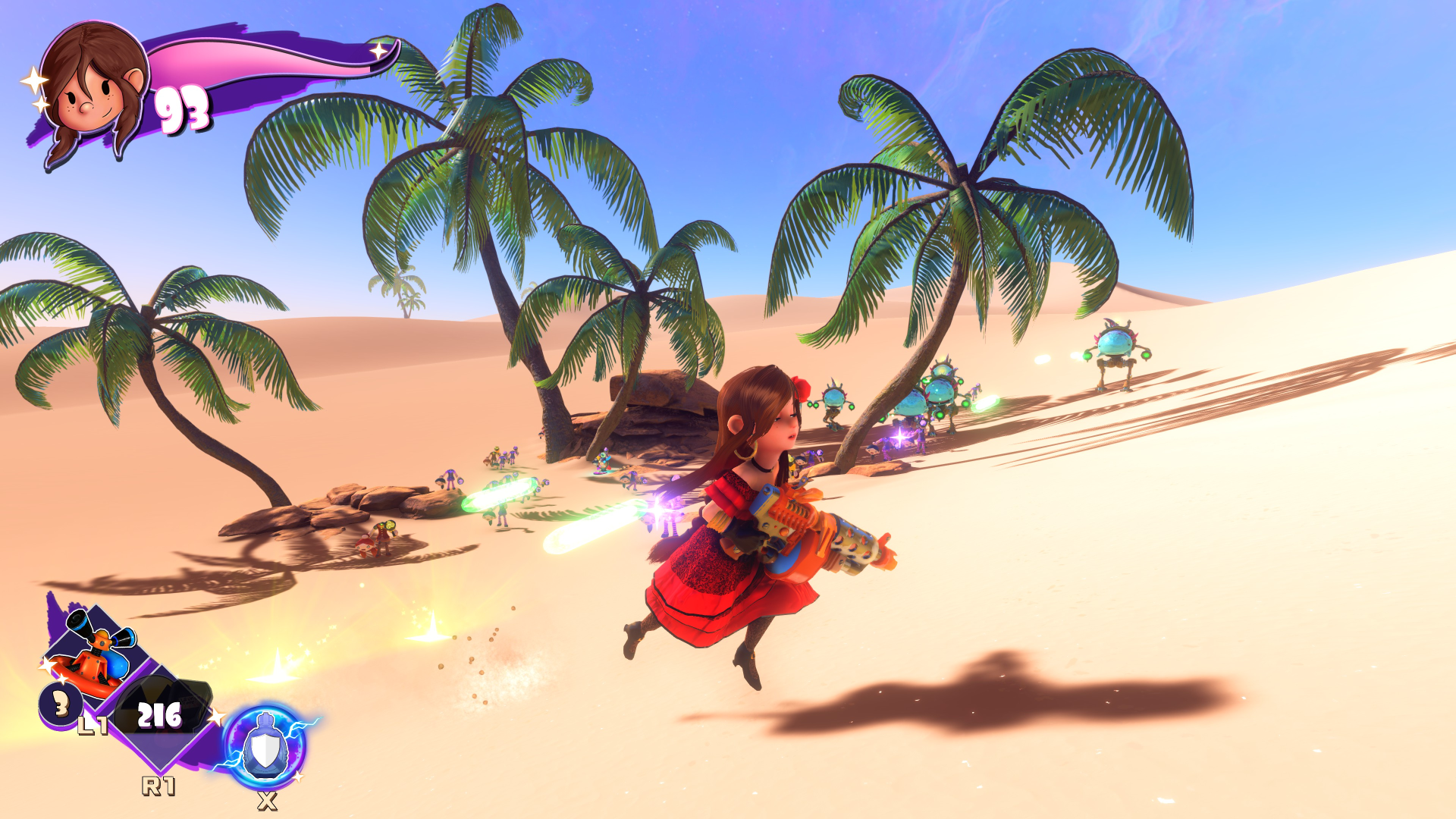
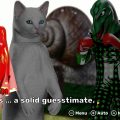
This level outright embraces the Serious Sam comparisons.
Early on, the game feels like it’s trying to be a Serious Sam ripoff with an excuse plot.
At first, it plays a lot like it, complete with enemies that are basically ersatz copies of that game’s enemies. The Kleer skeleton horses are replaced with praying mantises made of K’nex type blocks. The headless screaming kamikaze enemy holding bombs is replaced with a more softly shrieking toy holding a bomb with a drawn cartoon face. All the Serious Sam ripoff enemies behave much the same. Even your basic hairdryer that you keep at all times is somewhat similar to Serious Sam’s basic pistol, having constantly replenishing ammo, and being usable in any situation if you’re out of ammo for your other guns.
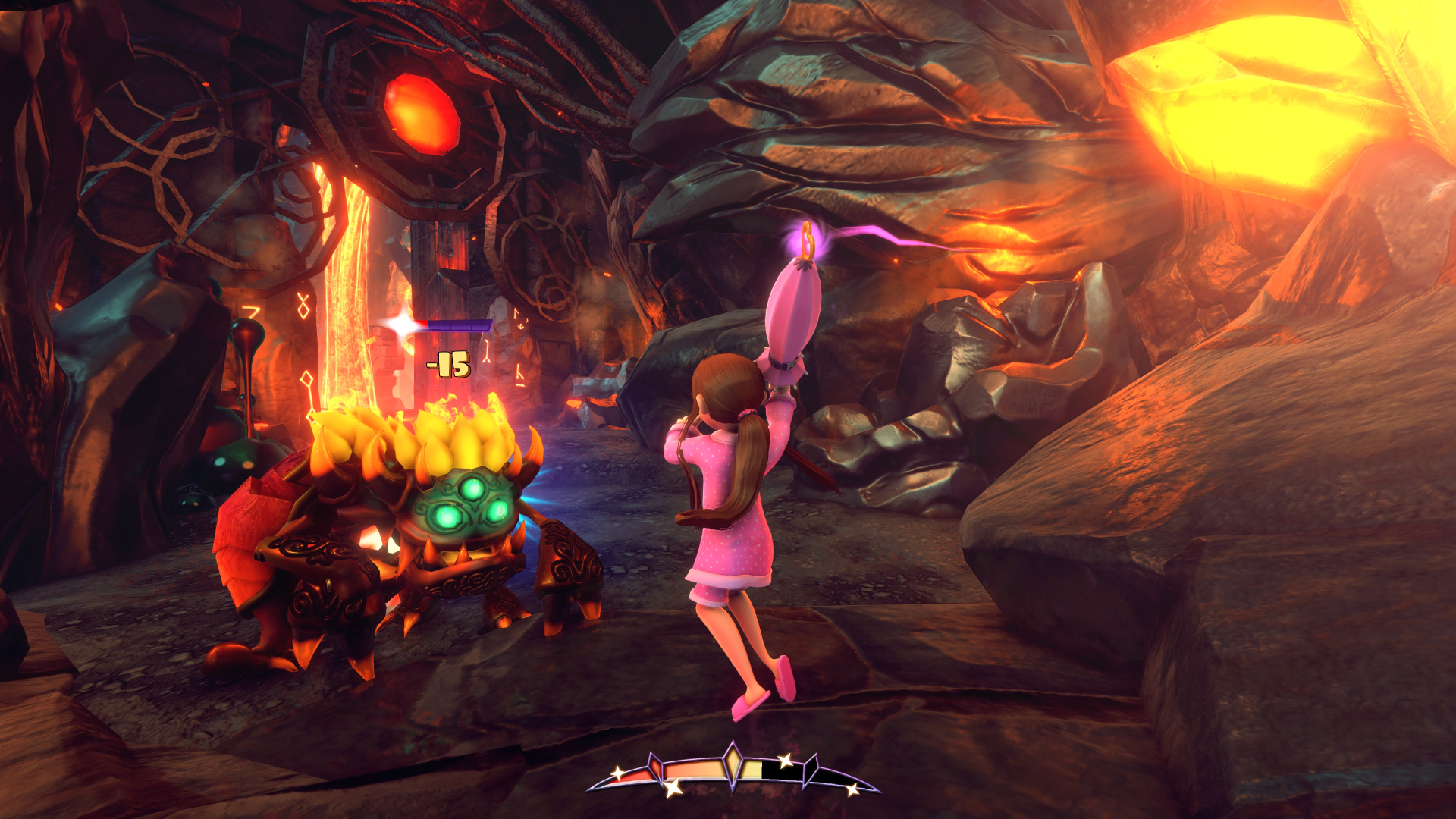
The main difference, at first, is that you push a button to switch between “shooter mode” and “platformer mode.” When in “shooter mode,” the perspective is over Carol’s shoulder (you can adjust the camera to switch to a first-person view), and pressing the attack button shoots your gun. When in “platformer mode,” the game controls more like a platformer, where pressing the attack button results in smacking enemies with your umbrella or performing combo moves such as body slams, punches and kicks.
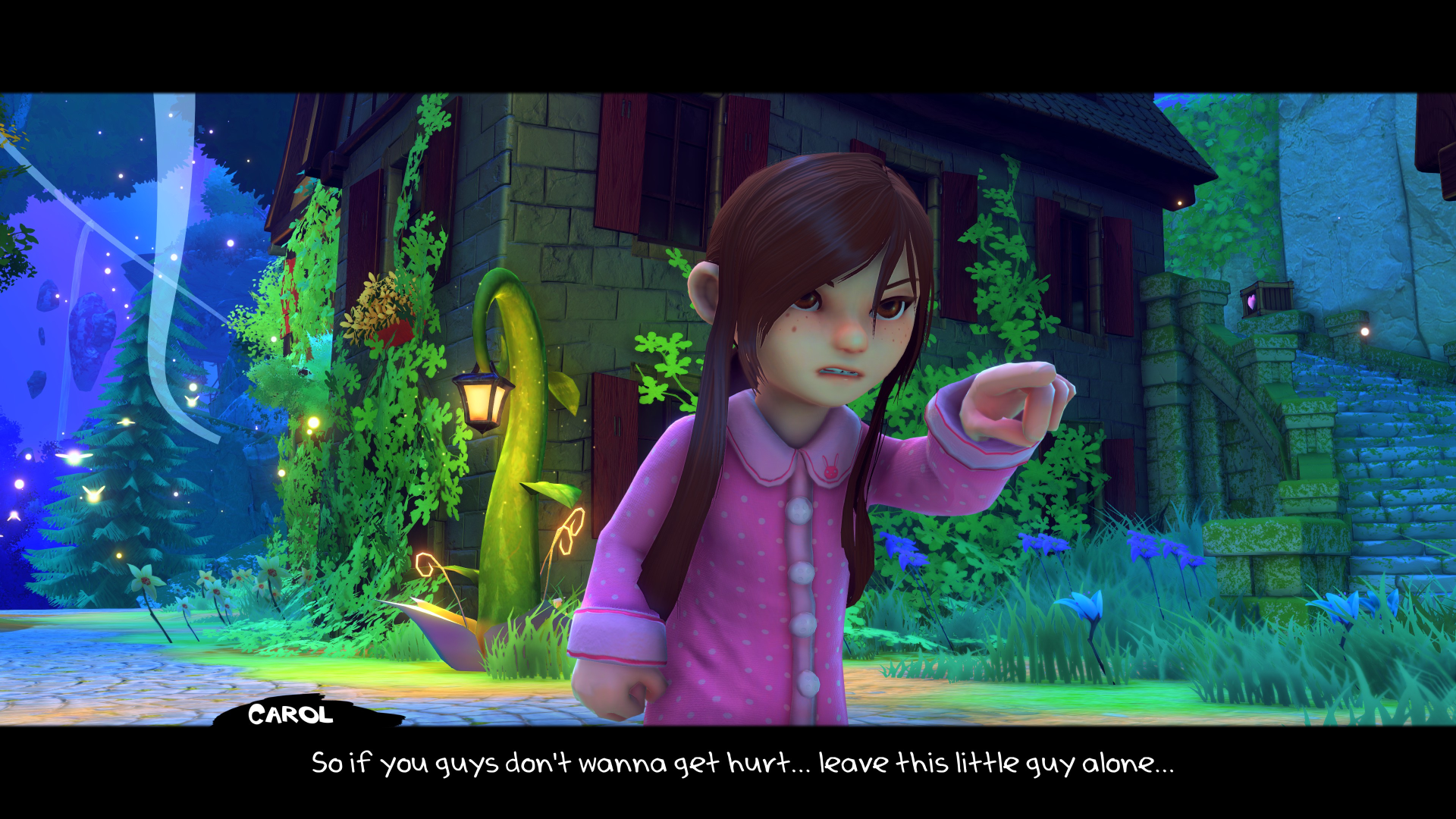
In fact, Carol controls a lot like a platformer hero more than she does a shooter hero. You can combine the jump, dash, dodge and attack moves together to perform a variety of maneuvers such as diving on the ground and sliding along your belly, rolling back onto your feet (which also can knock aside enemies with a bowling pin sound), lying on your belly and rolling to dodge enemies while shooting back, performing jump kicks in the air, doing a slide that transitions into a high jump, and a lot more. The moves chain together naturally in an almost Super Mario 64-like way.
Melee is very much a valid strategy for beating enemies due to the ability to chain together combos and perform dodges and jumps to avoid attacks as well as to block by hitting the “dodge” button when not moving. So is sneaking up on enemies with charged umbrella attacks, or shooting them a few times and following up with an umbrella attack to save ammo.
There are many hidden upgrades for your weapons, health and stamina. All of these help a lot, as the game will sometimes put you in combat arenas or boss fights where ammo does replenish from openable containers… but not always, sometimes resulting in you having to rely on your infinite ammo hairdryer. Stamina allows you to run longer and perform dashes more often.
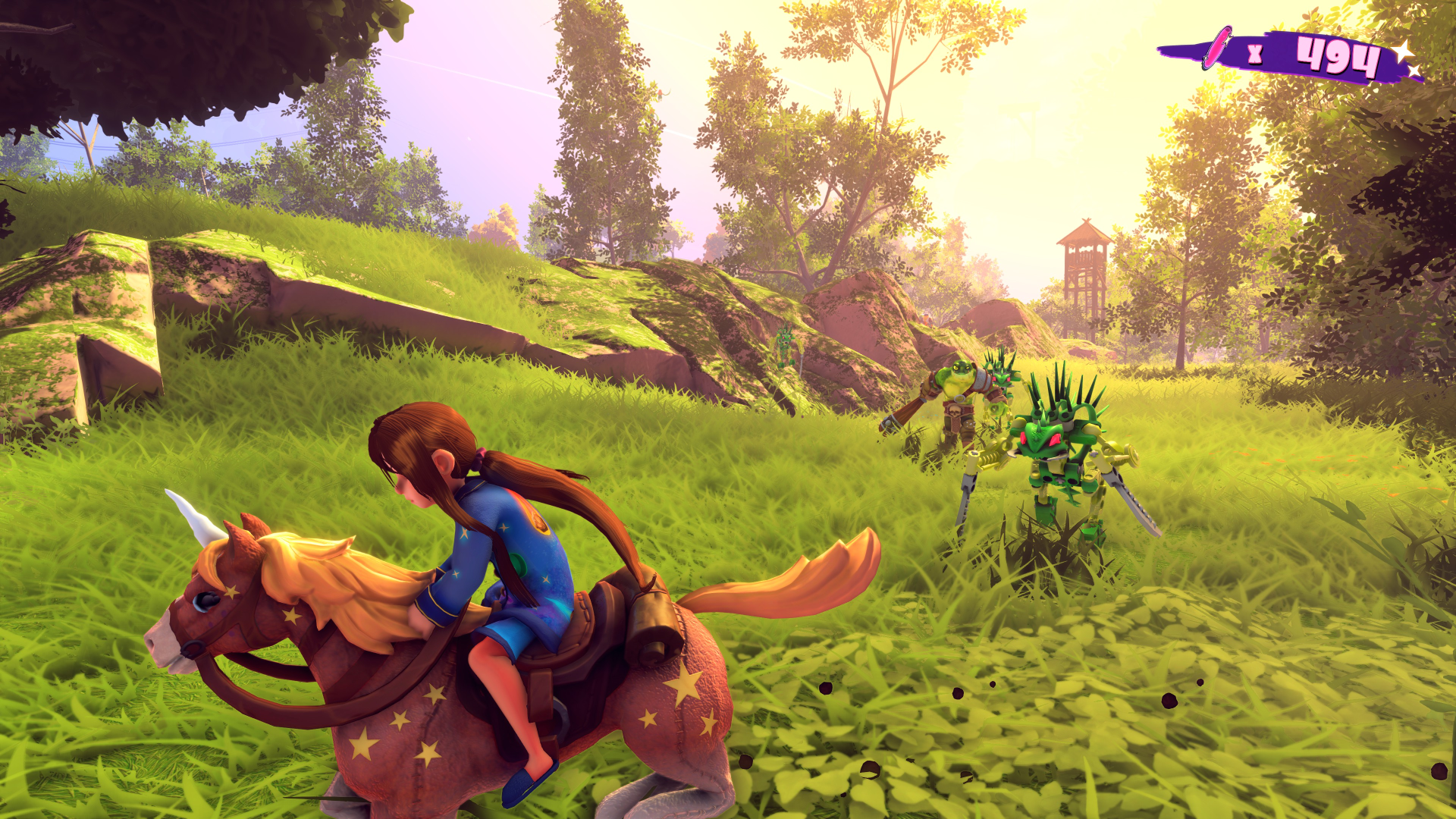
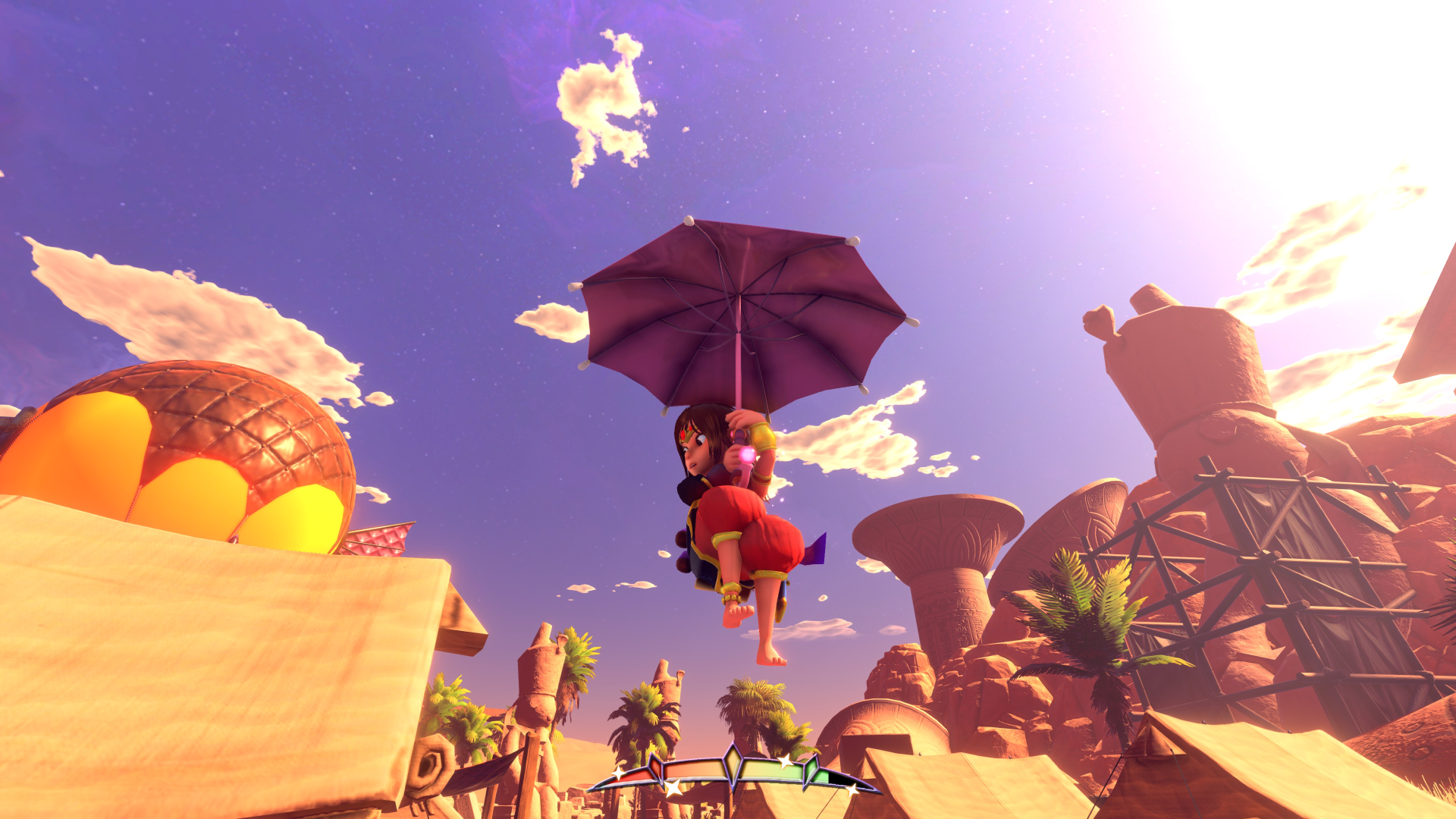
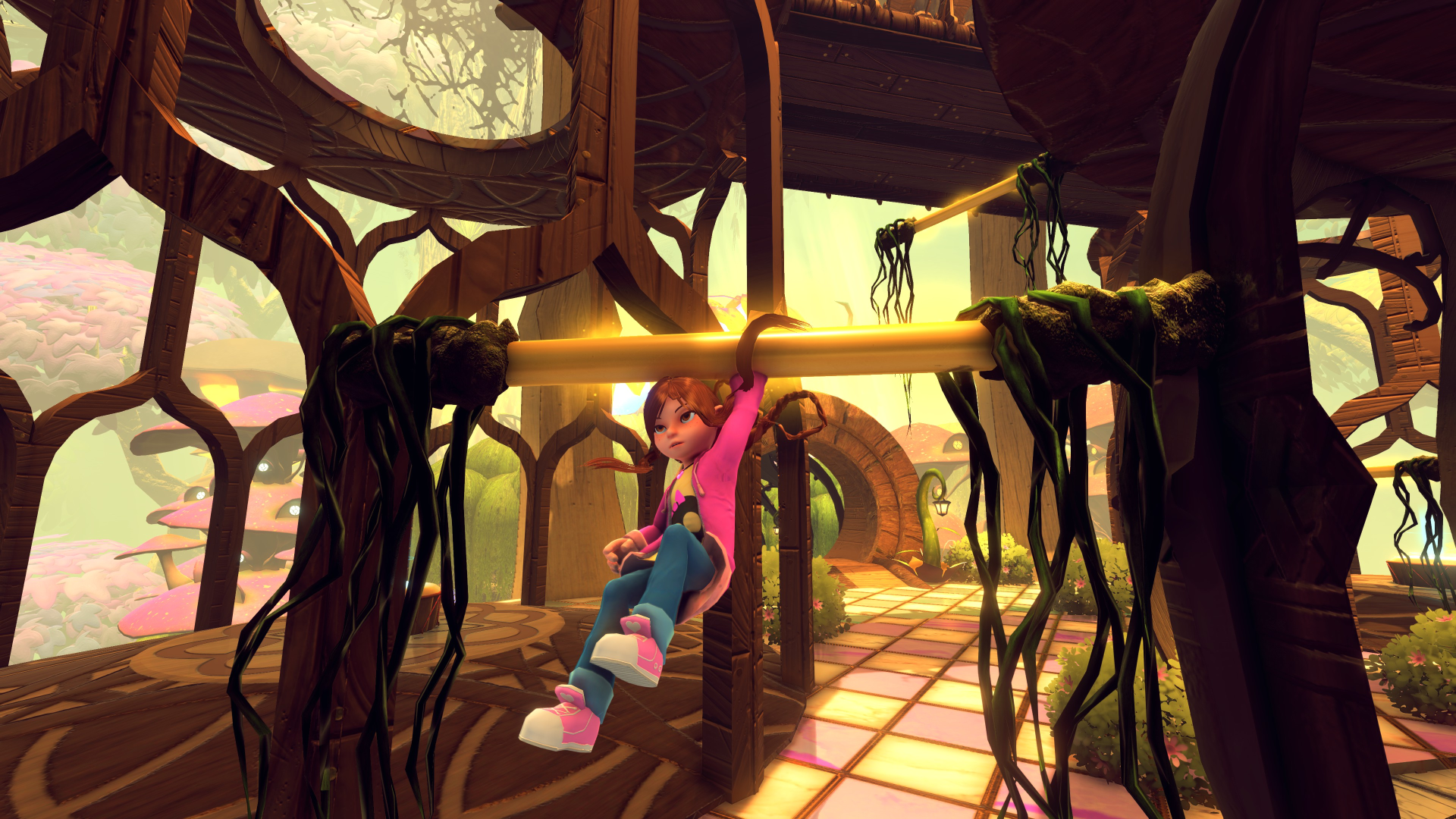
Platforming is also a huge part of the game. You gain abilities over time that let you do double jumps, mid-air dashes and floating with your umbrella, and the more challenging platforming sections are built with those entirely in mind.
And you’re gonna need to do that platforming to find many of the upgrades. Upgrades are typically either placed up high or in out-of-the-way hidden areas, so you’d better be ready to explore if you want to strengthen Carol to deal with later encounters, as this game’s difficulty does not mess around, at least on medium and higher. The difficulty levels are built around how much damage you take, and large enemy ambushes still happen. If you play on lower difficulties, you can blow through the game faster with less regard. But on medium and up, you’ll end up in situations where you might have to snipe enemies before they become a threat, or hide from enemies and try to take them out sneakily more often.
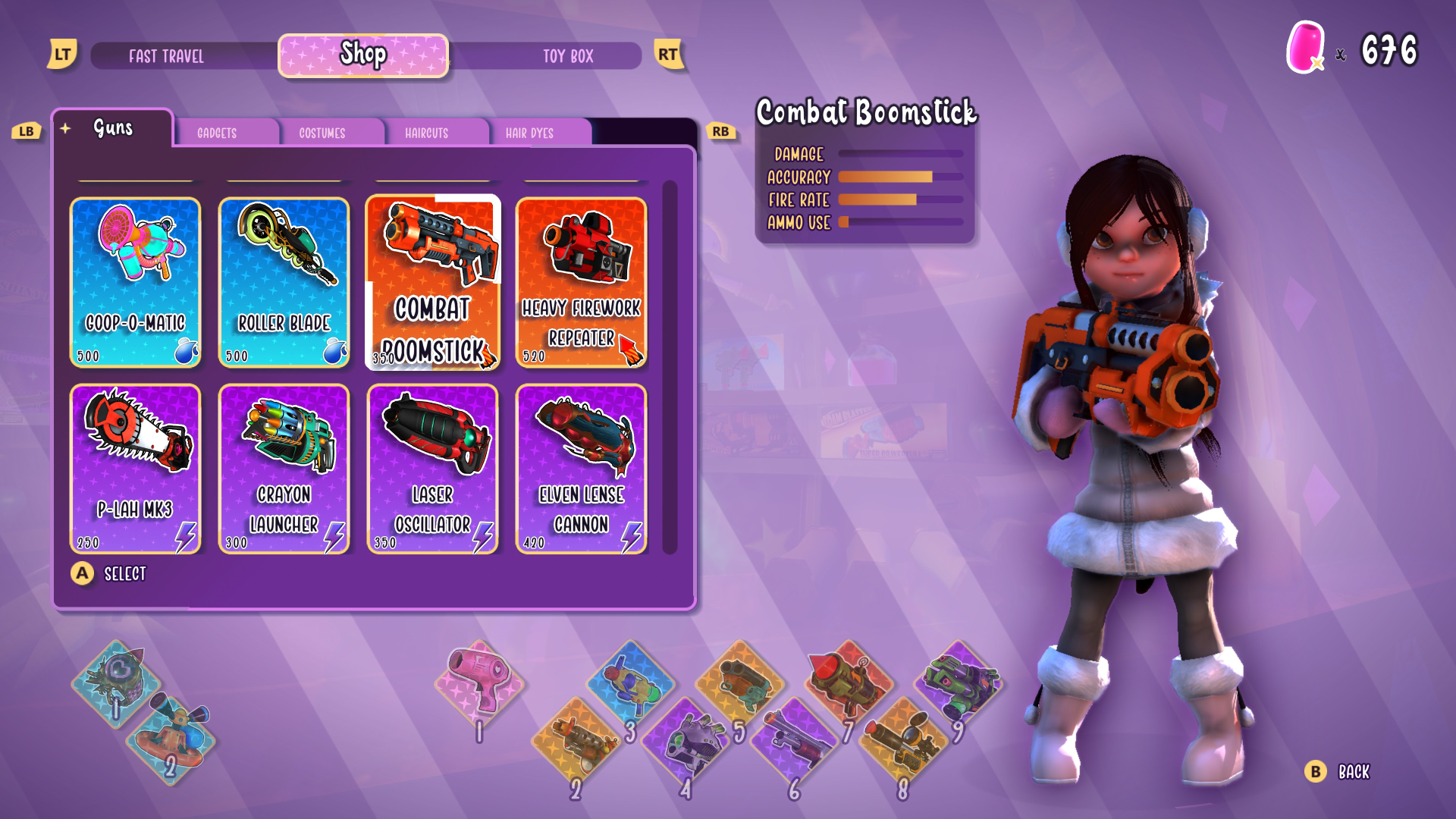
The combat starts out using standard weapons with a toy-like design but the number of weapons the game has is absolutely enormous. These enemies are as varied as a gun that fires homing orbs, a staff that summons rabbit-like figures to fight for you, and an electric gun that both causes stun damage and spreads to nearby enemies. There are four ammo types shared between the weapons, so it’s important to vary up your weapons so if you run out of one ammo type, you can still use other weapons.
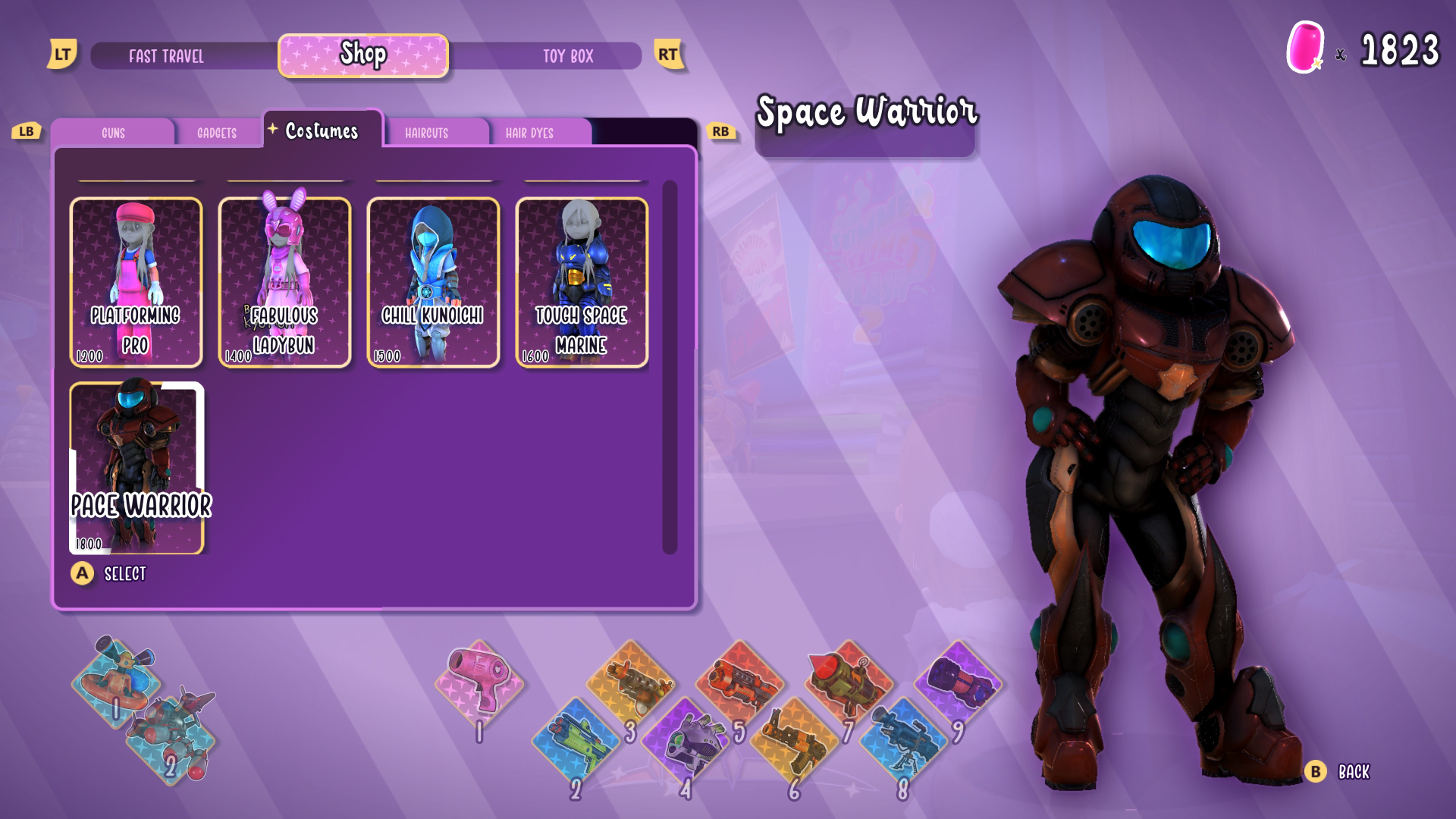
The weapons themselves can be earned from defeated enemies, found in treasure boxes, or purchased at stores which also sell outfits (some of which are themed after various gaming and media franchises) and let you fast travel. If you use the same weapon that the current enemies do, picking up their weapons refills ammo.
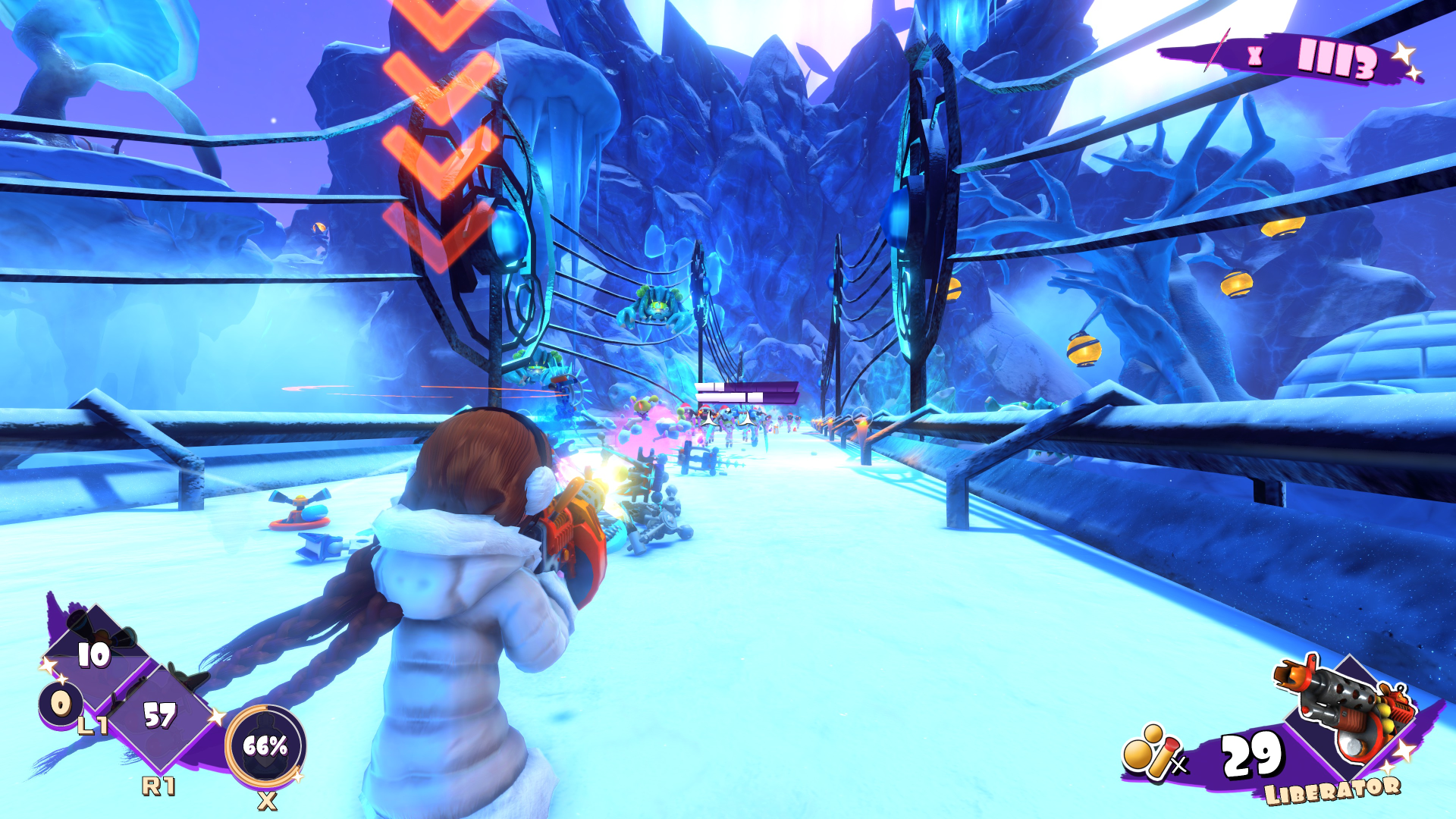
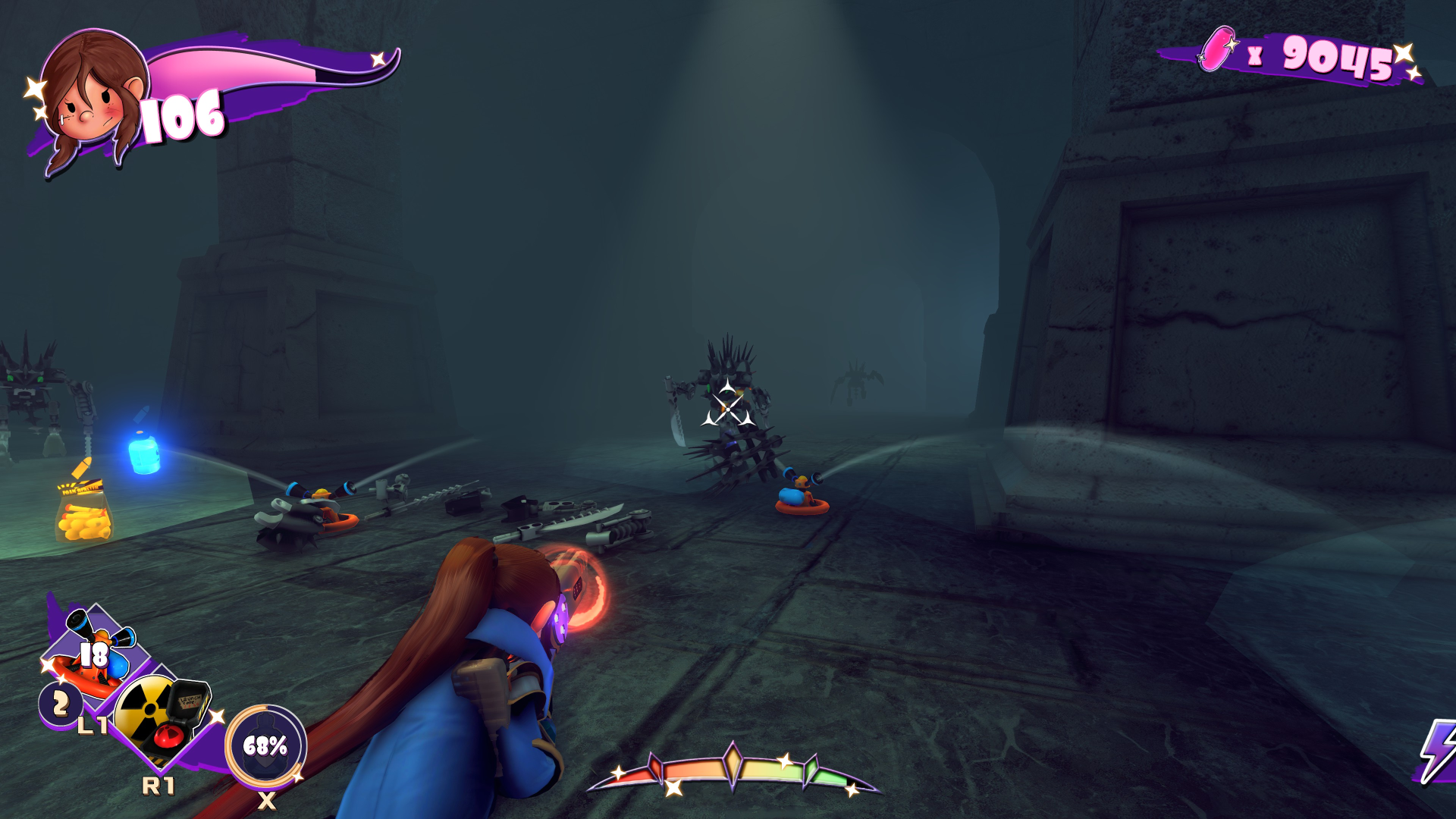
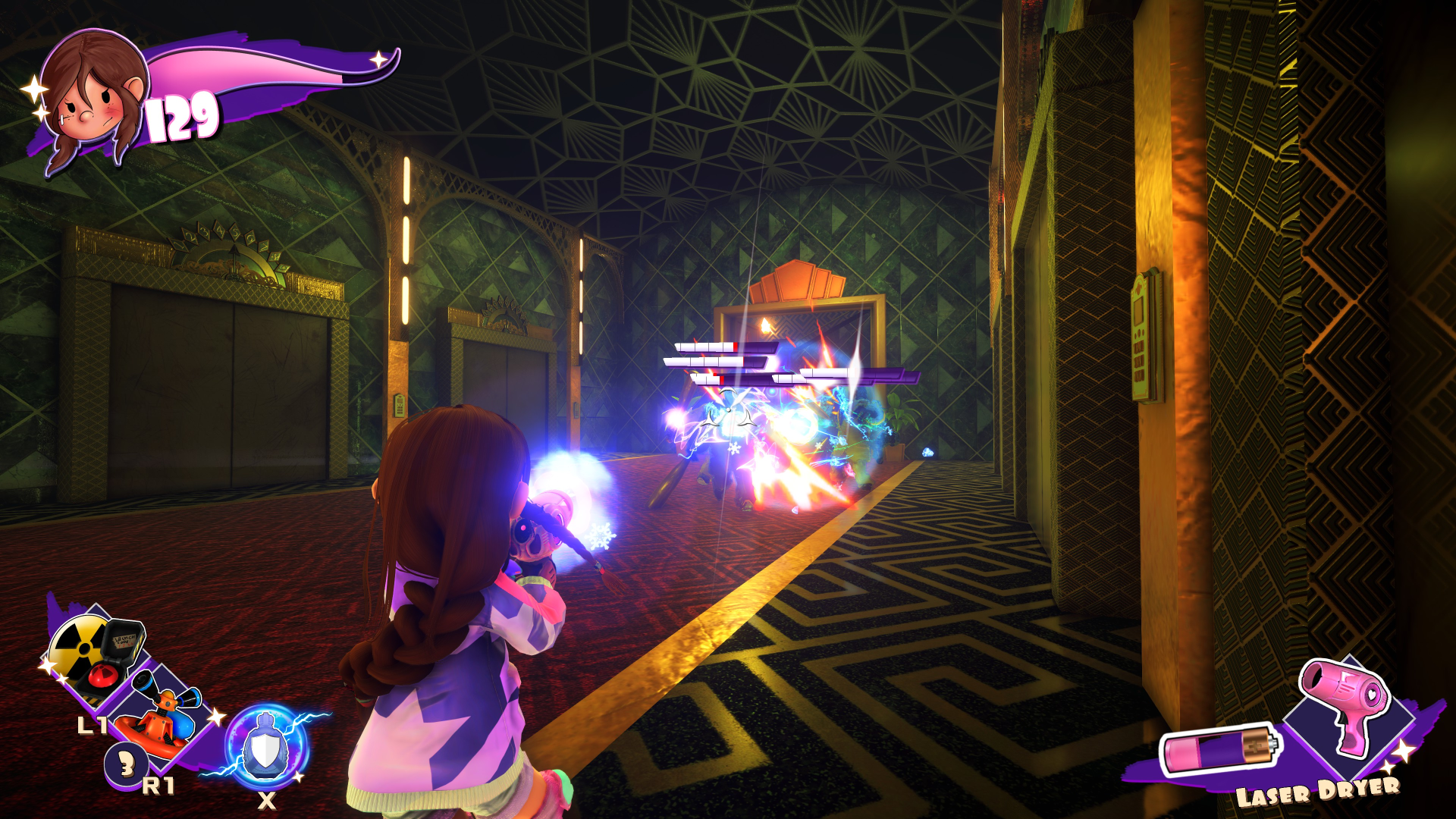
That sprinkler shown a bit to the left, along with others, helps wear down enemies who get too close. The arrows also indicate where a player-summoned air strike will take place.
Even besides weapons, you can get subweapons, which are even more varied. There’s a handful of throwing weapons such as boomerangs and perfume bombs. Sprinklers can be placed on the ground to do huge amounts of damage to enemies that stay in them, making it a good strategy to drop a few in one major spot and then lure enemies to it. There are also potions that grant you extra defense, strength or speed for a while, and then have a cooldown period. And if you’ve saved up a lot, you can buy the Nuclear Broccoli Test, which is basically a smart bomb with long-lasting fallout and a 10 minute cooldown, to save up for the truly troublesome moments in battle.
Which there will be, as this game is stingy about checkpoints, especially later in the game. Very stingy. As in, you might lose 20-30 minutes of progress if you die before reaching another checkpoint, especially on medium and up. As in, the game encourages exploration, but if you’re low on health and don’t know where another checkpoint might be, it just might not be worth it to risk dying and losing a lot of progress. As in, if you’re lost and don’t know where to find the keys or other items you need to progress, you could get killed while you’re lost. Some areas are mazelike and confusing! The checkpoint starvation is a major issue that really needs to be fixed in a patch.
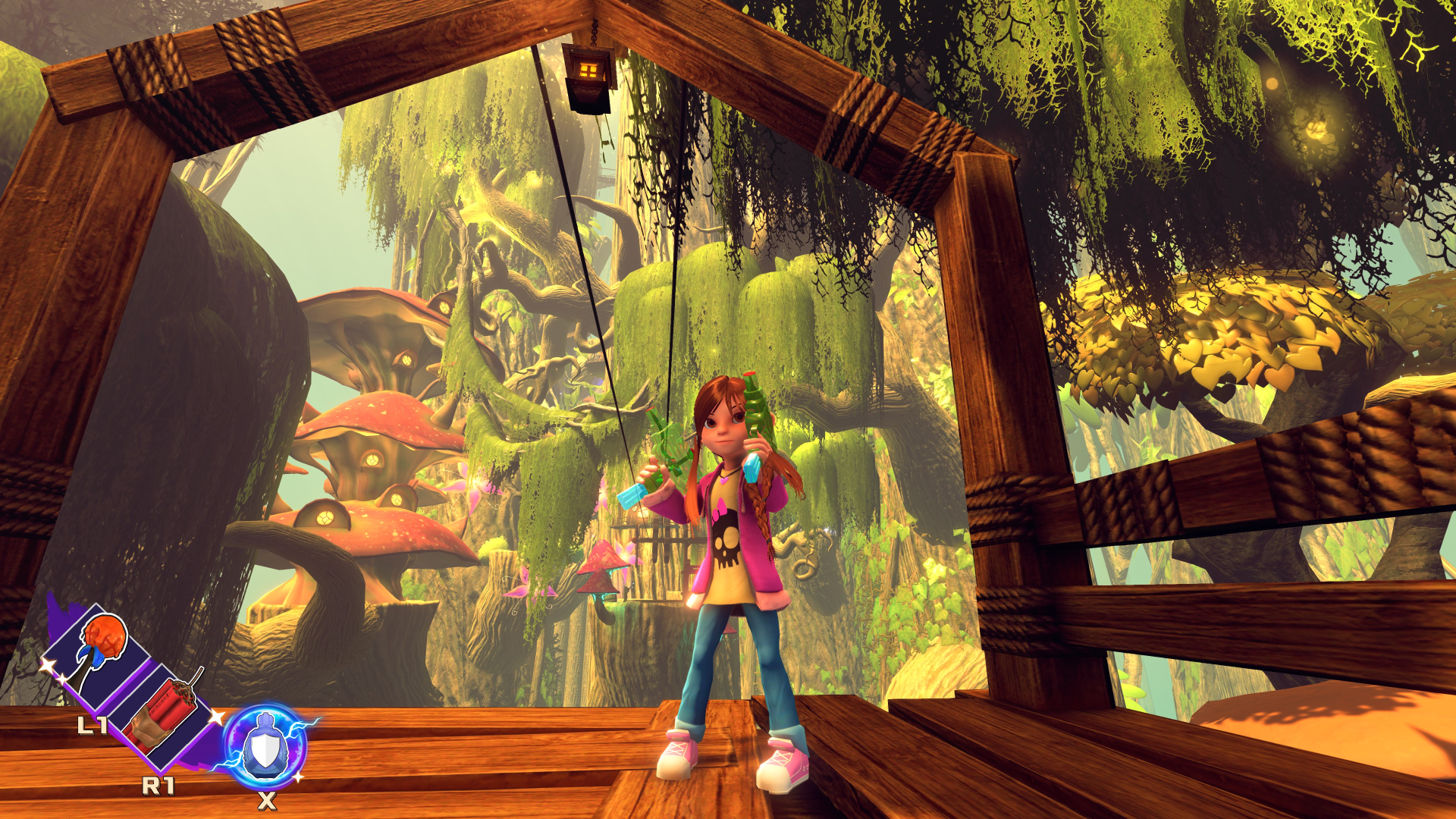
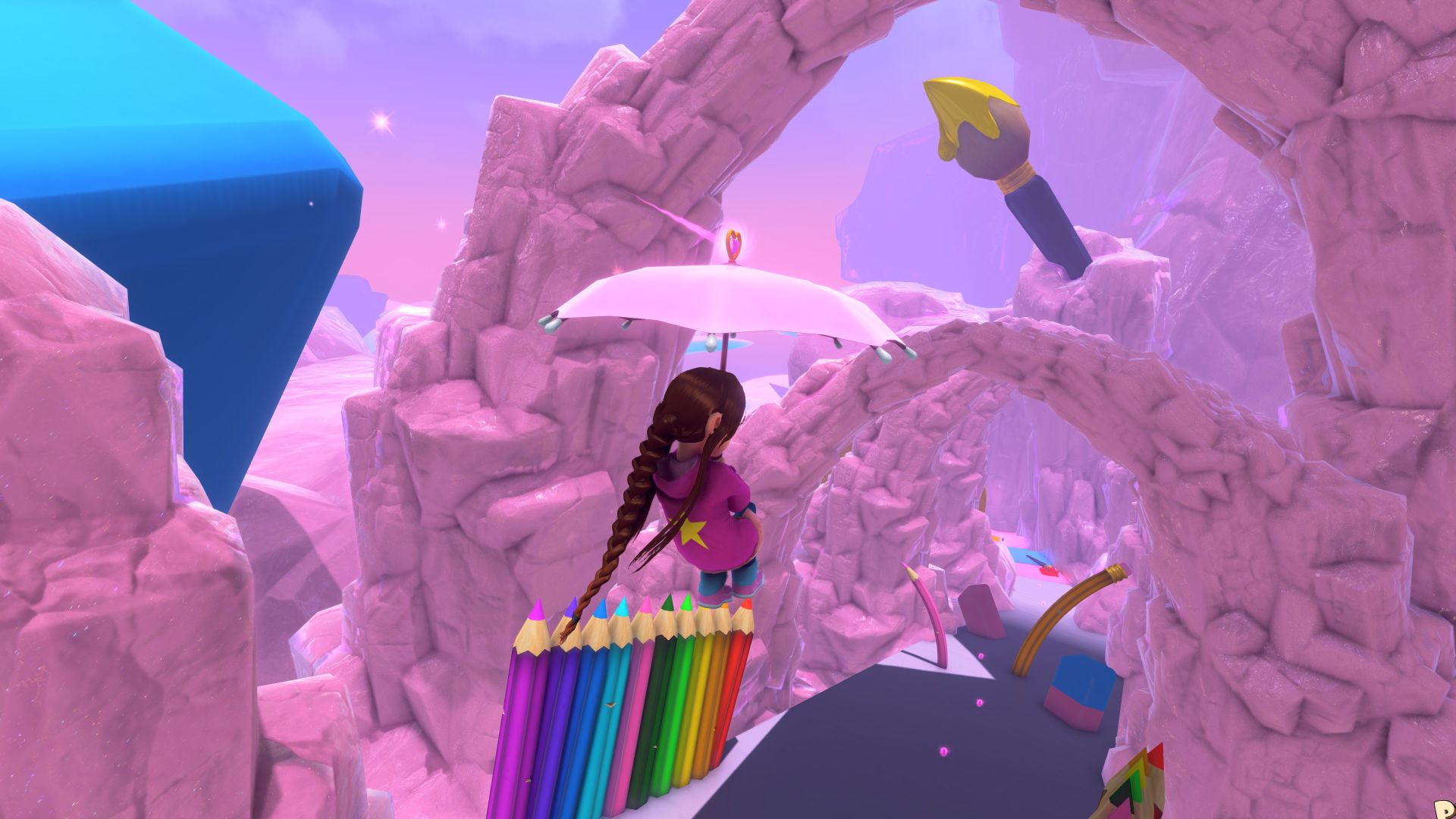
The levels themselves are tremendously varied both in theme and layout. Forests with giant mushrooms. A town of friendly crochet dolls you can talk to. A treetop town leading to a giant beehive. A land of vikings with a boat that you can use to drive to other islands. A zombie-filled manor of keys and locked doors. A 1940s-style city where mobster sharks and peaceful windup automatons both coexist. A castle in the sky sitting on giant food such as donuts and cookies, with nearby factories made of a combo of retro and sci-fi tech placed on giant floating cookies and confectionery, which happens to have a large sideways-moving elevator that leads to a citadel with inter-dimensional portals leading to a nightmarish dimension. There’s also a day/night cycle, which sometimes dramatically changes the look of these levels with very different and even some downright gorgeous color schemes for each time of day. There are even hidden bonus levels which have varied themes such as a long slide down a mountain past giant art supplies.
Some of the levels have sequences that change up the gameplay with vehicles to drive (such as a motorcycle, unicorn that fires magic beams, or even a giant mecha) or an objective-based mission, such as disarming bombs and freeing prisoners on a train. However, some of these objective-based levels are not well thought out, and really need some work.
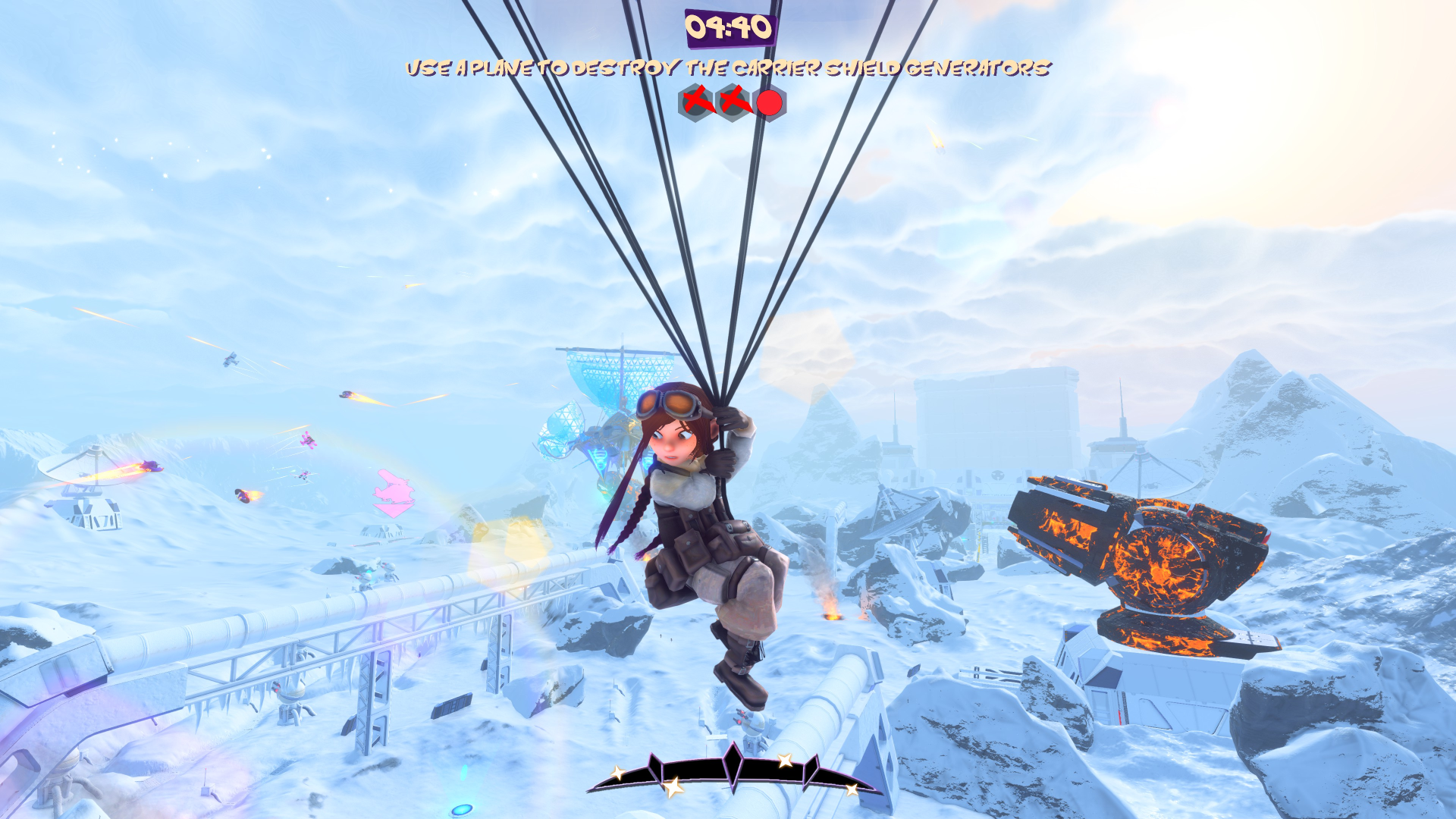
For example, a level named Battle for Glahalla has a time limit, and takes place across many phases. Secure these bases by going inside and destroying their cores. Fly this airplane up to this flying fortress and take out these generators. Then take out these other things – except the game mistakenly labeled both cannons and the things you actually need to take out, making it unclear which is the real target. Then, when that’s done, guide this robot bomb to the front door of a large building.
Oh, you haven’t flown an airplane before, and now we’re suddenly throwing you into one without instruction, and with a time limit, to destroy something located up high whose position we haven’t made clear? Sorry, you’ll just have to figure it out yourself, and if you fail, the entire mission restarts.
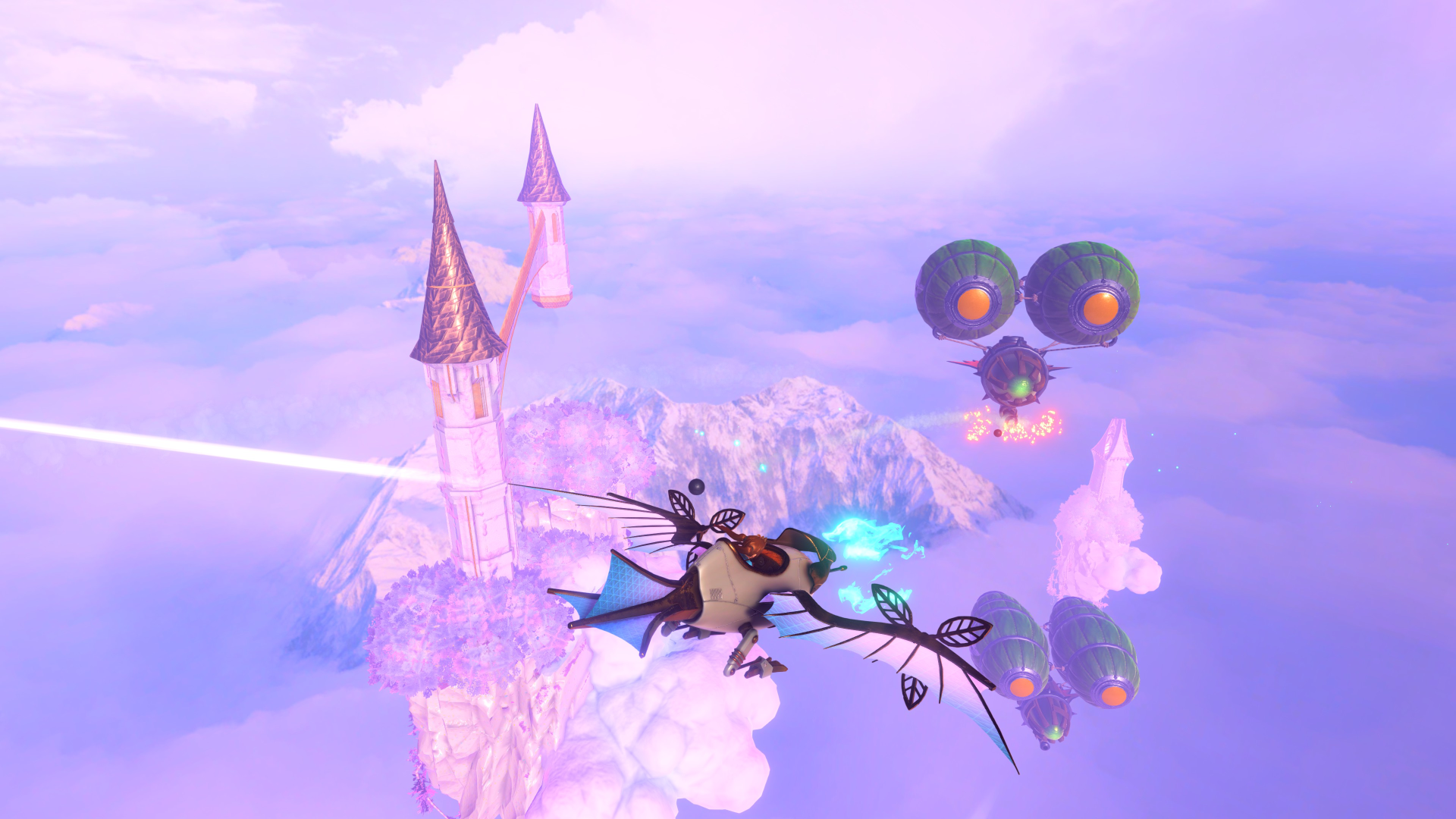
The huge number of enemies that come at you while you’re guiding the bomb is also a problem, as is the required closeness to the bomb to get it moving, and playing on the lowest difficulty does nothing to reduce enemy numbers. The company did release a patch increasing the time limit for the mission (while also addressing major flaws with an unrelated prison break mission in a different level), but the fundamental design flaws with this massive mission still remain.
Similar problems show up for some other missions that mix up the gameplay. One stealth sequence in a desert world has instant one-hit-kills from enemies who merely look at you, but you can hide in bushes right in front of them to avoid them. Basically, using an imbalance to fight an imbalance. Hope you remembered you can crouch, because it’s only taught to you once and then not required again for a good 10 to 20 hours.
Essentially, the core platforming and combat gameplay is polished, but when the game tries something different, that’s when it usually hits problems. Sometimes mild, sometimes major. Aside from that, there are sometimes moments where what you’re supposed to do isn’t obvious, such as one level that has mountains with giant dandelions at the top. You’re supposed to get up top and jump to a dandelion so you can slowly ride it down, and up updrafts that can be activated via some switches, so you can reach other mountains. However, it’s sometimes possible to reach other mountains through creative use of jumping and mid-air dashing, making it even less obvious that the dandelions are the intended solution, and the only way to reach the other remaining mountains.
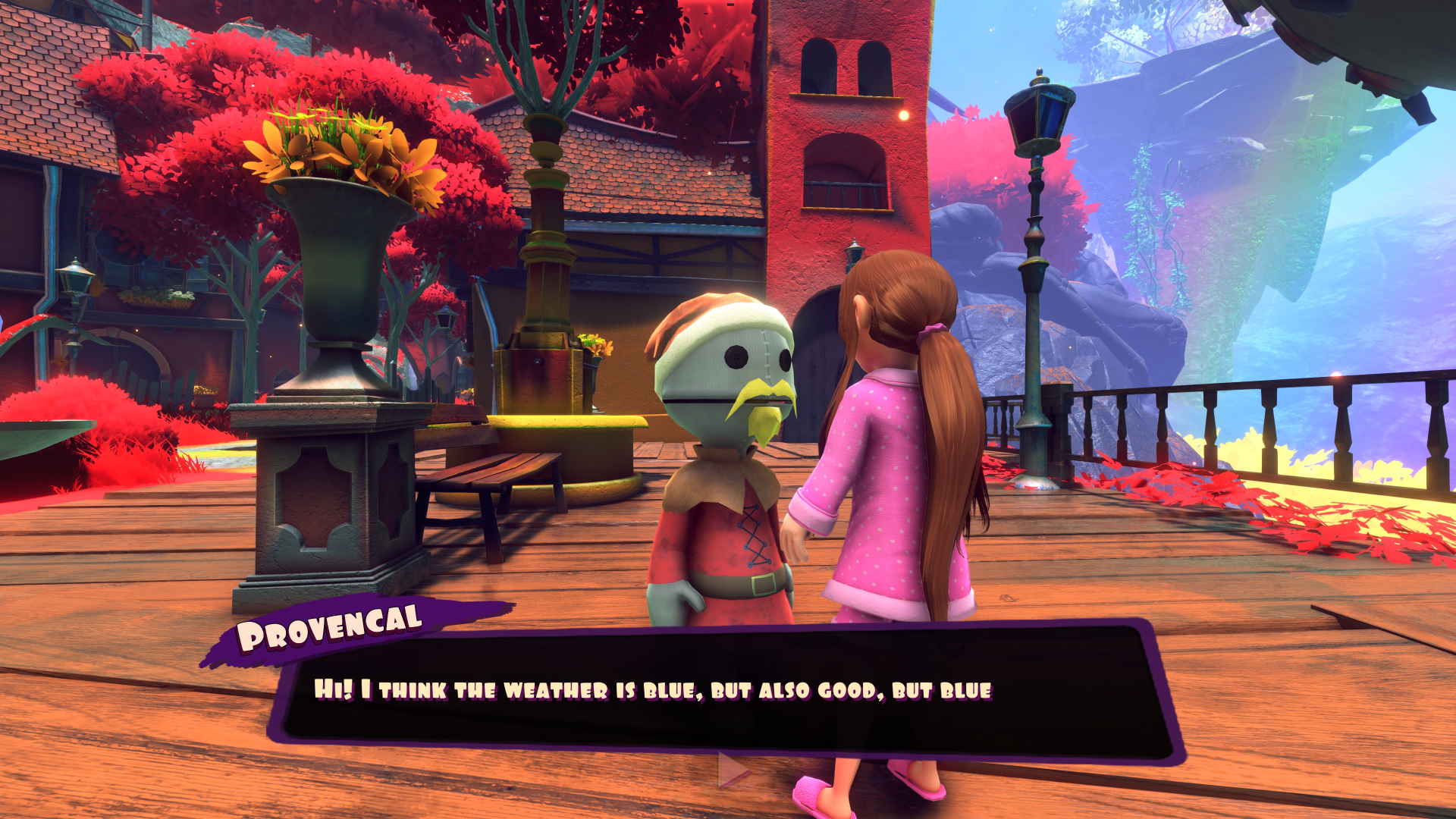
Besides that, it’s easy to get lost in these massive levels. The map doesn’t always tell you where to go, and sometimes, how to get there can be really hard to find out. For example, the viking world marks locations that are very far away but doesn’t make it clear that you can use a boat located before the start of the island. This could prove to be a bigger problem for younger players, or those with less time to spare. If these issues were ironed out, a few hours could be cut off this game’s ~60 hour playtime. A playtime that’s a lot shorter if playing co-op, lower difficulty levels or both, or if you ignore upgrades or run past most enemies instead of always fighting them.
Carol is immature and bratty, and she makes it clear that she’s not fond of many of the creatures she meets and is focused on her singular goal of rescuing her Bunbun, though she does mellow out over time. After beating a dragon boss in the early game, Carol asks why it hates humanity, then as the dragon is giving his answer, changes her mind and says she doesn’t care, and smacks it with her umbrella. In a way, Carol is going full id. She does what many kids only dream they could get away with! Perhaps that’s part of this story’s dream logic, as it does take place in a dream world after all.
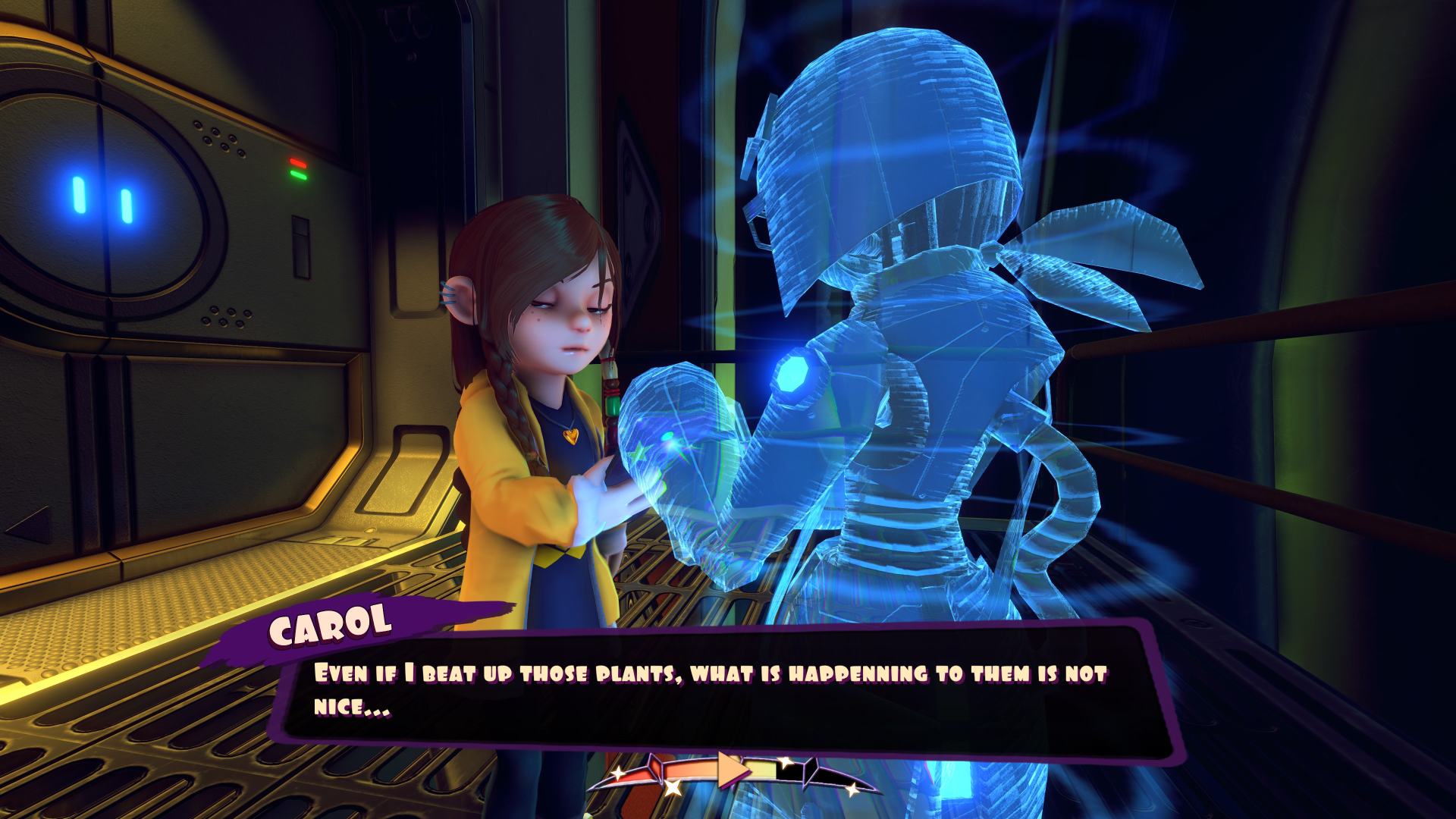
Her childishness extends to her one-liners. Her taunts to enemies are things like, “One, two, three, you’ll be sorry!” and “I didn’t meeean to hurt you! Just kidding!” Getting new weapons yields dialog such as “Give me a meanie to test this on!” And even getting hurt gets stuff like “Stop it! I’ll tell!”
How old is this kid? It’s indicated that she’s ten, and close to middle school age (middle school in France starts at age 11). Either way, she’s basically on the edge of the “Kiddie Kid” trope. Weirdly, she introduces herself in an early cutscene with narration saying, “I’m not your usual little girl.” Which is a strange thing for any kid to say – who is she saying that to? What kid calls themself a “little girl” even when talking to adults?
Speaking of, there’s a major “little kid” theme going on. Weapons both used by you and enemies shoot things such as bubbles, water, crayons, pencils, fireworks, nerf-like darts and even paint. One of the outfits you can buy is called the Cootie Slayer. Do kids still think about cooties at all? The bad guys even give each other ice cream as a reward. A major character in the story is Prince Blueberry, who comes from a candy kingdom.
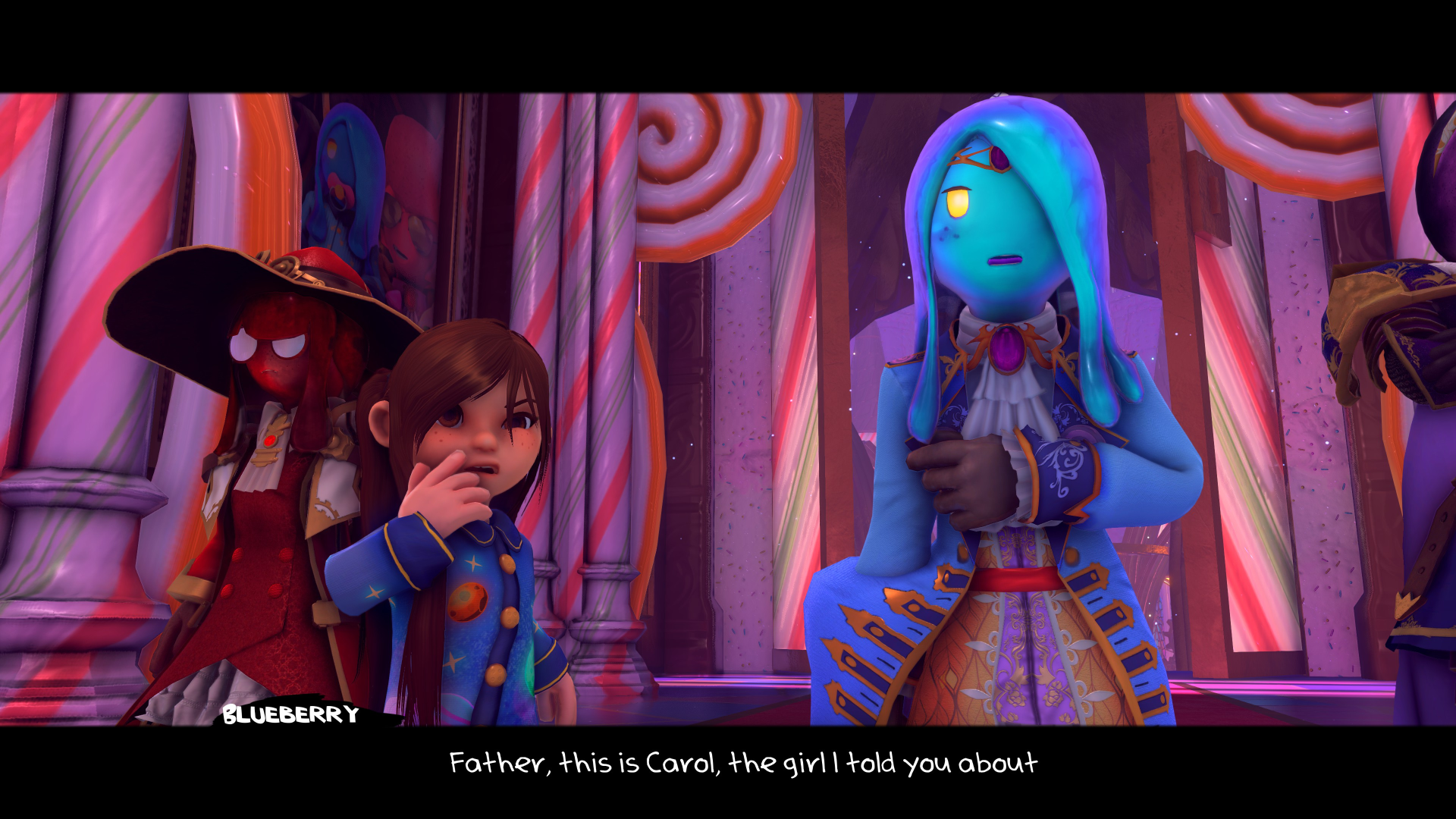
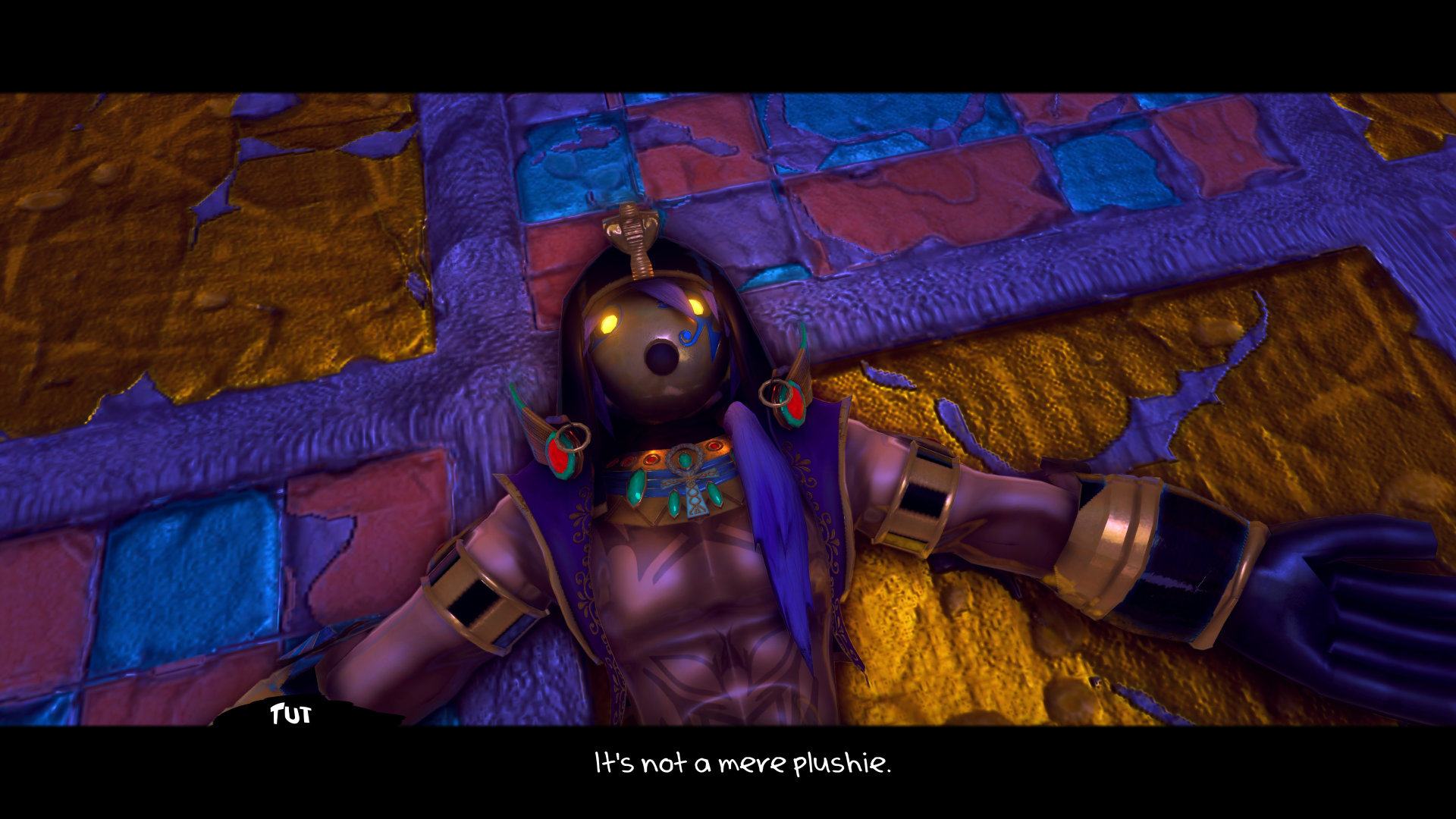
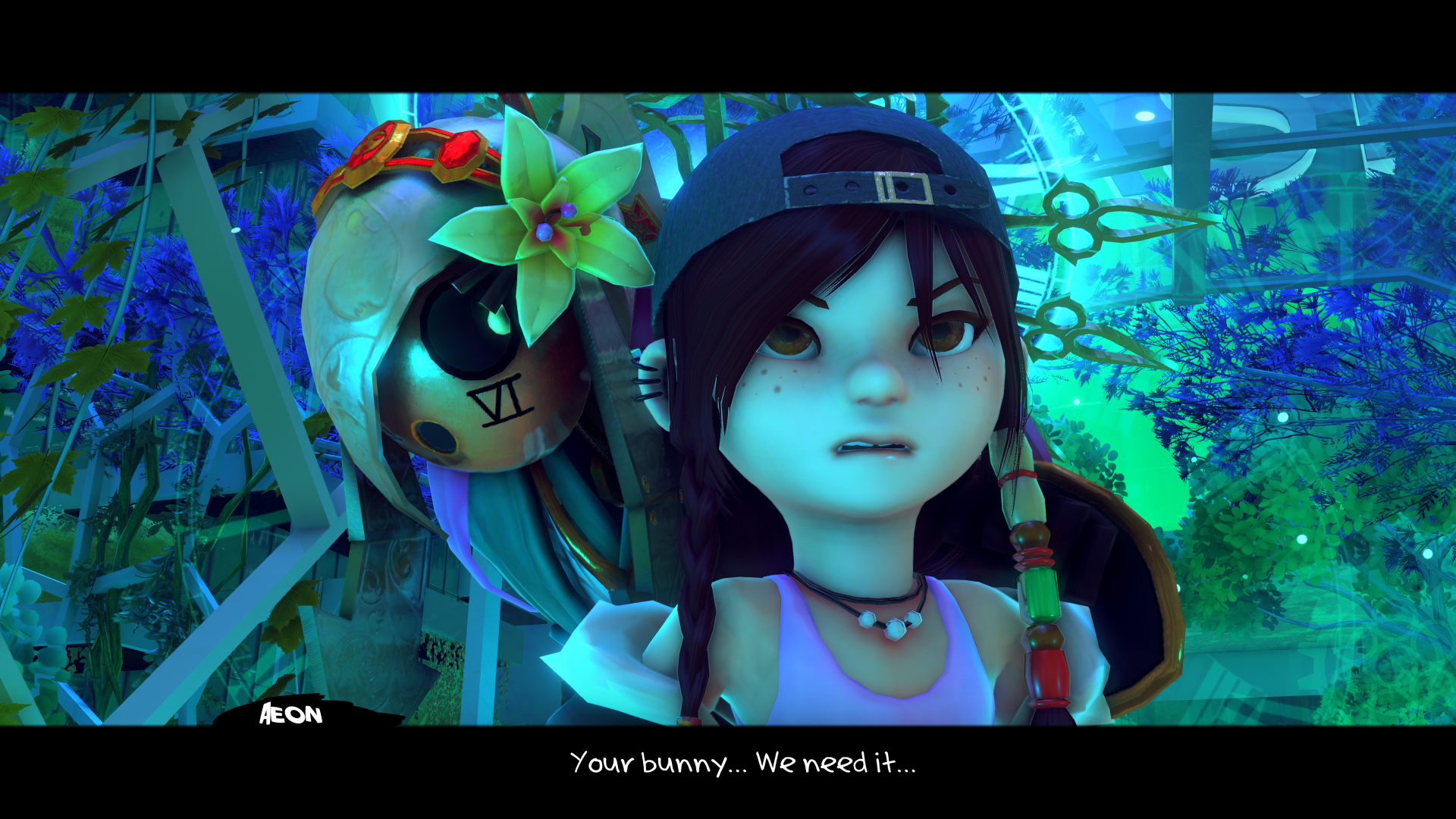
Beyond that, the story follows its own sort of dream logic, with things like enemies that later become friendly, or a boss who later joins you as an ally in a future boss fight, as it starts out going off in all sorts of tangents at first, with Carol being pulled into solving this problem or dealing with that situation. The scientists in this greenhouse have been turned into dangerous plants. Evil frogs are preparing an assault on this house so they can steal its cookies. A sultan has mistaken Carol for his own daughter, a kid pirate who is basically Carol’s doppelganger. The mood is constantly ping-ponging between the silly, the ridiculous, the epic and the creepy, much like a dream would. As for Carol, she’s willing to help solve others’ problems… initially begrudgingly.
But as Carol matures and starts to become more willing to help for its own sake, she also finds herself directly confronting the bad guys more often, who thwart her at every turn. They fight her, they disguise themselves as allies and betray her, they freeze her in ice, they try to intimidate her and they tell her that Bunbun is actually needed for some kind of elaborate plot. The bad guys work for an organization called The Corporation, which seems to be involved in many of the bad things happening in Crearia.
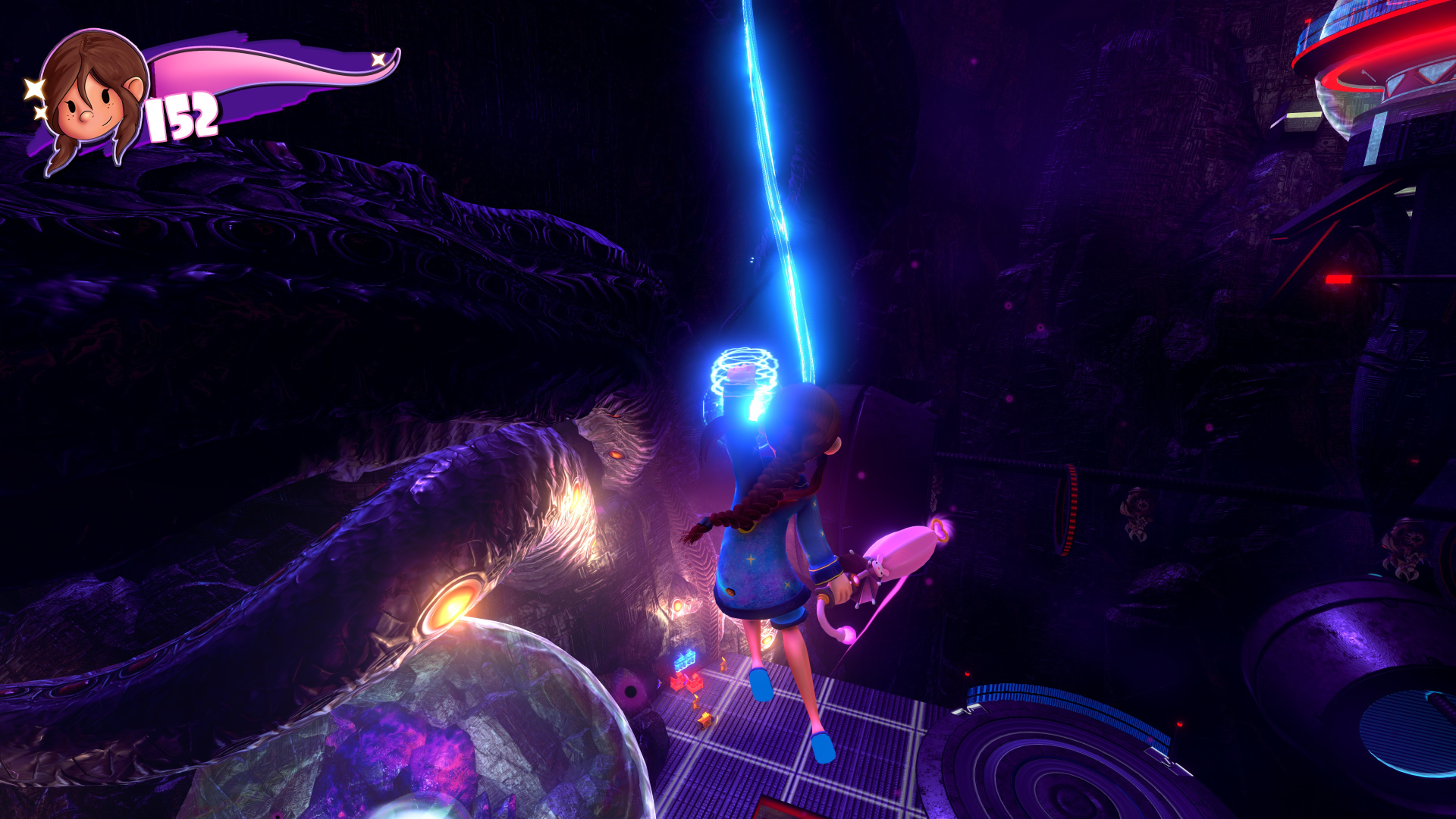
The story gets more complex and full of surprises as you progress further through the game, and even encounter things such as an alternate nightmare world full of viscera, teeth, eyeballs and endlessly spawning twisted enemies, which slowly drains your health as you stay in it. Even the bad guys are horrified by you messing with the portals that take you there. You can get your health back by entering globes of light emitted by plush toys, which is a Metroid Prime 2: Echoes reference.
Oh, speaking of Metroid, there are also grapple beam-like areas marked by a symbol similar to the grapple point symbol from the Metroid Prime games. Onirism is sometimes very unsubtle about its sources of inspiration.
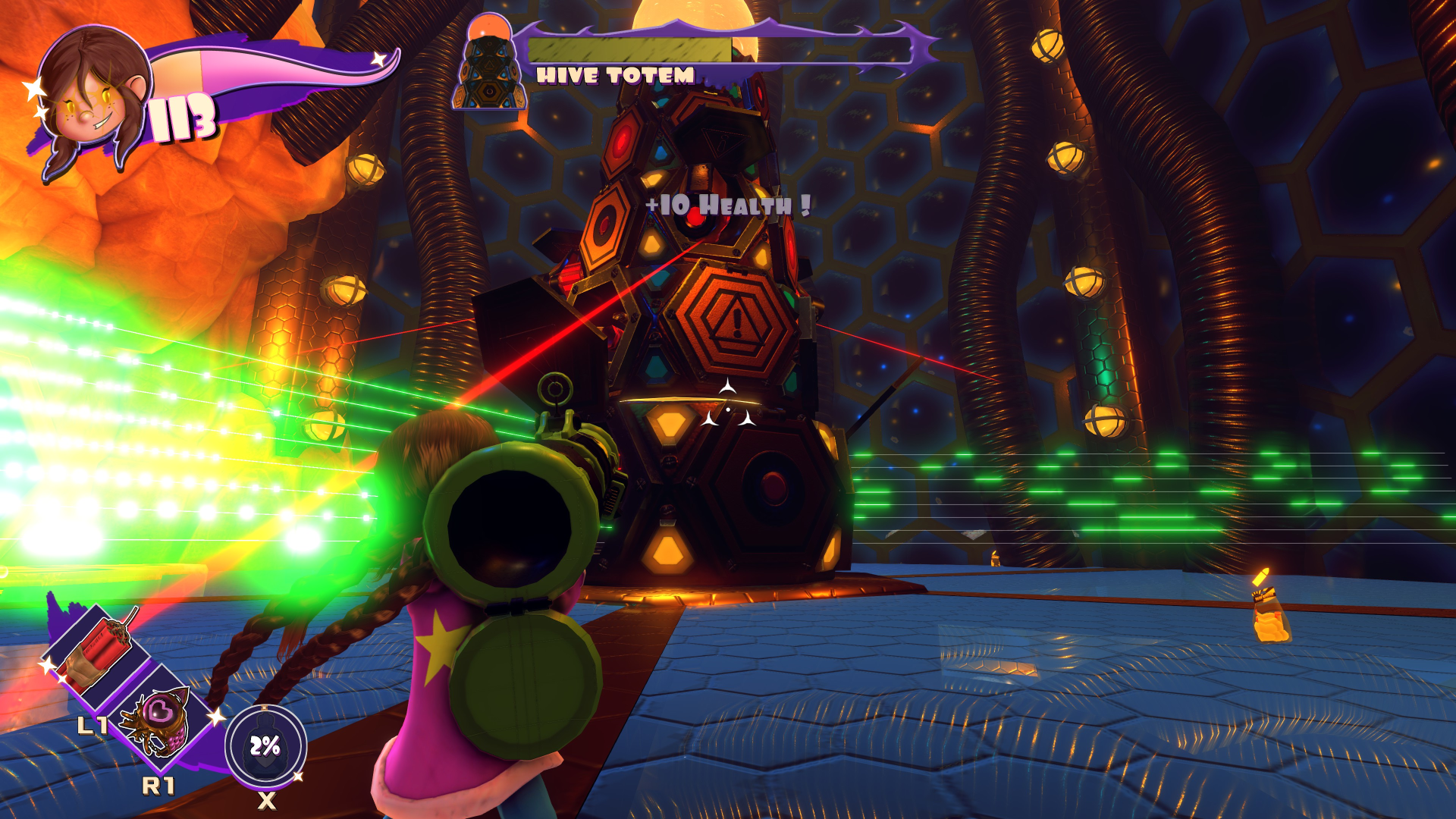
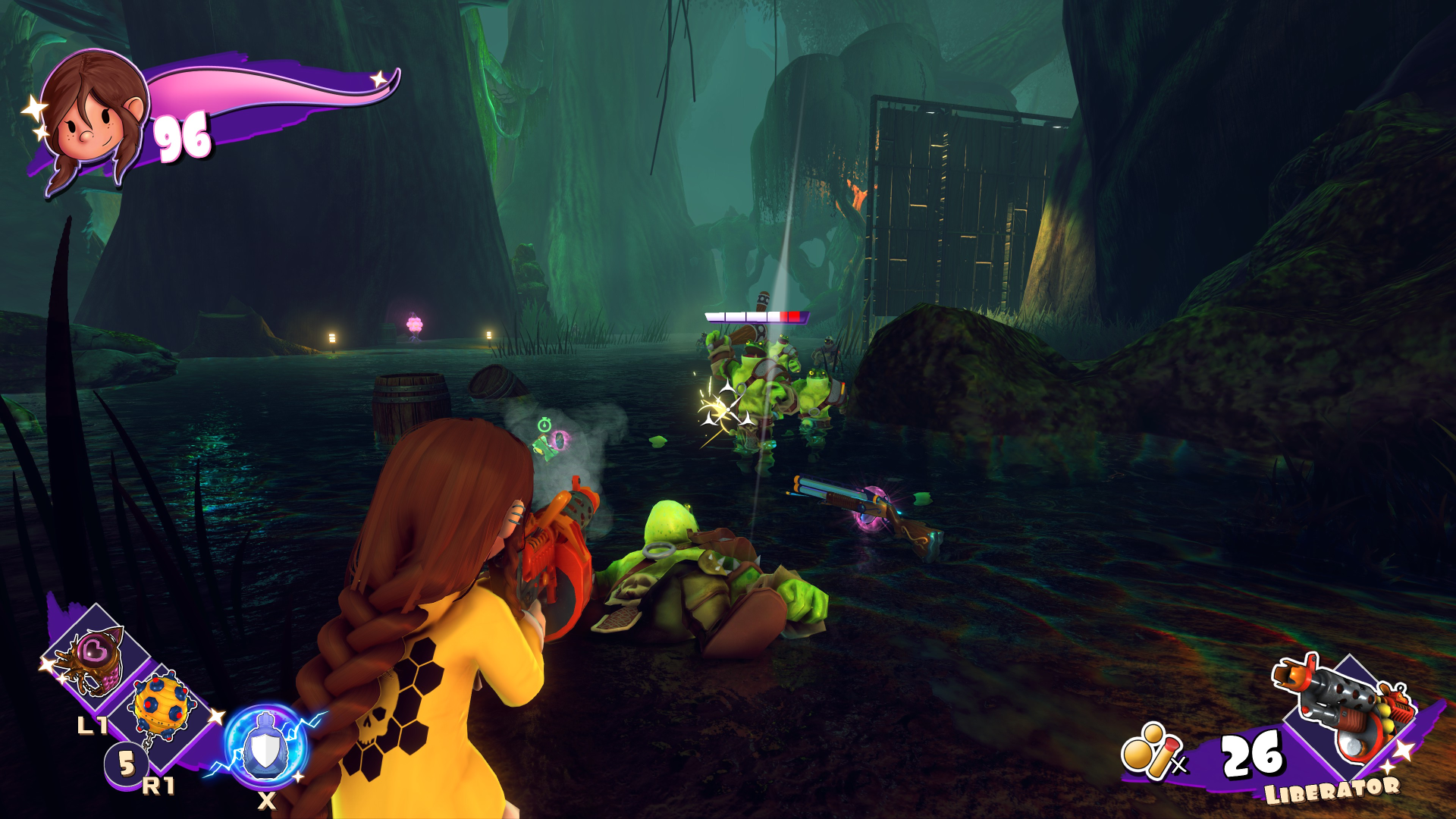
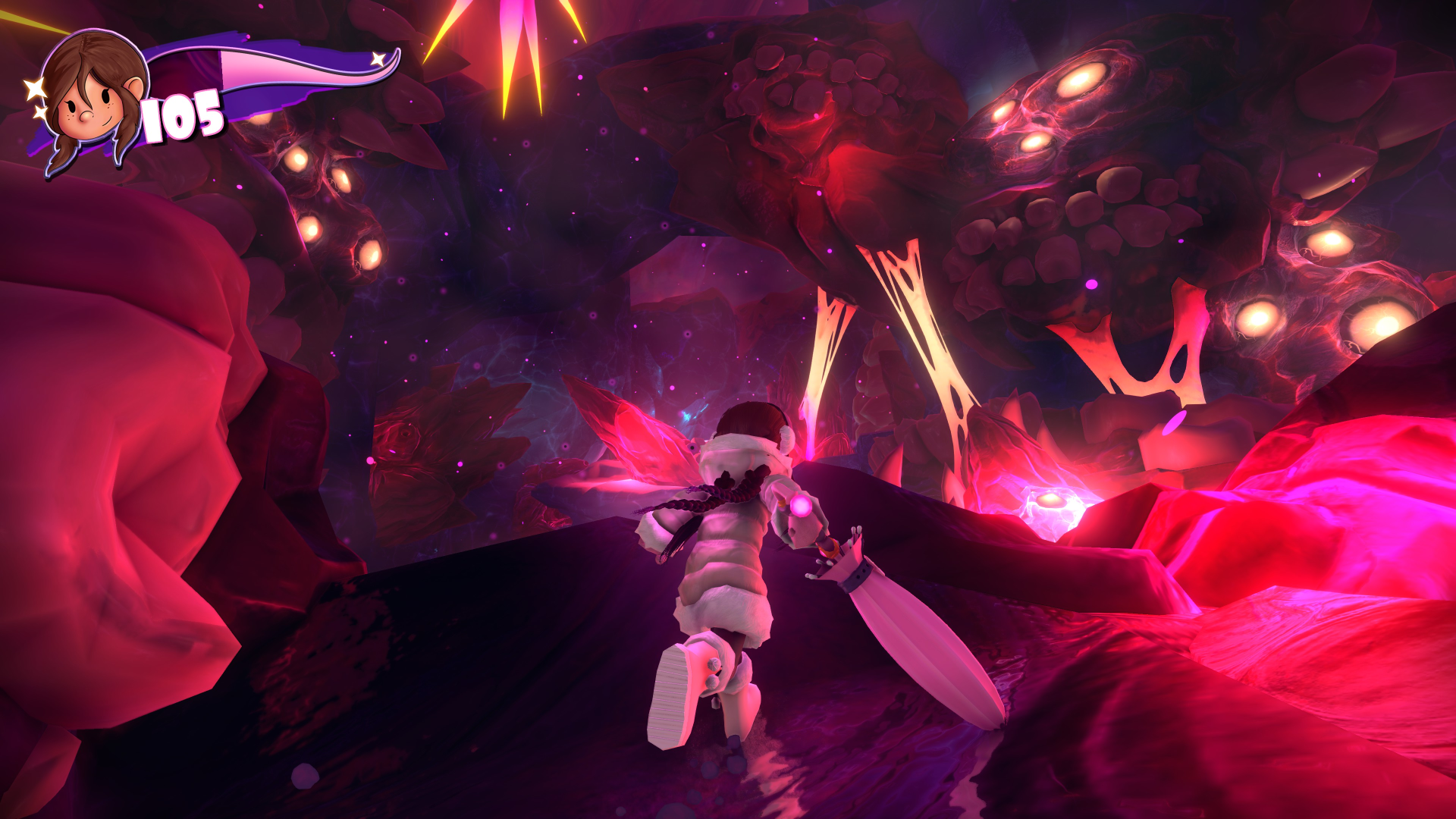 See that red stuff creeping up the life meter? Think of it like being corrupted by Phazon.
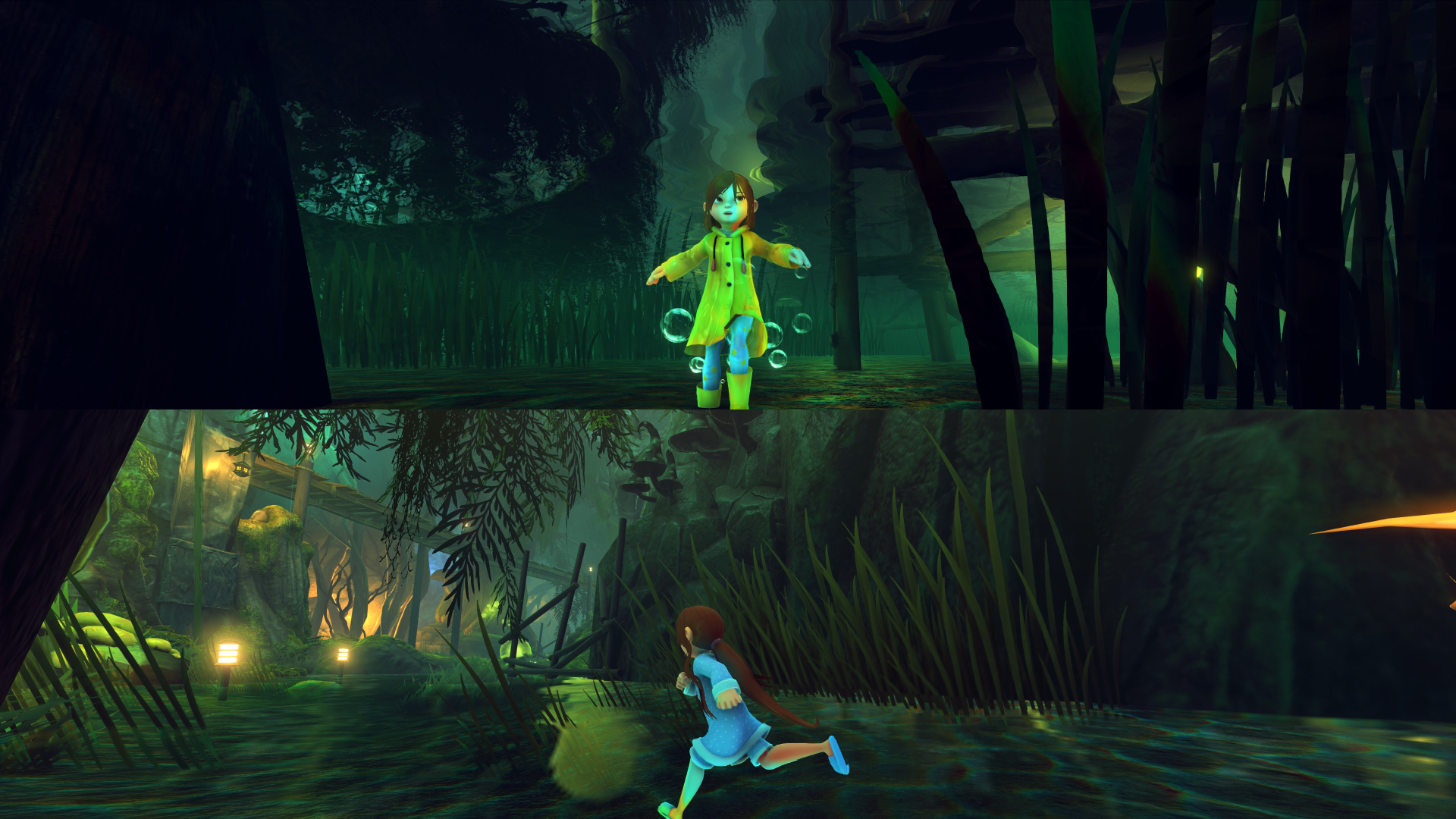
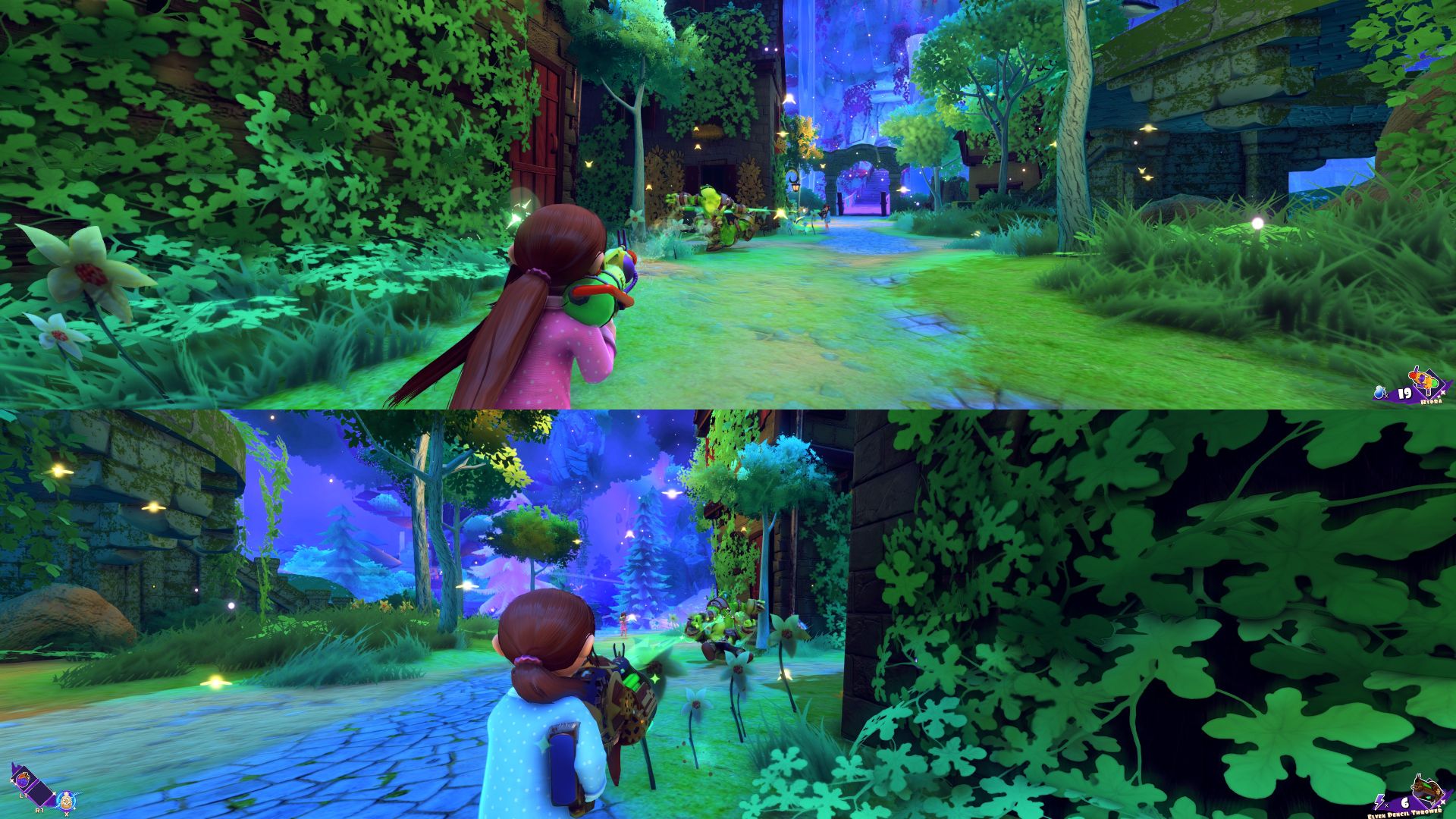
A quick mention of another feature: there is multiplayer in the game, of both the cooperative and competitive variety with original maps, and the ability to play through the main adventure co-op together. Some of these modes can also be played single-player either by oneself or with bots. That said, these modes also feel unfinished despite the game being an official v1.0 release. Co-op adventure works really well, though it has some jank issues as well as a map that fails to separately identify players. Checkpoints cause all players to group together as well as reviving dead players. Players whose health drops to zero can lie on their back and keep shooting, while a timer counts down, giving surviving players a chance to revive them.
Who do you play as in co-op? Carol! Everyone is Carol! Cutscenes show only one Carol.
While Onirism has a lot going for it in terms of imagination and content, it also has some major quality of life issues that some might be willing to overlook or at least push through, but others might find to be dealbreakers.
The major ones were already mentioned above, but there’s more: Random bugs which are often fixed by reloading a save, clipping through random out-of-the-way walls, the game’s UI being designed around keyboard/mouse even if you’re playing on a controller, enemy ambushes that require defeating all enemies to progress sometimes not registering the last enemy killed, the way vehicles are difficult to control and get destroyed easily, and other miscellany that means this game is clearly not ready for a console release and probably should still have been considered Early Access. And the finale gives you a scavenger hunt with vague hints to revisit previous levels to find hidden portals to the nightmare zones to fight bosses whose level of challenge varies wildly, in order to collect required items to reach the game’s end.
Which is a shame, as a big action-adventure game with a massive length and tremendous variety is exactly the sort of thing many are starved for. And for it to be delivered by a nine-person development team and sold at the astonishingly low price of $18 US is simply amazing. Especially with the game’s production values, which include smooth, detailed animation and lots of voice acting.
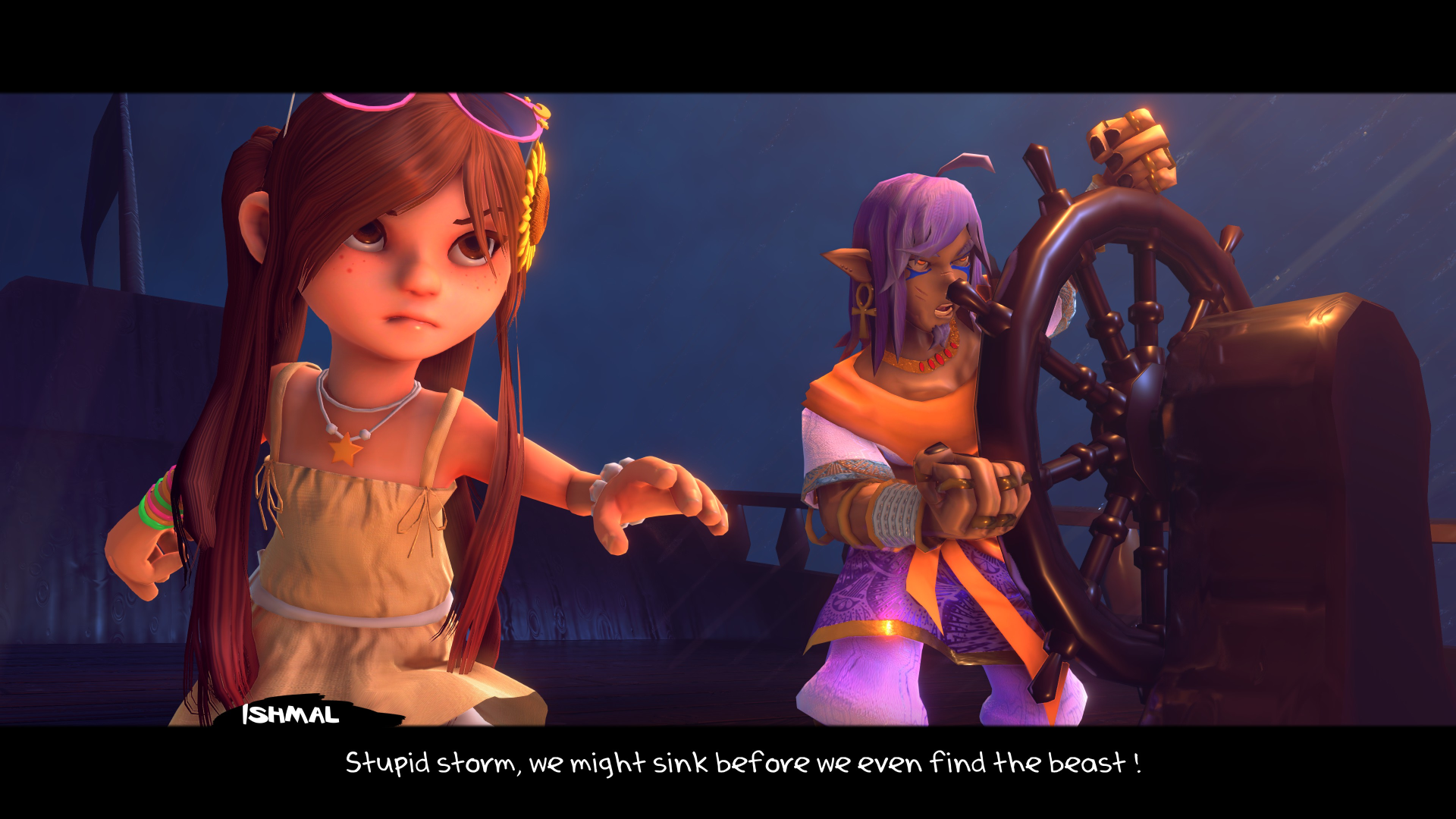
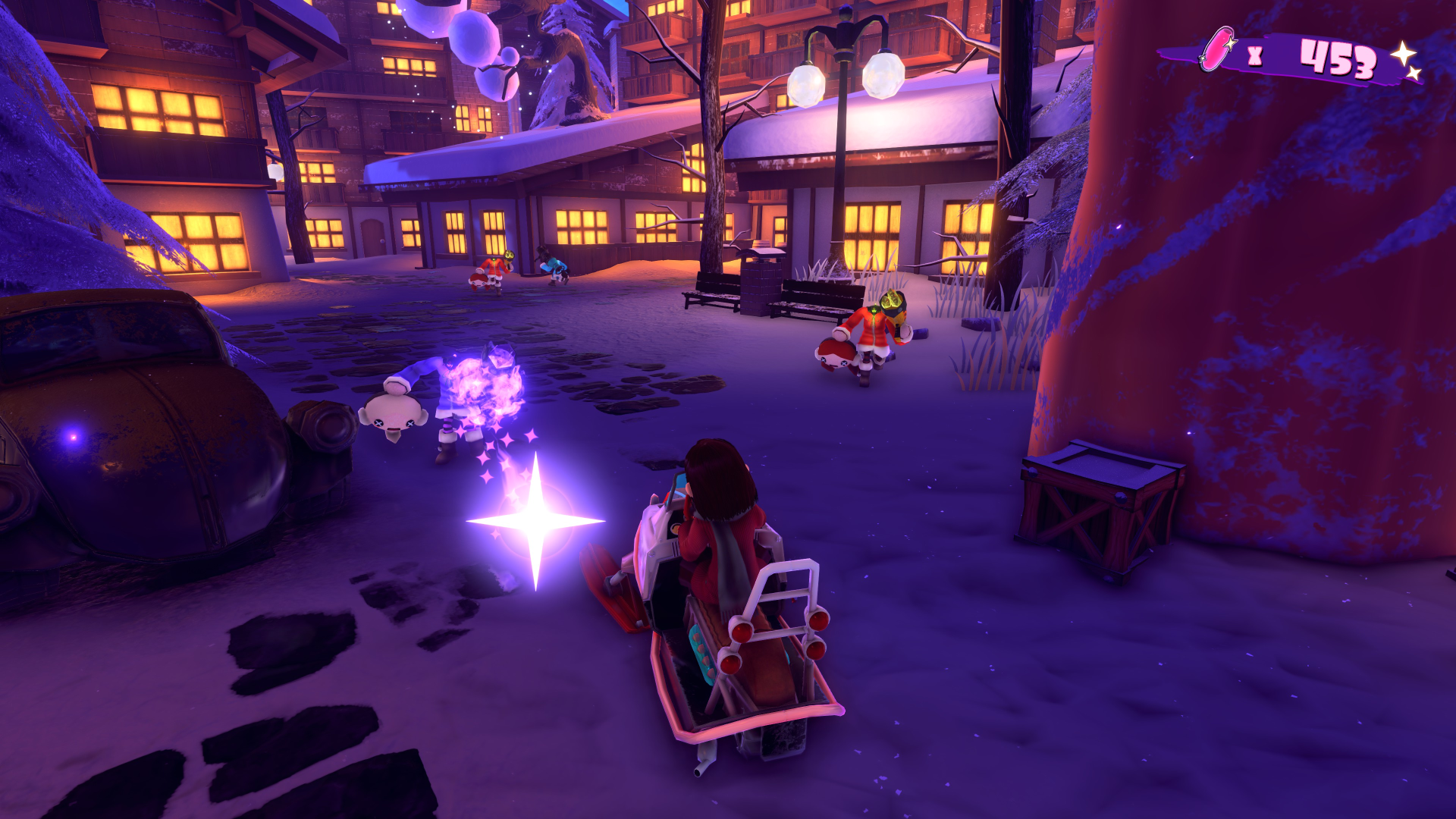
Indie developers truly are taking up the mantle of doing what large developers once did, albeit sometimes with less polish. Onirism has ever-changing themes that throw Carol into new situation after new situation, from infiltrating a snowy base, to fighting the kraken at sea on a ship, to fighting in a big war between string dolls and frog monsters, to being in a film noir-style 1940s detective-themed city. Where else do you find something with this kind of variety?
For parents, the main issues might be the game’s quality of life issues more than its content, particularly its mid- and late-game checkpoint starvation. Consider a kid who’s allowed to play for, say, one hour per day. If they play for an hour and die only once, they could have achieved 40 minutes’ worth of progress. Lower difficulties help with that, but if the kid has to be called away from the game, “Wait, I have to save!” might mean playing for 15 more minutes before they find that spot to save.
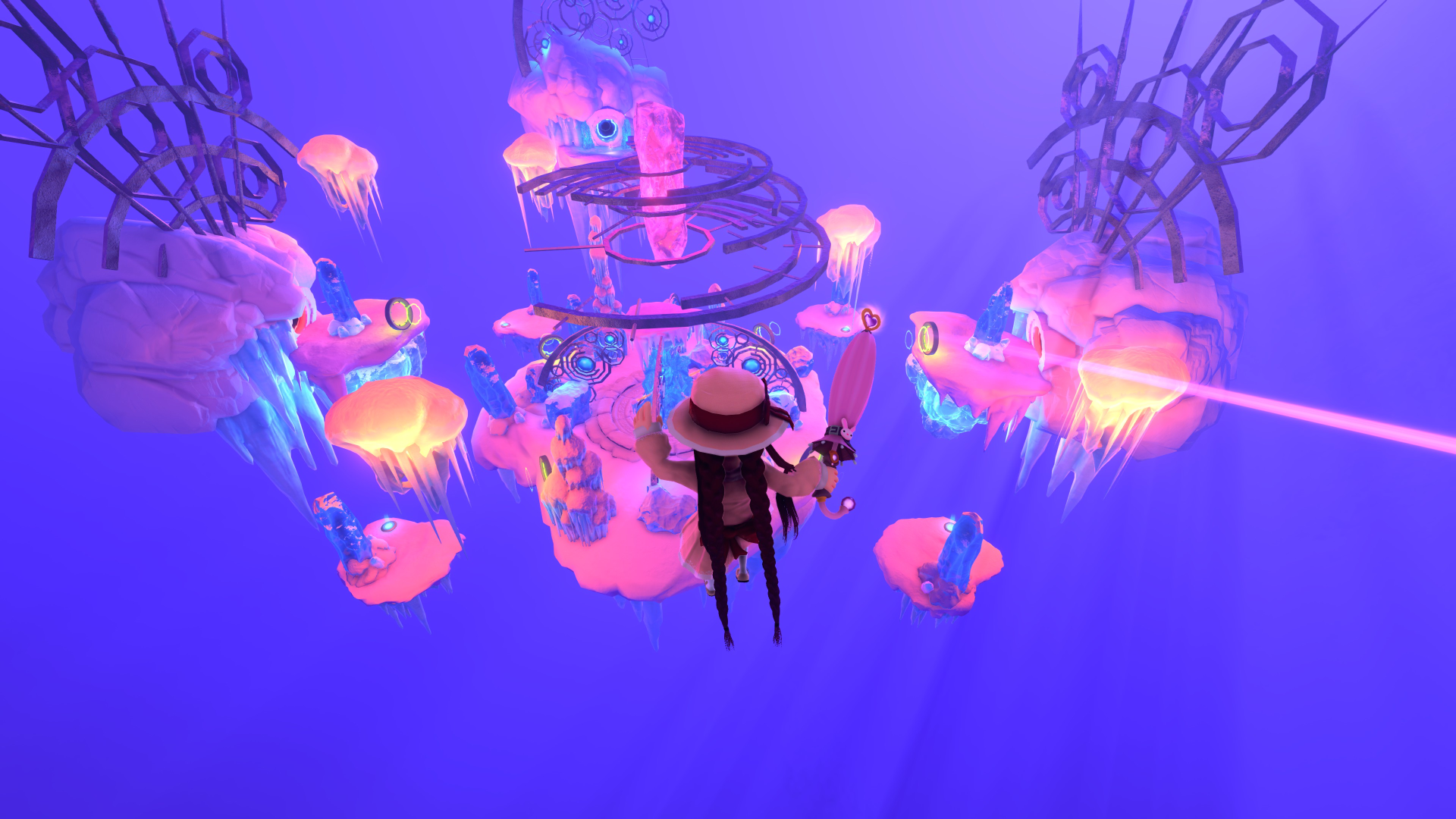
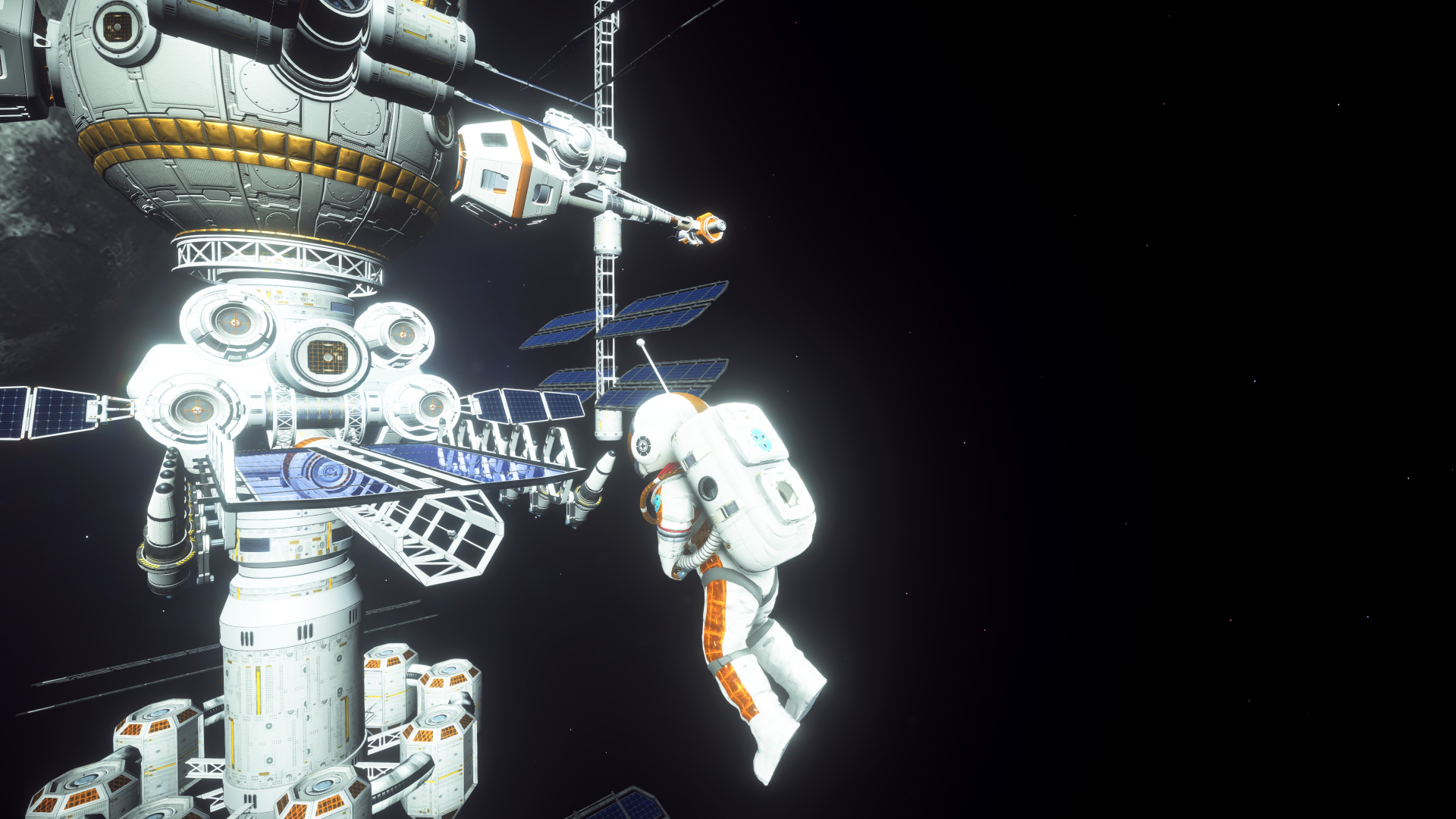
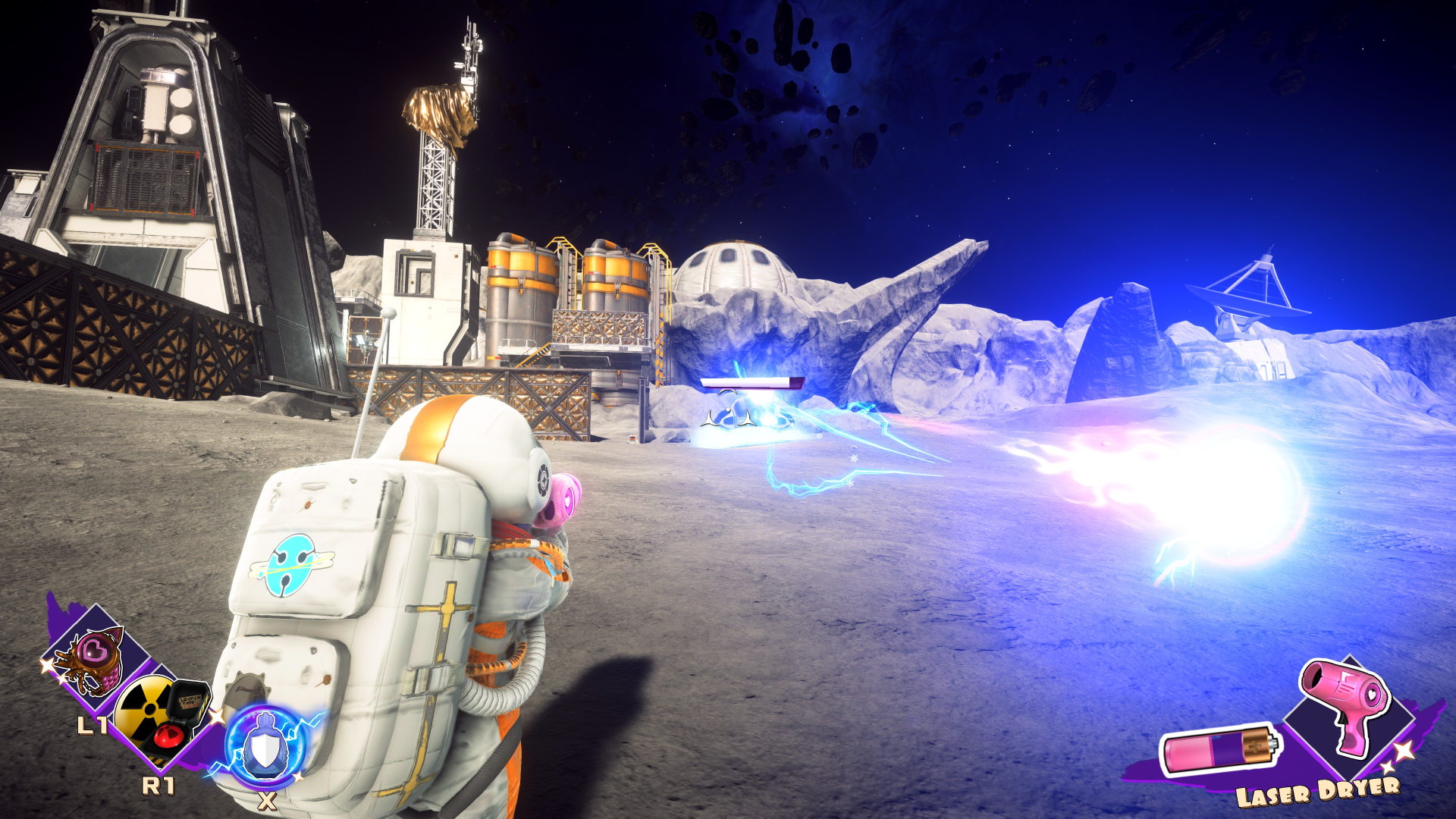
It’s worth pointing out on the content side of things though that while most of the violence is not graphic and simply involves enemies collapsing and fading out, there are two exceptions: zombies (a late game enemy not encountered until about 40ish hours in) splatter in purple blood with their heads breaking off when they’re killed by melee attacks, and enemy astronaut soldiers in a zero-gravity outer space level float through space (instead of vanishing) when killed. Finally, profanity is almost nonexistent (some enemies even outright say “darn it!” in the heat of battle), but there is the very rare “hell” or “damn” in some easily missable NPC dialog.
Even with its faults, Onirism is a massive action-adventure platformer shooter packed full of content. Its original take on the genre, having a little girl in a dream instead of a cartoon animal on a fantasy planet or something similar, gives it a different feel than other games of the genre. And it’s not exactly a packed genre like it was in the late 1990s and early 2000s. If that sounds up your alley, and the QoL issues and occasional difficulty spike caused by deeply flawed mission or boss design sound manageable, maybe give it a try.