- Giga Wing
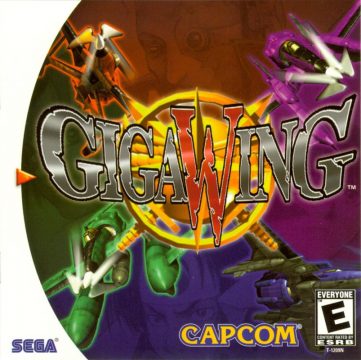
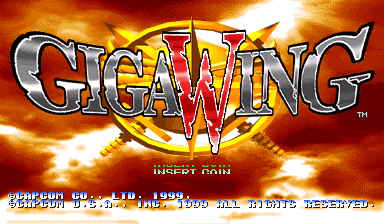
Takumi was one of the companies assembled from the wake of Toaplan, who went bankrupt in 1994. Their first game was Kyuukoku Tiger II (Twin Cobra II), effectively finishing up some work that was started at Toaplan. They followed this up with Giga Wing, a vertical shoot-em-up published by Capcom for their CPS-2 System arcade board.
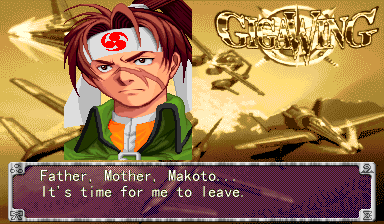
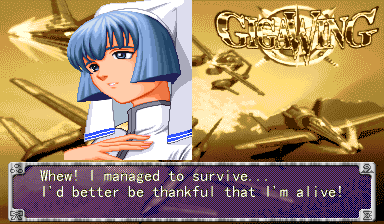
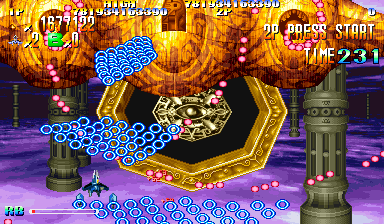
You can choose from one of four characters, each with their own ship – Sinnosuke, ostensibly the main character, who dresses like a samurai; Isha, a young nun; Stuck, an older man with a half-cyborg body; and Ruby, an ex-sky pirate. They are hunting down an ancient weapon called the Medallion, which grants incredibly destructive powers to those who wield it. Of course, one such person is a time-traveler known only as the Stranger, who pops up for a fight a few times throughout the game’s seven stages. The game’s sixth stage is a lengthy multi-stage fight against the Medallion, but if you manage to complete the whole game to this point without continuing, then you can play the final battle (and see the true ending) against the Stranger himself. The character designs were provided by manga artist Kei Toume (Lament of the Lamb, Sing “Yesterday” for Me). Like Psikyo’s shoot-em-ups, the characters pop up between stages to deliver some vague dialogue explaining the story, with different cutscenes in two-player mode as the pilots converse with each other. The stage order also depends on which character you’ve chosen.
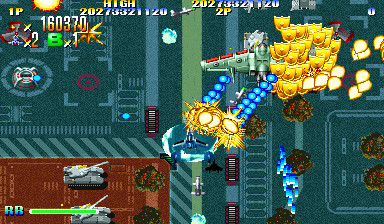
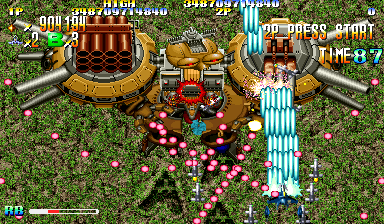
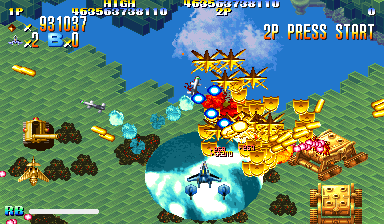
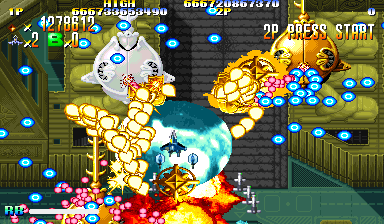
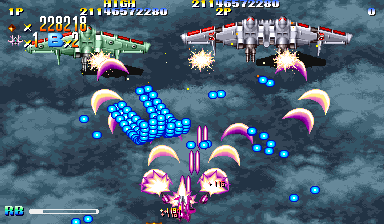
Giga Wing asks and answers the question, what if there was a shooter where you could score a trillion points? The highest score runs a full fifteen digits, and it’s easy enough to score a million points within the first minute of the first stage without even really trying. Each enemy drops a score-multiplying medal, which drastically increases the points obtained from defeated enemies. This multiplier chain increases exponentially as long as you keep obtaining medals, crawling higher and higher as you stay alive. The chain itself resets if you die or complete a stage, though the actual score multiplier remains as long as you don’t run out of lives and continue. The score multiplier itself can go well into the millions, which accounts for the score inflation.
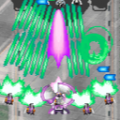
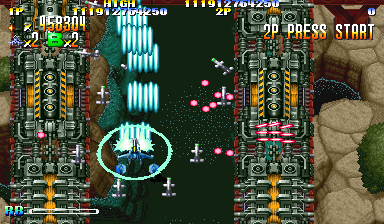
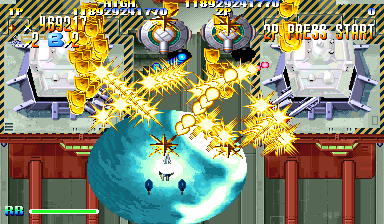
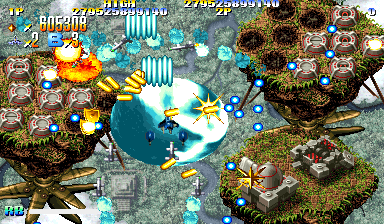
The real key to high scoring lies in its main mechanic: the Reflect Force. Activated by holding down the fire button for a brief moment, it’ll surround your ship with a barrier, reflecting any bullets back at the enemy that shot them. Bullets knocked back by the Reflect Force, as well as any enemies destroyed by them, will drop shield medals that appear in greater numbers than regular medals. While you can use the Reflect Force as often as you want, the catch is that it only lasts for a couple of seconds, after which it needs to cool down for a few moments before it can be used again. It also takes a moment to charge up, so you need to consciously activate it before running into any bullets, because it can’t be used at the last minute to save you from death. Thankfully you can also drop screen-clearing bombs if you’re stuck in one of these cooldown moments and really need to escape, though these are obviously limited in number.
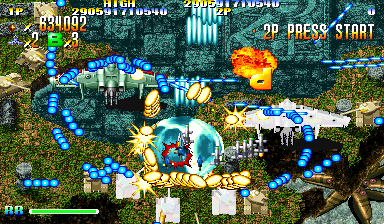
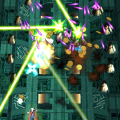
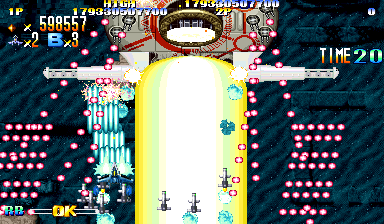
Giga Wing puts a big emphasis on the Reflect Force, not only for scoring purposes, but also for survival. Some of the enemies, particularly larger craft and stage end bosses, send fierce waves of bullets that can be extremely difficult to dodge, so the Reflect Force is your best option to make it through alive. But it’s also tricky to use, because using it too carelessly or aggressively will result in you getting a face full of bullets. While the bullets and medals have high enough color contrast to tell them apart, it’s all too tempting to run head first into a medal cluster, only to get caught up in a swarm of bullets from another attack. You really need to memorize the levels and the enemy placement to use the Reflect Force most effectively.
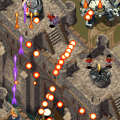
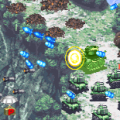
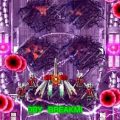
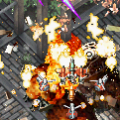
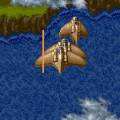
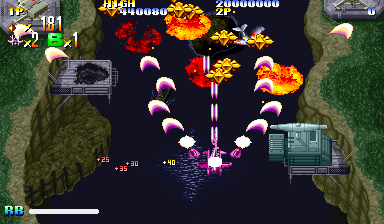
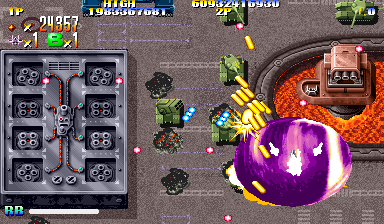
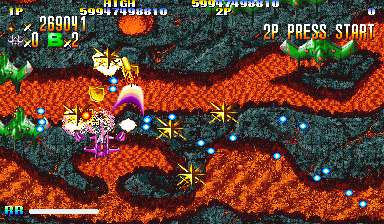
Visually, Giga Wing looks nice and colorful. Most of the stages are typical shoot-em-up territory, though the final stages take place in mystical ruins, owing to the ancient origins of the Medallion. The game uses a 4:3 horizontal monitor rather than the 3:4 of most other vertical shooters, something which affected a few other CPS-2 shooters from this time, perhaps because it made it easier to swap into arcade cabinets. The soundtrack is loud and messy, often drowned out by the sound effects.
Giga Wing saw a Dreamcast port in 1998. The CPS2 displays at a 384×224 resolution, which doesn’t quite map on the 640×480 of the Dreamcast, resulting in some screen shimmering thanks to the uneven pixels. Technically all of the other CPS2/3 Dreamcast ports suffer from this as well, but most of these are fighting games that don’t scroll as much or as quickly, so the effect is less noticeable. The soundtrack has been rearranged so it’s a little cleaner and louder, but no less abrasive. The Japanese version adds in voice acting for the main characters with some pretty big names, like Maaya Sakamoto (Hitomi from Escaflowne) for Isha and Akio Otsuka (Solid Snake from Metal Gear Solid) as Stuck, but this was removed for the North America release. Regrettably, there’s some noticeable input lag, which is apparent even when moving your ship. It also includes a rapid fire button and a score attack mode, plus you can unlock the Stranger ship, making for five total playable characters.
Giga Wing also showed up on the Capcom Arcade Stadium compilation for Windows, Xbox One, PlayStation 4, and Switch. Like all of the other games here, it’s a pretty straightforward arcade game port. Regrettably, it still seems to suffer some input lag. The timing of the Reflect Force is already a little mushy since it needs to be charged up, and maybe the developers didn’t think quick movement was all that important, so perhaps this is why it persists between versions.