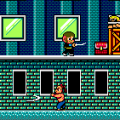
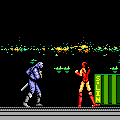
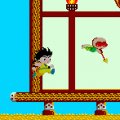
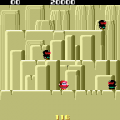
Ninjas were a huge thing, worldwide, in pop culture media in the 1980s. Their popularity can be seen in any number of imported karate flicks, but perhaps their biggest influence can be seen on video games from the time. Although Sega’s Shinobi (a word that’s basically a synonym for “ninja“), initially released in 1987, was not the first ninja game, it was one of the most popular ones. The hero, Joe Musashi, started slicing up terrorists and created the path for scores of other cloaked assassins.
Arcade
Beginning life in the arcades, Shinobi’s gameplay style changed quite a lot as sequels appears on consoles and portables. Despite these alterations, there are common threads throughout the games. Taking place in a near futuristic setting, you’ll fight against army men and ancient Japanese demons, as well as biological monsters and robots. Almost all of the games arm your character(s) with swords and shurikens, as well as ninjitsu magic to clear the screen of enemies or grant temporary invulnerability. Regardless of the style of each game, most of them range from good to excellent, with only two real below par efforts.

Arcade
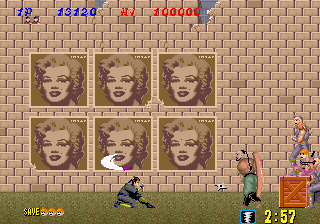
The original Shinobi, released on the Sega System 16 arcade board, is a pretty straightforward arcade affair, putting you in the shoes of ace ninja Joe Musashi (who, lacking a cool mask, doesn’t look as cool as the iconic title screen suggests). An evil organization called Zeed has begun terrorizing the Oboro ninja clan by kidnapping their children. The goal of each level is to find all of the hostages and escape to the end, although the kids are never hidden and finding them is pretty easy. The basic mechanics borrows heavily from Namco’s Rolling Thunder games, mixing strategic gameplay with fast action. Like Rolling Thunder, you jump between planes by holding up or down and hitting jump. Joe can leap between rooftops, or behind fences, in dual-plane level designs that were pretty original for 1987.
Arcade
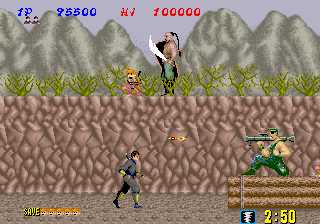
Of course, the relentless stream of bad guys makes the trek difficult – some of them mindlessly charge at you, but others hide behind boxes or block your attacks with shields. Even more deadly are the ninjas, who appear out of nowhere in large numbers and will surround Joe if they’re not dealt with quickly. Sure, you’ll be hammering that fire button to toss out as many shurikens as possible, but you’ll also have to properly time your assault, hopping on enemies while they’ve dropped their defenses. While your primary weapon is an unlimited supply of throwing shurikens, getting close to an enemy and attacking will unleash a melee attack – either a karate punch or a sword slash, depending on your power-up – that will usually break through their defenses. Joe’s a fragile ninja and one bullet or stab wound will kill him, sending him back to the beginning of the level, but he can still ram into enemies as long as no weapons touch him. This is actually one of the finer strategies of the game, as it allows you to stun enemies and deliver a quick killing blow.
Arcade
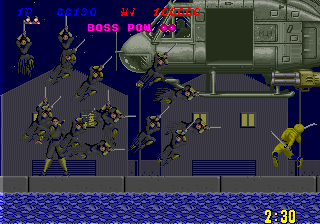
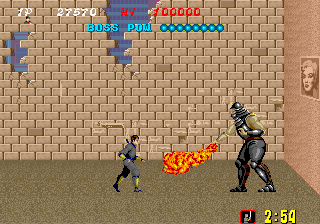
There are plenty of memorable boss battles too, plus they will usually make an appearance in the stages, to taunt you or get off a few quick shots. Each boss is introduced with a document prefacing every level, showing the route of your attack. and their portrait, which is stamped when they are killed. The first is a hulking armor-clad warrior named Ken-Oh, who tosses fireballs from his fists and can only be damaged with a shuriken right in the face. The second is Black Turtle, an entire helicopter, which sends a flood of soldiers out of its bay doors until you, a mere human ninja, can take it down.

Arcade
The third level has a strange mechanical face called Mandara, which is attached to the wall and shoots bounding fireballs from its mouth. It’s guarded by a series of rotating statues that slowly creep forward and try to crush you against the wall. The fourth boss, Lobster, is a large sword-wielding samurai that, again, can only be attacked in the head. Finally, the fifth and ultimate enemy, the Masked Ninja known as Nakahara, who is also Joe’s former mentor, wields the power of lightning.
Arcade
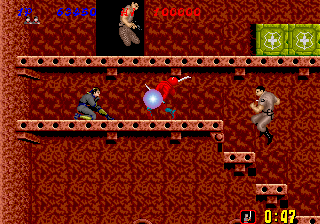
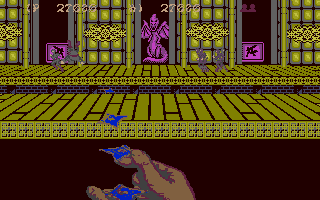
The game can be tough, but you get ninja magic to use once each level, which clears the screen of enemies or does some cheap and easy damage to bosses. There are bonus stages are first-person shooting galleries, where you chuck shurikens at an approaching horse of ninjas. If you miss too many and they get too close, you lose. These scenes are extremely tough but reward the skillful ninja with extra lives. The arcade game was originally slated to use a shuriken-shaped controller, which was said to work great for the bonus levels, but since it hindered the rest of the game it was changed to a standard joystick.
Arcade
Overall, Shinobi is still a damn fine game. It’s tough but fair, and meticulously designed, creating a true classic that’s aged very well.
Sega Master System
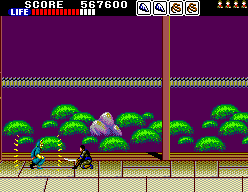
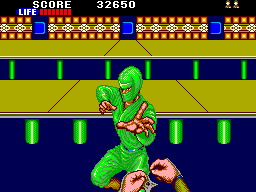
The first home port of Shinobi was the Master System version. While significantly slower paced than the arcade game, it maintains the methodical feel of the gameplay, and is still excellent. There are noticeable additions too, including a life bar and several new weapons you get for rescuing hostages, including guns, whips and bombs. Rescuing the hostages is also no longer mandatory, although given the power-ups, is a worthwhile thing to do. However, the importance of ninja magic is downplayed, as you only get to use it after beating one of the incredibly difficult bonus stages.
Sega Master System
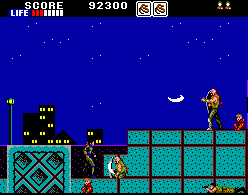
Much of the music is gone and replaced with a single tune, but the huge bosses still remain, although they don’t taunt you during the stages anymore. Despite being a very different game, it’s still one of the Sega Master System’s better action titles, even if they cut the ending: upon beating Nakahara you get the same “Game Over“ as you would if you’d run out of lives.
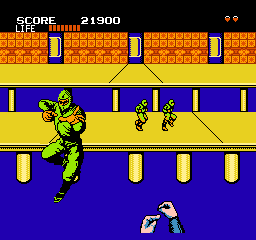
Tengen’s Nintendo Entertainment System port is based on the Sega Master System game, although it suffers from terrible graphics and shaky gameplay, like all of their conversions. The additional close-ranged weapons are gone, the vertically scrolling stages have been redesigned into horizontal stages, and Joe can only toss a single projectile at a time. The ninja on the title screen is also amusingly cross-eyed.
The PC Engine version, converted by Asmik, is closer to the arcade game, with decent (if somewhat darker) graphics and similar gameplay. However, all of the close-up melee attacks are gone, severely altering the way the game is played. It’s also missing the second stage from the original, and the bonus levels are completely gone.
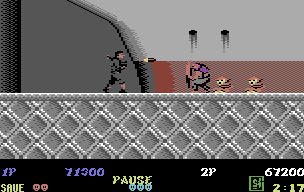
Commodore 64
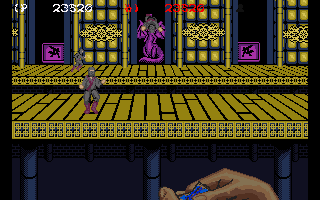
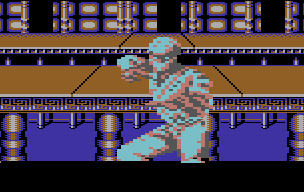
There are also a couple of home computer versions, mostly for European markets. The Amiga and Atari ST deliver the most faithful ports, which only differ from the arcade version in resolution, colors and HUD, as well as some different mechanics. Since most of these computers only support 1-button joysticks, Joe now jumps by pressing up, while holding the attack button and tapping either up or down switches between the planes. All the 8-bit computers have to live with even more compromises: the graphics are redrawn for all, and they lose the boss title-cards that used to be shown before each stage. Because of the not-so-smooth controls, they’re also a bit harder than the original.
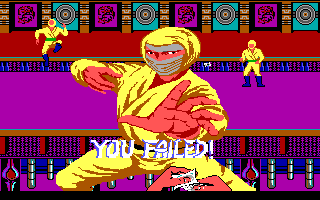
The C64 also loses the music, as well as some Spider-Man look-a-like enemies in the second level. The same goes for the IBM PC version, which seems to be based on the C64 release, but is a rather shoddy port altogether, with terrible controls and broken enemy patterns. The laziest is the MSX “port“ though, which is just a conversion from the Spectrum with the same yellow-dominated four-color graphics.
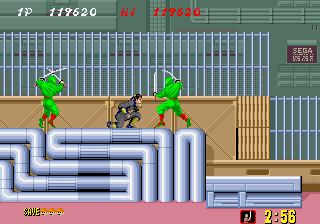
Arcade
The only other nearly-perfect ports of Shinobi are found as an unlockable on Sonic’s Ultimate Genesis Collection for the PlayStation 3 and Xbox 360, or as a separate download on the Xbox Live Arcade. The latter version has the Marilyn Monroe pictures that used to decorate stage 1-2 removed, and the Spider-Man enemy is now painted green.
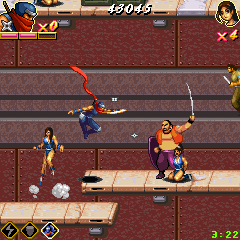
Mobile
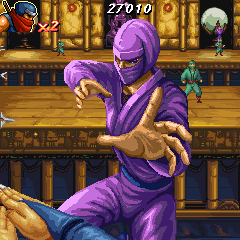
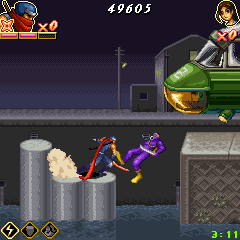
Shinobi for mobile phones appeared in China, dubbed Guiying Renzhe (“Ghost Ninja Shinobi“). Western sources refer to it as “Shinobi Tolerance“. This is a complete remake rather than a port, with entirely new graphics (the hero now looks like Hotsuma from the PS2 game and rescues female ninjas) and a second character to unlock. Joe (or Hotsuma?) also gets a health bar with three hit points and three different ninja spells.
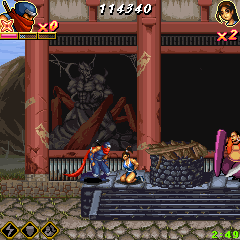
Mobile
This is no doubt the best looking version of the game, but the controls are terrible, as is typical for mobile phone games. Planes are switched by holding up (which is also jump) or down (duck) for a while, and probably for that reason every movement has a very annoying delay. You can save the game after each level, but it also keeps track of extra lives and score so it cannot be exploited. At least you’re not forced to always start from the first stage.
Shinobi was also released on the Wii Virtual Console. The Marilyn Monroe pictures are gone here as well, and the Spidermen are turned into goo-ninjas similar to the ones in Shinobi II on the Game Gear.
Screenshot Comparisons
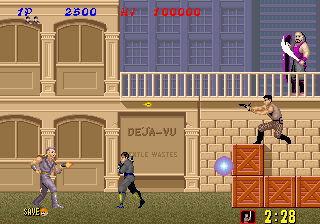
Arcade
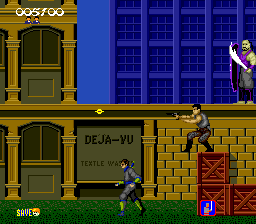
PC Engine
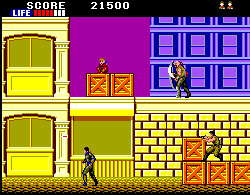
Sega Master System
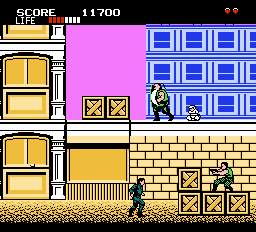
NES
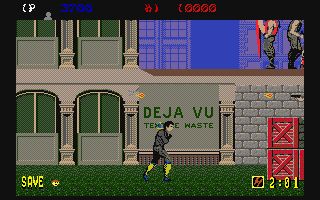
Amiga
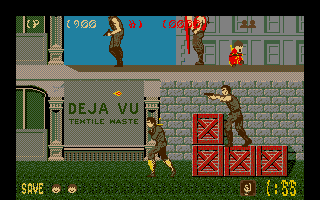
Atari ST
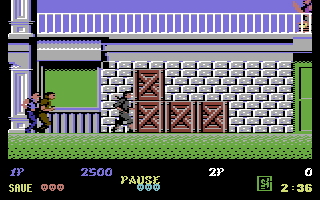
Commodore 64
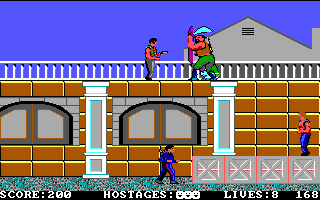
IBM PC
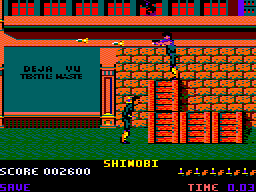
Amstrad CPC
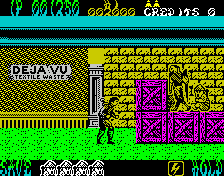
ZX Spectrum
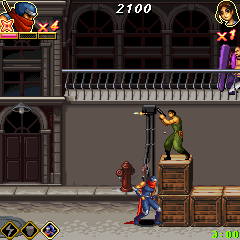
Mobile
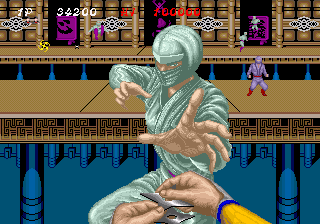
Arcade
Mobile
Sega Master System
NES
Amiga
Atari ST
Commodore 64
IBM PC
Mobile Screenshots
Mobile
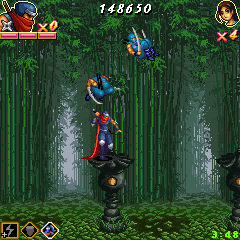
Mobile
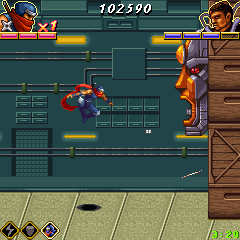
Mobile
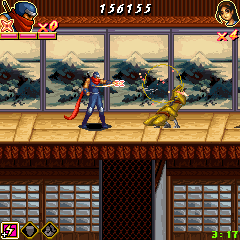
Mobile