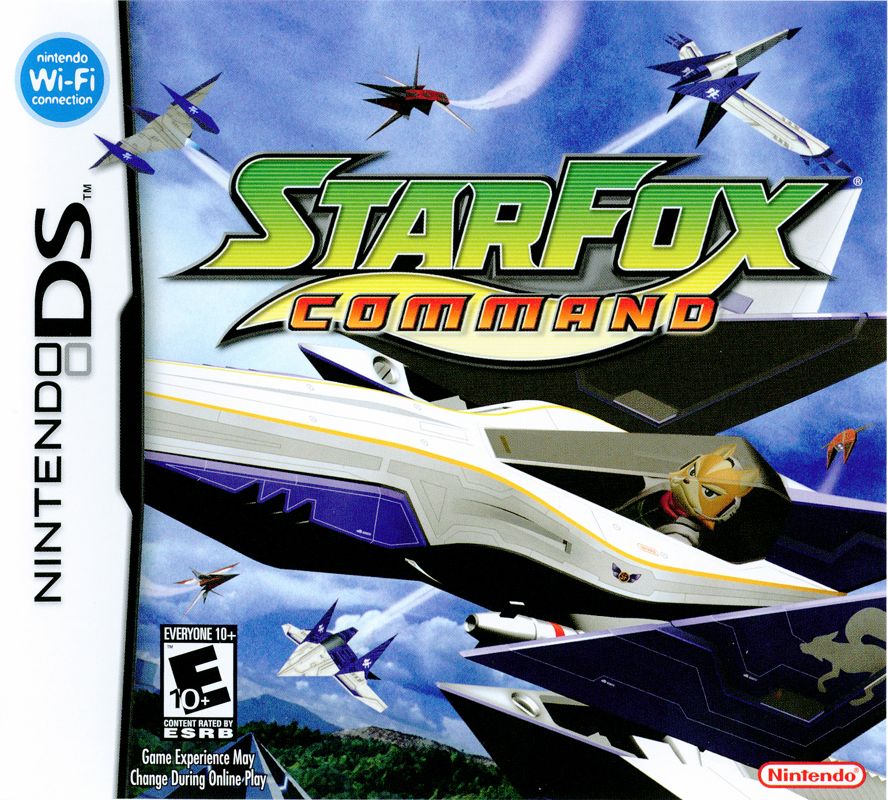
A good year after Star Fox: Assault, Nintendo followed up with a portable entry, Star Fox Command. The back of the box indicates that it’s a return to the franchise’s roots, which is partially true. The game was co-developed by Q-Games, the company run by Dylan Cuthbert, one of the programmers from the SNES original. Otherwise, this is a pretty stark departure from the series’ norms, with almost nothing resembling its predecessors. In essence, this is basically a follow-up to Star Fox 2, which at that point wasn’t officially released and was only known to fans who used emulators to play the leaked beta.
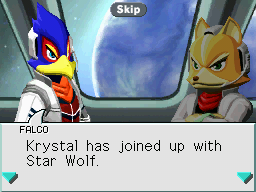
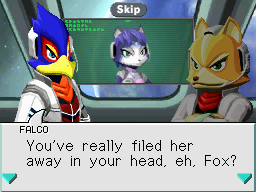
Taking place after Assault, a new enemy has once again threatened Corneria. This time it’s the Angler Empire, who have emerged from the polluted seas of Venom. The Star Fox team once again comes to the rescue, though they’re somewhat fragmented, as Falco is still out on his own and Krystal has left due to various romantic issues with Fox.
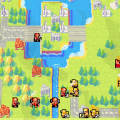
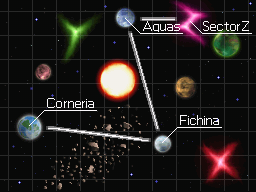
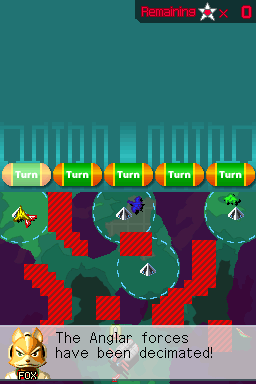
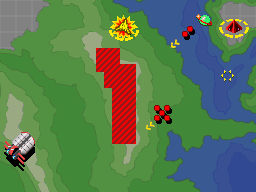
The game is broken down into several missions, each of which is presented with an overhead tactical map, similar to Star Fox 2. The goal is usually to destroy all of the opposing bases while protecting your own (here, the Great Fox ship) from enemy attack. In theory, the stylus is used to draw the flight paths for the allied ships. However, it actually works quite differently in practice. Rather than using the pseudo-real time movement of Star Fox 2, where enemies moved at the same time that you did, the flow here is broken up into turns. Your ships can only move a certain distance within a single turn, after which enemies will either try to intercept you or head towards the Great Fox. You only have a limited amount of turns to beat each mission, though destroying some of the bases will give you some extra turns. The maps are also clouded by fog, which is erased whenever your ships pass over it, though you can scribble a little bit per turn in order to reveal what’s underneath. However, this slowly grows back over time. If anything gets too close to the Great Fox, your base will be destroyed and you’ll lose the whole mission.
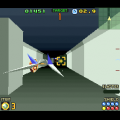
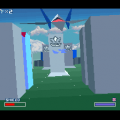
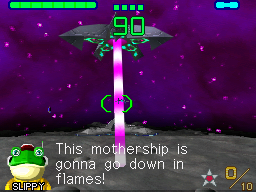
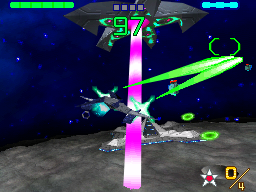
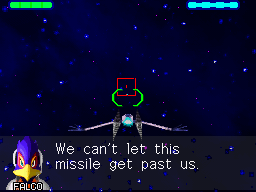
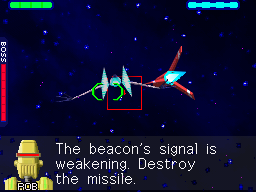
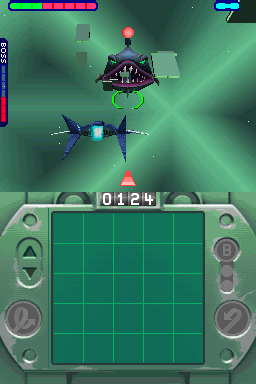
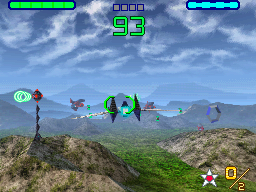
There are basically three kinds of encounters in Command. Most conflicts are presented like the All-Range mode sections from Star Fox 64, where you need to destroy a certain number of enemies and collect their cores to proceed. In the base missions, you also need to destroy the enemy mothership, which is done by flying through a series of red gates and then performing a barrel roll right before you hit it. If you fail at any part of this, you die immediately. Then there are missile interception missions. Much like the mothership destruction stages, you’re on a linear path to fly through red gates and must destroy an incoming missile. If you miss one, though, you’ll lose and the enemy attack will get through. Then there are boss fights, which are typically unique to each area, some of which include dogfights with old faces like the Star Wolf team.
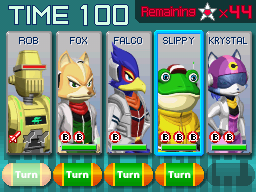
Beyond the turn limit, there’s also a running timer that counts down during the action segments. Once it hits zero, you lose a ship. This crosses over across all of your units, too, so if you end up with only 10 seconds left, the next character is probably going to be screwed. When the timer expires, the character will remark that they’re out of fuel, which doesn’t really make sense considering it’s shared. Ultimately, it feels like something that was bolted on at the last minute to make the game feel more intense.
Thankfully, there are a few ways to increase the timer. Hunting down non-essential enemies or zooming through rings may seem like a distraction when the clock is ticking, but they usually drop power-ups that replenish precious seconds. Barrel rolls gain further utility, as well, as in addition to deflecting enemy shots, they also add to the timer, meaning skilled pilots can build a surplus of time. There are time replenishments to be found on the map, too, in addition to missiles, which can be fired by the Great Fox as an extra layer of defense if one of your units can’t intercept an enemy attack.
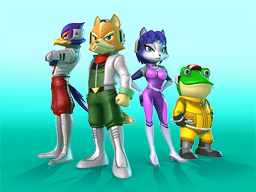
There are over a dozen playable characters, each with their own ship, ranging from the main cast of the previous games to their friends and family (Slippy’s girlfriend Amanda and Peppy’s daughter Lucy), to members of Star Wolf, and even minor characters from Star Fox 64 like Katt Monroe and Bill Grey (though they look a little different here, with Katt turning from purple to black). There’s also a young monkey named Dash who aspires to be a member of Star Fox. Their ships all have different abilities, pertaining to their weapon strength, whether they have a lock-on laser, the number of bombs they carry, how long their barrel rolls last, and so forth.
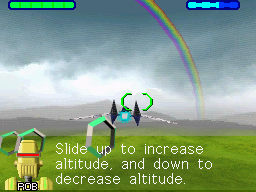
In combat, your ship is controlled completely with the stylus, with all of the other buttons on the system firing the lasers. Bombs can be dropped anywhere on the playing field by dragging and dropping them on the radar. You also somersault and perform u-turns by hitting the appropriate buttons on the touch screen. Boosting and braking is done by double-tapping either the top or the bottom of the screen, though, which isn’t exactly intuitive.
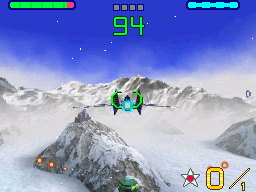
The touch controls definitely offer a level of precise aiming that wouldn’t be possible on an analog stick, much less the digital d-pad of the DS. Despite requiring an adjustment period, it works pretty well most of the time. However, it can still feel clumsy in certain scenarios, especially when you’re trying to do quick, tight turns. Giving the option to use the d-pad would’ve been welcome, as this reeks of the times when Nintendo thought they knew better than the player when it comes to control methods. They have a history of making things harder than they need to be (see: The Legend of Zelda: The Phantom Hourglass, Donkey Kong Country Returns, and Kid Icarus: Uprising).
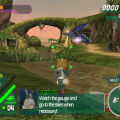
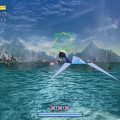
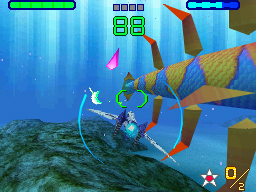
Despite the different map layouts in each mission, Star Fox Command suffers from the same basic issue as Star Fox 2 – there just isn’t enough variety. There are plenty of types of enemies with different behaviors, but fighting all of them is actually about the same. The boss encounters are usually pretty decent, but everything else is just the same stuff over and over. There are different planets at the least, so there’s a wide variety of scenery, but considering you’re usually just flying over open mountains (except for the city stages), it doesn’t really make much of a difference. (The Arwing can also apparently fly underwater, rather than getting into a submarine.) There still aren’t any on-rails missions at all, either.
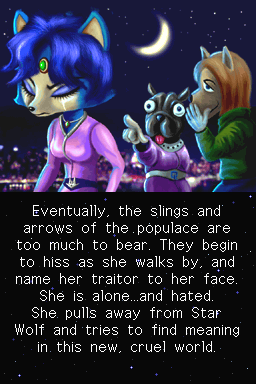
The game does offer an incredible amount of replayability thanks to its branching scenarios. You’re railroaded along a set story on your first time through, but on subsequent replays, you can make decisions that take the plot in different directions, giving new missions and taking you to new endings. Most of these veer straight into completely ridiculous melodrama, too. In one ending, Krystal leaves the team after having a fling with Star Wolf, gives herself the absurd nickname “Kursed,” and flies around the galaxy as a pariah. In another, Fox quits mercenary work and ends up joining an F-Zero-like racing league (here called G-Zero). Then there’s the one where Fox and Krystal settle down and have kids, leading to a new era of Star Fox pilots.
None of these could be considered canon of course, as they all mostly contradict each other, and the next non-remake game (Star Fox Zero for the Wii U) rebooted the story anyway.
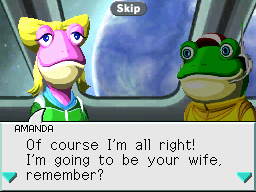
It’s not like the story was a particular highlight of the previous games, but there was some level of seriousness to it that made a group of intergalactic furries seem kind of cool. Here, it gets so bizarre that it approaches the level of fan fiction, particularly the over-the-top artwork in the endings. That’s not accounting for the fact that the designs for characters like Amanda, an absurd pink frog with a gigantic yellow bow, are already pretty bizarre.
Discounting this, there’s one other major aspect of the plot that might upset some long time fans, particularly in regards to General Pepper. Without getting into details, it’s revealed that Andross wasn’t quite the psychotic maniac that the earlier Star Fox games made him out to be, but rather was banished by Pepper for political reasons. On one hand it adds shades of grey into the conflict, but on the other, it’s not like Pepper had much depth beforehand, other than being a dog with a cool voice who provided your mission briefings. Did they really need to drag him out to present him as a bad guy for this?
At any rate, the story is interesting for its sheer insanity, even though the endings are just a few illustrations accompanied by text. There are nine in total, but due to how the branching works, you’ll need to replay many of the earlier missions several times if you want to see them all.
Visually, the game is on par with most 3D DS games – which is to say, lesser detail than the N64, though without the fog (and replacing the blurry textures with pixelated ones). This isn’t a huge deal, given the low resolution of the screen. The music, as with most of the games post-Star Fox 64, is based on that game’s soundtrack, though there are quite a lot of original tunes, since each pilot has their own combat theme. The speech goes back to the gibberish language of the SNES game, rather than using actual recorded English (or Japanese) speech. One neat aspect of this choice is that by speaking into the DS microphone, the game can turn your voice into its own unique gobbledygook. There’s also a multiplayer battle mode, which can be run locally with download play. At one point it was also offered online, but internet play for the system has long since been disabled by Nintendo.
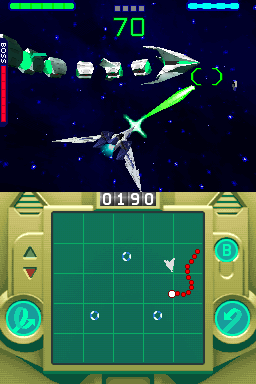
Star Fox: Assault disappointed many fans due to its departure from on-rails gameplay, but Command received even more blowback for being even more different. Seeing as how it’s basically a sequel to Star Fox 2, it’s a good indicator of how that game would have been received had it actually been released. There are certainly problems with Star Fox Command, due to the controls and general repetition, but the core gameplay loop is still pretty fun barring some occasional frustrations, and the story and endings are fun enough as long as you don’t take it too seriously. It’s not really a classic, but as long as you can acclimate to its style, it’s better than some might think.
Star Fox Command has only been ported once, on the Wii U VC. Considering that both screens are presented vertically, the controls become much more awkward, with only the bottom (emulated) screen accepting input. This can be alleviated by holding the tablet vertically, though. The game is also much easier to play on DS XL and 3DS XL systems, due to the larger screen sizes.
Links:
The Video Game Music – Star Fox Command Endings