- War of the Dead
- War of the Dead Part 2
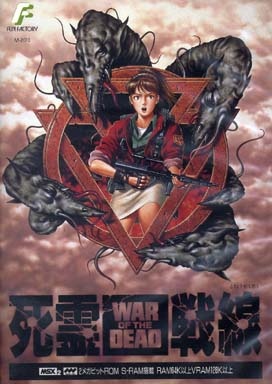
MSX2 Cover
Fun Factory, sometimes called Fun Project on the title screens of their games, is about as obscure as Japanese games companies get. There are almost no mentions in English for them online, while searching in Japanese doesn’t bring up much more. Only a few obscure Japanese blogs, briefly mentioning one or two of their games (like Draineron the MSX). In fact, the only thing they seem to be well known for is their War of the Dead games, AKA Shiryou Sensen. Even then, Fun Factory is sometimes ignored in favor of Victor Musical Industries, the publisher for WotD.
Fun Factory is sadly part of a large number of obscure little companies which did some interesting video game things pre-millennium, but then either went bankrupt, changed names, or moved out of games and into an entirely unrelated field. The kind of company which found some small success with a niche title that maybe developed some kind of cult following, but was then forgotten. The War of the Dead “series” comprises only two games: the first was released on three different platforms, all of them radically different. The sequel was released only on MSX2 and PC-88, but each was nearly identical. None of them left Japan, only the sequel was fan-translated (without any publicity at all), and generally only a few hardcore English-speaking retro fans talk about them.
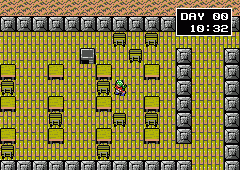
MSX2
Kevin Gifford’s blog provides the best information in English regarding the start of WotD. As he explains, a lot of people revere Capcom’s Sweet Home on the Famicom as one of the earliest survival horror games, especially since it was the inspiration for Resident Evil. According to the Tokyo Metropolitan Museum of Photography, Sweet Home was released on 15 December 1989, and as Gifford points out, the original WotD came out on the MSX in 1987, at least two years earlier. Its ports to PC-88 and PC Engine meanwhile came out in January and March 1989, again putting them before Sweet Home.
Gifford goes on to quote a 2008 issue of GameSide (a Japanese magazine dedicated to obscure classic games), which interviewed the creative mind behind WotD, explaining both the game’s origin and story.
Katsuya Iwamoto, producer and designer on the game, told GameSide that the project, like so many of the time, got its start from Dragon Quest. “I got a job as a game designer and they told me to come up with something, so I wrote the basic idea in two or three sheets of notebook paper,” he said. “There weren’t any horror games back then, really, so I wanted to make one. Dragon Quest taught me how I could tell a story through video games, so I wanted Shiryou Sensen to move along like that, too.’ The game he came up with, especially in its PC Engine incarnation, certainly betrays Iwamoto’s inspiration; it plays much like a modern-day Dragon Quest but with Zelda II-like battles, because Iwamoto thought turn-based fighting with guns and grenade launchers would be weird.
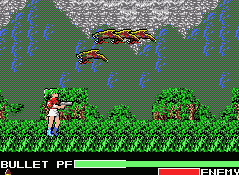
MSX2
Set in the small town of Chaney’s Hill, the game stars Lila, a member of the US Army’s team of paranormal investigators: S-SWAT (Supernatural and Special Weapon Attack Team). She’s sent to the area after all communications are cut off and an entire company of Marines disappears without a trace. The plot (involving a portal to another world and the family that’s secretly protected it for generations) is a little bit Escape from New York and a little bit Stephen King’s The Mist, both of which Iwamoto claims as inspirations.
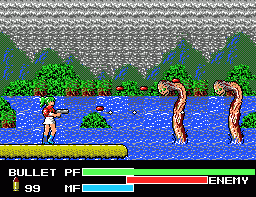
As stated by Gifford, the game is indeed a lot like Zelda II, with its overworld map and side-on battles. Except there are no dungeons as such, only a few interior locations such as a school and hospital to explore. The basic premise is that protagonist Lila has to wander the town, rounding up surviving townsfolk and marines, and leading them back to a church (where the priest is named Carpenter, after horror film director John Carpenter). What this equates to is a series of fetch quests, since each survivor has to be saved in a specific order which can’t be deviated from, and only one can be led back to the church at a time.
All three versions of the first game start off extremely linear, until you find the raft, whereupon the rivers and lake can be explored and the entire town is available to you, giving the game an almost sandbox feel to it. This is deceptive though. The first game’s biggest fault is that progress, despite the impression of non-linearity, is shackled to a very archaic, specifically ordered lock-and-key quest. Even if you stumble across a key character and talk to them, unless the immediately preceding flag has been triggered, they will be absolutely useless and you will be forced to visit them again later to trigger the next flag. Mildly annoying if you can read Japanese, since you’re forced to repeatedly talk to everyone multiple times for clues, it renders the game almost impossible if you can’t read Japanese. Failure to pick up on names mentioned results in random traipsing around the map, hoping you stumble across the right flag-triggering person to chat with.
MSX2
In spite of this steep barrier to entry, the “launch trilogy” of WotD games are worth struggling with, at least for a time, and to alleviate language woes we’ve provided a loosely translated walkthrough for the PC Engine version, which should suffice at least until someone does a fan-translation.
Most characters are named after someone connected to horror films, and generally are also connected to each other in some way, either as Vietnam war veterans from the same platoon, or as secret lovers. As you rescue more survivors snippets are revealed through conversation. All portraits were redrawn between ports: on the left is the MSX shot, the middle the PC-88, and right side the PC Engine portrait.
Characters
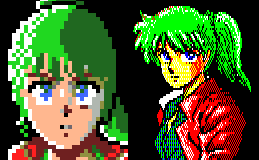
Lila
Or possibly Laila, Lyra or Raila depending on how you interpret the Katakana. Born June 5th 1966, she’s the youngest member of S-SWAT (the game is set in the late 1980s). It turns out she was actually born in Chany’s Hill, and is gifted with psychic powers (represented by the green bar in-game). These allow her to temporarily increase her weapon’s power, and as her psychic gauge goes up so does her defence.
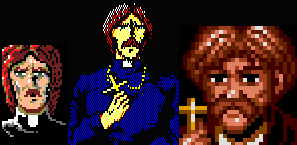
Carpenter
Named after horror film director John Carpenter. A priest from the church which survived the initial monster attack. He tends to the wounded survivors and often gives advice on where next to proceed.
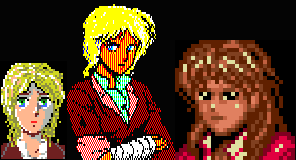
Carrie
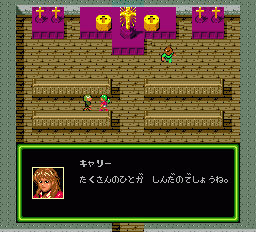
Almost definitely named after Stephen King’s book Carrie, which saw a film release in 1976. First survivor along with Carpenter. Studying folklore at University, Whitman is her teacher. Becomes friends with Lila and turns up in the WotD sequel.

Harvard
Exclusive to the MSX version, found in the library which appears as a ruin in the PC-88 and PC Engine versions.

Whitman
Maybe named after Walt Whitman. Exclusive to the PC-88 and PC Engine versions, replacing Harvard. Teacher of Carrie, he’s found in the underground ruins on the small island in the middle of the lake.

Mayor
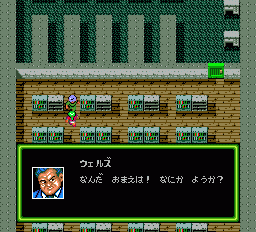
The mayor of Chany’s Hill is named Wells. Could be named after author HG Wells, who wrote some horror stories. Uncooperative and troublesome, he’s the first survivor you rescue. Found in the town hall.

Janet
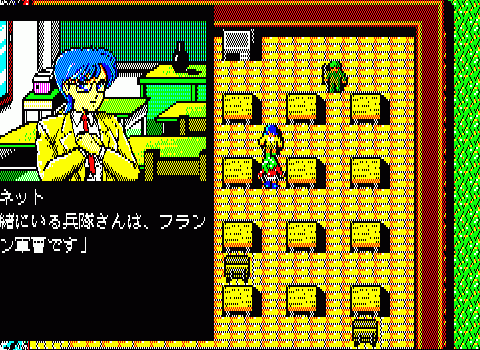
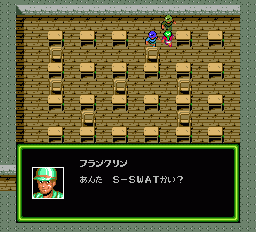
The closest we could think of, relating to horror and the name Janet, is Janet Weiss in the Rocky Horror Picture Show (there’s also a character called Weiss in the game’s sequel). Here she’s a teacher at the local primary school, found in a classroom alongside Franklin. Slightly traumatised by witnessing the deaths of children in the recent incident.

Carol
Several obscure connections to horror – likely erroneous. Hiding in the school’s top floor after being separated from her teacher Janet (in the MSX version she’s inside a box). Can’t be rescued until you’ve first saved Wells. After meeting her you need to find her teacher and then return.
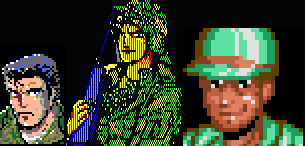
Franklin
Both actress Pamela Franklin (Legend of Hell House) and actor John Franklin (Children of the Corn) were known for starring in horror films. This foul-mouthed sergeant is a survivor of the initial troop deployment, found in the school.
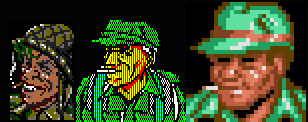
Gordon
Master sergeant of the first troop deployment, and Franklin’s commanding officer. In the MSX version he teaches Lila various techniques. Loves a good smoke.

Romero
Named after horror film director George Romero. S-SWAT captain and a great team leader, he can be found in the island ruins where he was attacked by monsters and wounded.
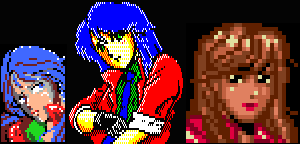
Cronenburg
Named after ‘body horror’ film director David Cronenburg. Senior to Lila, she’s the assistant commander for S-SWAT. Has extremely strong psychic powers. Is found injured under the cemetery.

Cameron
Probably named after film director James Cameron, a lot of whose early films were partially horror. Second-lieutenant in S-SWAT, once rescued he gives you the shotgun.

Wes
Probably named after horror director Wes Craven. Mysterious character with the surname Browning who keeps popping up in random places.
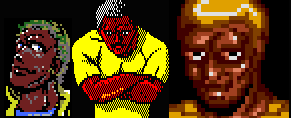
Peter
Tough talking Vietnam veteran who runs the local drugstore. Deep down is a nice guy. He doesn’t leave the store until late into the game, after which he gives you the flamethrower. Himself, along with Fran and Peter, are probably named after a trio of characters from the original Dawn of the Dead.
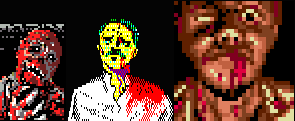
Dr. Bus
Later in the game he’s found in the hospital’s underground morgue, performing autopsies on corpses to try to ascertain the cause of recent events. He gives you the key to the locked room on the second floor.

Sandra
Nurse working for Dr. Bus, found in the hospital’s locked room looking after Patrick. In the MSX version she performs a blood transfusion from Lila to Patrick, which results in an event that explains his nightmares.

Patrick
Possibly named after 1978 horror film of the same name. Found in the same locked room as nurse Sandra. Suffers from terrible nightmares. The blood donation event in the MSX version was removed from later ports, leaving the nightmares unexplained.
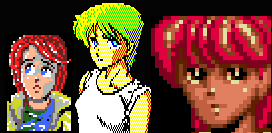
Fran
Travelling with her boyfriend Stephen in the mountains, they became separated when the monsters attacked. Hides out in the log cabin on the eastern side of the map. Stubbornly refuses to be rescued, instead choosing to wait for Stephen.
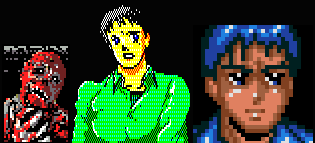
Stephen
In the MSX version he’s killed before he can be rescued. In later ports he’s discovered in Peter’s store, searching for food. When brought back to the church he gives you special light.

Omadon
A native American, she’s the oldest person in Chany’s Hill. Normally lives in the mountain log cabin on the eastern side of the map, she has a lot of knowledge regarding ancient legends, and sheds light on recent events.
MSX2
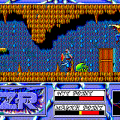
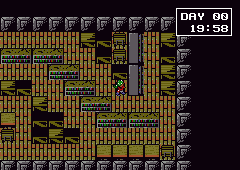
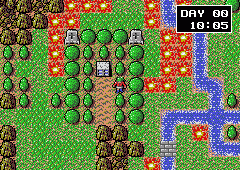
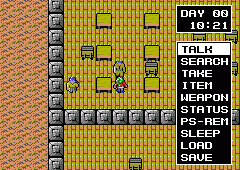
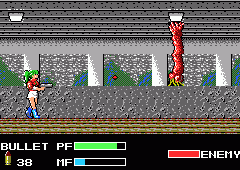
As mentioned by its creator Katsuya Iwamoto, the game copies Dragon Quest albeit with a horror setting. Movement is slow and tile-based, while actions such as talk, search and take need to be selected from a menu which is in English. Battles are random like in the DQ series, except real-time instead of turn based. You’re confined to a single screen with one or more enemies, whose health all contributes to a kind of collective health bar at the bottom, and have to either shoot your way out, dispatch them with a knife, or escape. You can run from most battles by reaching the rightmost side of the screen, or by pressing against the leftmost side for a bit (the amount of time varies, usually in proportion to the difficulty of the battle you’re running from).
And here is its first failing. Whereas most RPGs initiate a random battle after a set amount of steps have been made, or in some cases they roll a random number each time you make a step, here it rolls a random number every real-world second the game is running, meaning it’s quite possible to have two fights in a row, within one second of each other, without ever even touching the controller.
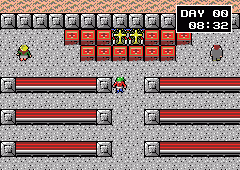
The opening sees Lila standing outside the game’s church, inside of which is the only safe place without battles. Interestingly the game introduces a constantly shifting 24-hour day and night cycle, along with a counter for the number of days you’ve survived. Although it doesn’t appear to have any affect on the game’s mechanics, this is still an extremely cool idea, and there are about half-a-dozen discernible periods of light and dark depending on the time. Dawn starts off gloomy, the early morning is pleasant, midday is especially bright and midnight is pitch black. At any point you can also choose to sleep (between 1-9 hours) from the menu, which speeds up time and recharges health. Although you can sleep anywhere and no enemies will attack, sleeping the full 9 hours only refills a tiny amount of health.
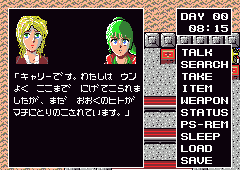
MSX2
Heading out from the church you have only the ability to punch, attack with a knife or shoot a basic gun which starts with 99 bullets. Ammunition is scarce and found only in a few remote crates. Until you find a better weapon it’s possible to use psychic energy to temporarily enhance the power of your current weapon, but it only lasts for one battle, and you can only do this a limited number of times between sleeps, so you need to use it wisely. There is a leveling system, but the progression is invisible to the player, as experience gains happen in the background without player knowledge.
This is the game’s other big irritation. You are constantly underpowered and it doesn’t check what state you’re in regarding health and weapons when starting a random battle. Quite often it’ll throw several high-level enemies at you, which cannot even be damaged with your current weapon, and which take a little too long to escape from (or, in the case of set “boss” enemies, can’t be escaped from at all). Even when you do encounter a low level fight, such as zombies, a large group can easily consume nearly your entire clip of 99 bullets before falling. The knife is more powerful, and fells a lot of enemies in one hit, but this requires getting close to an enemy which can instantly kill you. This is often mitigated by ducking when you attack, however, which increases the range of your knife while also decreasing the chance of enemies hitting you back. The later-acquired “bush knife” weapon is a bit bigger than the default knife, too, and also allows you to damage enemies simply by coming in contact with them, whether or not you actually have your weapon drawn.
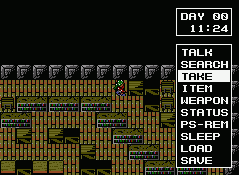
MSX2
While it is rather difficult, the MSX2 release has a somewhat smaller world than the later remakes. For a start you find the inflatable raft in a box in the school’s attic, which is much closer to the church than in later games, while the traversable water area is considerably smaller. Some buildings such as the boat house are missing entirely, and the cemetery is much easier to reach. In fact the map bears little resemblance to later versions. Having said that, the game still goes out of its way to make this small world frustrating to explore. There are fires all over the place which block your path, turning everything into a tricky maze.
The MSX2 version also has a few exclusive things, such as the survivor named Harvard and several additional dead NPCs whose corpses you can find, along with a handful of extra enemies and a unique end boss. It also contains items not found in later games, such as the sleeping bag which increases healing when resting, and night-vision goggles which improves your attack during dark.
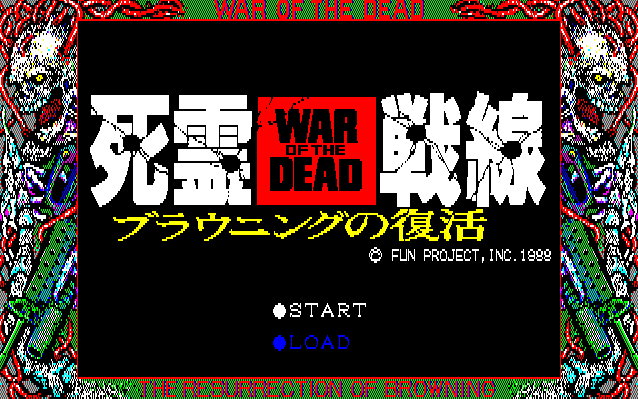
Shiryou Sensen: Browning no Fukkatsu (死霊戦線 ブラウニングの復活) – PC-88 (1989)
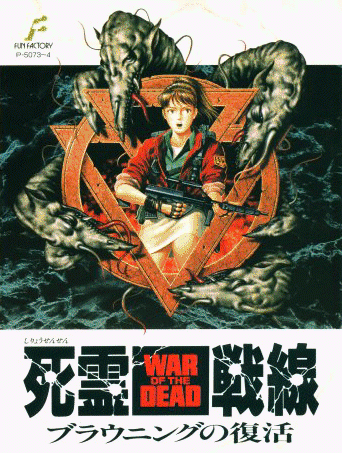
More than one source online has claimed that music was only introduced in the PC Engine port, but in fact both the MSX2 and PC-88 games had some fairly decent and atmospheric music. The MSX2 version’s overworld and menu tunes are actually more somber than the PC Engine version.
Around two years after the MSX2 release, in January 1989, a remade version of War of the Dead, subtitled Browning’s Resurrection, was released for NEC’s PC-88 home computer. The differences between the two are extensive.
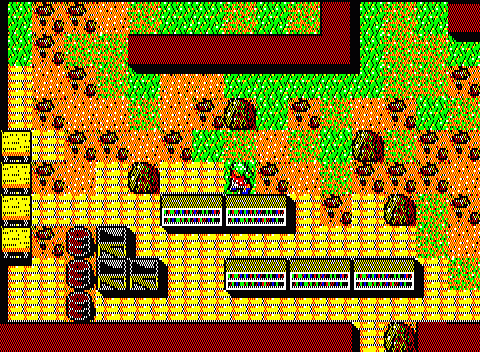
PC-88
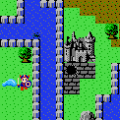
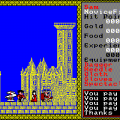
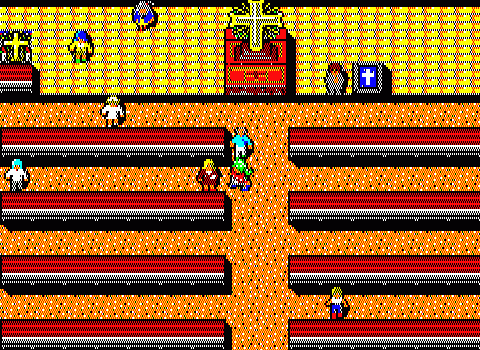
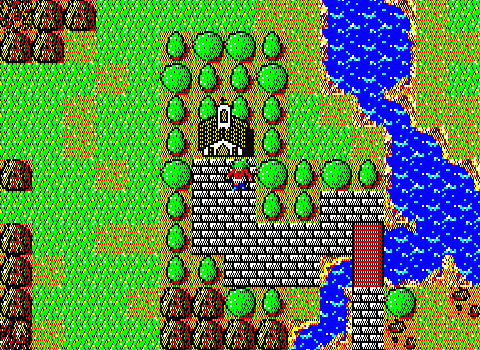
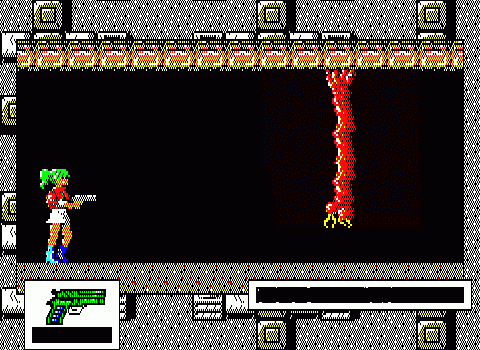
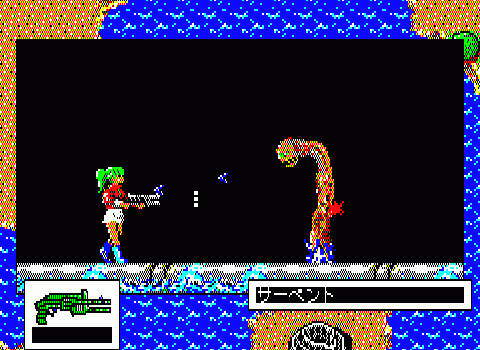
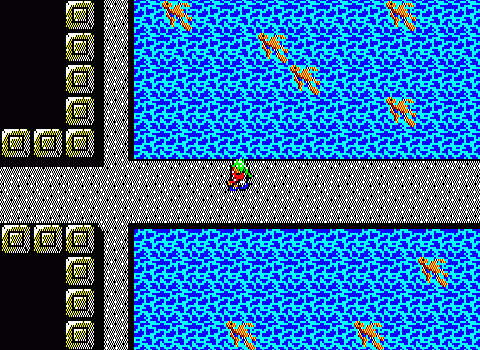
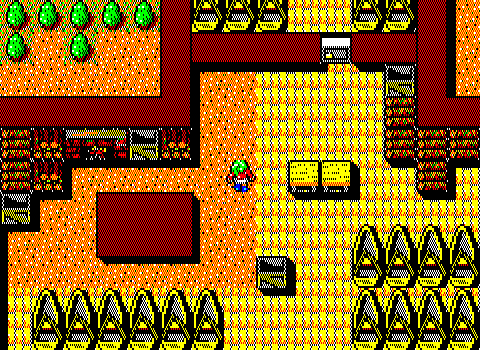
What’s immediately apparent is the scale of the game: everything in relation to your character seems larger. It’s also considerably faster, with improved walking speeds and no need to bother with menus when searching boxes or talking to people, just touch them to activate (this is a blessing). Although the PC-88 version only displays 8 colours on-screen, compared to the MSX2’s 16, it uses a much higher resolution, mixing pixels to imply more colours. With objects appearing bigger, more detailed, and much bolder in colour and style, the PC-88 actually looks better in motion than the MSX2 version, which feels antiquated. It also uses some border artwork featuring two biomechanical skeletons, which we’ve removed from most screens here.
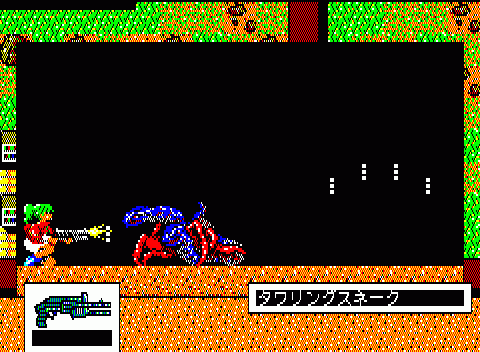
The one major downgrade is that battles no longer have dedicated backgrounds based on location, and instead take place in an empty black square. Also, while the MSX2 had multiple enemies on-screen, the PC-88 limits you to just one, which has the advantage of making it much easier. Along with these cutbacks combat has been completely overhauled with several improvements. Enemy encounter rates have been reduced significantly, and if you aren’t moving you won’t get attacked, unlike the MSX2 version. The encounter rate may still prove frustrating for some, but the game only rolls a number with each step, so it’s possible to quick save after walking a short distance, and reload if you encounter a battle.
PC-88
Guns also now have unlimited ammunition (to our knowledge the version tested did not have a trainer enabling this). To prevent combat becoming too easy, certain enemies are only weak to specific weapons. For example the Rock Monster is impervious to attack with the gun, rifle or shotgun, but can be dispatched with the knife. Using psychic power to charge weapons is still possible, this time giving them a numerical value which decreases with each shot fired. Overall battles are a lot more fun to engage in. Having said all this though, enemies still don’t drop any items and there’s no levelling system, so they’re entirely redundant, acting only to slow you down. There are d88 files floating around with a trainer that removes overworld encounters and some but not all interior ones, which considerably speeds up play time.
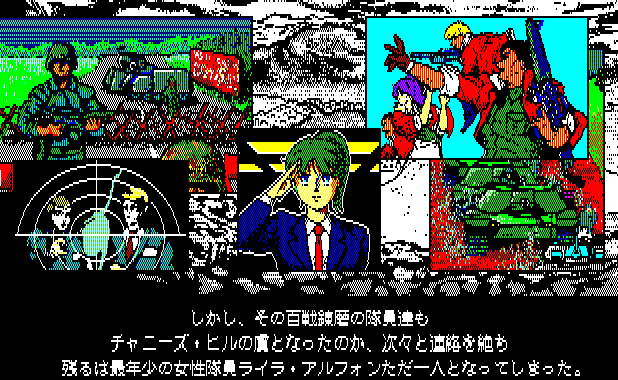
Generally the PC-88 version has most of the enemies found in the MSX2 game, although you only fight them singularly. Where it differs drastically is the map, NPCs you can encounter and overall structure. The Harvard survivor is missing entirely, replaced by Whitman, while the map has undergone major changes. Gone are the fires which blocked your path and a lot of the rocky mazes, while the spaces between areas has increased, giving the world a much larger and more realistic feel. There’s also the introduction of the boat shed and changing of certain objectives, which significantly alters the pacing. Additionally, the boat you later acquire is no longer an item to be carried, but is a vehicle which has to be left on the shore. This further increases the map size – previously once the boat was acquired you could ignore the rivers, whereas now you need to be aware of where you’re beaching so you can later return.
PC-88
Other changes include removal of the day/night cycle, which is a shame since it was a good idea. Along with it goes the ability to sleep, plus the sleeping bag, flare and goggles. The bush knife weapon is removed, in the MSX2 game it acted just like the knife but with extended range. The sub-machinegun is also gone, as is the parabola launcher. You do get a nifty flamethrower though, which is new. Areas are also dotted with more crates holding items – for example in the church there are now around half a dozen recovery items. With the addition of new event scenes, such as the massive hole in the school classroom, there are extra items such as the ‘Jacob’s ladder’ (this is a nautical term for a specialist type of rope ladder – though ironically the film came out after the game so the two are unconnected).
Similarities in music composition between the MSX2 and PC-88 vary, but the PC-88’s fantastic synth sounding tunes are actually an improvement over the MSX2. It’s reminiscent of cyberpunk themed games, or something from the C64 or Amiga’s music library. It’s more foreboding, and gives the game an even greater atmosphere of oppression and hopelessness.
The game is well worth trying, and could be the best version of the original three. While the MSX2 release may have birthed the series, it was the PC-88 remake which created the template for the subsequent PC Engine version, and to a degree influenced the sequel. The PC-88 and PC Engine games are even similar enough in structure and objectives that you could use the walkthrough (though not the map) for the PC Engine version to complete this one. Which is its biggest attraction: it’s actually playable compared to its predecessor. For those emulating, here is a zip file containing two d88 files of the game, one with a trainer which reduces enemy encounters, and a standard version. The standard version comes with a pre-made save file further into the game (choose load from the title, the raft has been left some ways east and south a bit). Saving in the PC-88 version has been reduced to only inside the church, which is fine, since it prevents you breaking your game by saving when close to death. Not that it matters, since the M88 emulator allows for quick-saving. There are no fan-translations available, but the PC Engine guide is mostly compatible (see below).
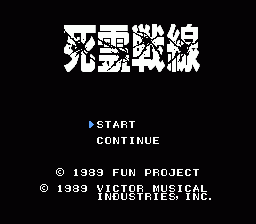
Shiryou Sensen (死霊戦線) / War of the Dead – PC Engine (1989)
PCE Cover
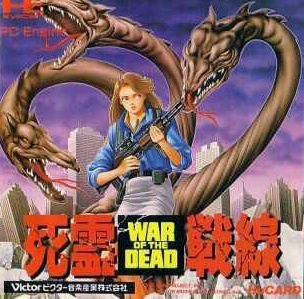
This is the version likely to interest people. Released around two months after the PC-88 game, the two titles were most likely developed concurrently. Which is interesting, since the PC Engine version has some major differences.
PC Engine
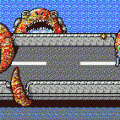
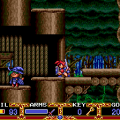
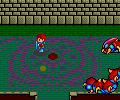
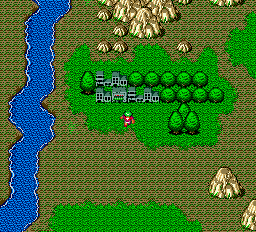
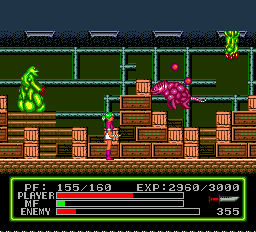
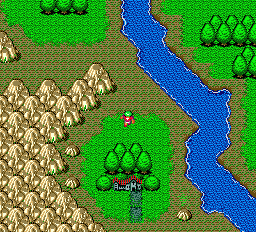
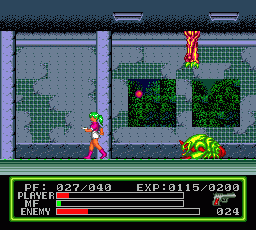
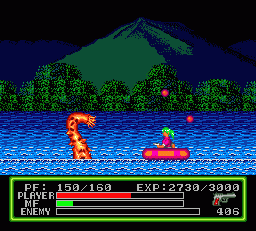
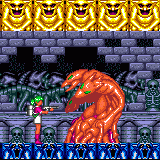
Besides the obvious increase in onscreen colours, the other major improvement is the battle system which has been overhauled. Battles now take place in large, horizontally scrolling arenas, which a distinct background based on where it was randomly triggered. The scrolling is super smooth, giving the game its Zelda II vibe, and you can escape by walking off either the left or rightmost edges. There’s also a levelling system now, since certain enemies drop blue orbs which give EXP, and at set points this results in a stat boost. Enemies also drop ammunition, health pick-ups, and PSI rejuvenators. To balance this there are far less recovery items on the world map compared to the PC-88 release (in our PC Engine playthrough we found roughly 10 recovery items all in, compared to around triple this in the PC-88 version). With guns now requiring ammunition, there’s a communal pool of bullets, with each weapon using a different amount: the gun and rifle use one bullet per single shot, whereas the shotgun fires a 3-way shot but consumes 9 bullets (rendering it too thirsty to be useful).
Due to the levelling system and need to conserve ammunition, the PC Engine game starts off extremely difficult. By the time you’ve levelled up a couple of times you’ll likely be out of ammo, at which point it’s worth wandering the overworld farming ammunition boxes from the tiny orange and green crab monsters. After a few hours though the difficulty drops off and it becomes a little too easy. Interestingly, if your EXP goes over 9999 it resets all the way to zero. As Videogameden.com reveals though, this would appear intentional, as explained by a pink slip of paper included in the PC Engine version:
War of the Dead on PC Engine comes with a little pink disclaimer that advises the player on five things to do to win the game. It explains that listening and talking to people is more important than getting experience points. It even states that Laila can’t gain more that 9999 experience points, and if she does, her stats will go back to zero and she will die. This is rather interesting, most of the other sites on the web claim that this is a bug – all of this leaves us to wonder if the developers finally decided to turn this bug into a feature or if it was deliberately designed this way. The disclaimer also warns that there is a mistake in the instruction manual, although it mentions that the player can carry 15 items, he actually can only carry 14 in the game. They acknowledge and apologize for the annoying length of the passwords and recommend to directly contact them if you happen to be stuck in the game.
PC Engine
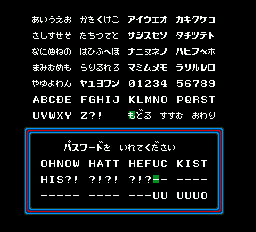
Which raises another point about the PC Engine version: unlike the computer versions it has no save feature, and instead relies on a 54 character password. This is both alpha-numerical and features both Japanese Kana scripts, for a total of 128 available characters. It’s the worst back-up system imaginable, which is why, as many people point out, War of the Dead is best experienced now through emulation.
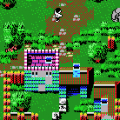
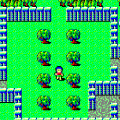
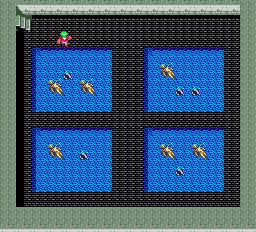
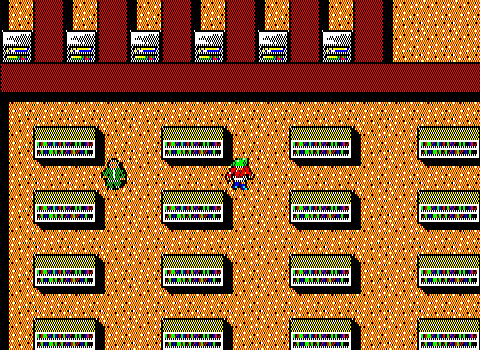
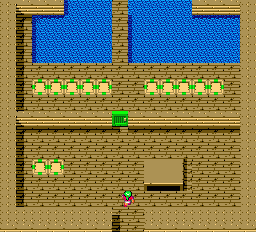
In a lot of ways the PC Engine release is less substantial than its PC-88 forebear. Clearly the HuCard medium wasn’t big enough, since whereas the PC-88 and MSX2 versions had at least 38 unique enemies, the PC Engine game has at best maybe 15 which then undergo repeated palette swaps. They’re also less gruesome and weird than in earlier games. Furthermore, there is less detail in the environments, despite the improved colors. Since the map is zoomed out more, it all adds to a feeling of bareness on PC Engine. The ruined library on PC-88 had bookshelves and strewn rocks, whereas on PC Engine it looks like someone’s garage. As does the military base and adjacent ruins. The town’s general store looks rather basic compared to its PC-88 equivalent, as does the log cabin. Also, notice how in the PC Engine version none of the school classrooms have TVs? Other changes include not seeing the characters you rescue once on the world map; on PC-88 you saw them following you all the way back to the church.
PC Engine
This is all a terrible shame, since while the PC Engine had the power to draw some exquisitely beautiful sprites, implement smoother scrolling and feature a really slick and very fun battle system, it lacked the memory to use this power to its full potential. As such battles become rather repetitive with the same boring enemies, and the environments feel a little too empty. Oh, if only it had been a PC Engine CD-ROM2 game!
In spite of all these complaints though, it still retains a lingering charm. The first War of the Dead on PC Engine is resplendent with numerous idiosyncrasies unique to older videogames. It mixes genres and styles (both overhead and side-on), contains mainly fetch-quests, has an obtuse levelling system, relies on passwords instead of a save system, starts off unforgivingly difficult but becomes progressively easier until you reach 9999 EXP, whereupon your level resets and you die – and yet still remains intriguing. It’s also an example of a really weird, really imaginative Japanese action-RPG. In 1987 and 1989 Japan was on top of the world, and despite the archaic problems endemic with WotD, it still holds value for those willing to persevere and with the Japanese language ability to enjoy its story.
It is something the likes of which will never be made again.
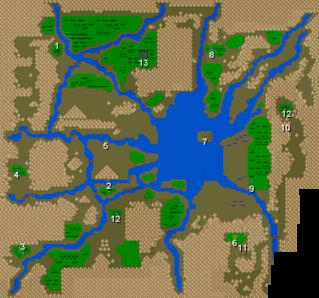
A numbered map of the entire overworld can be found above. The corresponding walkthrough, which has been Babelfish translated from its original Japanese (complete with original author’s mistakes), can be found here as a TXT file. It won’t explain the backstories of the characters, but it gives just enough information in wacky Engrish to aid completion without making it too easy. Be sure to speak to every character multiple times, and investigate anything of interest. The manual is also available in PDF form from Videogameden.
Links and thanks:
Thanks to Trickless and Snake Plissken at Tokugawa Corp
Magweasel
Videogameden
PCE guide
PCE map and guide
MSX/PC88/PCE comparison info and screens
Generation MSX
WotD2 guide by P and P by PPPP
Screenshot Comparisons
MSX2
PC-88
PC Engine
MSX2
PC-88
PC Engine
MSX2
PC-88
PC Engine
MSX2
PC-88
PC Engine
MSX2
PC-88
PC Engine
MSX2
PC-88
PC Engine
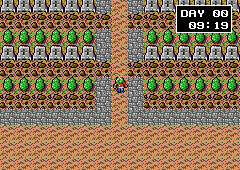
MSX2
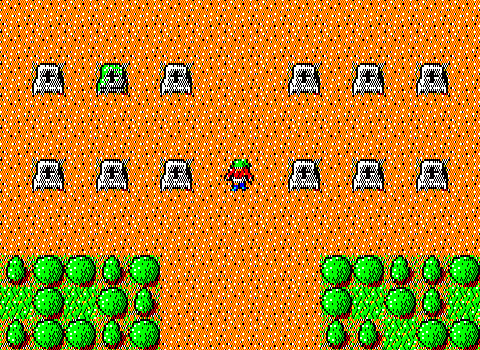
PC-88
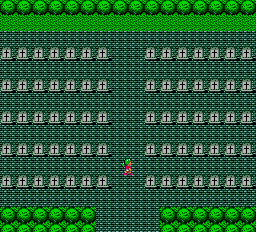
PC Engine
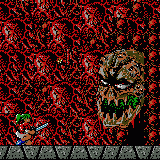
MSX2 Cover

PC-88
PC Engine
The following areas have no MSX2 equivalent and are only in the PC88 and PC Engine versions.
PC-88
PC Engine
PC-88
PC Engine
PC-88
PC Engine