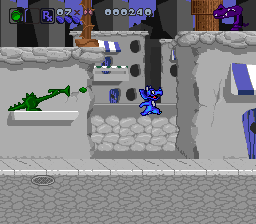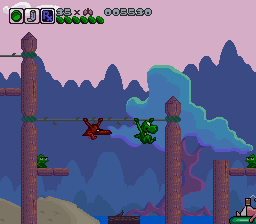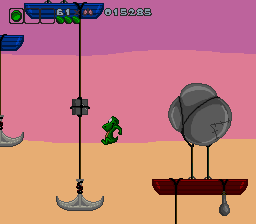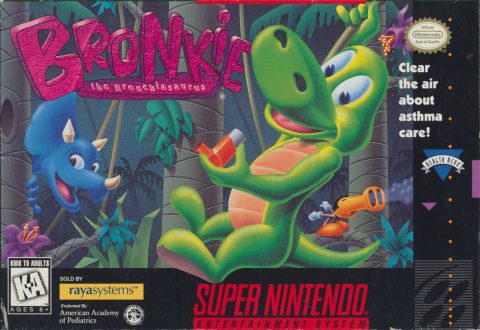
Video games have always been popular with kids, so it makes sense that companies would want to capitalize on that by creating games that didn’t just entertain but teach them things about the wider world. One such company was Raya Systems, with their “Health Hero” line of Super Nintendo side-scrollers that educated players on topics such as diabetes (Captain Novolin and Packy & Marlon) or the dangers of smoking (Rex Ronan: Experimental Surgeon). None of these could be considered great games, though their heart’s at least in the right place. The same is true for Bronkie the Bronchiasaurus, an okay enough platformer starring asthmatic dinosaurs that gives you a basic introduction on understanding asthma.
Yes, asthmatic dinosaurs. Many years ago, meteors collided with the planet of San Saurian and threw up a mighty dust cloud that choked the atmosphere. A powerful wind machine was invented to clear the air, but diabolical businessmen Mr. Rexo has stolen its components in order to gain control of San Saurian, scattering them across the land and forcing other dinosaurs to guard them. It’s up to Bronkie the Bronchiasaurus and Trakkie the Tracheratops (along with their co-op exclusive counterparts Sam and Kyla) to travel the world, retrieve the wind machine pieces and defeat Mr. Rexo before the dust clouds return.
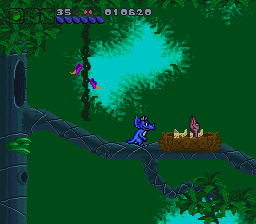
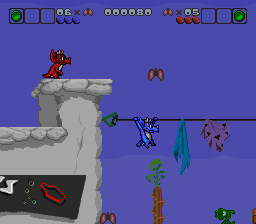
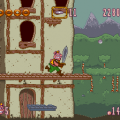
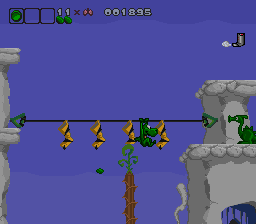
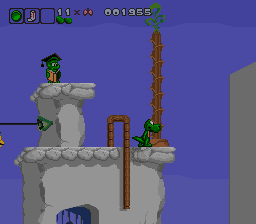
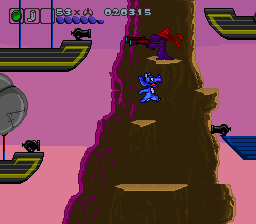
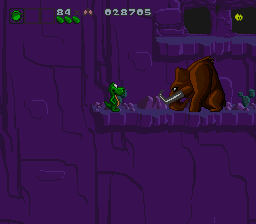
Bronkie’s a straightforward side-scroller where you need to reach the end of the level. Along with your basic walking and jumping, you can hold up when near ropes or poles to grab on and start clambering across or climbing. There’s various enemies to deal with, either using a foil to hit them up close or a breath attack that deals damage at long range. However, breath attacks are a limited resource, refilled by collecting lung icons dotted around the stage, and they’ll only be available as long as you’re in top condition.
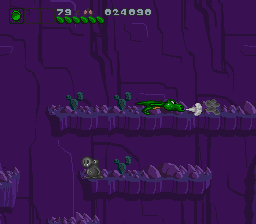
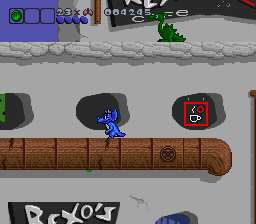
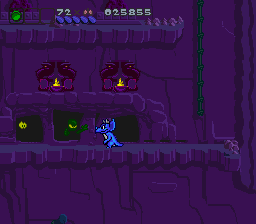
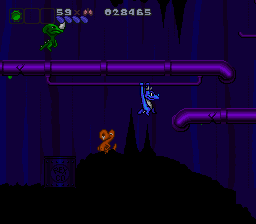
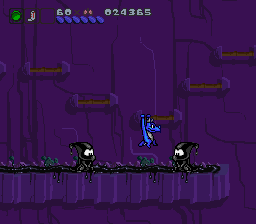
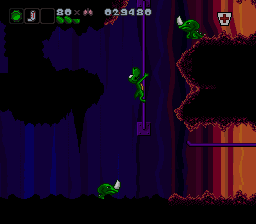
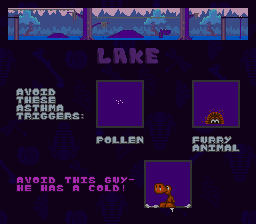
See, the levels are dotted with hazards that won’t hurt you, but will trigger your asthma when you come into contact with them. These range from smoke trails and feathers to pollen and fuzzy animals, and they gradually reduce your condition (also known as “peak flow”, aka your strongest breath, indicated here by a circle that goes from green to yellow to red). Even more worrisome are the handful of critters suffering from a cold, as getting sneezed on will severely affect you. As your asthma worsens, you’ll lose the breath attack, you’ll stop to cough on occasion and the screen gets gradually darker until you’re no longer able to see and have to restart the level.
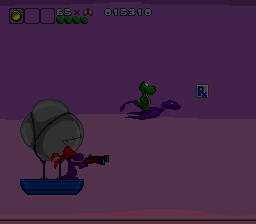
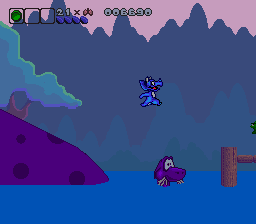
When you’re peak flow is in a yellow state. This is the only screenshot like this, since diminished visibility doesn’t really work when trying to show off the game in a non-interactive context.
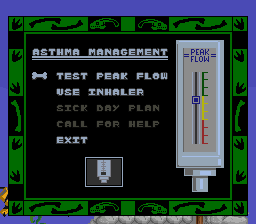
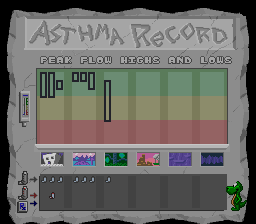
You’re encouraged to avoid these hazards as best you can, which is important since your state persists between stages if left unattended. But help is at hand if you’re stuck, by bringing up the asthma management screen with the select button. Here you test your peak flow, and can use medications found in that level – inhalers that moderately restore your peak flow, and sick meds that cure your cold and significantly heal you. It’s a somewhat tedious process mechanically, having to check your peak flow every time before being able to use your inhaler or sick meds, but it helps players to get into the routine of checking their own condition and knowing how to remedy it.
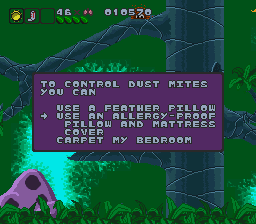
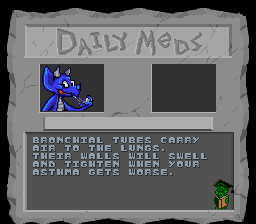
Teaching players how to understand and cope with asthma is also baked into the levels, where the way forward is opened by encountering a variety of friendly dinosaurs and correctly answering questions about asthma. The information is provided to you via the Daily Meds screen preceding every level, accompanied by an animation on how to take your inhaler, but you can always find the helpful Hazel nearby to remind you if you give an incorrect answer. The info given here is very general, and the game insists that it’s not supposed to dictate the player’s specific needs, which should be figured out with a doctor. Individuals need to discuss and figure out what works best for them, so it’s much appreciated that Bronkie approaches its asthma education from that perspective.
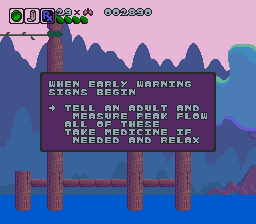
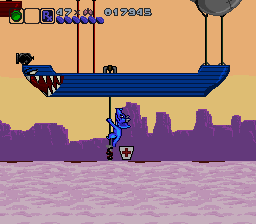
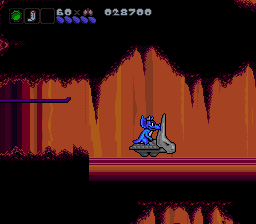
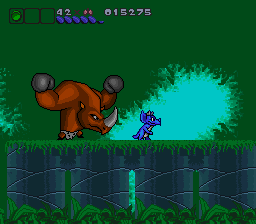
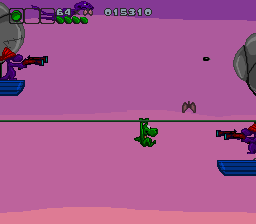
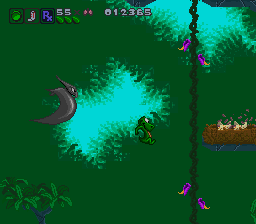
But even if you’re not asthmatic or looking for a general introduction, you’ve certainly got a serviceable side-scroller to spend an afternoon on. Movement’s a bit slow and stodgy, enough to make strolling around feel middling, but jumps are quite dependable and you’ve got decent air control. The stage designs offer plenty of rope climbing, jumping and general opportunities to explore for secrets, and there’s a nice variety of unique obstacles for each world, such as the vines and swooping pterodactyls in the jungles or the flying creatures and blimps in the sky area. That said, levels tend to stop suddenly and don’t offer much progression in challenge, so the last third of the adventure falls quite flat.
It’s difficult at times to see when a platform ends due to the artwork, which can often result in you walking off by mistake and plummeting into a pit. Death has more consequence since there’s no checkpoints, booting you back to the beginning of the level, and you’ll have to restart that world from the first stage if you lose one of your three continues (though you can find more lives hidden about). There’s 18 stages to play through and strangely no password system, so you’re encouraged to play more carefully. But that’s easy enough to do, and the game largely doesn’t test your reflexes with very generous health pick-ups and boss fights that mostly ask you to hit them and then walk away from their attacks.
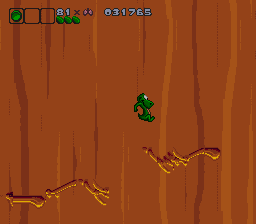
The overall sense of unremarkable pleasantness also extends to the graphics. They feature cute dinosaur characters and natural landscapes sometimes bathed in pretty colors, but the game’s visually middling beyond that. At least they’re better than the soundtrack by John Bartelt, which plods along with a collection of repetitive tunes scored by endless guitar chords and high-pitched timpani melodies that grate on the ears after a while.
For what it sets out to accomplish, Bronkie pulls everything off well enough even if it’s mostly average. That said, it’s much appreciated pleasing that it features a proper co-operative mode where you and another player can go through the adventure together, playing as Brokie and Sam or Trakkie and Lyla (everyone plays the same, the only difference is in the sprites and the respective player colors). Considering how many platformers at this time still used the “taking turns” style of multiplayer, this is genuinely quite nice and it’s impressive that the game runs just as well as solo play.