- Blood Omen: Legacy of Kain
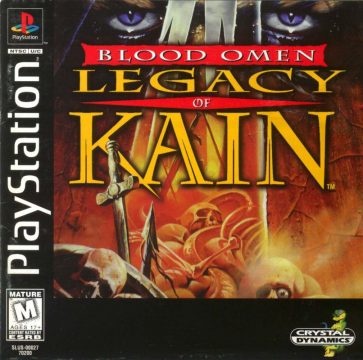
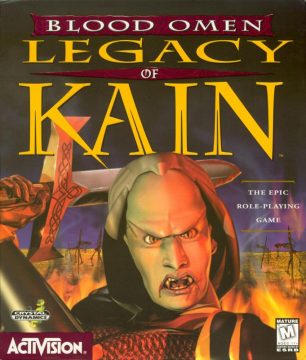
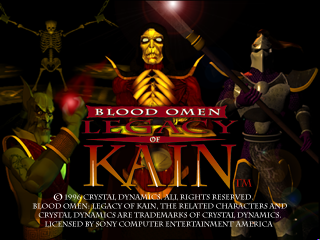
When Blood Omen: Legacy of Kain first dropped for the original PlayStation in 1996, it found itself at the crossroads of video gaming. Around this time, the industry was beginning to shift towards 3D graphics, especially with popular games like Super Mario 64 and Tomb Raider. And yet, Blood Omen is a top-down 2D RPG that was dark, violent, and theatrical, something like The Legend of Zelda: A Link to the Past but as reimagined by Anne Rice. Developed by Silicon Knights and Crystal Dynamics, Blood Omen is a game whose mechanical and technical elements have aged ungracefully, but whose writing and world-building remain its most enduring legacy.
Blood Omen was developed for the original PlayStation, and like many games from that era, its exact budget wasn’t disclosed. However, the scale of the project can be gleaned from team size and development time. Most RPGs developed for the PlayStation were done by smaller teams, typically ranging from 20 to 40 people. This was an era when game directors were also coders and artists – indeed, Silicon Knights head Denis Dyack was both the director and lead programmer. But Blood Omen was an ambitious project, so Silicon Knights had to double their staff and even request support from publisher Crystal Dynamics over a three-and-a-half-year period of the game’s development cycle. Despite the fact that it didn’t adhere to the contemporary trends in gaming, Blood Omen was still clearly above your average game developed in the mid-90s, at least in terms of team size and resource commitments.
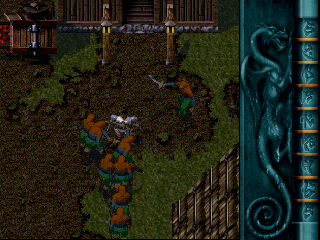
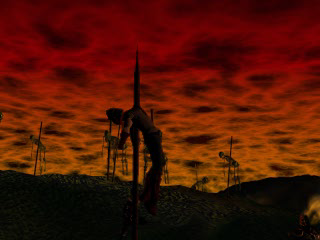
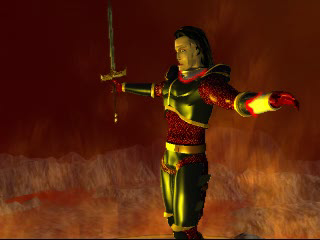
The story follows Kain, an arrogant nobleman who’s killed within the first five minutes of gameplay, only to be resurrected as a vampire by Mortainus, the Guardian of Death. Initially driven by a desire for revenge and a cure for his vampiric un-life, Kain’s journey takes him across Nosgoth, a decaying land whose fate is bound to a group of corrupted guardians called the Circle of Nine. The game wastes no time establishing the setup, as told via foreboding monologue by Kain himself over a CG intro cinema
And this is where Blood Omen’s identity really sharpens. While many console RPGs of the time favored straightforward quests and lighthearted narratives, Blood Omen goes the other way and establishes a grim, Gothic atmosphere and a dense, Shakespearean script. Kain isn’t a noble hero, but an antihero drawn deeper into a world of betrayal and decay. The voice acting, particularly Simon Templeman’s performance as Kain, gives the impeccable writing its bite, with Kain’s monologues framing story.
At the same time, computer RPGs like Ultima VII had already been exploring more complex gameplay systems and player-driven structures. This makes Blood Omen feel like it’s stuck in between traditional console RPGs and computer RPGs – it’s less complex than a typical computer RPG, but far more theatrical, character-driven, and above all, more violent, than other console RPGs of the time. Compare this to any number of 16-bit action-RPGs, and it just looks and feels so much different.
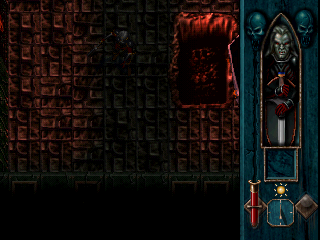
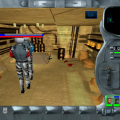
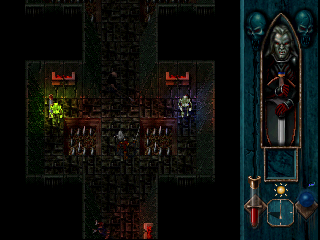
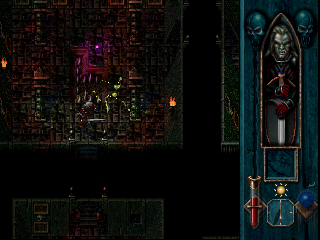
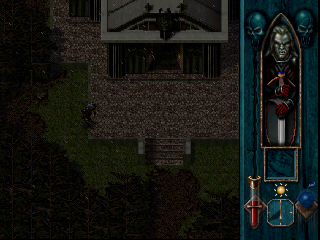
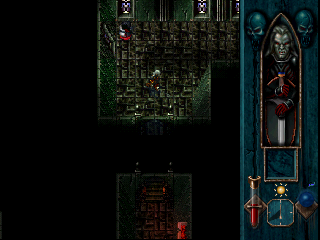
The graphics in Blood Omen are dark. Extremely dark. The overworld is murky, and it’s hard to make your way around dungeons (particularly on older CRTs that lack brightness controls), as the shadows are lit only by torches and other colored light. And its computer rendered intro, while dramatic, definitely shows its age. You can zoom the camera in and out, in case you want to get a better view of the area, or get a more dramatic view of the combat. However, this also severely taxes the PlayStation hardware, so it’s usually best to keep it close up. But Blood Omen compensates for these issues with its tone. The world of Nosgoth is hostile and diseased, the architecture is brutal, the interiors are claustrophobic, and villages feel less like safe havens and more like feeding grounds that fuel Kain’s survival.
Blood Omen has an overworld to explore, but at some point, progression will be blocked and you’ll need to visit a dungeon or some other locations to obtain spells, items, or abilities that allow you to continue. The overworld itself isn’t really open, but rather a series of areas that connect towns, dungeons and other important locations. For example, Kain, as a vampire, can’t traverse water until players pick up a shapeshifting spell that allows him to assume a misty form and “glide” over water. There’s a day/night cycle too, with certain doors opening up at nighttime. Kain is strong enough that he’s unharmed by the daylight, though it does make him a bit weaker.
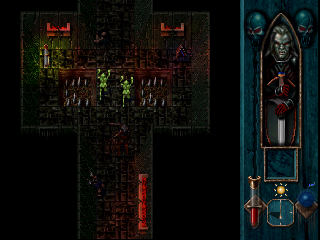
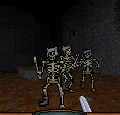
The dungeons and other locations focus on both combat and survival, but also puzzles. These usually come down to locked gates and doors and their usually switch-and-key logic. These spaces are filled with enemies that would love to turn Kain dead-dead indefinitely, reminding the player that they’re not just a predator, but also prey that has to manage its health and hunger. Kain’s vampirism is both a power and a constraint, as he has to feed on blood to restore his life. While this can be done in combat – it’s quite satisfying to slash up something then suck blood straight from its body – indiscriminate feeding isn’t without consequences. For example, depriving entire villages of their blood will create scarcity later on, which introduces some interesting resource management. Certain enemies also have blood that’s poisonous to Kain, so best not to feed on them.
Combat is also quite straightforward, consisting mostly of hacking and slashing, but Kain acquires more weapons and spells as the game progresses. Though you can obtain upgraded equipment, there’s nothing in the way of leveling or stats. Magic spells let you fire lightning, repel enemy attacks, or even possess an enemy’s body. Shapeshifting abilities are particularly important: as previously mentioned, mist form allows traversal across water, wolf form enhances mobility, and bat form enables fast travel between checkpoints. The world is filled with secrets, so exploration is not just encouraged but also handsomely rewarded.
Though Blood Omen was truly ahead of its time in many ways, the original PlayStation release was notorious for its lengthy and frequent loading screens. Nearly every action, whether it’s entering a building, opening a menu, or transitioning between areas, triggers a loading screen. And these are long – moving to a different screen can take 20 seconds or more. Sadly, this issue persists through emulation, and modern gamers that want to experience this narrative will either have to get accustomed to its sluggishness or try loading up the Windows version. The PC version alleviates the loading screen issues considerably, offering much smoother navigation without changing the core visuals. Beyond that the PC version is very faithful to the PlayStation original. Its menus are re-done in high-res, but other than that, no other significant changes were made to the Windows port.
Despite its technical blemishes, Blood Omen endures because of its narrative. The main focus is the fantastic story and Shakespearean dialogue, fueled by impeccable vocal performances. But, buried beneath a mountain of loading screens and simplistic combat, lies a somewhat flawed game, worth experiencing mostly for its deep and rich lore. It also remains unique in that all of its sequels ditch the 2D format in favor of 3D adventures, while shifting viewpoints between different characters.