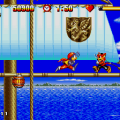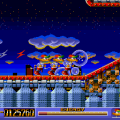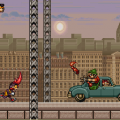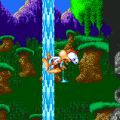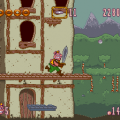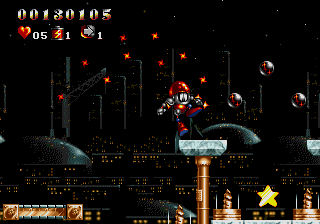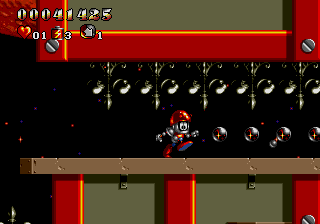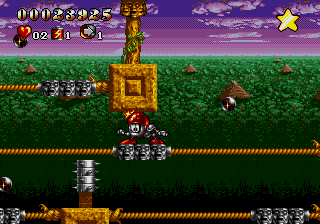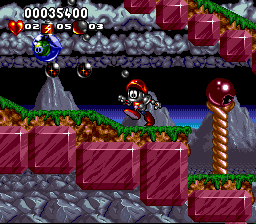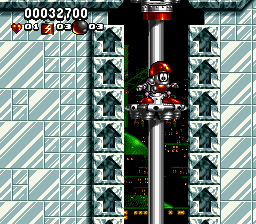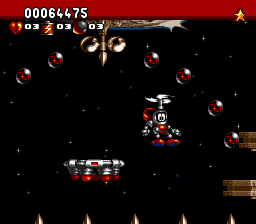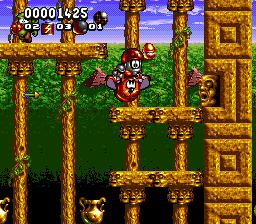
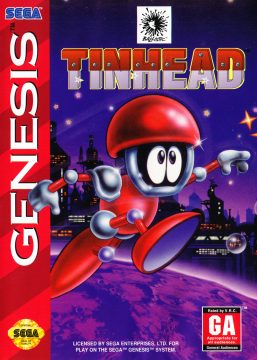
By the early 90s, MicroProse had established a UK division to publish externally developed titles and create ports of their own games such as Gunship, F-15 Strike Eagle II and Pirates! Gold. In the middle of this, a small team within MicroProse UK (including future Crystal Dynamics/Naughty Dog designer Richard Lemarchand) developed an original side-scrolling action game called Tinhead, inspired by the likes of Sonic the Hedgehog and Blaster Master. Despite their high hopes for its success, Tinhead only saw a limited North American release due to financial issues within MicroProse, dooming a decent though frustrating adventure to obscurity.
The galaxy is under threat by the foul goblin Grim Sludge, who’s using his strange spaceship to suck up stars and scatter them across the cosmos. It’s up to Tinhead, a small patrol robot who receives the stars’ distress signal, to travel across four worlds, rescue the stars and stop Grim Sludge. This plays out as a 2D platformer where you need to collect a star lurking somewhere in the stage, which will activate a teleporter to bring you to the next area.
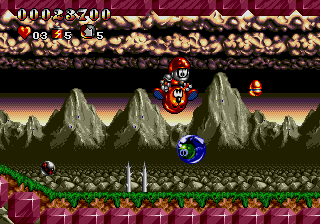
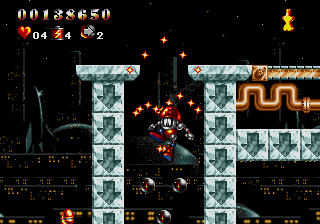
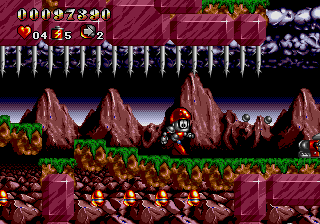
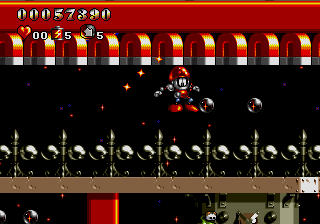
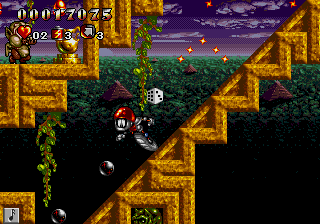
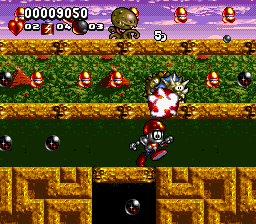
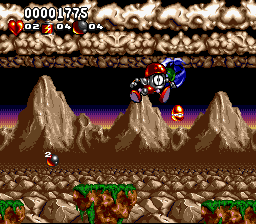
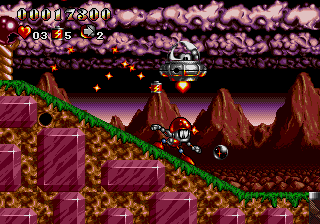
You can run, jump and duck about the place to avoid obstacles and enemies, but you’ve also got the ability to fire little balls at different angles, swapping between shooting straight ahead, diagonally upward and diagonally downward with the press of a button. These balls also ricochet off walls when fired upwards or bounce along the ground when fired downwards, so you’re able to hit enemies from various angles. Your rate of fire is pretty slow, only shooting one ball at a time, but you can increase it to a maximum of five by finding power-ups hidden in orange metallic shells dotted around.
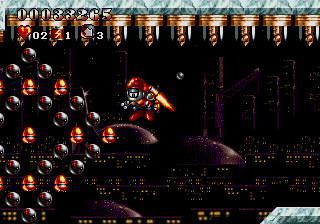
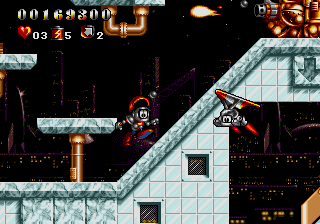
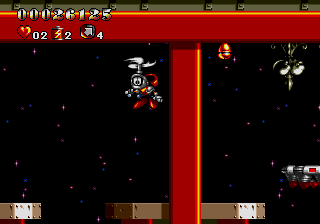
These shells also contain various knick-knacks that provide points, health-restoring batteries, and even vehicles which allow you to reach further parts of the level. These vehicles, ranging from space hoppers to gyrocopters, usually aren’t required to beat the stage, which is good because they’re overly sensitive to control and you lose them after a single hit. Getting hit is something that’ll happen a lot, as levels are full of foes and hazards that you can’t anticipate until it’s almost too late to do anything.
Almost. The box proudly boasts of your ability to move the camera around when you pause the game, giving you some chance to see what’s ahead, but this encourages a very stop-start style of play that results in every stage lasting at least 5-10 minutes. This is exacerbated by the cramped convoluted designs, where you’re likely to get lost or even wind up back at the beginning while trying to figure things out. Levels are thankfully generous enough to offer plenty of goodies to keep your health and fire rate up, even providing extra lives and secret areas to earn more points for the diligent explorers.
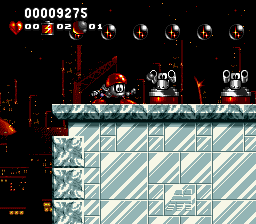
But there’s a point where it becomes exhausting going through these stages, especially because the lack of checkpoints forces you to start the entire thing over whenever you die. Anything past the first world sees you groping in the dark whilst being bombarded by enemies, spike pits and other dangers, forced to play so carefully until you memorize every layout or go mad in the process. It’s just as well that the game offers passwords for each of the worlds’ three sectors (individually comprised of two stages), because having to tackle the game with just three lives and no continues would be damn near impossible.
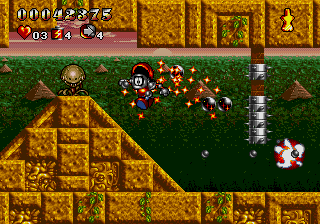
Tinhead‘s high difficulty frustrates considerably because the underlying game is quite solid. The controls take a while to get used to, since you lose all momentum at the height of your jump and you need to constantly move on slopes to avoid sliding down them immediately. But you have surprisingly fine control over your jump height and can turn round straight away, something which levels are designed around well enough to ensure you can explore and overcome whatever comes your way (albeit with a tight margin of error).
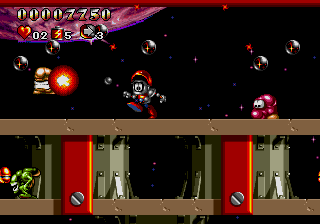
In terms of the gunplay, it’s satisfying to blast enemies, using your bullets’ ricocheting capabilities to hit them from safe angles. You can even hold down the fire button to keep firing away, though this is limited to five bullets at most onscreen and that will go down by one whenever you get hit. If you’re able to approach the game on its terms, there’s a substantial adventure with twenty-four sizeable levels dense with secrets and challenges. The variety of stage designs is laudable, with open-ended areas, linear winding corridors, and tangled mazes to dig into.
If things are too much, there’s a practice mode you can choose from the options menu (complete with its own set of unique passwords) that cuts out every other stage and two of the game’s four bosses to make for a somewhat more approachable affair. Bosses are generally quite a bit easier, asking you to shoot them whilst avoiding their attacks, though they can still put up a fight if you come into them underequipped.
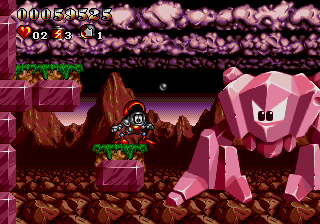
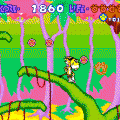
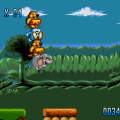
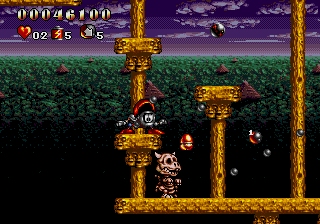
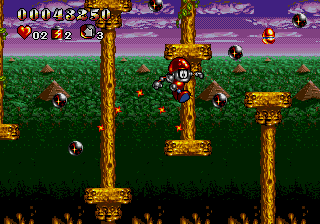
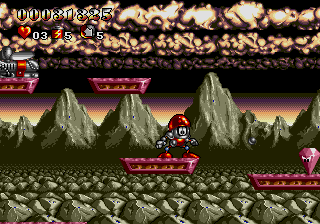
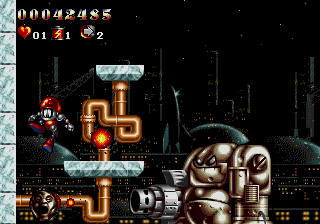
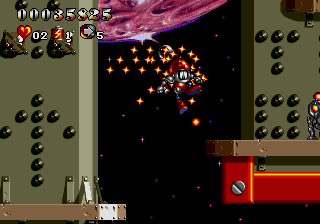
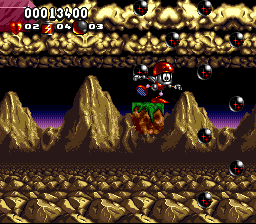
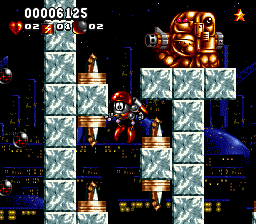
It’s hard to sincerely recommend Tinhead unless you’re looking for a real challenge, because the length and complexity of those levels becomes too punishing after a while that it’s a slog. The game’s an acquired taste when it comes to mascot platformers, and that’s possibly true for the presentation. The graphics run very well despite how many objects and enemies can be onscreen at any time, Tinhead has some cute animations like when they’re precariously perched on an edge, and each world features a unique selection of foes in addition to backgrounds that shift color every two stages.
The soundtrack was Paul Tonge’s earliest work on consoles, having spent his earlier years composing for home computer titles, and it’s got a solid foundation. Every world gets a unique lengthy track specific to its mood, from the Crystal World’s carefree dance rhythms to Star Hulk’s uneasy drones, which is appropriately scored with various metallic sounding instruments. It’s admittedly easy for the music to get lost under the many sound effects, which are generally pleasant but occur so frequently that it becomes rather cacophonous.
While Tinhead only officially came out for the Genesis, there were plans to port it to the Amiga, the Atari Jaguar and the Super Nintendo. The Amiga versions were cancelled before they’d gotten far, while the Jaguar and SNES ports were finished but ultimately unreleased. A prototype of the SNES version was dumped online at some unknown point, possibly from producer Stuart Whyte’s website in the early 00s if not earlier, before the rights were eventually acquired by Piko Interactive who have since sold it via reproduction carts, an emulated Steam release and their Evercade collections.
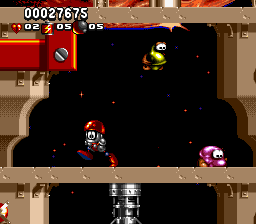
SNES version
It’s identical in most ways to the Genesis version, utilizing the same mechanics, level designs, and presentation as closely as the system could manage, but with a couple changes to the controls and camera. Jumping is easier to perform when moving, your mid-air momentum doesn’t drop as suddenly and you can jump further from a slope, so it’s less finicky to move around. The extra face buttons on the controller means there’s a dedicated fire button for each shooting style, and the shoulder buttons allow you to pan the camera left or right.
You’ll definitely need that, because the SNES port lacks the ability to move the camera around while paused. Combined with the cramped viewpoint due to the smaller horizontal resolution, you have considerably less ability to see what’s coming ahead, resulting in a much harder version of a game that’s already difficult to begin with.
Comparisons:
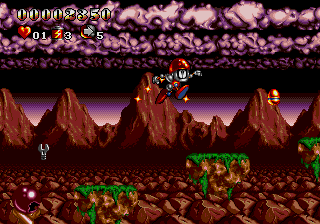
Genesis
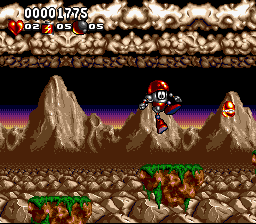
SNES
Links:
A collection of development materials from producer Stuart Whyte, some of which were originally featured on his long-defunct and mostly unpreserved website – https://archive.org/details/tinhead-dev-materials
“The Making of Tinhead”, Retro Gamer Issue 269.