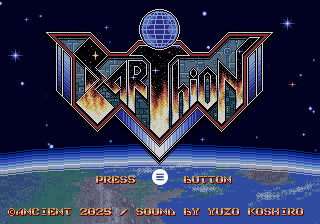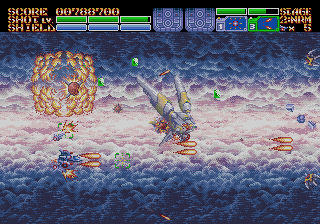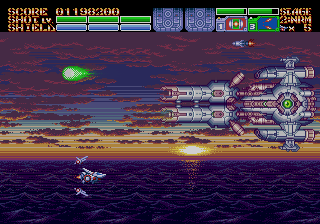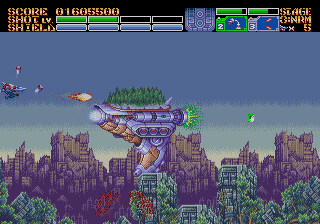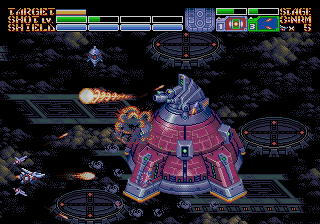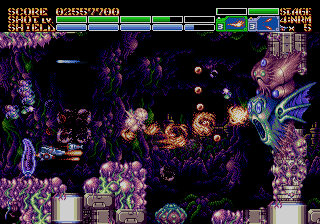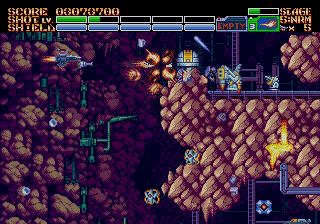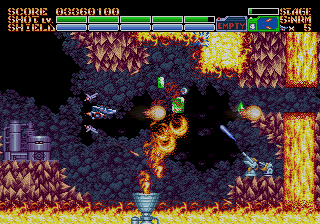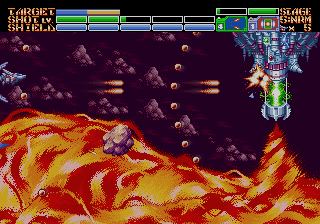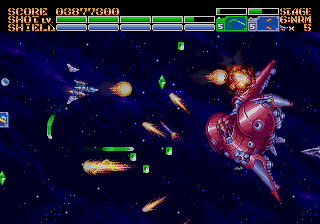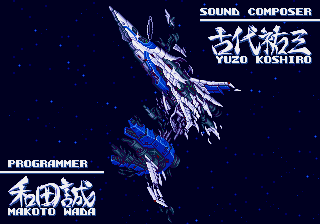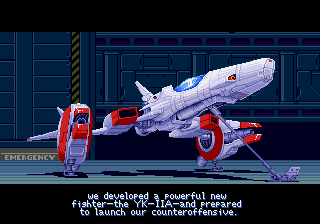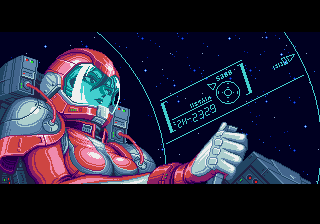
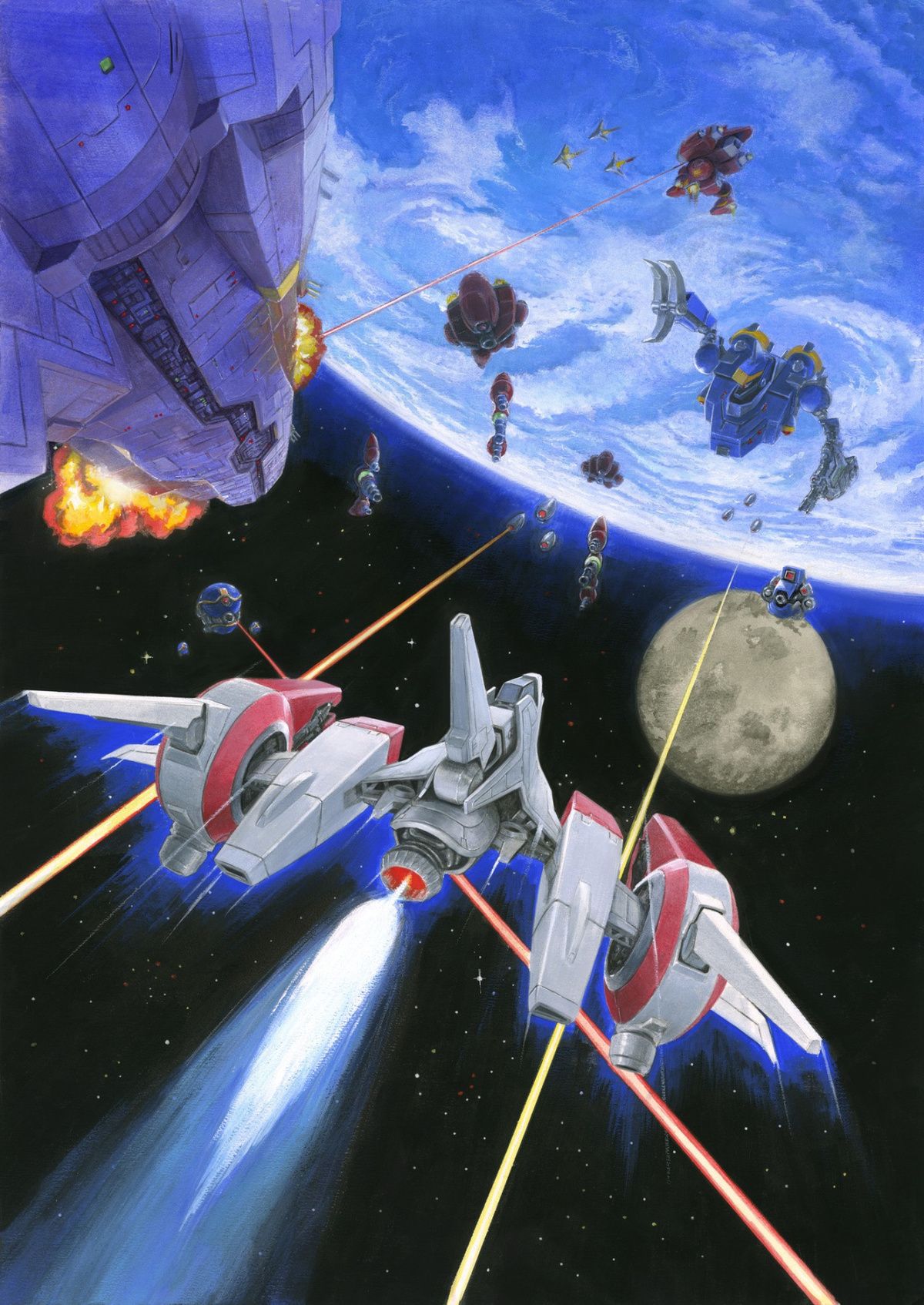
Earthion is the ultimate Genesis shoot-em-up, an immediate classic that channels 16-bit games like Thunder Force III and Whip Rush while still having its own identity. It comes from Ancient Corp, including programmer artist Makoto Wada (Gotta Protectors) and the legendary composer Yuzo Koshiro (Ys, Streets of Rage), putting their all into a singular work of passion. The setup is the same as so many other shooters – aliens invade, and it’s up to scientist Azusa Takanashi to pilot the YK-IIA spaceship to stop them.
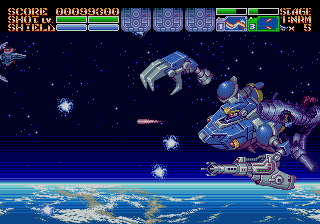
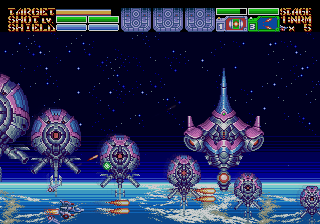
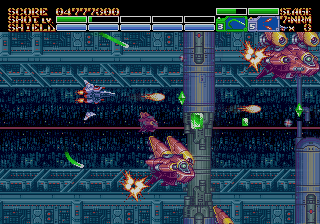
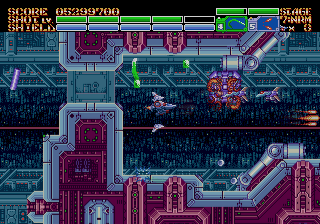
The shoot-em-up basics, from the style to the feel, are all quintessentially Genesis, though it benefits from cleverly modern design. Unlike so many other contemporary shoot-em-ups, Earthion features a regenerating shield system, an aspect that feels refreshingly modern. At the outset, it can only take two hits before leaving you vulnerable to destruction, but if you manage to avoid damage for several seconds, it’ll quickly regenerate back to full strength. Enemy fire is denser than most other 16-bit shoot-em-ups to counterbalance your high defense, which requires both quick reflexes to dodge the bullets and strong offense to defeat enemies before they can overwhelm you. It’s also a testament to the programmer that the action doesn’t flicker and rarely slows down, alleviating a regular problem from the era
Earthion also benefits from a flexible weapon system. You’re always equipped with a rapid-fire weapon, along with two collectible subweapons. You power these up by collecting green gems, but taking damage also decreases their strength, and you’ll lose the subweapon if its strength hits zero. You’re restricted to whatever subweapons pop up in each stage, but there’s a good variety among them that allow several different valid strategies to make your way through both the levels and the bosses. You’ll find wide-range weapons like the Detonator, which lobs bombs upwards and downwards simultaneously, and V-Fire, which fires dual lasers above and beneath your ship. Alternatively, you can find the Pyro Cannon, a flamethrower which annihilates enemies at close range, and the Hyper Missiles, which fires explosive shots. Also among these is an unusual weapon which activates a targeting cursor that moves forward as you hold the fire button and detonates a powerful bomb in its sights when you release it.
Along with this is a unique customization system. In every stage, you’ll find an adaptation pod, which takes up one of your subweapon slots and has no ability by itself. If you manage to make it to the end of the stage with this pod intact, you can choose from one of several upgrades. Some of these are permanent enhancements that extend your shield and power gauge, expand your maximum subweapon level, or increase the number of subweapons you can hold. Alternatively, you begin with the stage with an additional subweapon or give yourself an extra life. What’s more, when you get a game over, you’re given a password that lets you start a new game with all of your enhancements intact. This gives players a leg up to allow them to more easily get through the game on subsequent plays, though expert players can also choose to ignore it if they’d like a more straightforward arcade-like experience. Between the four difficulty levels and the password feature, Earthion is as easy or as hard as you want it to be.
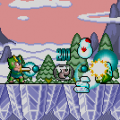
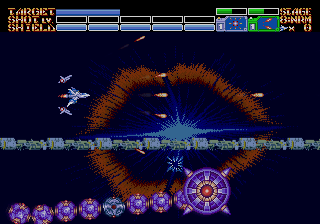
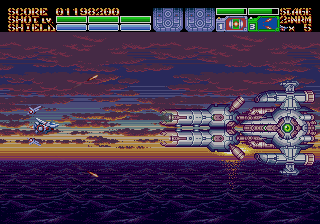
The stages are just as expertly designed as its mechanics, with plenty of scenarios that are both fresh and familiar. The first stage takes place in Earth’s orbit, with the boss battle including an array of satellites that float around an enemy spaceship, one of the first 3D effects used in the game. Smartly, the satellites themselves can’t actually hurt you, so you just need to dodge its targeting cursor in order to avoid its fire. The second stage takes place in the cloudy skies, always a great place to show off parallax scrolling, while the third takes place in a ruined city, complete with a destroyed Statue of Liberty, ever the post-apocalyptic favorite.
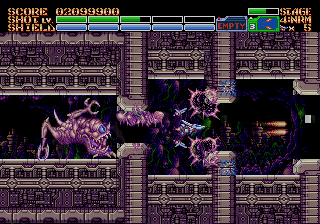
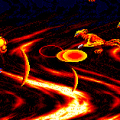
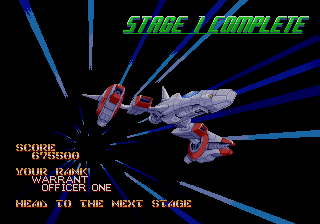
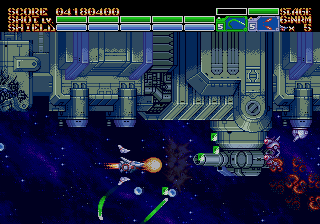
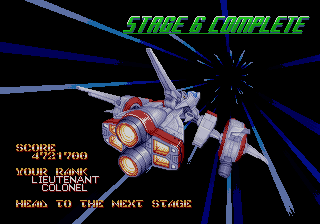
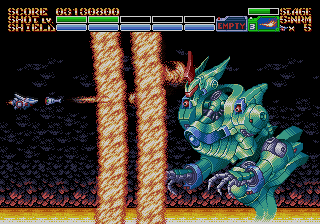
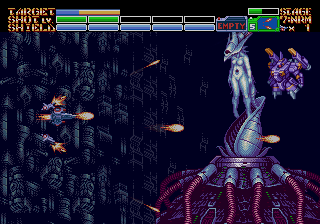
The fourth level begins with you being chased by an alien monstrosity through a tight series of tunnels, and you continue through the rest of it cleaning the level of Life Force-style biological goo. The fifth stage takes place underground, where you fight an enormous MECHA in a pool of lava, who attacks with gigantic claws and flame pillars. The final three stages are one long assault on the alien HQ, beginning as you fly around its exterior, zoom inside to the core for a Gradius-style base level, then back into outer space for a three-part final boss encounter. Each level also begins and ends with a lavish animation of Earthion smoothly blasting into the gameplay field or out into the victory screen. It’s really showing off that 60 megabit of ROM space, which is several times larger than any Genesis shoot-em-up from the 1990s.
As expected from an Ancient title, the soundtrack is fantastic. Yuzo Koshiro isn’t just a brilliant video game music composer, but he’s a big VGM nerd in general, and he’s able to assemble a crunchy soundtrack that screams “shoot-em-up music”. Some of it channels Konami, particularly the distinct orchestral hits, with other compositions being more complex than typical 16-bit soundtracks. Most of the best songs are near the end, including as Gradius-as-hell song for the Gradius-as-hell penultimate stage, and a truly rocking heavy metal track for the final battle, which proudly stands up next to MUSHA and Thunder Force IV as one of the best showcases of the Genesis sound chip. Also hidden is the track called “Space Travel 2025”, based on an unused track composed for ActRaiser thirty-five years prior. (At the beginning of the sixth stage, hold down A+C+Start to change the music.)
While designed for Genesis hardware, Earthion was first released in emulated form for computers and consoles. This was designed by BitWave, the same company behind many Toaplan arcade game reissues. There’s a variety of display options, including the ability to tinker with the color output to make a modern HD monitor look a little more like a CRT. Unlike other emulated games, though, there are no save states or rewind functionality, since this is a new game rather than a retro game and it’s considered a little too close to cheating. Also welcome are several prototypes so you can see the game develop over time, including an early prototype where you pilot a mecha rather than a spaceship. There’s no ability to save the passwords though, so you still need to write them down old school style. The original release had spinning triangle-shaped bullets that were somewhat difficult to see, but a later revision changed these to circular bullets, which is a definite improvement. Earthion was also released on the exA-Arcadia platform, which includes several slightly different variations on the soundtrack and a revised scoring and a hyper system meant for arcade play. It’s a little annoying that this mode is exclusive to an arcade platform almost no one has access to, when it could easily be activated as an optional mode on the standard release, but that goes for everything on the exA-Arcadia.
Comparing Earthion to 1990s Genesis shooters almost feels unfair – after all, it benefits from thirty years of shooter design evolution and development tons, plus as an indie project, it’s also free of the compromises made for other titles. But it’s also the work of two monumentally talented individuals who put their heart into making another all-timer.