|
Page 1:
Introduction
Prince of Persia
|
Page 2:
The Shadow & The Flame
Arabian Nights
Harem Adventures
|
Page 3:
The Sands of Time
Warrior Within
|
Page 4:
The Two Thrones
Battles of Prince of Persia
|
Page 5:
Prince of Persia 2008
The Fallen King
|
Page 6:
The Forgotten Sands
|
Page 7:
The Graphic Novel
Before the Sandstorm
The Sands of Time (Movie)
|
|
|
Back to the Index
|
Prince of Persia - PlayStation 3, Xbox 360, Windows (2008), Macintosh (2009)

European Regular Cover
|

American LE Cover
|

European LE Cover
|
|
By The Two Thrones Ubisoft's well proven formula for their Prince of Persia series had begun to show first signs of fatigue. And while both follow-ups to Sands of Time were great games, they've strayed quite a bit from the original direction with their dark settings and the troubled Prince. October 2007 Jordan Mechner wrote in his afterword to the Prince of Persia graphic novel:
Ubisoft followed up Sands of Time with two sequels, Warrior Within and The Two Thrones, which gave the prince a more ruthless, violent edge. They're hard at work now in Montreal crafting his next adventure, which promises to feel closer in spirit to the romantic fantasy of Sands of Time and of the original game.
And it is. At least its Prince is a light-hearted, playful lad, albeit a plundering good for nothing. A real magnificient bastard. He's the most likable Prince yet, safe for the cringeworthy anachronisms in his speech. He is first seen walking through a desert shouting for Farah. First the fear that this would build up to a lame tie-in with The Sands of Time, but it turns out an awesome reference: Farah is his donkey, which was loaded with all the gold from his latest tomb raid, but he lost it. Before can find the animal, he bumps into a young woman that is chased by armed guards. Being the roque gentleman that he is, he of course decides to help her. Elika—so the name of the woman, as he eventually finds out—tries desperately to reach a temple to restore some kind of seal, so he goes along for the ride. Inside the temple, however, her father, whom she was running away from, destroys the seal and unleashes the god of darkness, Ahriman, onto the world. The evil deity immediately covers the whole country with his dark taint, but Elika uncovers strange powers that can help her to fight him back. Prince and Princess set out to undo the magical oil spill and make the world bright and colorful again.
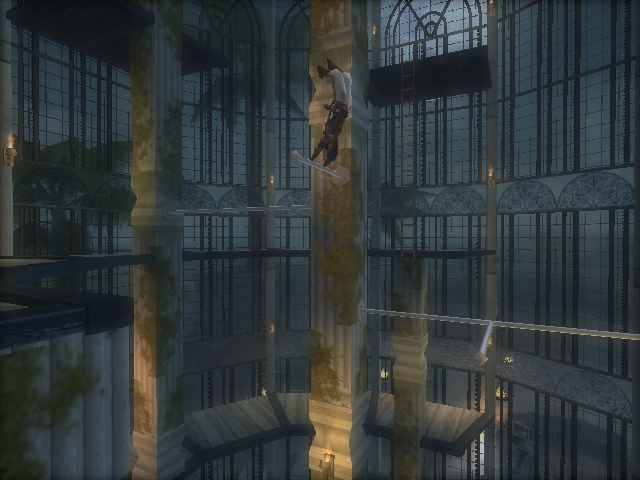
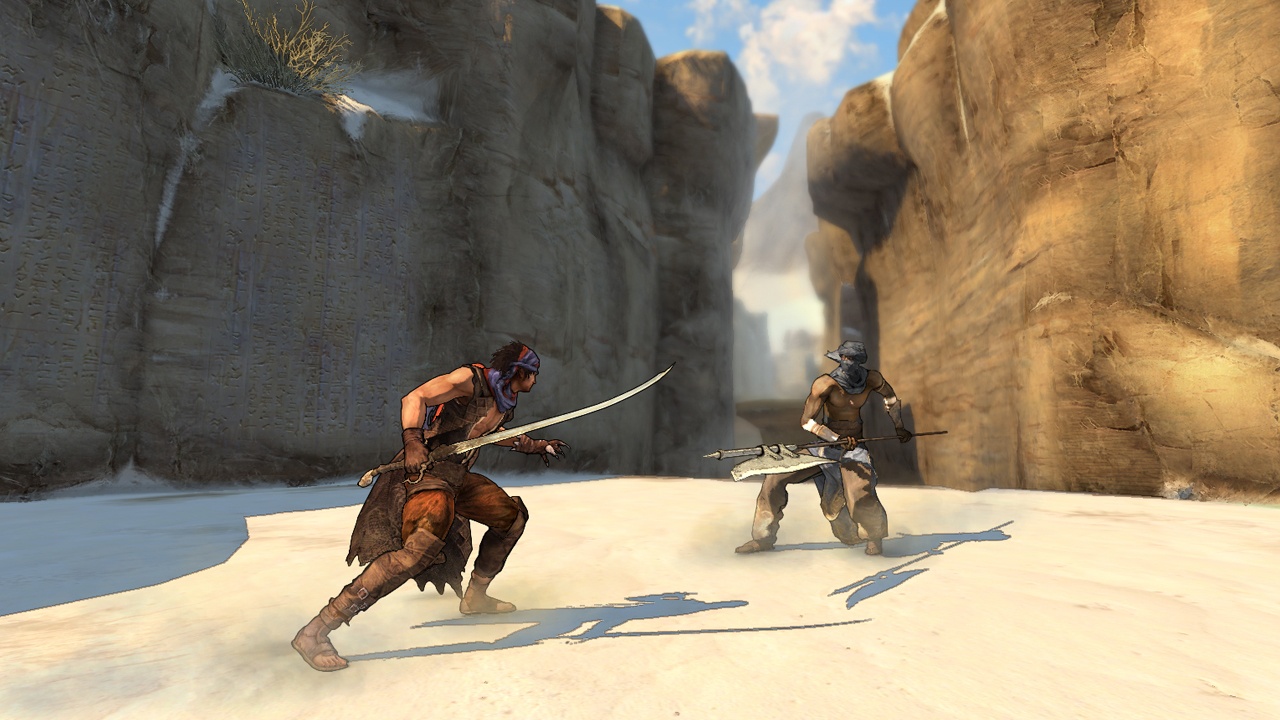
If you've casually followed talk about Prince of Persia... stop! Yeah, this game is called Prince of Persia. Just Prince of Persia. At some time, it was supposed to carry the subtitle The Prodigy, but of course it's much cooler to name a new game the exact same as another, because being able to properly identify them by their title is so narrow-minded. Well anyway, if you've very casually followed talk about the game, chances are you've heard about one good thing and one bad thing. Good things first: The graphics are wonderful. They capture the miraculous spirit of The Arabian Nights more than any other game in the series. The colors are vivid (at least after fighting back the taint in any given area), the characters accentuated with very subtle but effective cell shading and there's a ton of visual effects worthy of the fairy tale atmosphere.
The "bad" thing most talked about is the fact that you can't die. Whenever the Prince misses a jump or gets overwhelmed by an enemy, Elika intervenes and catches him in the last moment. That's... not so bad. In the previous games, you'd wind back time with the Sands at fatal missteps, until you'd run out of containers. That only ever happened at particularly hard or annoying challenges. So when no Sand containers were left, you'd have to start over from the last checkpoint. When you were lucky, that'd be right before the hard section, rendering the limit mostly meaningless. Worst case, you'd have to do a lot of boringly easy jumps and maybe even watch a cutscene again before getting to the actual hard part. This just equals an endless supply of Sand containers, cutting all the annoying bullshit. Or at least in theory, as it doesn't always work that well. Elika will always bring the prince back to the last piece of solid ground he stood on, which especially later in the game can well be as far back as a conventional check point, certainly farther than the Sands of Time would take you. Then Elika is a real overachiever, pulling you out of jumps that would have been no problem without her. At some points the prince can miss a jump to a patch of vines (which are used for climbing), but safely grab the patch below it, Elika pulls him back while he's already landes safely, hanging onto the vines. When Elika saves the Prince in combat with an energy ball to the enemy's face, its life bar will recharge a bit, which is a cool gameplay idea but doesn't make much sense when you think about it. She can also always save you, no matter if she's supposed to be trapped some 100 feet away. But despite the few flaws, it is still a good gameplay change. There won't be coming much more (good ones, that is).
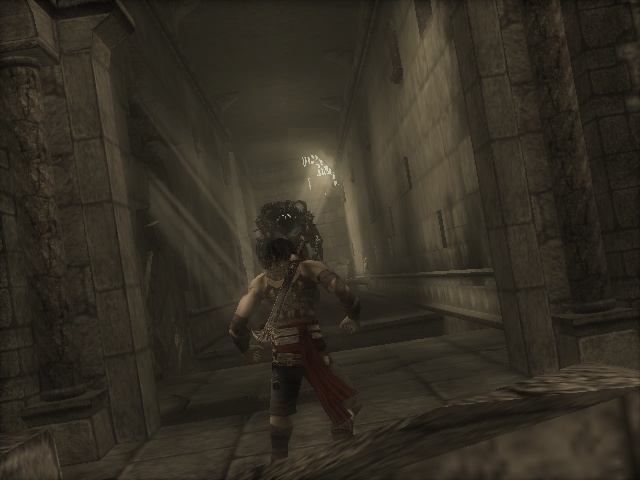
The Prince himself has mostly the same set of standard movements, with only two notable additions. He's wearing a strange metal claw throughout the game, which he uses to grind down walls. This is so incredibly slow, it's not even funny. There's no way to just drop down, either, and jumping away is likely to get you killed. He can now also do ceiling-runs, another meh-element. There's one or two places where it's used cleverly, but most of the time it just wastes your time because you have to climb a pole all the way up to jump to the next instead of just jumping over. There's no seperate button for wall runs anymore, as they're just done by jumping towards a wall and going on. As a result, the prince can to wallruns out of any jump, making him somewhat more agile. That means only the jump button is used for platforming, with two exceptions. There are rings on walls where the prince can hold on and use them to lift himself up a little more, which uses a different button. There's no good explanation in the physicality for this, and the distinction seems quite arbitrary. Then there's a third button to call Elika so she lifts the prince up a bit in the air, which is just a glorified double jump, only that you need yet another button for something that should just be jumping. Despite all that button waste, there's not much skill or speed needed for the platforming. That's mostly thanks to the levels, which are even more obviously staged to form your paths, making them feel more like an automated rollercoaster ride. Not quite as dull and boring as in Assassin's Creed (whose graphics engine it uses), but nowhere near as exciting as in former Prince of Persia episodes. Because you can take on the levels in any order, they're also all vaguely the same difficulty.

A new Prince
|

Elika
|
Speaking of time wastes. Elika has no meaningful place in the gameplay. Yeah, she has a lot of powers that are really useful, but there's no need for a second human character doing all those things. Elika follows the prince around everywhere, so when you change directions while climbing, she'll be in the way, making you wait through a place-swapping animation that's only charming the first 5 times you see it. When climbing the vines, the Prince waits for her to carry her on the back, yet when he jumps or wallruns onwards, he leaves her hanging onto the vines alone, which means she's perfectly capable of that, so why make the player wait in the first place? Her presence also makes the prince look like a wuss as he needs saving constantly, sometimes he's even screaming for her. He's also uncapable of turning cranks alone, so he has to wait again for her lame ass to catch up and grap the other side. One of the more useful skills she has is shooting a magic arrow that lines out the direction of your current selected target, but a cool Prince could learn to do that by himself, too.
Then there's her stupid special powers. The biggest change in the game design philosophy is not the Prince's inability to die while being a total loser, it's the non-linear game progression. The whole map in Prince of Persia is spread out like a tree where all major areas can be reached from the beginning. However, to get to the "Fertile Grounds" where Elika's magic is supposed to drive out Ahriman's taint, you need to use teleporters in most of them, and Erika's special powers are the fancy keys to activate them. At least one has you flying around like in a tunnel shooter (minus the shooting) which is pretty cool. To unlock new "powers," the game puts you through a collect-a-thon for sparkling Light Seeds, which are spread out in every area after the taint is gone. Since the areas all used to have been decayed long before the dark god's release, they're all ruins still, and instead of an open world you just have a bunch of linear path that meet every now and then, making for lots of aggravating backtracking to get enough lights to unlock the next power. There is a teleport function to fast travel to visited places, but you still gotta go and collect the Seeds.
At least Elika is an interesting character in the story, with lots of fun banter between her and the Prince. But not even that they did right. Instead of just talking away while platforming like the Prince and Farah did half of the time before, you have to actually stop and engage in the talks, which are carried out in cutscenes, which means more unnecessary waste of time. There is a little bit of ingame banter, but the timing is all messed up, making it seem involuntarily comical, like when the prince notices "You're heavier than you look," after taking Erika on his back for the umpteenth time. Her characterization also suffers from the modular structure of the game. Her relationship with the Prince just seems to jump back and forth depending on the order in which the areas are cleared. Even the optional banter is usually bound to location rather than progress.
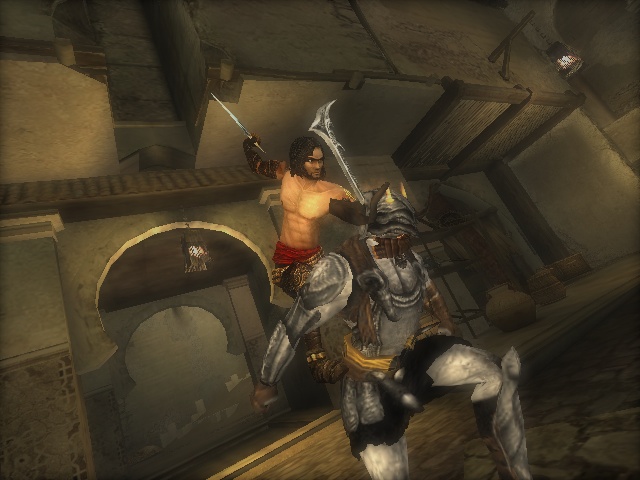
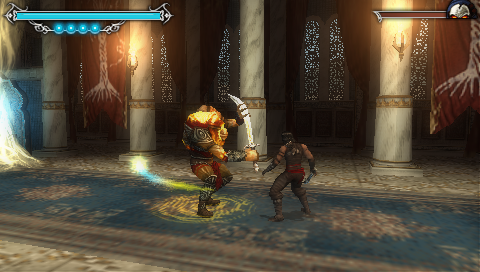
There's one good thing to say about the combat in this game—it's much rarer than in the Sands of Time series. Normal enemies, of which there are a whooping two different types, can be undone even before they spawn when moving fast, and with the right, simple combo, taking them out in a fight is a matter of mere seconds. The bosses, however, are annoying as hell. The aim was obviously to go back to the duel-style of the classic Prince of Persia games, but the system is not very exciting. Besides the standard attack, rolling, jumping over the enemy and blocking, the only new moves are to call Elika or to grab the Enemy with the princes claw and throw them into the air. Usually, the prince would dash into this attack, but when you're just one pixel to far away, he'll just do an utterly pathetic and dissatisfying version of the move that just slows him down and doesn't feel very good. Combat does have that back-and-forth element that made the original great, but it's so badly drawn out and QTE-infested that it just bores. There's never any sense about the Prince's standing in the combat, as he doesn't have a life bar and can only be taken out by getting knocked down and then missing a really slow random button prompt. About half of a boss battle consists of such badly paced QTEs, whenever an opponent blocks an attack or uses a special move, the prince falls down on the floor, or the opponents cling their weapons together. To make the parade of fail complete, sometimes during combat the controls just won't respond (at least on the Xbox 360, which was used for review). And worst of all, each of the four major bosses has to be fought six times.
The saving system is somewhat messed up, too. It pretends like it lets you save at any time, but really it is based on checkpoints. So it's easy to quit and delete the last ten minutes of gameplay progress when not paying attention to this issue.
Now, this review kinda makes it sounds as if Not-Prodigy was a real stinker. It's not. Aside from the almost insufferable boss battles, it's still kinda good in a consumer-review-decent-score way. But since it takes such a great series and throws in so many unnecessary, annoying little things, it can really spoil the impression in direct comparison. It's just hard to believe that this game was made by the same team as the glorious Sands of Time trilogy. It's like someone was given all the ingredients for a great Prince of Persia game, but had no idea what they were doing. At a few unfortunate times the level design is so bad it can make you cry. At some point there's a tower where a teleport brings you to the second floor. Apparently, the game only expects you to go up there once, as there's no "naturally" laid out way back down. It would be possible, however, to sequence break by using the double jump, grinding down a wall and a short drop, but Elika won't let you, so you're forced to go up all the way to the 5th-or-so floor before you can grind down the outside. Not to mention that the tower contains one of the longest, most annoying to repeat jumping passages in the whole game, containing no less than 22 jumps before the next speck of solid ground. Prince of Persia: The Lost Subtitle is so great to look at, yet so aggravating to play at times. No wonder they immediately went back to make more Sands of Time sequels.
The game does have a few nice special costumes for both the Prince and Elika to unlock. To get Altaïr from Assassin's Creed you have to connect the game to an Ubisoft account, so sometime in the future this won't be obtainable anymore. You can punch in a code to turn the two main characters into the Prince and Farah from The Sands of Time (the option says "pre-order code," but the same code works for everyone), but they look rather awkward with the new models. When you beat the game, Elika can become Jade from Ubisoft's underdog favourite Good and Evil. Finally there are outfits from some prototype concepts. The last two are by far the best costumes in the game, but they require finding all 1001 Light Seeds to get, so there's probably like 10 people in the world who ever got them. And even then, there's no point in using them anymore, afterwards. It's almost as if they wanted to miss not a single possible stupid design decision.
|
|
Oh, I lied. If you've heard about the good and the bad thing I mentioned in the beginning, you've almost certainly also heard of another bad thing: "The greedy bastards make you pay extra for the ending!" Well, the first ending is a cliffhanger and the DLC ending is a cliffhanger, only with another dungeon and some mindless chatter in between. If you still want more after the already much too long main game, here's your chance to test out your 1001-Light-Seeds costumes, you crazy nerd. In truth, the first ending already is too much as it is. It should have ended five minutes before and go out in style with a powerful downer ending. Instead it goes on to make a total ass out of the prince. Worse yet, it makes an ass out of the player by forcing to enact the stupidity, interactively. If you've got any self respect, just turn the game off before the very final task (after the first staff roll). No need for any DLC to drag out the misery even further.
|

Prince of Persia (2008)

Prince of Persia (2008, promo)

Prince of Persia (2008, promo)

Prince of Persia (2008, promo)

Prince of Persia (2008, promo)

Prince of Persia (2008, promo)

Prince of Persia (2008, promo)

Prince of Persia (2008, promo)

Prince of Persia (2008, promo)

Prince of Persia (2008, promo)

Prince of Persia (2008, promo)

Prince of Persia (2008, promo)

Prince of Persia (2008, promo)

Prince of Persia (2008, promo)

Prince of Persia Epilogue (promo)

Prince of Persia Epilogue (promo)
|
Prince of Persia - Mobile (2008)

Prince of Persia (Mobile)
|

Prince of Persia (Mobile)
|

Prince of Persia (Mobile)
|
By the time Ubisoft decided it was high time to try out new directions, Gameloft apparently had found their formula to stick with. Even though at times you're given direct control over Elika to fly around and lift things with her magic, and the prince got his new moves from the big brother, the game plays and feels almost exactly like mobile The Two Thrones. As one would expect its entirely linear, and the lights you collect merely unlock extra stuff, like survival and time attack modes. It also mostly drops the duel-style combat in favor of some mass brawls.
There is one portion, however, where the game is entirely different, and that are the Space Harrier style rail shooter levels on the back of a Griffon. There's two of them, but they look the same, and most of the time your main concern is to avoid pillars, except for the boss in the second one.
The graphic style likewise is very similar to the former mobile game, not quite as magical as the title it's supposed to be based on. Apparently Gameloft also decided they'd want to be taken seriously now, as the silly softerotic pictures in between stages are gone.
|

Prince of Persia (Mobile)
|

Prince of Persia (Mobile)
|

Prince of Persia (Mobile)
|

Prince of Persia (Mobile)
|
Prince of Persia: The Fallen King - NDS (2008)

Cover
|

Prince of Persia: The Fallen King (NDS)
|

Prince of Persia: The Fallen King (NDS)
|
|
2008 was not the year of the Prince. While Prince of Persia 2008 was easily the worst since Prince of Persia 3D, the Nintendo DS was given the dubious honor to host the handheld counterpart. Produced by Ubisoft Casablanca in Morocco, Prince of Persia: The Fallen King ties in directly with The Game in Dire Need of A Subtitle but drops the red&blue-scarfed hero into a super-deformed cartoon world. The plot is picked up where the former game left off, conveniently keeping any ties to a minimum. The Prince is seperated from Elika and travels alone to The City of New Dawn in order to find remnants of the power of Ormazd, god of light, to fight Ahriman's corruption. Here he frees and befriends the half-tainted wizard Zal, who then becomes his sidekick for this adventure. There's the usual fair share of (text only) banter between the two, but the dialogue between the two is so bad, it's hard to tell whether it was written for a five-year-old or by a five-year-old.
While it uses 3D graphics, the DS adventure takes place on a (gameplay-wise) perfectly flat 2D plane. The game is divided into about 50 medium-length stages, which are connected by Super Mario Bros. 3 style world maps. The Prince is entirely controlled with the Stylus. The Prince just walks whatever the stylus points at, tapping causes him to jump from ledges, double-tapping is for combat rolls. When trying to slide down a wall (once again painfully slow) or jumping hastily through traps the controls can be a bit finicky, in a particularly annoying way. Whenever they aren't, the game feels even more automated than its predecessor. In fact the platforming is so damn boring, it's entirely possible—and recommendable— to read a comic book, listen to a podcast, surf the web or do whatever else doesn't require your undivided attention.
Combat isn't much better, either. You simply tap enemies to attack. Stroking results in a painfully slow charged attack that's required to destroy some obstables, but is completeley useless in battle and in fact harmful when initiated by accidental strokes, which can happen quite easily. It is also possible to block by pointing at the Prince himself, but that's hardly ever necessary—until the game starts spamming monsters that can only be hurt after blocking their attack, which makes for a tiresome, staged back-and-forth. It's not so bad when you can just casually murder single enemies in passing. The portions where constantly spawning enemies use force fields to hold the Prince inside an artificial arena are when it gets annoying fast.
Buttons come only into play when commanding Zal to use his magic, whereby any button is as good as all the others. In the beginning, Zal can only activate switches and stun enemies with his energy projectiles, but in the later course of the game, he gets overwhelmed by the taint several times and has to be saved by the Prince. After these episodes and after beating bosses, he learns new powers, like the ability to manipulate tainted orbs that serve as strong magnets for stone platforms and enemies alike, or a magic hookshot. Although the setups to use them always remain very simple, Zal's powers are easily the most interesting part of the game; The fact that you have to replay stages that were boring the first time to get him back each time much less so.
Nowadays action games rarely seem to get away without any form of "RPG elementz" upgrading system. Here it's kept quite simple: Gold coins are dispersed all around the stages, and can be used to open certain doors, behind which lie locked-away powerups. Chances are you don't have enough money when encountering such a door for the first time, requiring some backtracking through the growingly tedious stages. The best method is to just skip the doors where you don't have enough money and instead save up your ressources for the next one, as the rewards of extra life points and force shields are hardly worth the hassle of going through the same stage twice. The game's condescending insistence to show the effect of every switch in a cutscene no matter how obvious, even with the opened door right in front of your eyes, is further prove that the main intent and purpose of The Fallen King is no doubt to waste your time without giving you anything in reward.
As is to be expected from a fully 3D game on the DS, the polygon models look very coarse, especially in close-ups during cutscenes. The stages occasionally show some nice details that distract from the dull overall layout. While it looks OK, there's an in-universe issue with the graphics: The land is supposed to be corrupted by Ahriman, yet it doesn't look like that at all. The sceneries have their bright (though often monotonous) colors perfectly intact.
While not as annoying as Prince of Persia 7, The Fallen King lacks the highs as well as the lows. It's slow-paced, laughably easy and badly written. The Prince of Persia series continued to deteriorate under Ahriman's taint at a worrying rate.
|

Prince of Persia: The Fallen King (NDS)

Prince of Persia: The Fallen King (NDS)

Prince of Persia: The Fallen King (NDS)

Prince of Persia: The Fallen King (NDS)

Prince of Persia: The Fallen King (NDS)
|
Page 1:
Introduction
Prince of Persia
|
Page 2:
The Shadow & The Flame
Arabian Nights
Harem Adventures
|
Page 3:
The Sands of Time
Warrior Within
|
Page 4:
The Two Thrones
Battles of Prince of Persia
|
Page 5:
Prince of Persia 2008
The Fallen King
|
Page 6:
The Forgotten Sands
|
Page 7:
The Graphic Novel
Before the Sandstorm
The Sands of Time (Movie)
|
|
|
Back to the Index
|
|