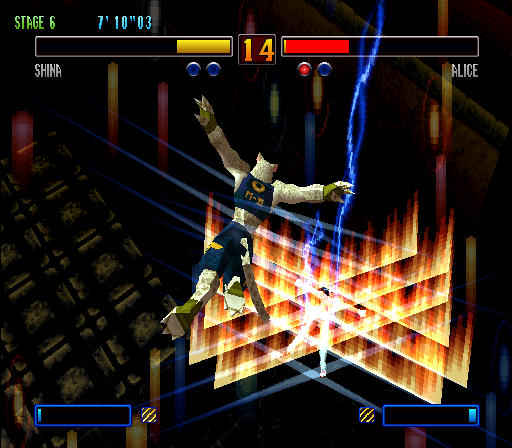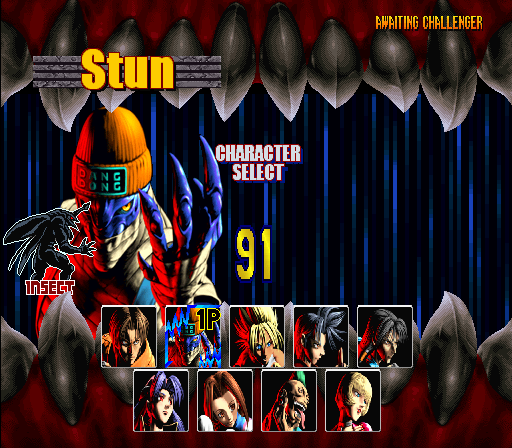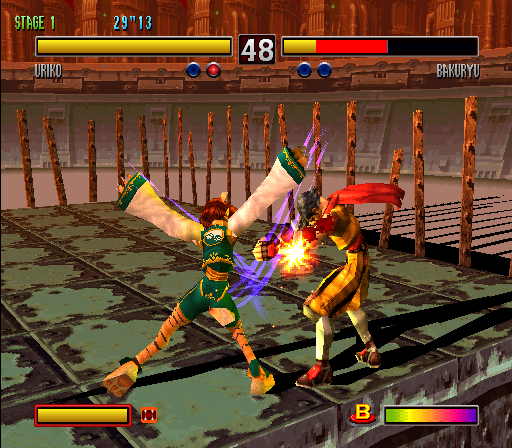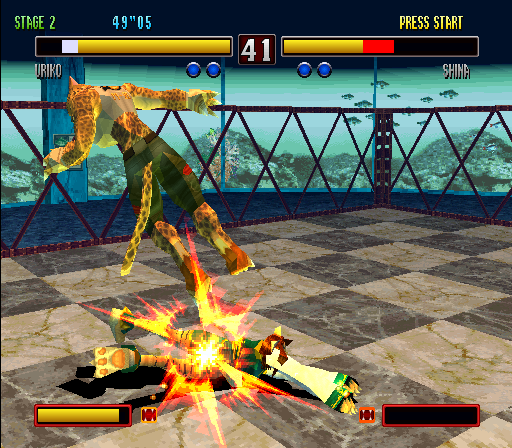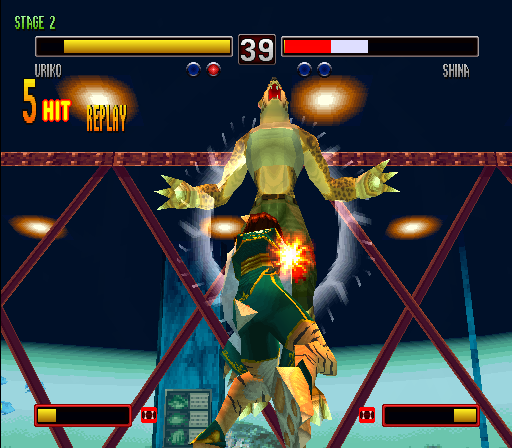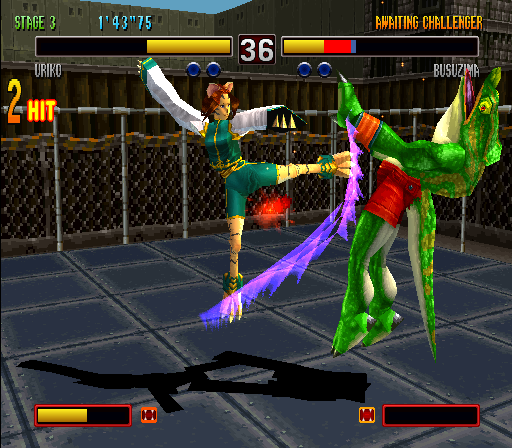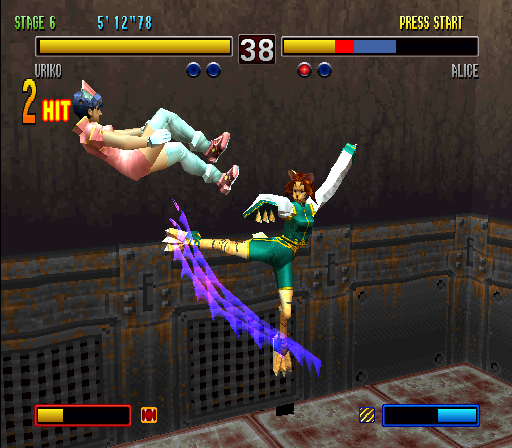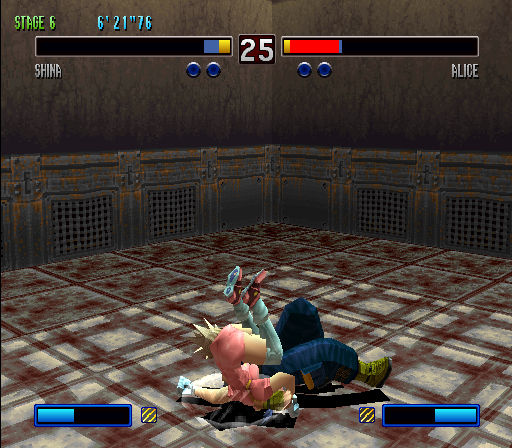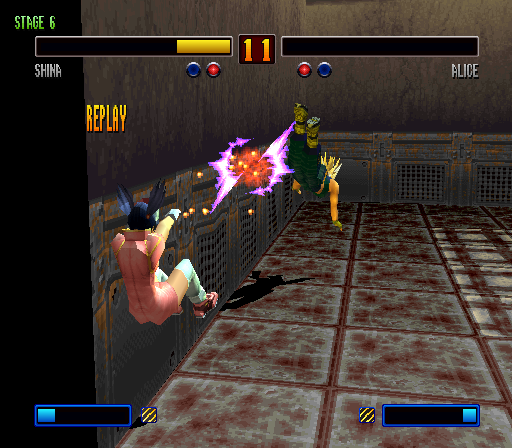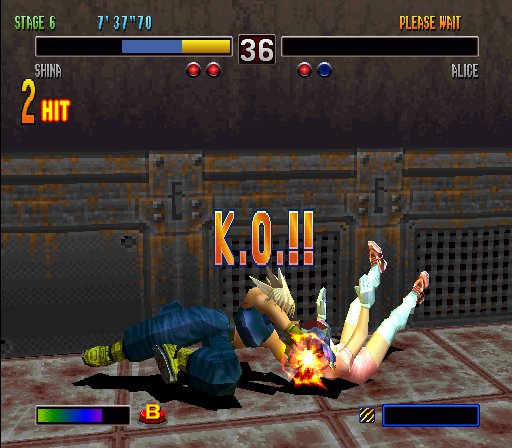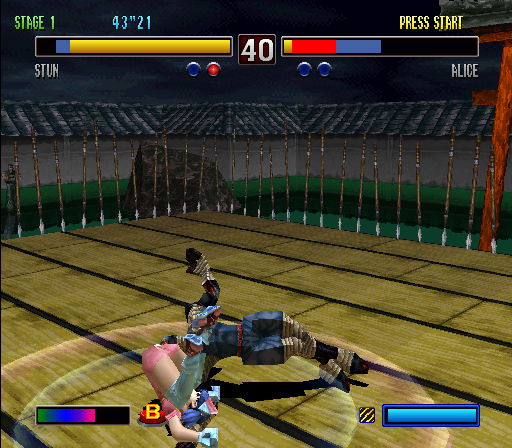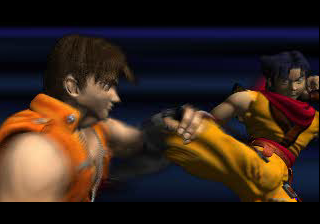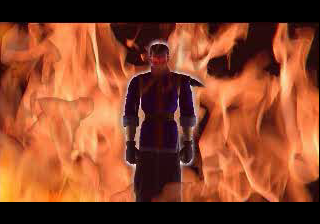
Released more than a year after the original game hit arcades, Bloody Roar 2 stands as an improvement on almost everything its prequel had. It’s often considered a favorite by series fans, and while it’s more of a matter of taste, it’s certainly a valid perspective to take. It certainly competes a lot better with the PS1’s many 3D fighters, although whether it beats the legendary Tekken 3 is a very iffy call.
Five years after the first game and the destruction of the Tylon Corporation, the world has finally taken notice of zoanthropes. A new underground organization known as the Zoanthrope Liberation Front claims to be fighting against the violence and persecution they now face. It turns out they’re actually a terrorist organization bent on world domination, attacking humans as well as the zoanthropes who don’t cooperate. New fighters and old gather on both sides of the conflict, although they’ll fight amongst each other regardless for whatever flimsy reasons they can think of.
Characters
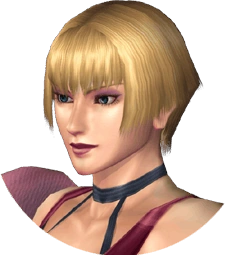
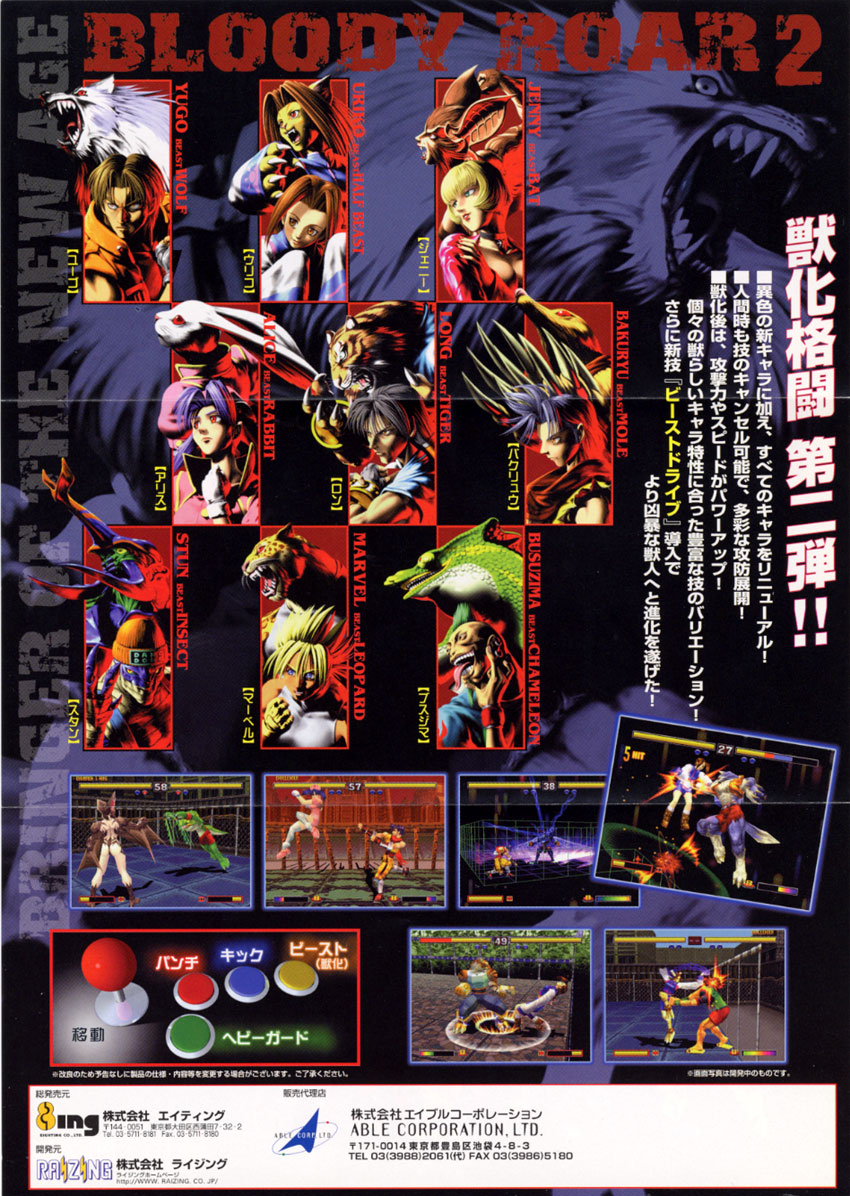
Jenny the Bat
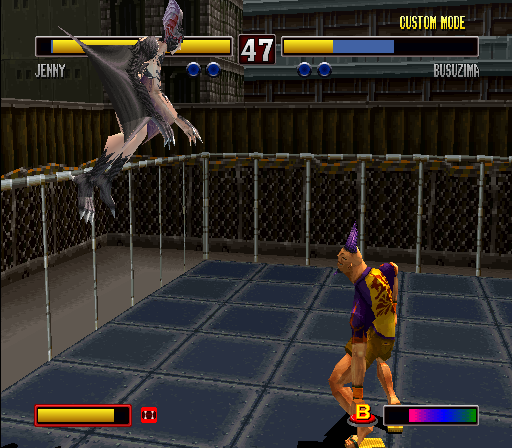
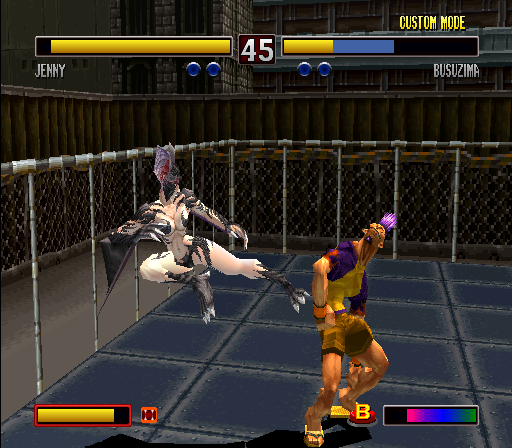
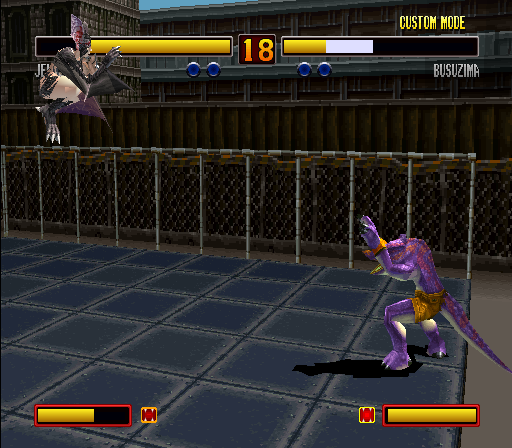
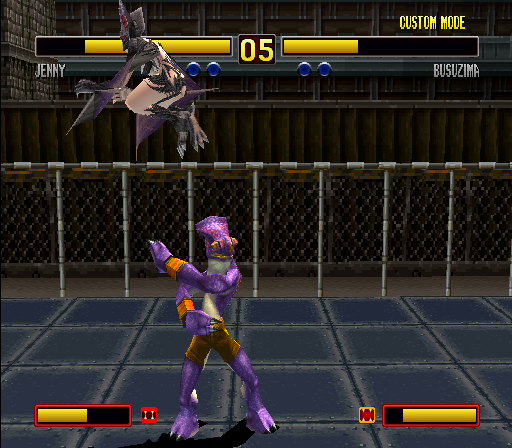
A secret agent who’s a model as her cover, Jenny is initially hired by Gado to investigate the Zoanthrope Liberation Front. She does this, of course, by beating everybody up and apparently really enjoying herself doing so. From there, she’s sent out to investigate whatever the current plot happens to be. She inherits some of Fox’s moves from the previous game, but has plenty of her own, as well. Being one of the few characters with wings, she has some unique aerial attacks and movement options that give her an advantage trying to land a hit.
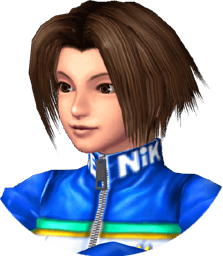
Uriko the Half-Beast
After the first game, Uriko is raised as a normal teenager alongside Alice by Mitsuko. For whatever reason, she’s been depowered. Instead of becoming a hulking werebeast, she instead becomes a cute catgirl. After her mother Mitsuko is kidnapped by the ZLF, she seeks out Long to learn martial arts from him in order to get her back. She’s one of the fastest characters in the series, with her own special combo tree to pressure opponents hard.
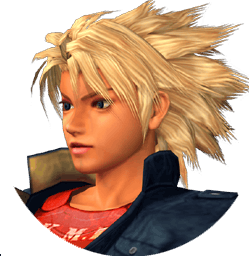
Marvel/Shina the Leopard
When Marvel was a young war orphan, Gado adopted her from the church she was being raised in. She eventually becomes a mercenary just like her foster father, trying to find out the truth behind Gado and the ZLF. In all Western releases, she’s renamed Shina for copyright reasons.
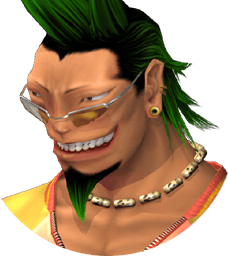
Busuzima the Chameleon
The rare combination of comic relief character and recurring antagonist, Busuzima looks, sounds, and generally fights like an absolute dumbass. Despite this, he’s smart enough to make himself into a zoanthrope, and he’s the true mastermind behind the ZLF. His goals from there are mostly to use various zoanthropes for his evil schemes, but instead, he always ends up getting his ass kicked. He’s a particularly tricky character with poor mobility but, he’s got some great range and can turn invisible.
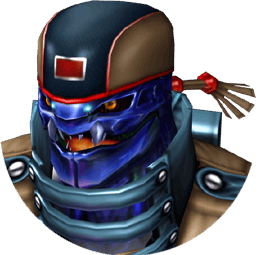
Stun the Insect
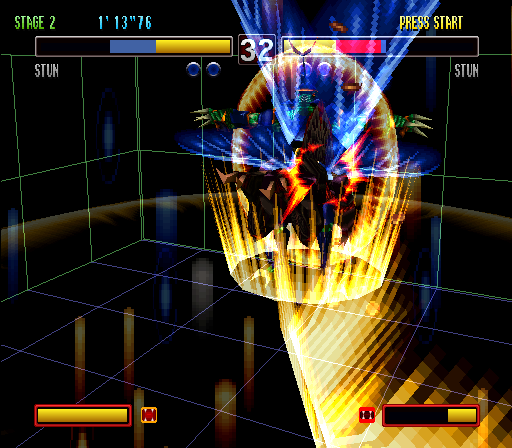
In the past, Steven Goldberg was friends with Busuzima in their time at Tylon. After objecting to his partner’s schemes, he ends up getting mutated into a man-made zoanthrope. After choosing not to take vengeance on Busuzima, he ends up becoming a wandering monster, seeking a way to end his curse. He takes on the primary grappler role in this game, including getting the ability to pull off chain throws from BR3 onwards. His name and fighting style – especially if you look at his Beast Drive – probably aren’t a coincidence.
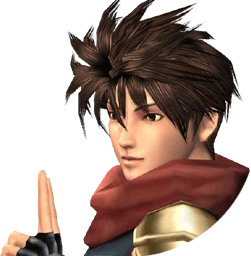
Bakuryu The Mole (BR2 & Onwards)
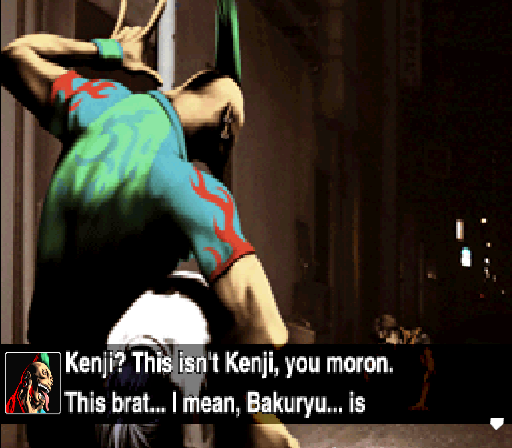
After helping destroy the Tylon corporation’s headquarters, Yugo adopted a young boy he found there, naming him Kenji. Busuzima kidnaps him and reactivates his ninja asssassin programming. Eventually Yugo helps Kenji break free, and from there, Kenji primarily appears to both protect and spar with Yugo. The more games pass, the more of his own moves he gets to set himself apart from his predecessor.
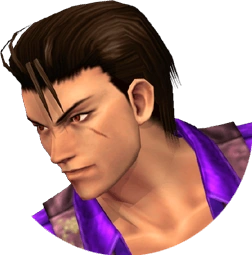
Shenlong the Tiger
A clone of Long created by Busuzima to serve as the frontman of the ZLF, Shenlong first appears as the secret boss of BR2. At first wanting to destroy the original Long and all of humanity with him, he eventually mellows out into a a nihilistic jerk who just wants to drink and fight. While his moves are similar to Long’s at first glance, he’s much more focused on pressuring his opponent hard as opposed to Long’s more all-rounded play style.
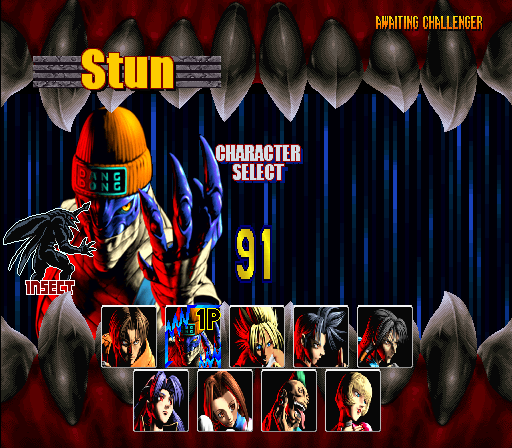
The basic mechanics remain unchanged, although there’ve been some additions and some subtle changes. Guarding can now be done with its own separate button, which allows you to cancel out of your dashes and special moves to feint out your opponent. You can also mix up your offense by transforming instantly during certain strings, or by performing a beast special while in human form. On the defensive end, just as useful is the ability to escape from throws, something that you’d definitely note the absence of in the original game.
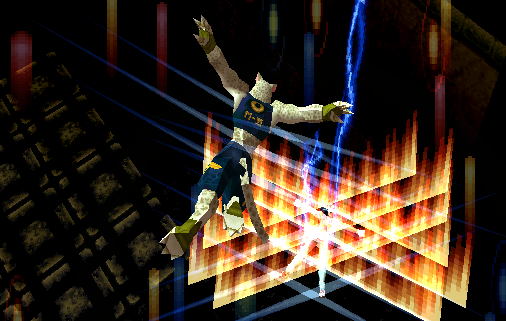
The flashiest new feature is the ‘Beast Drive’, a super attack that can be performed while you’re in beast form. Launching the initial attack that has to land to pull it off will force you back into human form whether it lands or not, so it’s not something you can throw out without some kind of plan. Befitting with the series’ emphasis on easy execution, you can perform a complicated motion to pull the move off, or simply press all three buttons. The easier input will do less damage, however, which gives you some motivation to learn the motions. The game also asks for a little more in terms of execution in general between the Beast Drives, character-specific combo trees, and Stun’s unique chain throw, but the basics remain accessible as always.
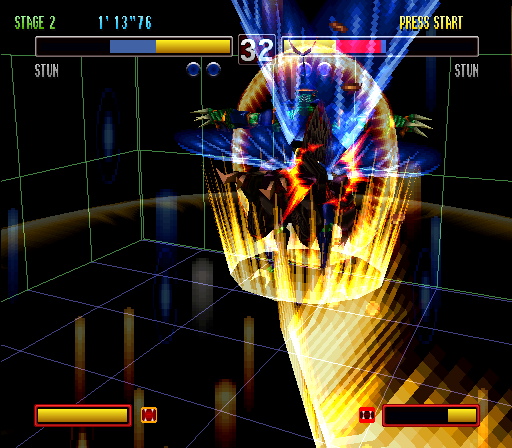
Beyond that, the changes are more subtle. Every character has had at least some tweaks to their moveset, giving them moves that stand out somewhat more against the other characters. The new characters are all winners, each providing decent replacements from those missing from the first game while each standing out on their own. The minor make for a game that feels somewhat more fluid, while not feeling drastically different from the original. Unless you’re particularly fond of the first game’s cast, there’s no real reason to go back to the original game unless you’re especially fond of its exclusive characters.
While the game maintains its ultra smooth framerate, the models have been touched up to be somewhat less blocky. The stages are also a little more unique, featuring locations like a ninja fortress and an indoor garden. They’re all still functionally the same gameplay wise, but it makes for some nice visual variety. The music once again offers two unique soundtracks, with the arcade version leaning more electronic, the PlayStation version more rock, but neither still especially stand out. In a somewhat more subjective change, there’s a little less blood, and the puking is gone, although that’s probably for the best.
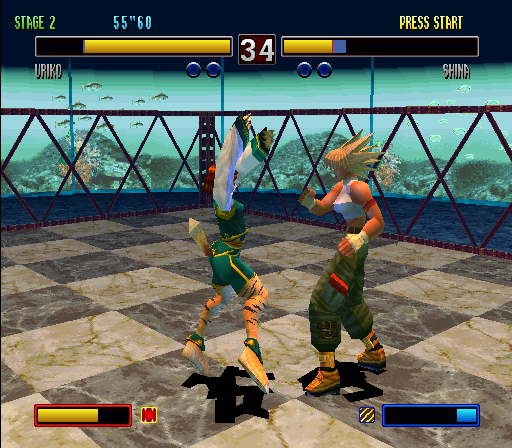
The PlayStation version’s big new feature is the addition of a ‘Story’ mode. You select a character and bring them through a pre-determined series of fights, each one preceded by some still images and story text. It feels a little low budget, since all these story scenes are shown in near complete silence, but it does at least add some replay value.