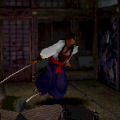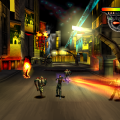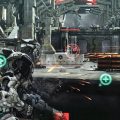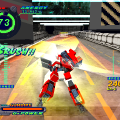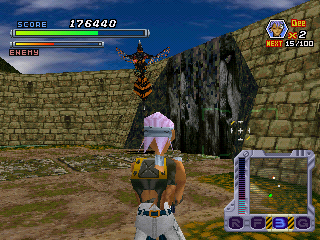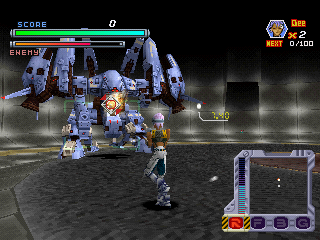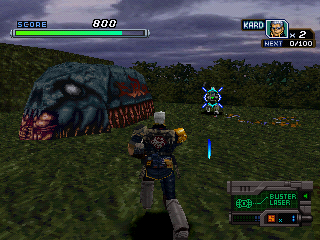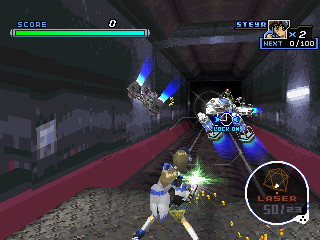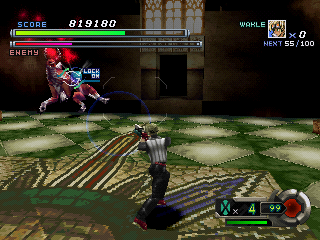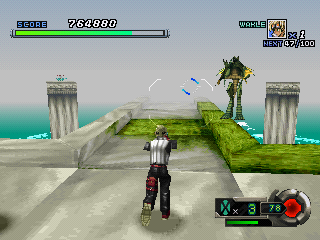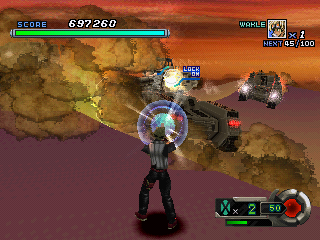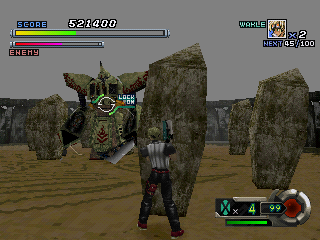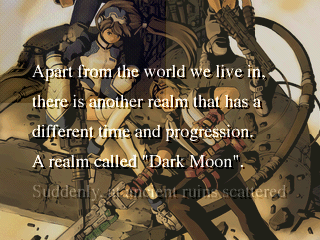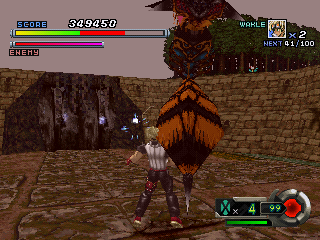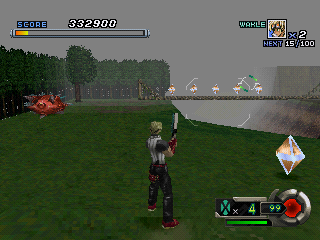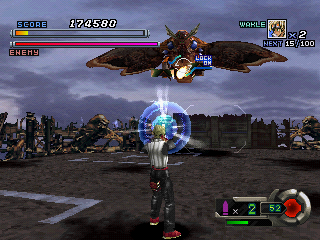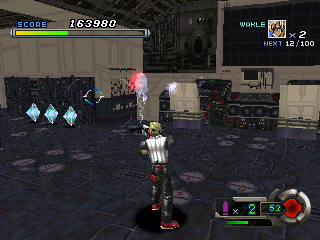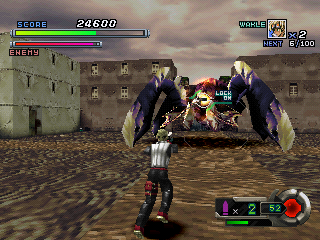
In Konami’s 3D run-and-gun Gungage, a portal has opened to the Dark World, unleashing its denizens onto the Earth – giant insects, large mutants, evil robots, even a few mythical creatures. It’s up to four heroes, each with different abilities and very silly names, to defend the world.
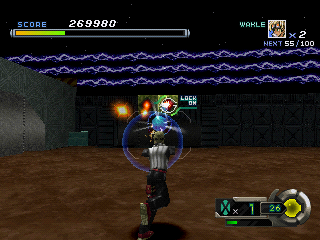
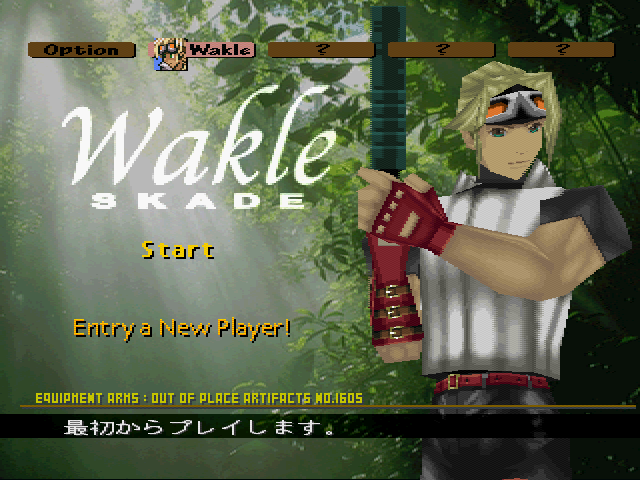
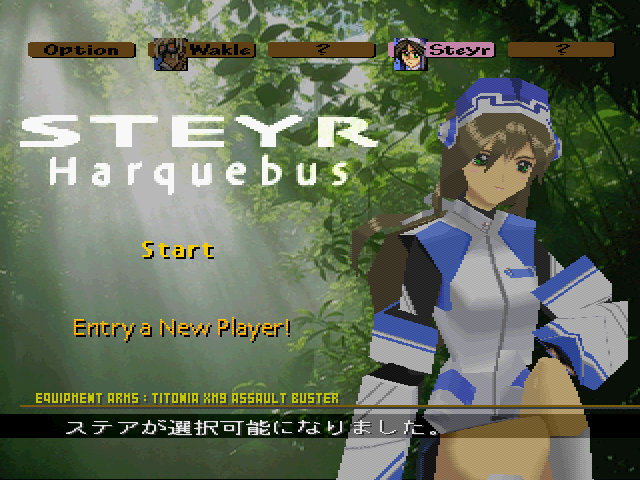
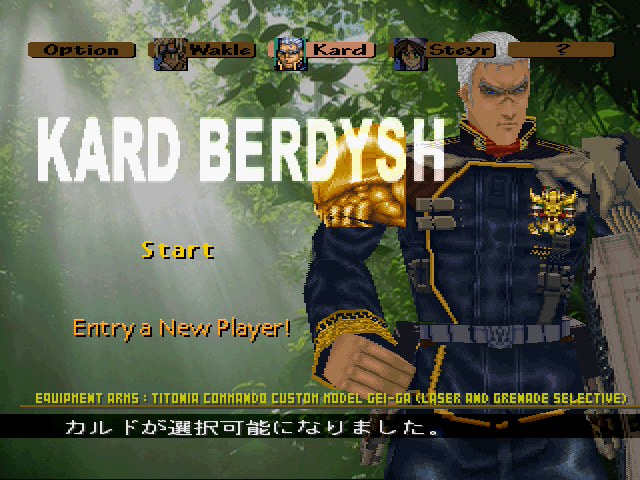
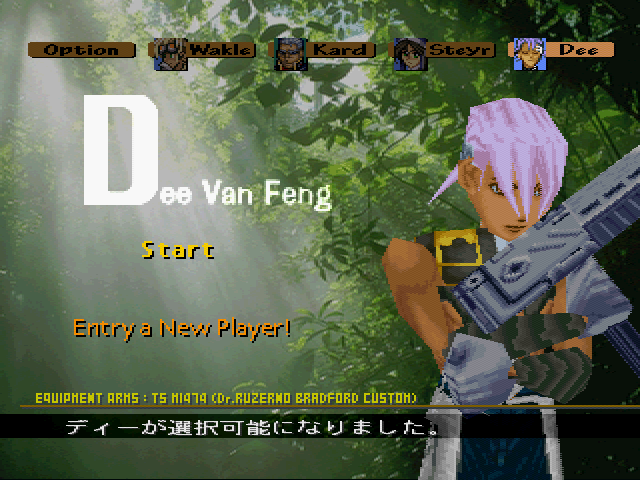
You begin the game with just Wakle Skade, who attacks with a rapid-fire gun, plus he has a shield and a bullet that can stun enemies. Steyr Harquebus wields a chain gun and has a mix of short and long range attacks, including a lock-on laser. Kard Berdysh is a bruiser with a cannon with a bunch of heavy armaments, while cyborg Dee Van Feng wields dual Uzis and has a with a variety of unique attacks.
Gungage was released in that awkward time when 3D PlayStation games were still transitioning to the Dual Shock controller. It supports vibration, but you can’t actually use the right analog stick for anything, resulting in an action game that feels stilted and clumsy for something released in 1999. Movement not only suffers from tank controls, but your characters trudge along very slowly, too. You can strafe with the L1 and R1 buttons, plus you can dodge by double tapping either, but you can’t directly control the camera at all. Thankfully, the game has a built-in lock on system, so as long as you’re vaguely facing an enemy, you’ll automatically shoot at them until they die, or they wander out of range. This works well against ground-based enemies, which is especially helpful because even minor foes can take plenty of sustained fire to kill, but it’s less functional against flying enemies, who regularly flutter out of sight. You can use the L2 button to re-center the view and manually aim, but this is so disorienting that it’s hard to use effectively. There isn’t much platforming, but what is there is incredibly janky.
Enemies tend to sneak up behind you, too. Most characters have different ways to indicate their positions – Steyr and Dee have helpful radars, Wakle just has a colored light to show when danger is nearby (which isn’t all that useful), and Kard is apparently so strong that he doesn’t need anything like this at all. Steyr is more agile than the rest, being able to duck and forward dash, plus she has a compass and night vision goggles to help in the desert stage.
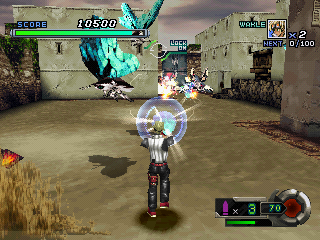
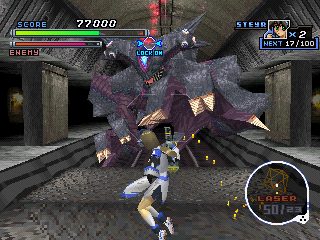
The levels aren’t entirely linear, as you’re incentivized to hunt around to find health and energy restoratives, including a few items that can expand your maximum health. You’re also on the hunt for flowers, which aren’t mandatory to collect but unlock various functions like an art gallery and a level select. The layouts are rarely complex, but due to the repetitive scenery, it’s also very easy to run around in circles. There are a few levels that deviate from the norm, including one that takes place on a series of moving subway cars, including a dramatic boss encounter with an enormous monster that tries to smash your rail car. One stage is a series of submerged ruins, which seems like it was created for a totally different game and accidentally ended up here, including a fight against two demonic dog creatures. One stage where you’re dropped right in the middle of the desert and have to destroy a whole bunch of tanks. There are some pretty creative ideas on display like these, but most of the game takes place in boring towns, labs, or outdoor areas.
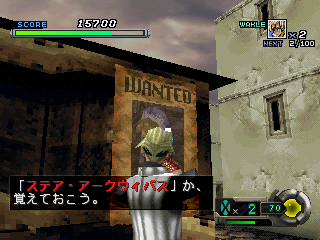
What’s curious is that you need to unlock most of the playable characters. You begin with only Wakle on your team, but you can activate the rest by either completing the game or finding certain things that will unlock them. The latter is quicker but much more obscure, since you aren’t given any hints. For example, you can unlock Steyr within the first few minutes of the game, but only if you notice a tiny, destroyable poster in an easily overlooked spot. You can unlock everyone in less than an hour if you know what you’re doing, but it’s frustrating that one of the main appeals of the game is hidden behind so many roadblocks. You can’t save your game progress – across the game’s nine levels, it takes roughly an hour to finish – but it does record unlocked characters, scores, and flowers you’ve obtained. You start with three lives, and dying will send you back to an earlier checkpoint. You can get more lives by finding collectibles, but you only have three continues.
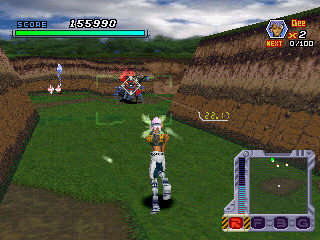
The playable characters differ not only in weaponry, but they also play through the levels in different orders, too. In some cases, they play through the same level but under different conditions – the Plain outdoors level is filled with fog when you’re playing as Wakle but is much brighter when going through it with Dee. In many ways, this is similar to the N64 Castlevania released earlier in the year. The interface changes slightly depending on your character, as do their power-up items – Wakle snacks on turkey legs to heal himself in true video game fashion but Dee chugs on gasoline. Despite the diverse roster of characters, there’s barely any storyline outside of an occasional text window at the beginning of each stage, which seems like a wasted opportunity considering the chaotic “alternate reality floods out world” premise. Gungage was only released in Japan and Europe, the latter of which is translated into English, but the text is mostly inconsequential.
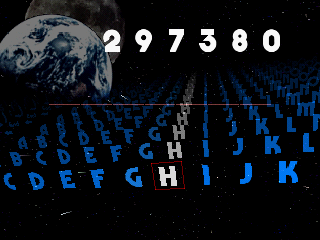
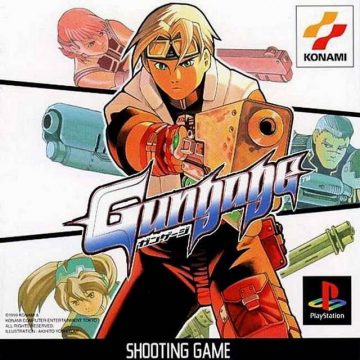
Gungage was directed by Hideo Ueda, a programmer who worked on several Konami shooters, including Axelay. He also directed Akumajou Dracula for the X68000 as well as Sparkster for the SNES, but like a lot of developers from the 1990s, seemed to struggle with making a 3D game. At least it has a cool high score name entry screen, with 3D letters floating out in space, something which would’ve felt at home in a Gradius title. The character illustrations are provided by Akihito Yoshitomi, famous for the Eat-Man manga that started publication a few years prior.
The highlight of Gungage is the soundtrack by Michiru Yamane (Castlevania: Symphony of the Night), with some additional tunes by Sota Fujimori (Neo Contra, the arranged tracks on Castlevania Chronicles for the PlayStation). They both provide a catchy, diverse supply of tunes that supply some much needed energy to an otherwise sluggish game.
Gungage didn’t make it to North America, but outside of the cool soundtrack, it really wasn’t missing much. The closest comparison is C: The Contra Adventure, another 3D run-and-gun published by Konami, though developed by a different company in Hungary. While there’s less stuff to unlock in The Contra Adventure, the run-and-gun action just feels better. Considering how that game was torn to shreds by press and players alike, it’s unlikely that Gungage would’ve gotten a warmer reception, even though it doesn’t have the weight of a legacy franchise weighing it down.