- Rygar (Arcade)
- Rygar (NES)
- Rygar: The Legendary Adventure


There have been many great video game events all throughout the annals of time. 1986: Rygar saves Argool. 1987: Rygar saves Argool… again. Then for a long time, nothing happened. Action-adventure titles have barely found their niche in 3D around this time. Konami perfected the cross-genre in 2D with Castlevania: Symphony of the Night, but their attempt to do so in 3D on the N64 was not very well-received by the public. Capcom would find greater success with Devil May Cry, which tended to focus more on the action, but still had some exploring to do at certain parts. Tecmo had their NES Rygar, of course, and now that it had come this far, the company just had to get in on it. They would show Konami and Capcom who’s boss, and they would do so with the man that started it all. After a fifteen-year hiatus, Rygar would return for yet another adventure.
But not just an adventure… the most glorious, dramatic, spectacular, challenging, breathtaking, and overall kickass adventure for our hero yet.
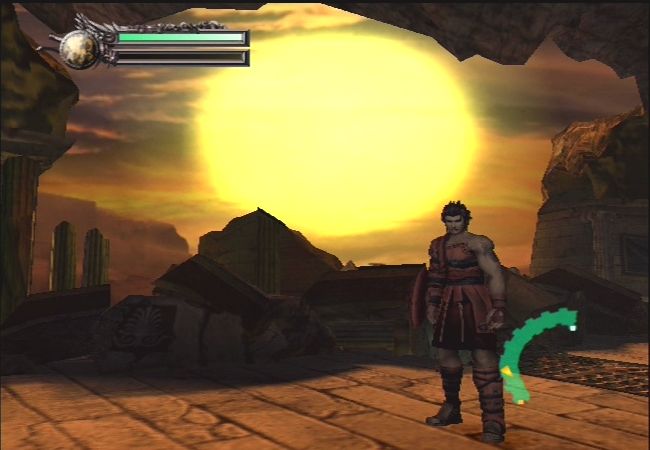
The tale begins at the land of Argus (the Japanese name of Argool, now assimilated into America, like how Princess Toadstool became Peach or Dr. Robotnik to Eggman), with our hero being commended by Princess Harmonia for his bravery and courage as a gladiator. She also would like to confess a strange and horrifying dream that she had, where Rome was being torn asunder by horrid demons, fire and brimstone, ungodly earthquakes, absolute darkness… you know, all that wonderful stuff. Rygar (named Zane in the Japanese version) is disturbed, for he had the exact same dream as well. Almost on cue, the dream begins to take tangible form, as an evil lady claiming to be a Titan crashes the party with her Minotaur assistant. A real sinister looking blue winged dude flies in and captures Harmonia, and the Minotaur kicks Rygar’s ass effortlessly. Falling through a deep crevasse, he is told by a mysterious voice to arise and wield the power of the weapon now before him: The fuggin’ Diskarmor! Rygar realizes that something wicked is going on, and this weapon will be the only thing that can help him save Princess Harmonia. Little does he know of the perils and trials that await him, along with mythological beasts, an evil god, and the secret of his past…
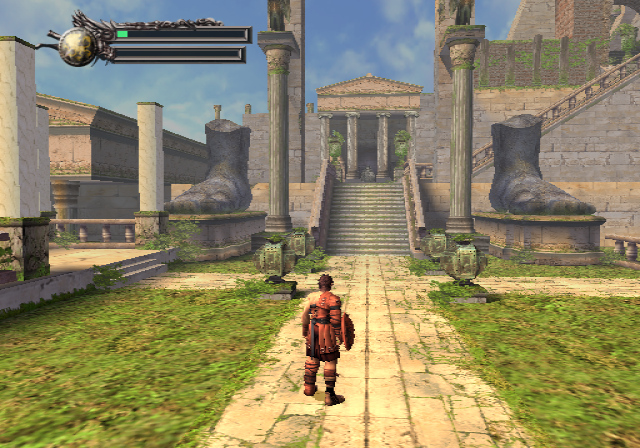
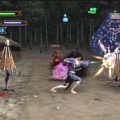
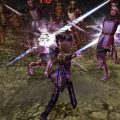
As Rygar goes on, the true power of his plain Diskarmor becomes realized, and it becomes the fancier and stronger Hades Diskarmor. Along with this change comes the addition of the Icol meter. Icol allows the spirit resting within the Diskarmor to burst out and cause good damage to the enemies in the imminent area. A little more on that later. Not too long after the Hades Diskarmor is brought to fruition, Rygar stumbles across another diskarmor! He has to earn the Heavenly Diskarmor in a brutal boss battle, but after getting it, Rygar obtains a whole new movelist. Instead of thrusting straight out, the Heavenly Diskarmor is swung to the sides with the purpose of clearing out multiple enemies surrounding our hero. Holding the square button allows for the still spinning H.D. to be controlled with the left analog and ward off enemies in front. The Remote is hardly as cool as the Snap, unfortunately.
Rygar’s power can grow to high proportions with the addition of Mystic Stones. These precious geological artifacts can be found around Argus here and there, usually in secluded places or after a boss battle. They serve all sorts of purposes, including practical status boosts of the Attack and Defense, giving Rygar new moves, and increasing his health and Icol. Two stones can be used with each Diskarmor… or, as you grow stronger, three or four. The Diskarmors can grow stronger and create more powerful Icol summons as well, through the magic power of Sfaria! These orbs can be found from pretty much everything you destroy, living or inanimate, and come in two flavors; regular 10-point purple or extra-juicy 100-point magenta! Collect 1000 build-up points to upgrade a Diskarmor to level 2, and then 2000 more to get it maxed out to level 3. As you can probably guess, the Sea Diskarmor is brutal at its maximum power. Not to mention that Rygar can gain a longer lifebar with Sfaria, and he can obtain nectar to improve his life, or even an Ambrosia apple to completely restore it whenever he wants. The Omphalos crystal restores all Icol, and if a Caduceus is in possession, Rygar’s health and Icol will both be instantly rejuvenated on his deathbed! There are also various tablets and scrolls scattered about, which aren’t necessary to advance in the game, but do offer some interesting reading.
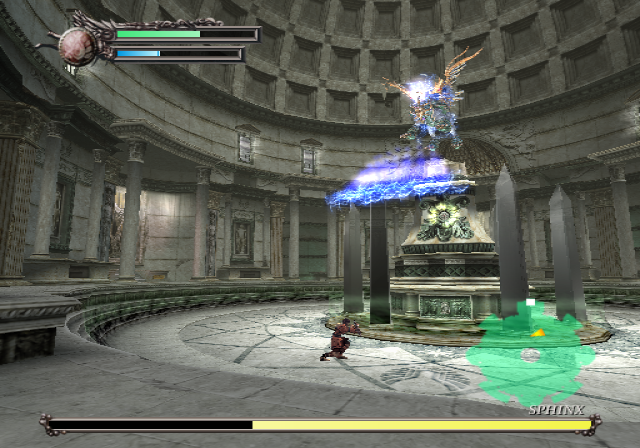
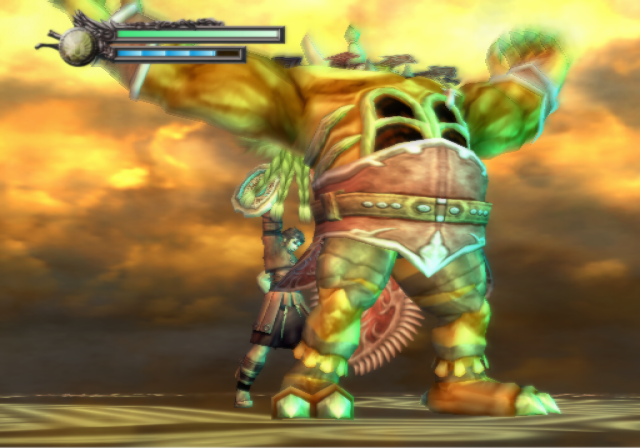
The boss battles are generally fantastic…for the first few playthroughs or so. There are some neato beasts to battle, many of which are taken right out of Greek mythology (like the Minotaur and Centaur), and one of the coolest is Typhon. However, after beating the game several times and possessing a maximum lifebar with all the Mystic Stones, it gets rather easy to beat them into the ground if the difficulty isn’t on Legendary.
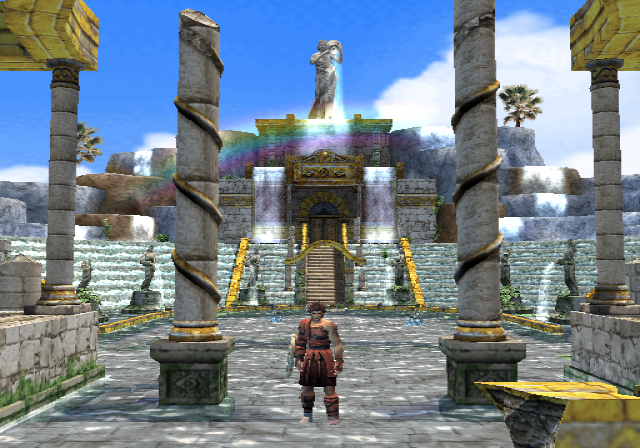
Onto the graphics. The PlayStation 2 was about two years old around this time, and programmers had begun to realize its full graphical potential. Thus, the game looks nothing short of gorgeous. It really looks like Ancient Greece, taken from the pages of Sophocles or Euripedes. Crumbled statues litter the ruins of the Coliseum, shrubbery and pools of water line up beneath the walls, and the sunlight of the rising dawn bathes it all in a golden color. There’s this one angle of the camera that displays the background… of the beautiful sun, Apollo’s brainchild, incipient in its existence of the new day. It shines as preciously as it did in the arcade and NES games, even more so in 3D! (That’s not the only homage, either – Rygar needs to move those same silly looking urns just like his arcade counterpart.) That’s just the beauty of the first stage; it never lets up all throughout. A lush green field with fallen columns everywhere serves as the main hub that pretty much connects to everywhere else, Poseidonia’s Shrine is absolutely steeped in lush waters that refract light every which way (and generate rainbows every now and then!), and wait until you get to the Lion’s Road, which is almost definitely a tribute to the floating isles of Lapiz.
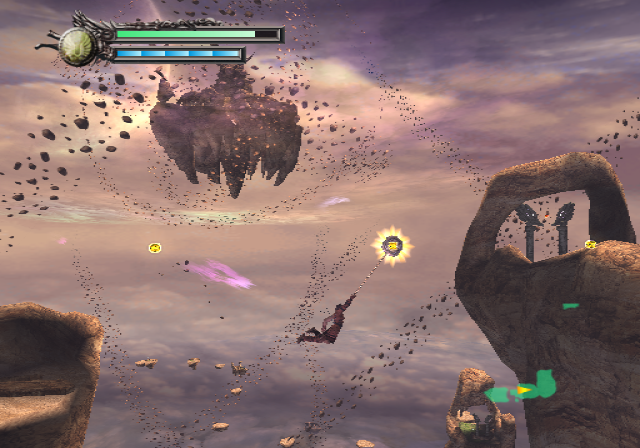
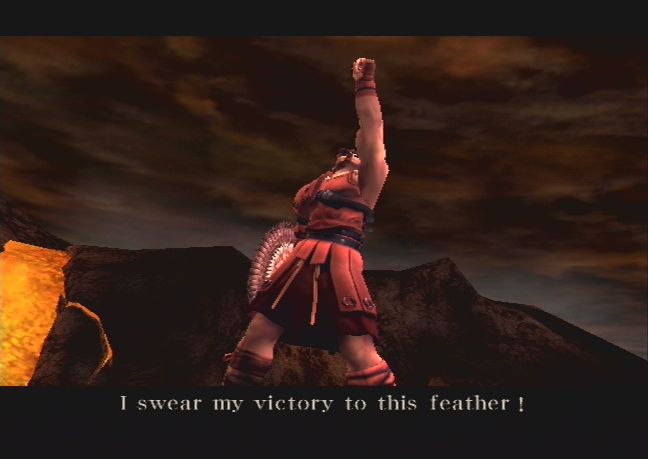
It also has a hilariously dramatic game over message, which proclaims “The Legend is Dead”.

Rygar: The Battle of Argus / Argus no Senshi: Muscle Impact (アルゴスの戦士 マッスルインパクト) – Wii (2008)
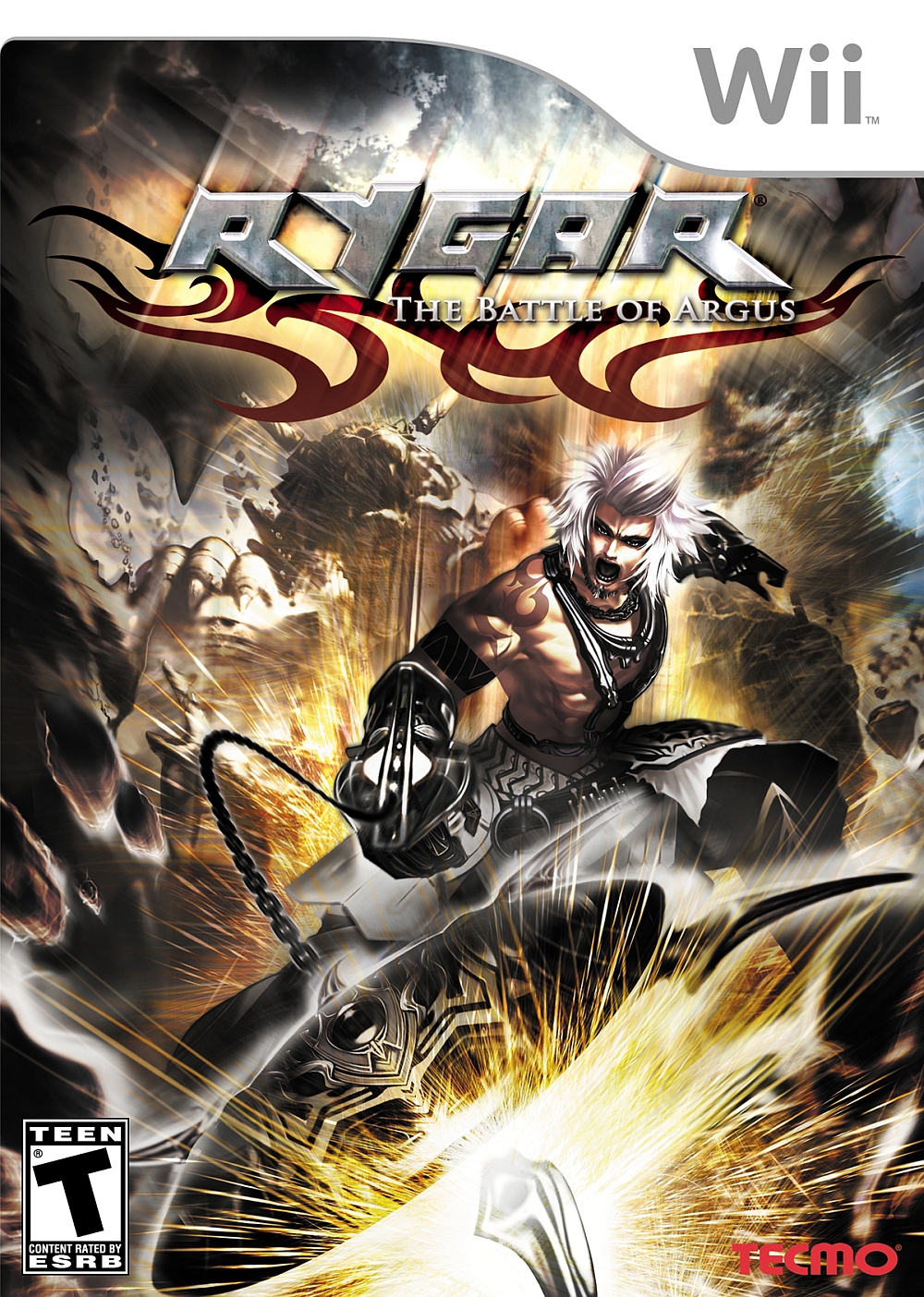
American Wii Cover
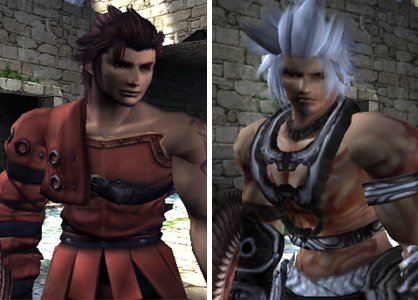
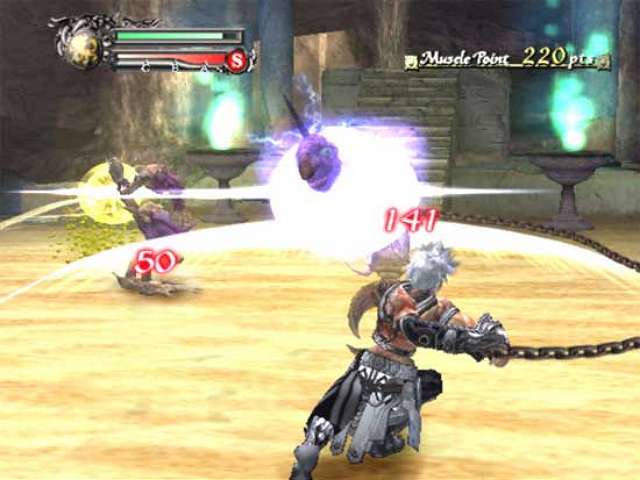
The PS2 Rygar was not a tremendous success upon release, and outside of its music and visuals, was largely forgotten by action fans in favor of later Devil May Cry games. However, Tecmo resurrected the game for a re-release on the Nintendo Wii in 2008. It has a new subtitle (“The Battle of Argus“) and a new hero, with white hair and a stylish look that seems much more modern. Except…that’s barely about the extent of the redesign. The rest of the game is almost exactly the same, other than the hero’s new look. And it’s especially strange, since he looks out of place compared to the Grecian setting.
There are a few minor additions, mostly a couple of new enemies, which works towards making the combat a little less monotonous in places. There’s also a new “Gladiator Mode” which involves waggling the Wii Remote to do damage to enemies. However, this is just a separate mode from the main game, which controls identically to the PS2 version (though the Classic Controller is unsupported, weirdly.)
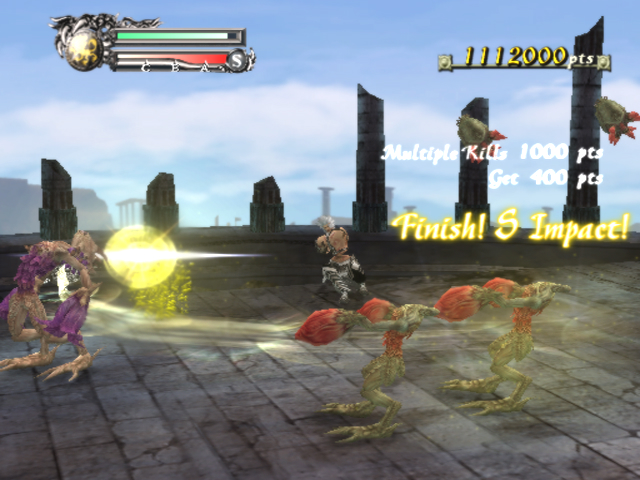
The PS2 Rygar was excellent so it stands to reason that this is pretty decent too. But six years is a long time in the video gaming words, and the bar for action games had increased substantially since then, so there could’ve been much more done to update it. Plus, there’s something sketchy about taking a game, giving it a new title and a new hero, then selling it without an indication that it’s basically otherwise the same as the PS2 version. Most of the ad copy insists that it’s a remake, rather than a (barely) enhanced port with a tacked on waggle mode.
Links:
http://www.gamesradar.com/rygar-the-battle-of-argus-review/