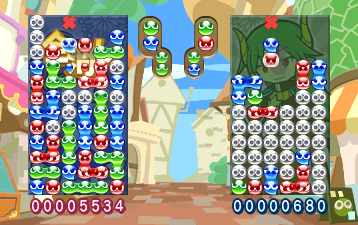
Arle's Adventure - Gameboy Color (2000)

Arle's Adventure

Arle's Adventure

Arle's Adventure

The most recent of the Puyo RPGs was released on the Gameboy Color in 2000. It's a standard overhead RPG, although it's obviously tained by the Pokemon craze. When you defeat a bad guy, you get its card, which means you can call it into battle. This monster collection might sound off putting, but it actually works much better than one might expect. This is mostly because you can have two monsters in battle at a time, as well as controlling Arle. The real major downfall is that even the most minor battles tend to drag on far too long.

Arle's Adventure

Nazo Puyo/Nazo Puyo 2/Nazo Puyo: Arle's Roux - Game Gear (1993)

Nazo Puyo: Arle's Roux

Nazo Puyo GG

Nazo Puyo: Arle's Roux

The Nazo (puzzle) Puyo modes in the original game was apparently so popular that Compile released them in their own cartridges for the Game Gear. You're given a preset field, and a goal - say, eliminate all red puyos. It's a fun take on the usual stressful comboing, but there's really no reason to release these as seperate games. And they all get pretty hard, pretty quick. The third Nazo Puyo game - Arle's Roux (Roux is part of a food mixture - the cover shows a meal of curry) has an RPG spin similar to the Super Famicom Naxo Puyo games noted below.

Nazo Puyo: Arle's Roux

Super Nazo Puyo/Super Nazo Puyo 2 - Super Famicom (1996)

Nazo Puyo SFC

Nazo Puyo SFC

Nazo Puyo 2 SFC

The Super Nazo Puyo games take the concept of the Game Gear titles and somewhat expands on it. The biggest difference you'll notice is that there's a lot more premade stages, where you'll have to solve a puzzle in a certain amount of pieces, rather than just trying more a specific goal.

The biggest difference is that it takes the framework of an RPG. In the first game, you take control of Arle as she runs around, visits enemies to fight their puzzles, then heads to the boss for the final showdown. The second game is pretty similar, except Rulue takes the spotlight.

Nazo Puyo 2 SFC

Puyo Wars - Gameboy Color (1999)

Puyo Wars

Puyo Wars

Puyo Wars

So apparently Compile felt the need to create a crappy strategy game and stick Puyos in it. None of the classic characters are here - in fact, it all takes place far in the future, where little kids battle each other with the power of The Puyo (which are really just lobbed back and forth.

Made for the Gameboy Color, it's your typical tile-based game, very reminiscent of the GBA Zone of the Enders game. Except the major problem is that you can act twice in a single turn. This means you can attack twice too. The unfortunate problem is that the enemy can do the same thing, making the simplest of fights very drawn out. The eye scratchingly bad graphics don't help its cause either.

Puyo Wars

Puyo Wars

Puyo Puyo Da! - Dreamcast (1999)

Japanese Dreamcast Cover

Puyo Puyo Da!

Puyo Puyo Da!

Out of all of the genres Puyo could've found itself in, I really wonder how they ended up in a rhythm game. Not being one of those games that uses the dance pad, you control the action entirely with the controller. The gameplay is exactly like Parappa the Rapper - the computer has a series of motions, and you have to copy them. Unlike our favorite old skool dog, your motions have no effect on the music, thereby eliminating the main draw of the game. While the ultra-happy J-POP you dance to is reasonably OK, copying motions with the controller is just pretty dull. I'm sure this was a great competitor to Bust a Groove back in the day, but Dance Dance Revolution and other games that require actual physical motion have made these kinds of games very outdated.

If you really need to see your favorite Puyo characters in 3D, this is your opportunity. They all look ridiculously cute and sport some amusing outfits - Arle gets it on with a hip-hop outfit, Schezo goes for some maraca action in a somewhat fruity Spanish outfit, and Rulue seems to be content in black lingerie. And seeing that dancing fish-whatever in a ballerina costume is pretty priceless. Beyond this novelty, the models are made of such low-poly models that it barely looks any better than a PSOne. In other words, if there's one Puyo game you shouldn't own, it's this one.

The concept of the game is actually based off of an old demo in one of Compile's Disk Station releases, called "Broadway Legend Ellena". Compile decided she was a worthy enough character to feature in a whole game, hence the existence of Puyo Puyo Da! Actually, putting an exclamation mark after that really just makes the game sound even more pretentious, because there's absolutely nothing exciting about it.

MP3s

Shakunetsu no Fire Dance

Puyo Puyo Da!

Puyo Puyo Da!

Puyo Puyo Da!

Puyo Spin Offs:

Dr. Robotnik's Mean Bean Machine - Genesis/Game Gear (1994)
Kirby's Avalance/Ghost Trap - Super NES (1994)
Timon & Pumbaa's Bug Drop - Windows 95/Macintosh (1997?)

Dr. Robotnik's Mean Bean Machine

Dr. Robotnik's Mean Bean Machine

Kirby's Avalance

Despite the massive success of Tetris (and general liking of variations like Columns), it took quite a long time for Puyo Puyo to truly leave Japan. However, Sega and Nintendo decided to put their own mascots into Puyo Puyo, in hope of drawing a wider audience. The results were Dr. Robotnik's Mean Bean Machine (for the Genesis and Game Gear) and Kirby's Avalance (for the Super Nintendo, also known as Kirby's Ghost Trap in Europe and Japan.)

Dr. Robotnik's Mean Bean Machine had a ridiculous plot where the evil scientest Robotnik was trying to take over Bean Town or something equally ridiculous. The puyos here are referred to as "beans" for some reason - the nuisance/garbage puyos are referred to as "refugee beans". Your opponents were characters from the old TV show (the syndicated one, not the one on ABC), though Carbuncle is still running around. Mean Bean Machine uses a lot of the music from the original Puyo Puyo, just in changed places and with a different instrument set. It also features a password system, which is quite welcome. The Game Gear version also includes some Nazo Puyo levels, making it quite a value. The Genesis version can be found on the Sonic Mega Collection for the Gamecube, making it quite easily obtainable.

MP3s

Duel

Kirby's Avalance, known as Kirby's Ghost Trap in Europe, features characters from the Kirby games, as well as old NES heroes Lolo and Lala. Kirby takes the place of little Carbuncle in these matches. Most of the interface and graphics are the same as the SNES Puyo games. , though the music is entirely different.

Disney Interactive even brought out their own version of Puyo Puyo for Windows 96 and Macintosh. Dubbed Timon & Pumbaa's Bug Drop, the game was featured the famous Lion King characters, who narrated the action. As the title suggests, the puyos are replaced with bugs. Despite the nice looking graphics (click the picture for a nicer, high-res screen), it's a very bare bones game, with only one and two player modes, no variation in the boards, and lame music. While most of the game is credit towards a company called 7th Level, a little note on the pack of the package says "Bug Drop Game system from Puyo Puyo copyright Compile".

It's nice Americans and Europeans were at least exposed to Puyo Puyo at some point, even though they were all quite butchered.

Kirby's Avalance

Timon & Pumbaa's Bug Drop

So most of your puzzle game playing friends are all into Super Puzzle Fighter II Turbo, right? Meh to that. Puyo Puyo is not only much simpler, but a lot more fun. Getting some skilled players together and just watching the combos fall into place - and the devastating result on the opposing player - is one of the truer joys of video game mastery. So while it may take some goading, grab some people, get one of the four player version of the game and plays some Minna de Puyo Puyo (Everyone Puyo) for some crazy insanity.

Thanks to Frank Lopez for the heads-up on the Bug Drop game.

Links

Puyo Puyo Museum Hasn't been updated in awhile, but lots of information about the entirety of the Puyo series. A lot of the Madou Monogatari computer pics from taken from here too.

Back to Page 3

Back to the index