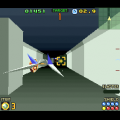

This article first appeared in HG101 Digest Vol. 4: Star Fox and F-Zero. Check it out!
Due to technical limitations, video games were mostly rendered in two dimensions through the 1980s. Still, there were always attempts to make games more lifelike by creating, or at least mimicking, display in three dimensions. Most of these were done with vectors (as with the Vectrex), or using sprite scaling techniques (with Sega’s many Super Scaler arcade games like Space Harrier). While impressive, the hardware required to run these was typically relegated to the arcade or on computers, where it was mostly used in racing games or flight simulators. There were console ports of many of these titles, but they typically failed to capture the look or the flow accurately. Systems like the NES, TurboGrafx-16, and even the Genesis simply lacked the muscle.
The SNES brought these effects closer to the consumer audience with its built-in Mode 7 scaling, which worked similar to the sprite manipulation found in Sega’s games. However, games were still fundamentally rendered using 2D graphics, just with assorted display tricks. The real future of 3D rested with polygons, which allowed full 3D worlds to be created. One of the most talented creators of these types of games was UK-based Argonaut Software, who developed Starglider for the Atari ST. In the early 90s, the company worked together with Nintendo to create 3D visuals for their platforms, first resulting in the Japan-only Game Boy game X. Though rendered in simple wireframes rather than full polygons, it still showed an incredible amount of programming technique. The SNES still didn’t quite have the power to run a game with polygons, though, at least not at an acceptable speed. One need only look at the port of games like Race Drivin’ for an example, which often struggled to display more than five FPS. To that end, Argonaut helped develop a chip called the Super FX. This would then be loaded onto each cartridge, providing the extra power to make polygonal visuals possible. A team of programmers from Argonaut – Dylan Cuthbert, Giles Goddard, and Krister Wombell – shacked up with Nintendo in their Japanese office to help create a new SNES title, produced by Shigeru Miyamoto and directed by Katsuya Eguchi.
In spite of the advancements, only simple polygonal models could be animated. This was where the marketing and character design skills of Nintendo came in – a spaceship assembled from a few triangles didn’t have much in the way of personality, but what if they were actually piloted by a group of cute, anthropomorphic animals? By adding in a sci-fi back story, heavily inspired by Star Wars (just as Starglider was), and populating it with likeable characters, they created one of the first blockbuster 3D breakout titles – Star Fox.
The game begins with a shot explicitly recalling the opening of Star Wars Episode IV: A New Hope, with a low view of a gigantic battleship approaching towards some distant target. The Corneria system is under attack by the evil Andross Empire, and the only defense is led by the mercenary team Star Fox. The leader (and player character) is Fox McCloud, piloting a ship called an Arwing. He’s also joined by three companions: Falco Lombardi (a bird), Slippy Toad (a frog), and Peppy Hare (a rabbit). The orders are given by General Pepper (a dog in a cool pair of aviator shades), the leader of the Cornerian army.
The opening level begins with another dramatic sequence, as the four Arwing fighters blast off from their base, with a digitized voice declaring “Emergency! Emergency! Incoming enemy fighters! Prepare for launch!”. The four heroes then share a brief bit of chatter as they check their communications before engaging with enemy forces. Combined with the opening animation, it establishes the Star Fox world as strongly cinematic. This helps to set it apart from the mathematically sterile levels typically found in early 3D games.
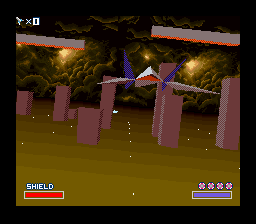
At its core, Star Fox is a rail shooter, meaning you fly in a straight line as you shoot stuff, with its closest relative being something like Sega’s Galaxy Force. The Arwings are equipped with lasers (which can be upgraded to a double laser) as well as a limited amount of bombs, which detonate with a gigantic explosive effect that takes out almost everything on the screen. You can tilt your ship (and even barrel roll) with the L and R triggers, necessary to squeeze in tight spaces, and can also accelerate forward or trigger a brake to slow down.
There are some digitized voices, used in the intro and when grabbing power-ups, but the chatter between the pilots is rendered in a gibberish language (in different tones for each character) with text displayed at the bottom.). Your pilot friends spend most of the levels off screen, though occasionally they’ll pop into view when they’re getting harassed by an enemy. If you manage to save them, they’ll stick around for a short period of time to help shoot down baddies; otherwise, they’ll lose a bit of their shields. If they get knocked out, they’ll disappear from the next level, but they appear later on once they’re repaired. It’s not a huge part of the game – they’ll complain if you shoot them but you can’t actually damage them – but it helps to create a sense of camaraderie, even if they aren’t all that useful.
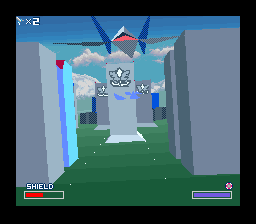
The Arwing has a huge wingspan, which also makes it an easy target, especially when trying to fly through buildings or past mountains. While you have a shield meter, these wings can also be torn off if they sustain direct damage, throwing your ship off balance as a result. Thankfully, these can be repaired by picking up wing gyro icons. There are also various rings, either scattered about the levels or dropped by destroyed enemies, which replenish a bit of health. Most levels have a ring that act as a midlevel checkpoint, as well, in addition to regenerating your shield strength.
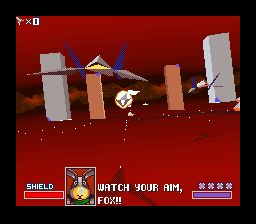
Before you begin the game proper, you’re allowed to choose from three different routes, each assigned a difficulty level. All of these start at the Corneria home planet and end at Venom, the home of Andross’ operations. You really only go through between five and seven levels in a single playthrough (Venom is divided into two), but the levels themselves are almost totally different on each path. Even Corneria in the first stage changes; on the easy and medium levels, they’re pretty similar, but the hard level changes the setting from midday to dusk and gives you a different boss to fight. Some of the stages, like the asteroid belts, are similar across the routes, but the actual planets are totally different, and even Venom has some changes.
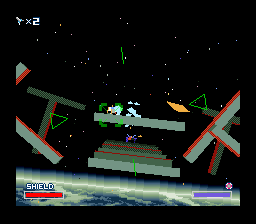
Corneria is a lush green planet, filled with cities and buildings, but the rest of the stages have more hostile terrain, often with different types of enemies and gimmicks. Fortuna is filled with dinosaurs and other prehistoric life, while the planet in Sector Y takes place entirely above an ocean, filled with all kinds of aquatic creatures. Titania takes place on a snow- covered planet and requires that you destroy a weather generator, otherwise the stage will loop infinitely. As befitting its Star Wars inspiration, one stage also recalls the Death Star attack in Return of the Jedi, as you fly through battle stations, weave through its interior defenses, and blow up the core inside.
There are a couple of hidden areas – the easy path has a “Black Hole” level that lets you skip over one of the stages, while the other found in the hard route is a strange area called “Out of This Dimension”, which features paper airplanes and ends with a fight against an interstellar slot machine. It also leads into an alternate “ending” of sorts, where you can shoot the letters “The End”, though the only way to actually exit this stage is to completely reset the console. There are other secrets, too – if you miss the checkpoint ring in certain stages, you’ll trigger a bird called the Silver Phoenix to drop power-ups, and if you manage to shoot all of the red stingrays in Sector Y, you’ll summon a space whale, who will also drop helpful stuff before the boss encounter.
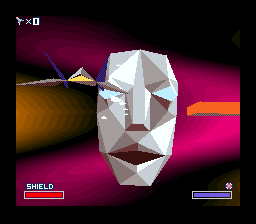
Regarding the 3D visuals, these were obviously a huge selling point for the title, to the point where it was heavily featured in retail store kiosks to show off the impressive power of the system. Obviously, it became fairly dated as soon as the Saturn and PlayStation came out, but time has wrapped around and there’s still a retro chic appeal to its simplicity. The Arwing might be simple, but its design has since become iconic, and many of the larger enemy ships have aesthetics that manage to recall the best arcade shoot-em-ups, despite their boxy presentations. Even the final encounter against Andross, a gigantic face made of visibly jagged polygons, looks pretty cool in a cheesy type of way.
The soundtrack is fantastic too, as it relies on both dramatic orchestrations (similar to the type heard in ActRaiser) combined with the deep electric guitar typical of SNES titles. The soundtrack is by Hajime Hirasawa, and served as his last project before leaving Nintendo. He’d previously only worked on two other titles: the FDS adventure game Time Twist and the shooter Super Scope 6, neither of which really showed off what he was capable of. The sequel, Star Fox 64, opted for a different style, more concentrated on the orchestra style. As a result, subsequent games in the series were based on that direction, often ignoring the SNES version. This at least gives the original Star Fox a unique sound, though it’s unfortunate that the later games don’t really draw on its motifs.
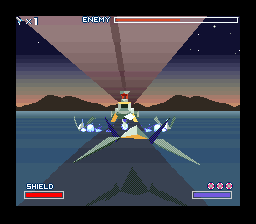
The lingering issues with Star Fox have less to do with its presentation and more to do with how it feels. Even with the power of the Super FX chip, the game only runs at about 10-15 FPS – higher than other polygonal games of the 16-bit era, but still pretty choppy. What’s worse is that the actual game speed is incredibly inconsistent, from sailing along nicely when there are no enemies to slowing down whenever there’s one or two foes on-screen. Further, the view is also surrounded by a black border that takes up about 20% of the screen.
The perspective also adds some frustration to the experience. You only have a third-person view in the planet stages, whereas in outer space, you can switch between first and third-person. Both of these have issues, unfortunately. In third-person view, there’s no targeting reticule, which makes it awfully hard to aim at anything. Generally the shots head towards the middle of the screen, and with enough practice you can feel it out, but when you need to hit something with precision, like the glowing weak points on boss ships, you essentially have to fire blind and adjust as you go. This obviously becomes a larger problem whenever the frame rate or speed dives. Trying to figure out the trajectory of enemy attacks in order to dodge them can be just as difficult, too. First-person does have a targeting cursor, but that also means that you don’t have any true awareness of what’s around your ship, though at least in these levels, you can switch to third person for when you need to dodge spinning girders.
These technical issues make the game very hard to play, but even without that, it’s not exactly forgiving. You can take quite a bit of damage, and health restoratives are common (if you can catch them), but there’s also no invincibility time after taking a hit, so it’s very easy to get soaked with multiple successive attacks, especially if you crash into something. You start the game with three lives and zero continues, though if you score high enough (based on your teammates’ health and how many enemies you’ve shot down), you can get some extra credits. The easiest course through the game isn’t too terribly difficult, but the hardest requires both a lot of skill and patience to get anywhere.
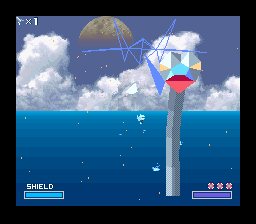
In that sense, Star Fox is still kind of a relic – it’s hard to play nowadays, though not exactly impossible for the determined. Its sequel was fundamentally a remake that does pretty much everything this SNES game tried to do, but without most of its technical limitations. Even so, there’s enough worth seeing here to make it not entirely redundant.
Due to copyright reasons, Star Fox was renamed Starwing in Europe, to avoid confusion with the German company StarVox. Andross is also known as Andorf in Japan, but other than these names, there’s no real regional differences between them.
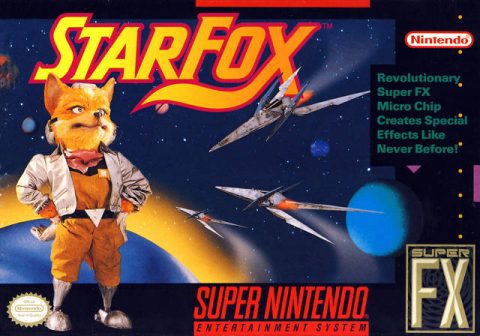
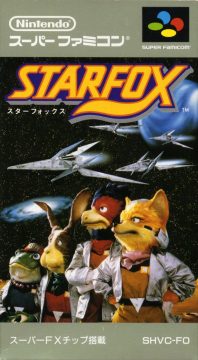
Various promo artwork (including the game’s cover) feature the cast created as furry puppets, giving them a realistic texture. However, the characters’ legs were seemingly made with metal. Over the years, this gave rise to a fan theory that the gravitational forces of the Arwing required the pilots to cut off their legs from below the knee and have them replaced with prosthetics. This was eventually brought up to the original creators, who confirmed that this was just an artistic touch, as something like voluntary dismemberment is a little too dark for a Nintendo game starring talking animals.
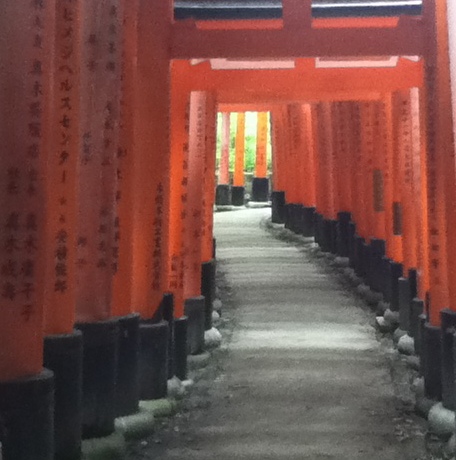
Fushimi Inari Shrine in Kyoto
Incidentally, the decision to choose a fox as the main character wasn’t arbitrary. The sight of the ships flying through gates had reminded the Nintendo staff of the Fushimi Inari shrine in Kyoto, located close to Nintendo’s offices at the time, which was closely associated with foxes. Additionally, in Japanese culture, foxes and monkeys are viewed as natural enemies, similar to the conflict between cats and dogs recognized in Western culture. Therefore, it made sense that Andross should be a simian.
For a long time, Star Fox wasn’t ported from the SNES and didn’t appear on any Virtual Console service. This was long believed to be due to a legal quagmire of who actually owned the Super FX technology, since Argonaut had been defunct since 2004. The game eventually popped up in the SNES Classic, though, and interviews with Nintendo confirmed that its absence had been due to issues emulating the Super FX. (This is itself a questionable answer, since amateur emulators had this functionality for years by then.)
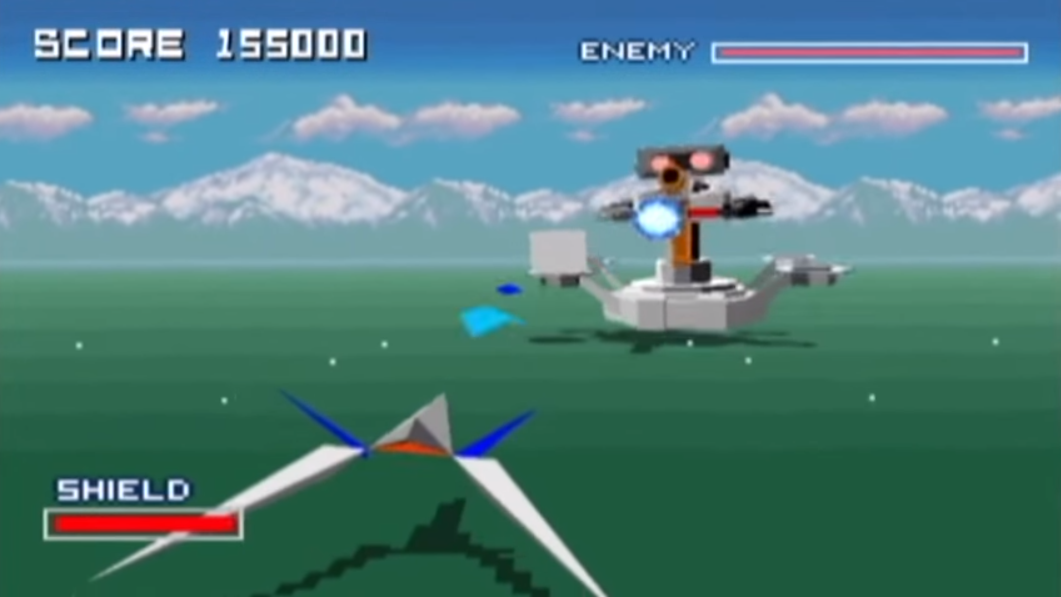
Wario Ware: Smooth Moves
WarioWare: Smooth Moves for the Wii features a few sections of Star Fox as a boss fight in some stages. These accurately replicate its look, displayed at a higher resolution, and moving at a smooth 60 FPS. While brief, it gives a glimpse at what a faithful remake of Star Fox might have been like. There are ways to increase the frame rate of the SNES game on emulators, but it also messes with the speed and causes other glitches.