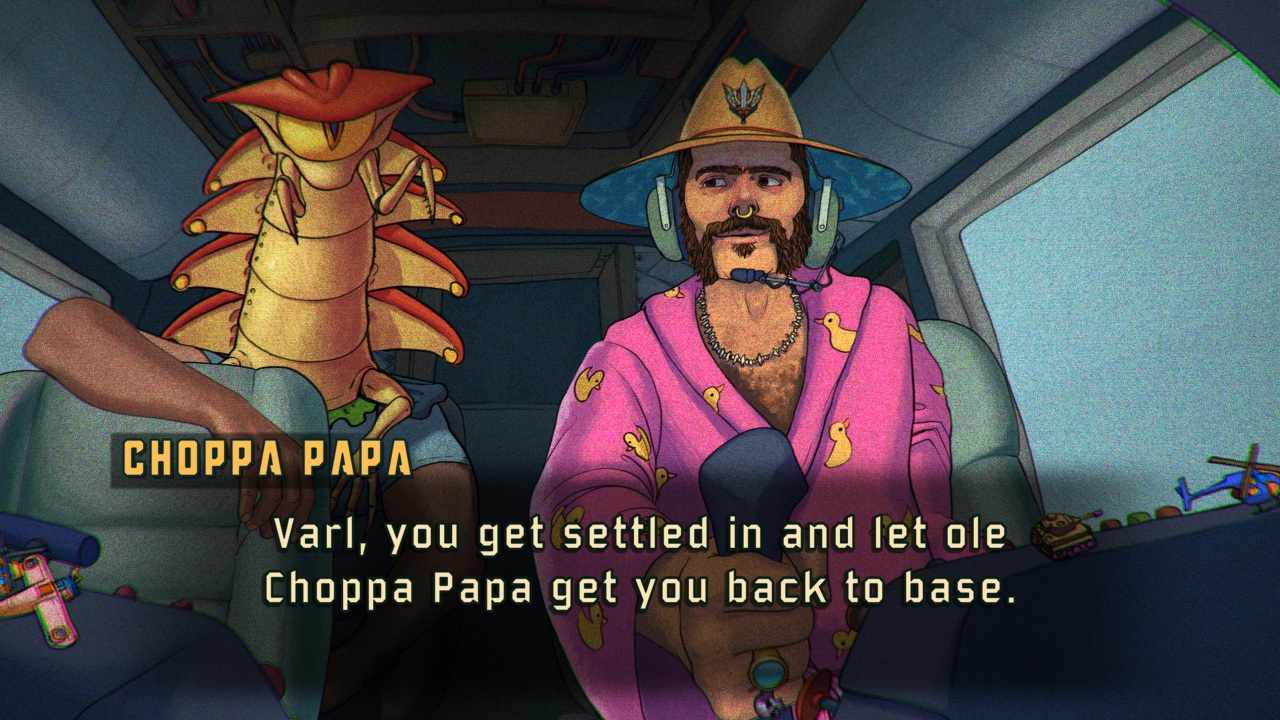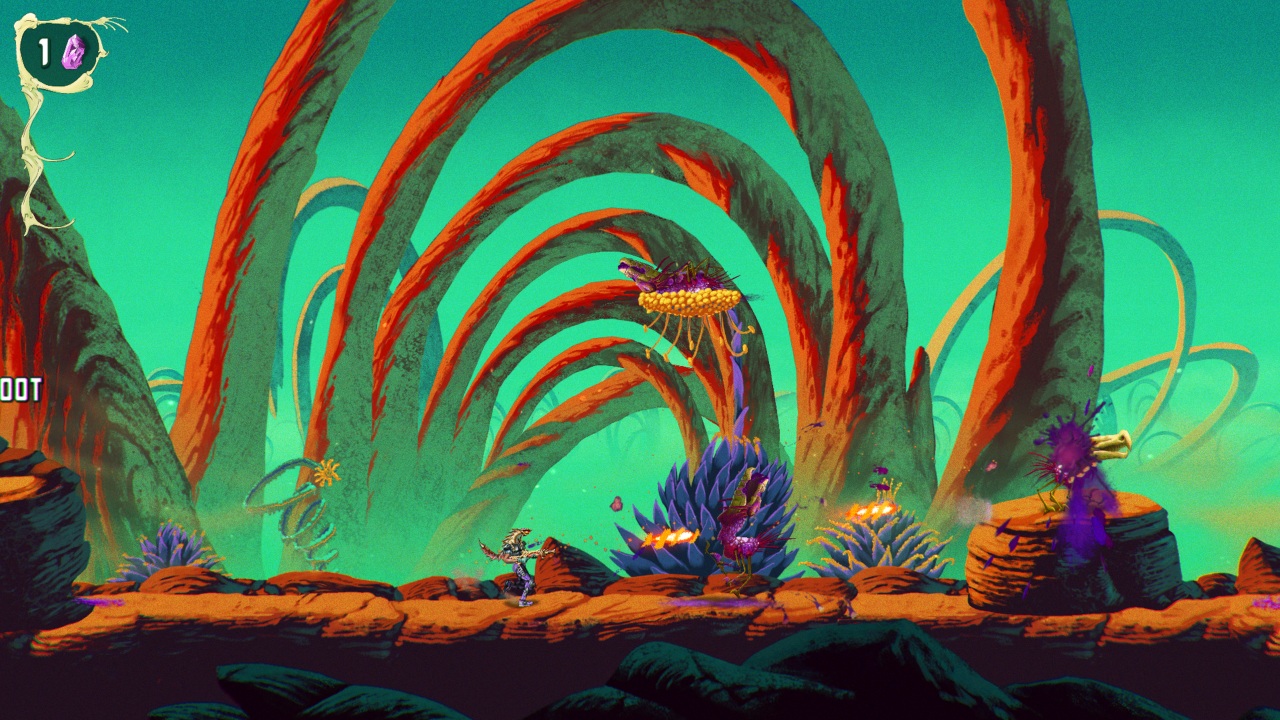
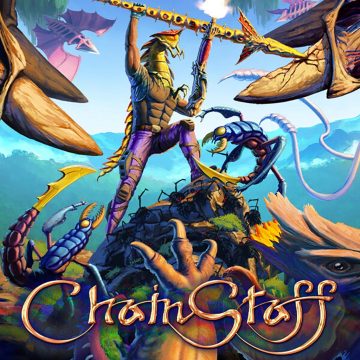
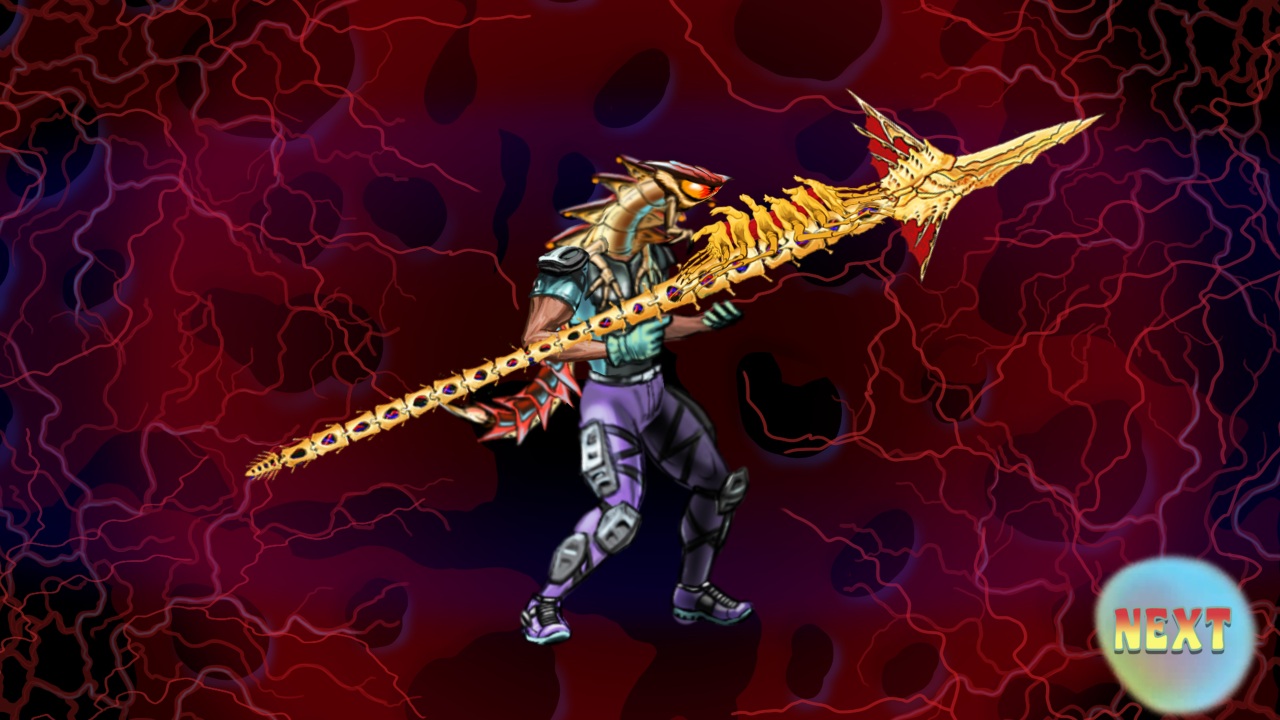
Earth has been overwhelmed with Star Spores from space, mutating its flora and fauna in ferocious ways! Courageous soldier Jesse Varlette has fought valiantly, except he’s ended up with an alien parasite on his body. He is, fundamentally, still human, and uses his newly mutated powers to fight back against the alien menace.
Chainstaff comes from Mommy’s Best Games, an indie American studio that’s specialized in 2D shoot-em-ups and run-and-guns since the XBLIG era, including titles like Weapon of Choice and Serious Sam DD. This is a culmination of everything they’ve done up until this point, with a distinct visual style and over-the-top gunplay that sets them apart from retro titles like Contra.
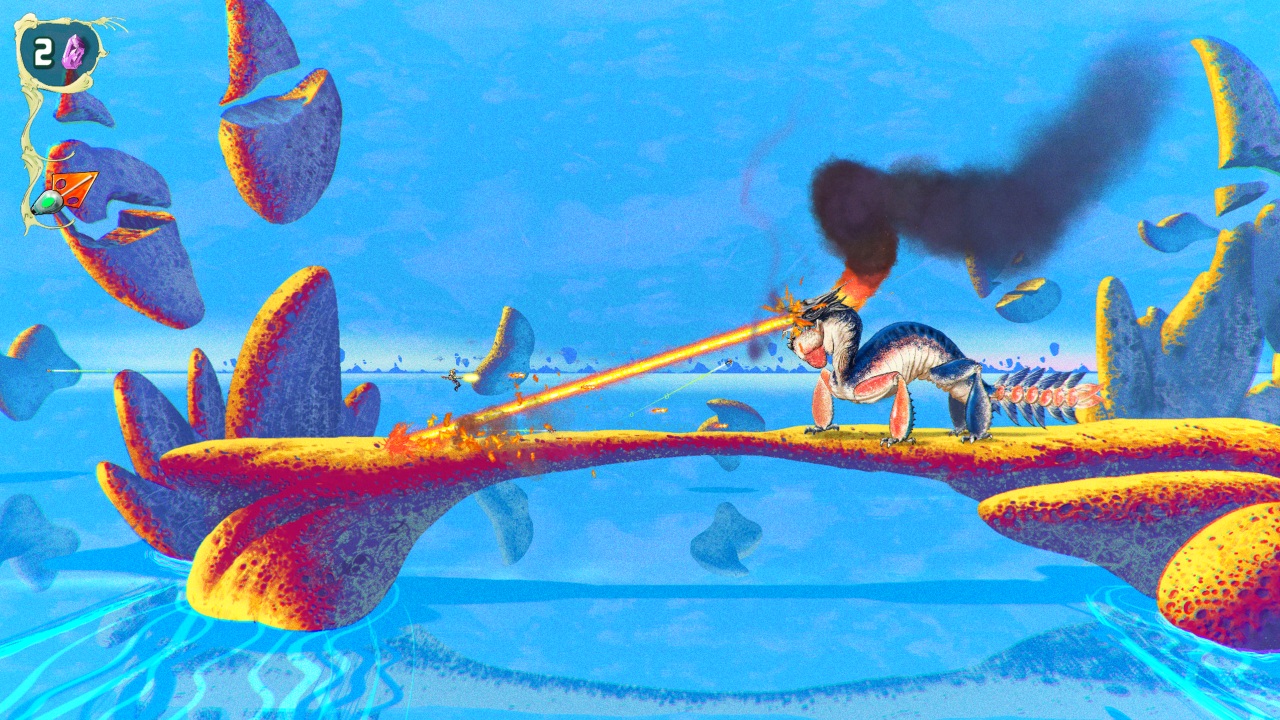
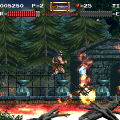
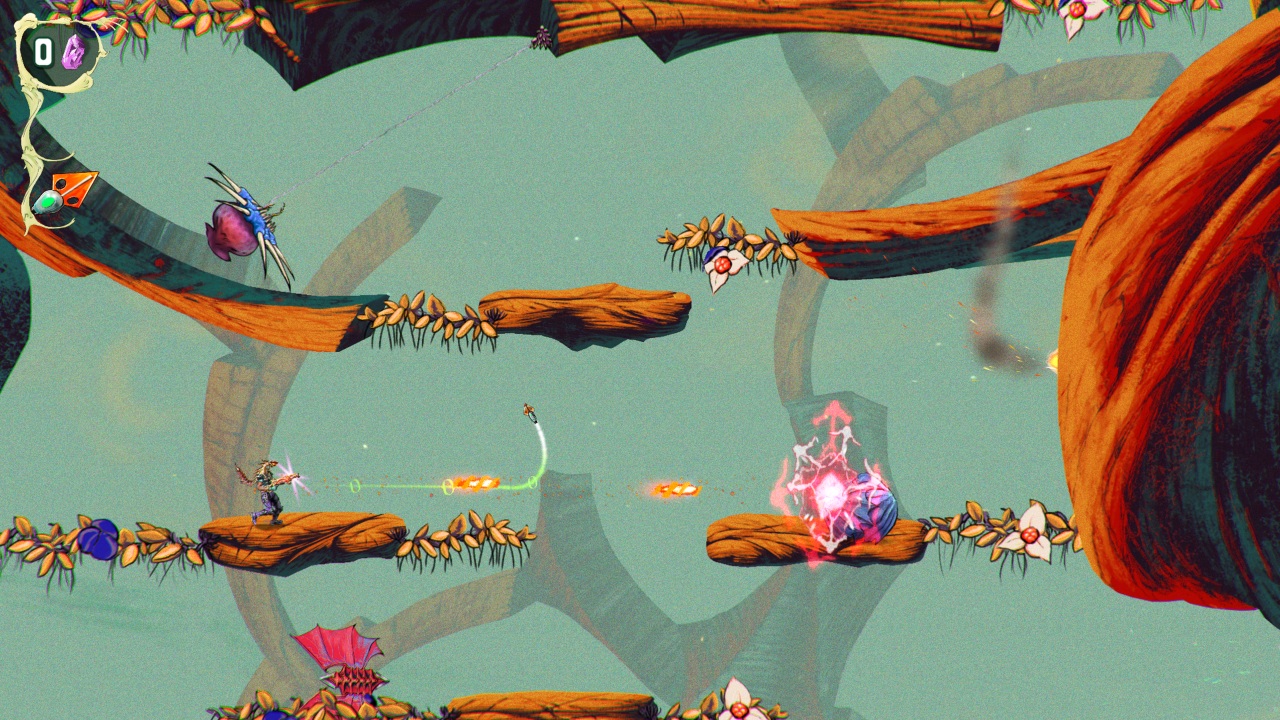
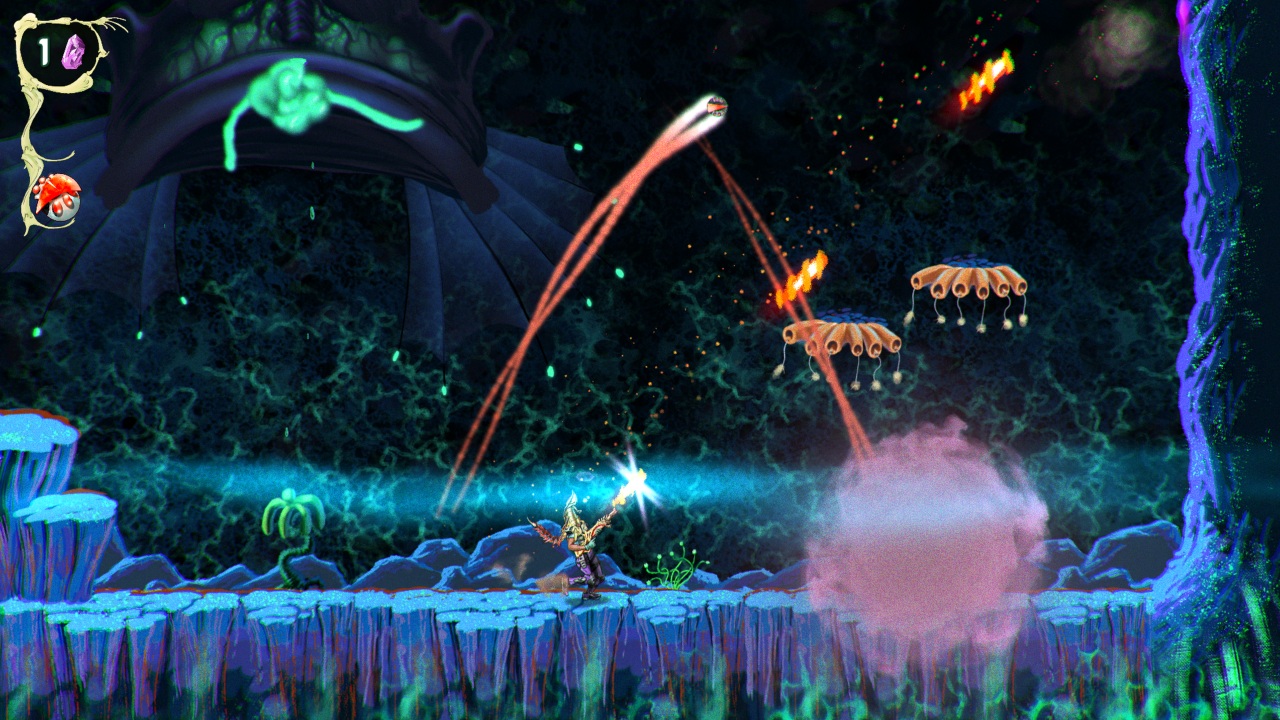
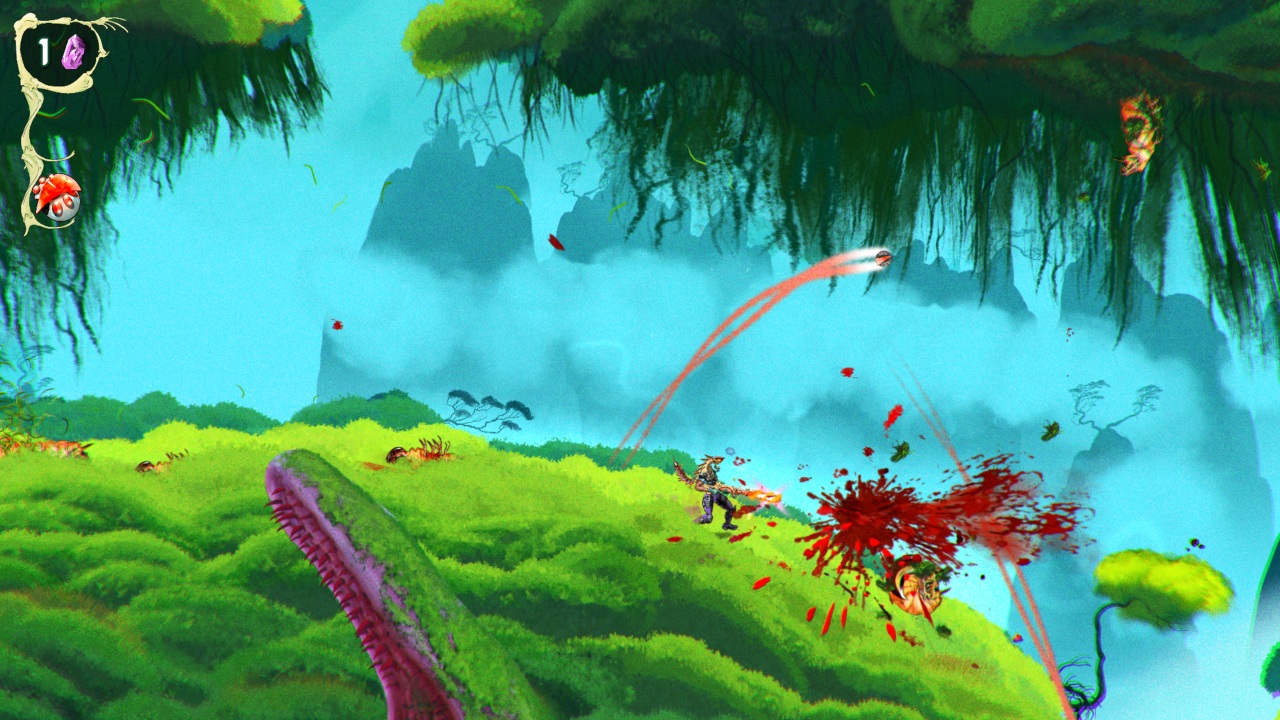
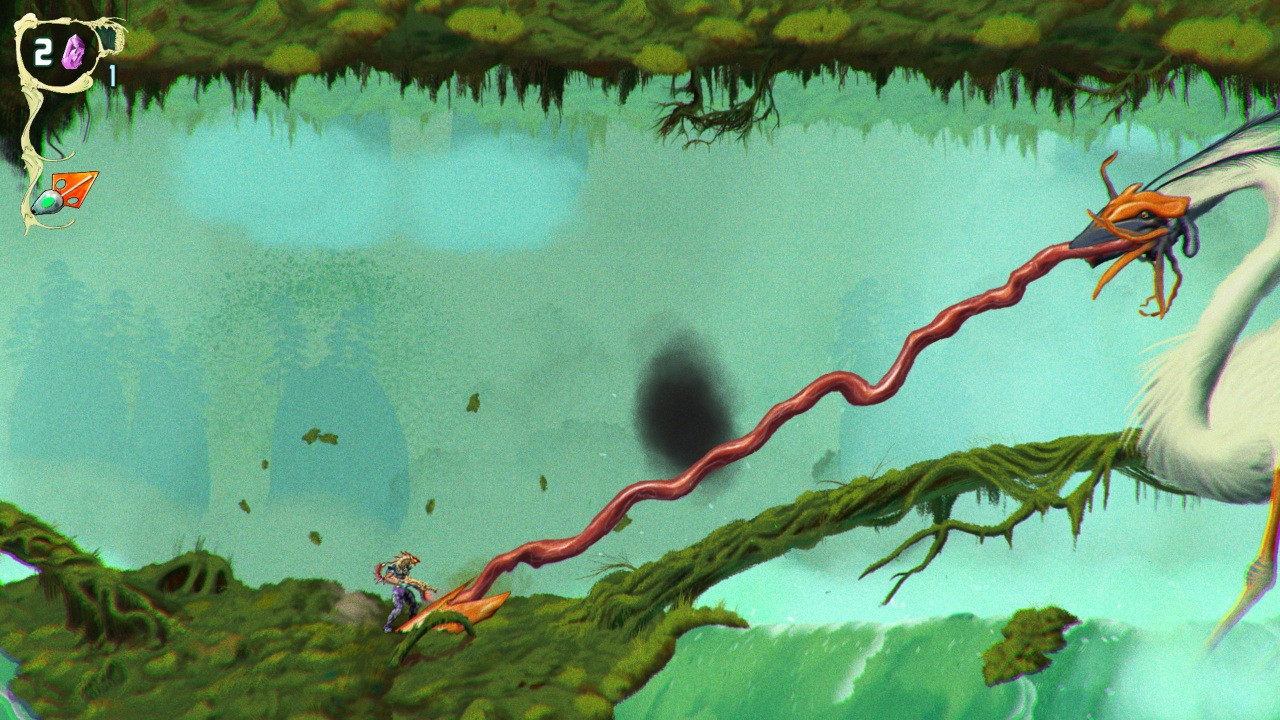
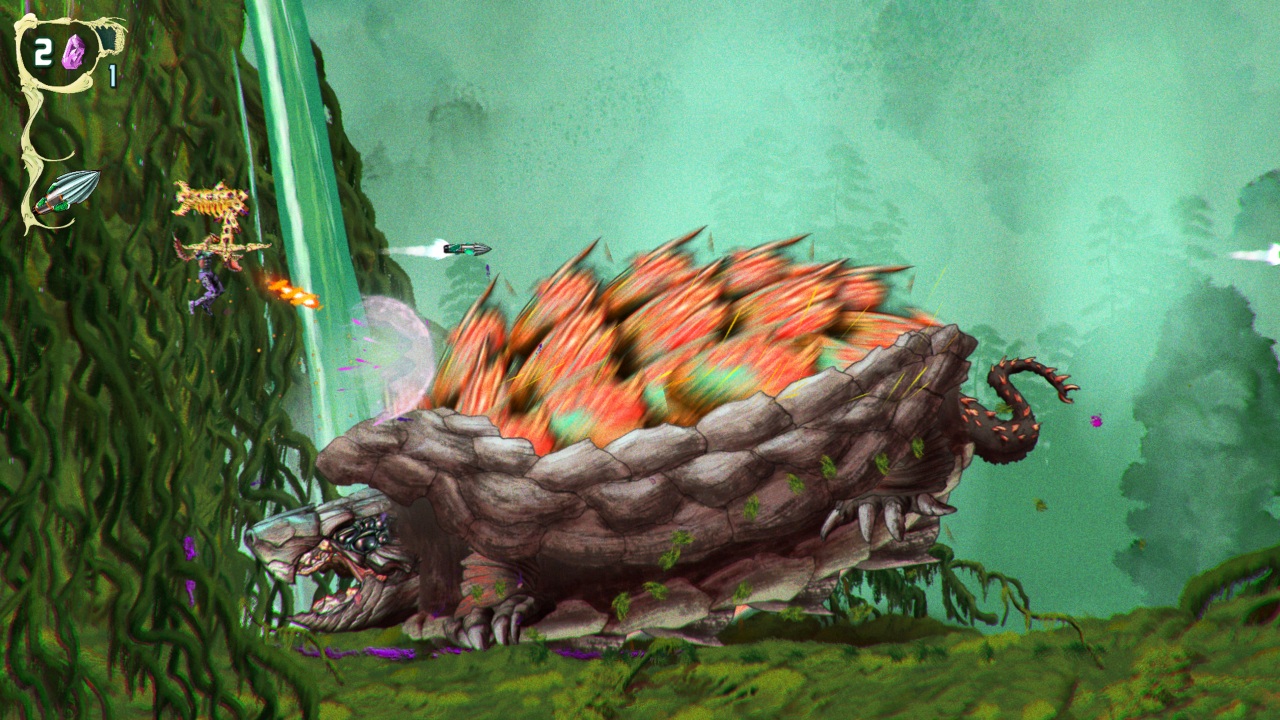
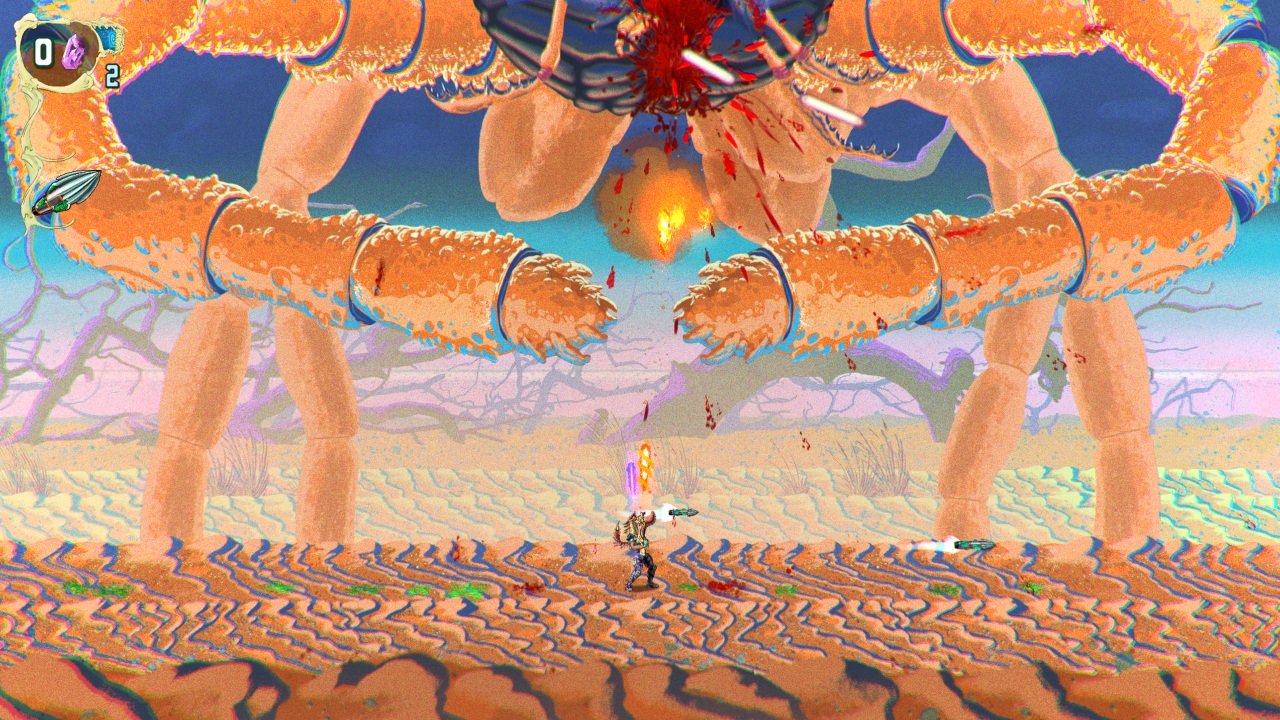
In the case of Chainstaff, the game looks absolutely gorgeous. The surreal world is inspired by artist Roger Dean, whose vivid landscapes adorned the album covers of the British bands Asia and Yes. Everything is bursting with color, yet each level includes enormous terrifying mutant creatures, filling the world with unsettlingly beautiful violence. (And perhaps coincidentally, it also ends up looking like a high res Amiga game, something like Shadow of the Beast, if mostly because they draw from the same inspiration.) And since this visual style is closely associated with progressive rock, the excellent guitar-driven soundtrack takes a similar direction. The game itself hammers in the point by presenting each new level as if it were a record cover.
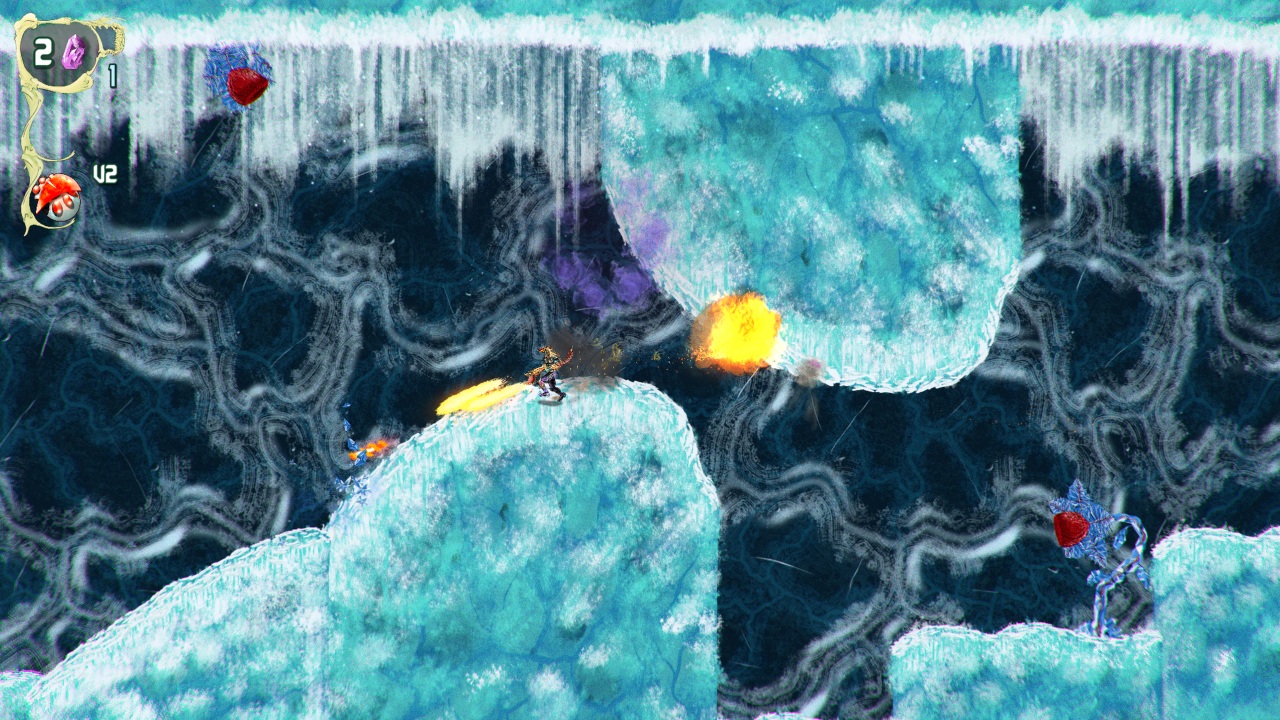
But Chainstaff is more than just a playable ’70s prog rock album, because there are quite a few interesting mechanics at work. The titular Chainstaff itself is an incredibly versatile tool. When used as a grappling hook, it has plenty of elasticity, allowing you to swing far and fling yourself upward, while also effectively allowing you to scale walls. In other words, it’s closer in function to Umihara Kawase than Bionic Commando. It can also be used as a spear, as you can toss it at various arcs and in any direction, which is particularly useful when piercing tough enemy armor. Whenever you lob it at anything, it also extends its spine and creates a platform, allowing you to climb on its sides and even stand on top of it. This will also block enemy projectiles, effectively creating a shield, though it can only take so much damage before it crumbles and you need to create a new one. Those are a lot of different functions to juggle, and even after the tutorial, it may take some time to get used to it – you need to remember to jump if you want to use it as a grappling hook, for example – but with enough time, it becomes second nature. When it comes to exploring the stages, as long as you have the swinging part down, you’ll be fine.
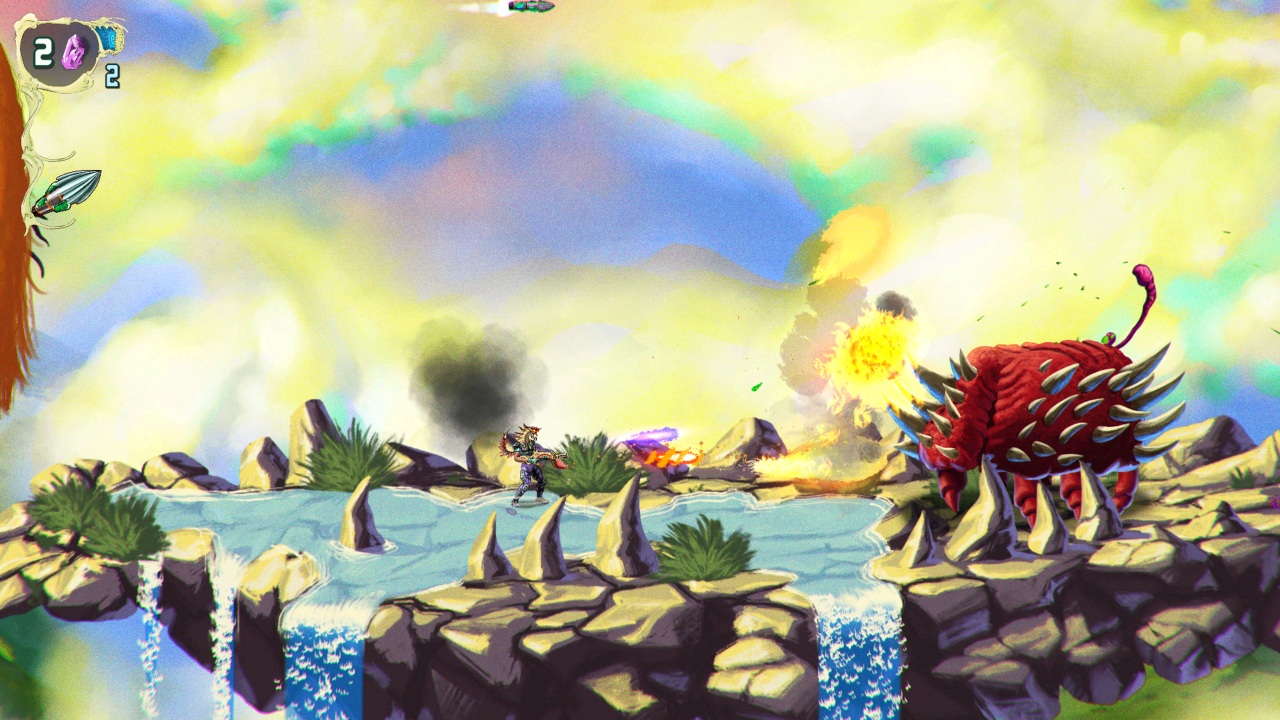
The enormous stages are what sets Chainstaff apart from something like Contra. They’re absolutely massive with incredible verticality, so you really get a lot of use out of the grappling hook. If a particular group of enemies seems too difficult, you can always try to climb to the level above them or swing below them.
However, it’s hard to get lost, because you can just keep walking right and eventually you’ll reach a goal. However, most stages have at least a couple of branching paths, sending you to different routes. Some of these have a boss at the end, but you’ll also find other items, like spores that unlock new stages. You can’t always access every part of an area on the first run through, so instead you’ll need to revisit earlier sections when you find new equipment. You’ll find standard genre abilities like the double jump, a flamethrower to burn vines, and the ability to ride up waterfalls. Each stage also has a few teleportation points, so you can easily jump into key branching points without having to retread much old ground.
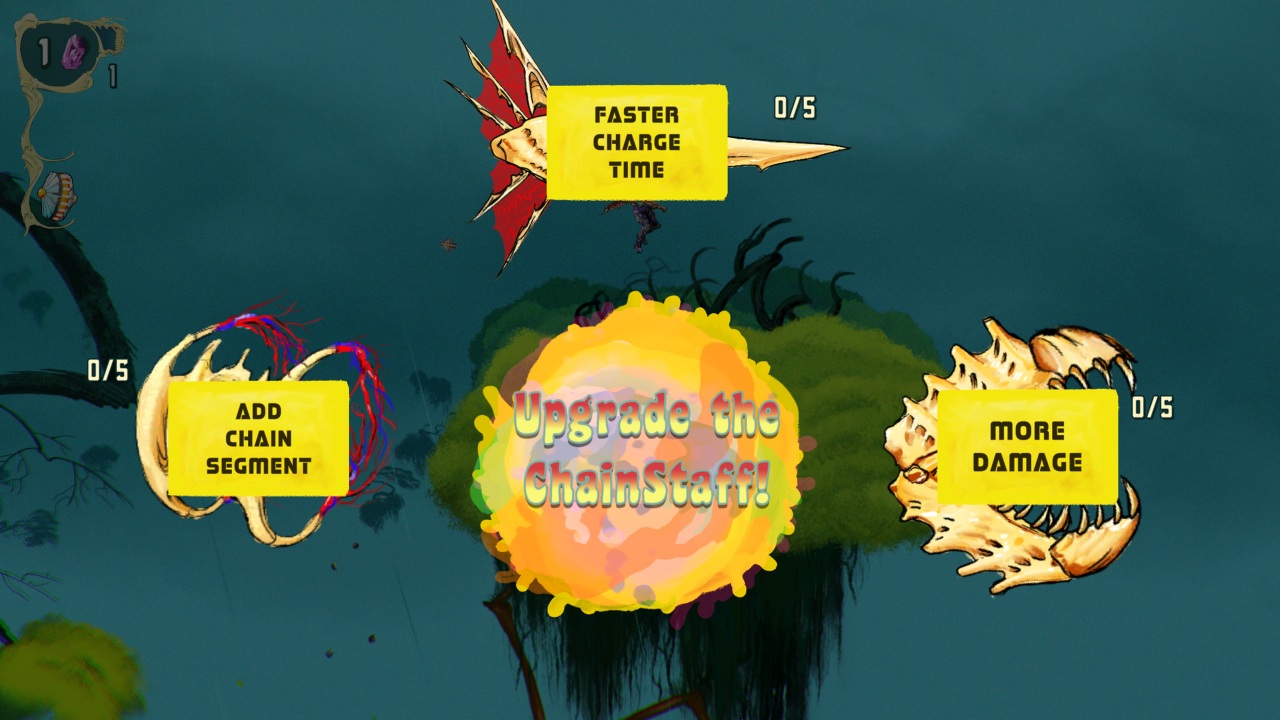
There’s also plenty of optional stuff to hunt for in the stages, including items to upgrade your Chainstaff. But most importantly, you’ll find stranded soldiers in need of your help. While not directly indicated on the map, you can pause the game and get the X coordinate of the closest soldier, so you have some approximate idea of where to look. When you find them, you can be a good guy and strap a jetpack to their back, rescuing them and granting a Tech point. These are used to unlock and upgrade secondary weapons that fire simultaneously with your main gun, plus you can extend your shield to take more hits. Alternatively, you can suck their brains or eat their heart, which will power up your gun and increase your health, respectively.
Whenever they pop up in video games, these types of moral dilemmas come with an air of pretentiousness, which Chainstaff lacks just because the whole thing has a very B-movie vibe. But it does feel like a legitimate moral choice because both upgrade types are quite useful. Yes, you definitely want to expand your weapon roster, because their versatility helps take down stronger foes. On the other hand, there’s no doubt that your main weapon feels a little weak at first, so feasting on some human brains every now and again feels awfully tempting. If you kill too many fellow soldiers, then you’ll get chewed out by your compatriots and slowly turn more into an alien monster – you can check this by using an X-ray during the mission selection. Depending on your choices, you can also reach one of several endings.
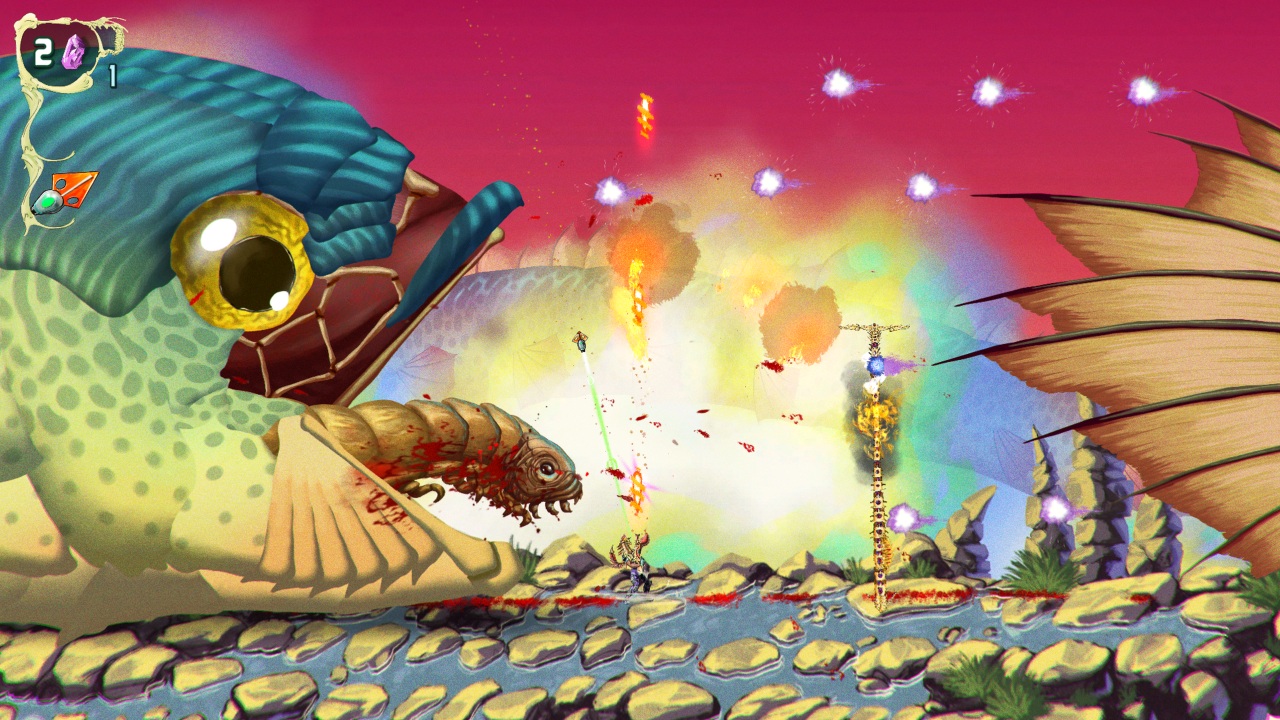
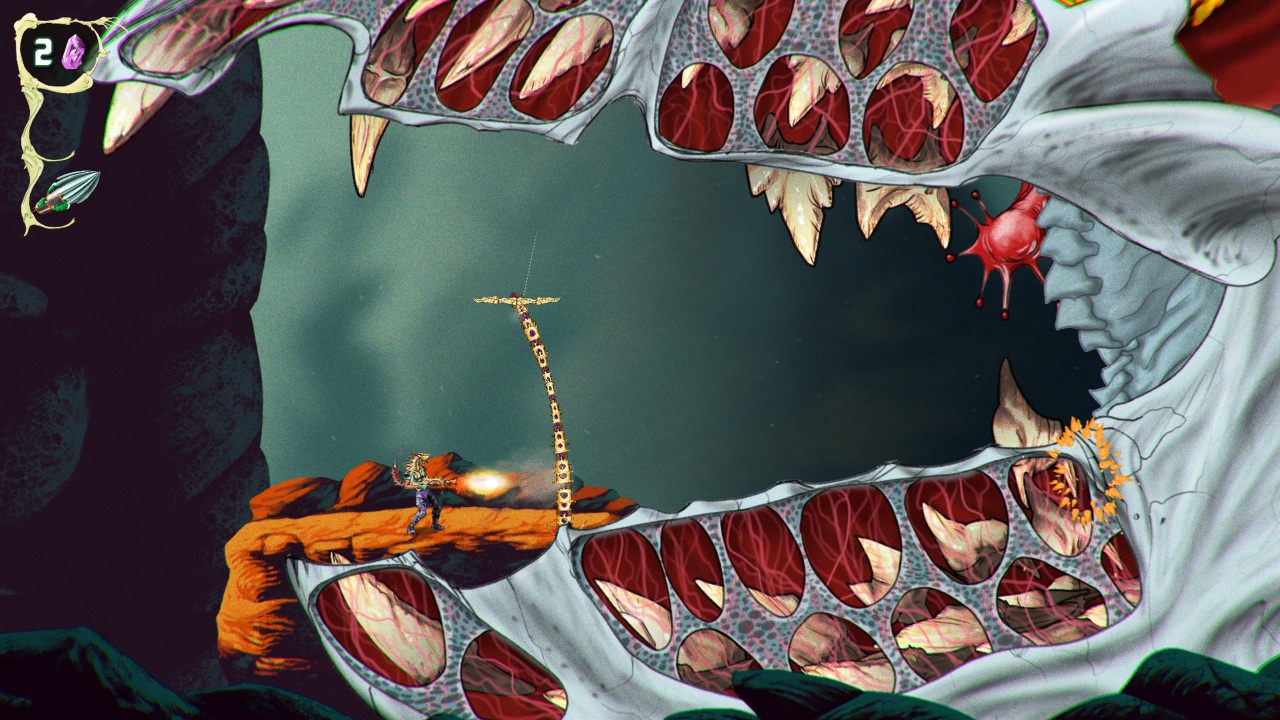
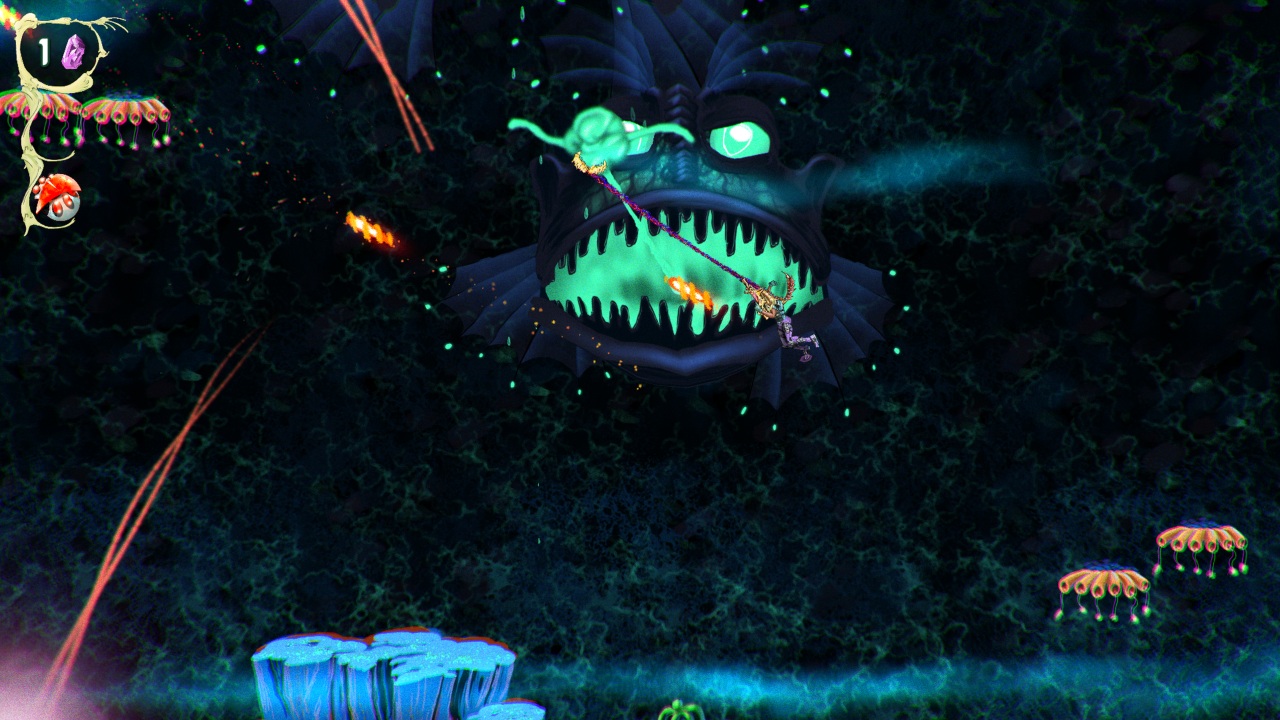
The boss fights are some of the wildest parts of the game, consisting of all kinds of overgrown creatures that take up the entire screen, even when it’s zoomed all the way out. Not only are these some of the most impressive parts of the game visually, but they also force you to think of creative ways to use the Chainstaff. For example, an early boss is a gigantic skeleton to some dinosaur-like creature. To only way to reach the weak point near its throat is to use the staff to pry open its jaws, allowing you to safely walk inside and shoot it. Here, you also need to destroy its teeth to make your way through, but you can see new teeth from its jaws just waiting to replace them. Another later boss is an enormous fish, where you need to shoot off its skin plates to reach the squishy organs inside. It shoots fireballs from its tail, so you can throw the staff to the right to act as a shield, so you can focus on gruesomely dismantling the boss. Since the staff is quite flexible, there’s no right or wrong way to use it, as long as it gets the job done.
This loose design permeates the whole game, for better or worse. The enormous levels, for example, are sometimes a little too open. While there’s plenty of hidden stuff to find, sometimes you end up exploring to some corner and end up at a dead end, other times you’ll venture through a corridor and find yourself looping back around. There’s also a lot of dead space in the stages, which either don’t have anything or repeat previous obstacles and terrain.
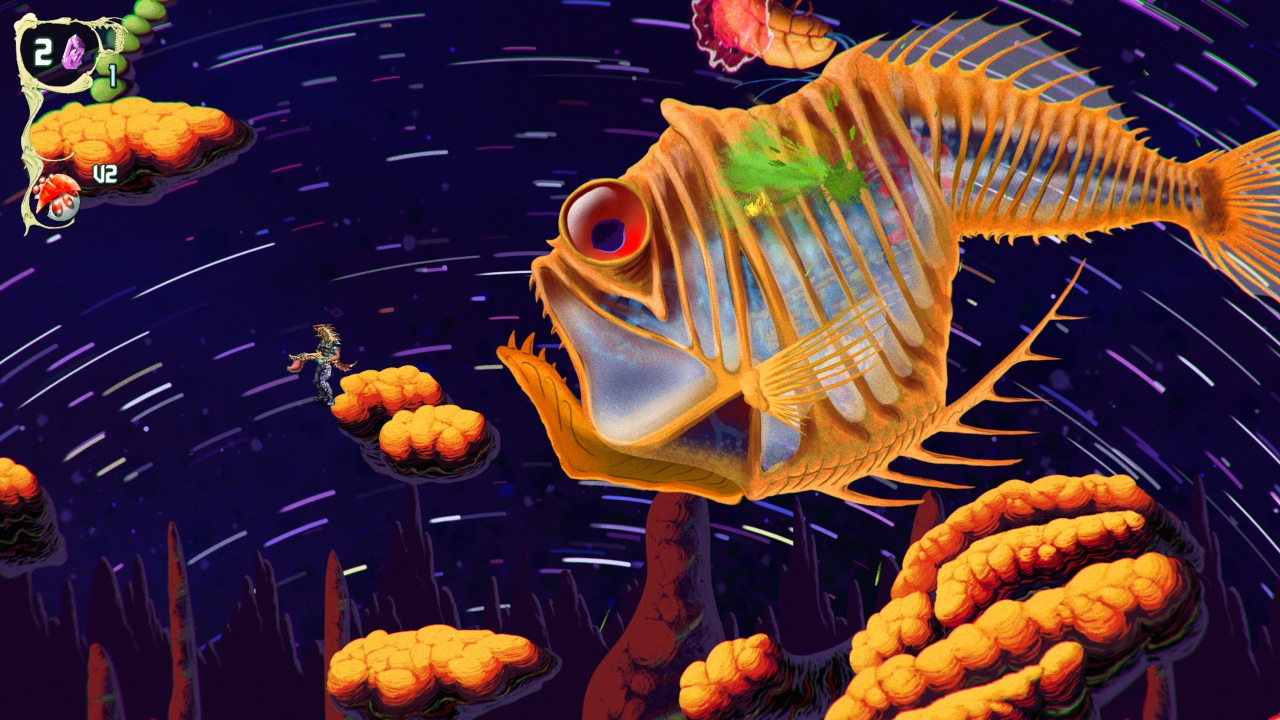
The visuals mostly work, but they cause some problems too. Sometimes enemies appear out of the ground but you can’t see them until they hit you. Most enemies leave corpses when killed, rather than disappearing, but it’s not always clear when they’ve actually died, so they can still be dangerous. One in particular leaves behind a blade when killed, which is very easy to miss and accidentally take damage. You do get unlimited lives, and while it’s not always clear where checkpoints are placed, they’re usually pretty reasonable, so the cheap hits generally aren’t too aggravating. The skeletal-based animation is 2D games like this is always contentious, but the camera is usually zoomed so far out that you don’t really notice it, and the fluidity is essential considering the bouncy physics of your grappling hook and the enormous boss animations.
Chainstaff may not be as meticulously designed as something like Contra: Hard Corps, but it’s also less rigid, and it still finds a nice rhythm between the jumping, swinging, and blasting. Plus, newer Contra titles and other similar games can be a little too nostalgia focused – they’re comforting, but there are very few surprises to be had. Chainstaff is filled with such gorgeous scenery and such weirdly grotesque bosses that the visual design alone is enough of an incentive to play it through, just to see what wild and ridiculous challenges the game throws at you.