
- Contra: Operation Galuga
- Contra: Rogue Corps
- Contra Returns
Contra: Rogue Corps has the unfortunate distinction of shared commonalities with Metal Gear Survive. Like that game, Rogue Corps seeks to take a beloved Konami franchise in a very different direction and without many of the people who made it so special. Rogue Corps at least had the benefit of series veteran Nobuya Nakazato overseeing it during development, but between the developer being Toylogic and the presentation coming off like a retooled free-to-play mobile game, it doesn’t take long to realize this isn’t the Contra you once knew. As a result of this new direction, an extremely ugly aesthetic, and years of ill-will towards modern day Konami, Rogue Corps fared poorly amongst fans and critics alike. It’s certainly a flawed game and one that shows its hand very quickly, but if you happen to fit into the specific audience it seeks, there’s a lot to chew on and you might be surprised to find yourself enjoying its on-brand flavor of hectic action.
Set after the events of Contra III, Rogue Corps deals with the aftermath of the Alien Wars. In the wake of the war, the mysterious “Damned City” has risen from the ashes, a hellscape full of fiends and treasure alike. Just being in the city causes psychic damage, so only those with immunity known as Jaegers can safely explore it. The titular Rogue Corps is made up of five Jaegers who share the common goal of wanting to destroy the Damned City at any cost: Kaiser, a cyborg that can turn his arm into a drill, Ms. Harakiri, a woman who keeps a monster sealed away in her abdomen, The Gentleman, an unusually polite alien, Hungry Beast, a panda hosting the brain of a scientist, and Aero Captain, the pilot of their Guillotine airship. As the team proceeds with their mission, they also have to rescue a scientist, confront the perpetrator of the presidential assassination they were framed for in the past, and deal with a bit of multiverse theory for good measure.
The story itself is straightforward, but the style and delivery make it a fascinating thing to behold and not for positive reasons. The script is excessively vulgar and has characters cursing in almost every spoken line. It makes sense that the characters wouldn’t be pleasant considering the harsh world they live in, but it becomes so egregious that it feels like the writing wants to be cool and just comes off as silly instead. There’s a predictably quip-heavy style to the banter that accompanies the vulgarity and is sure to displease those who have grown tired of Marvel movie-style dialogue. In order to even see the game’s story, you need to unlock and watch the cutscenes at the hub, which are hidden in one of the tabs of an otherwise unrelated menu. If you don’t check this menu, you won’t see another cutscene until the ending! Rogue Corps was written by Evan Dorkin and Sarah Dyer, both of whom have had extensive careers within comics as well as some experience with TV shows like Space Ghost Coast to Coast. The story is presented through comic book-style stills that fit their expertise perfectly, but can look a little cheap when action is being depicted.
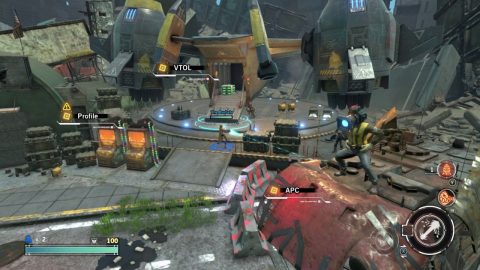
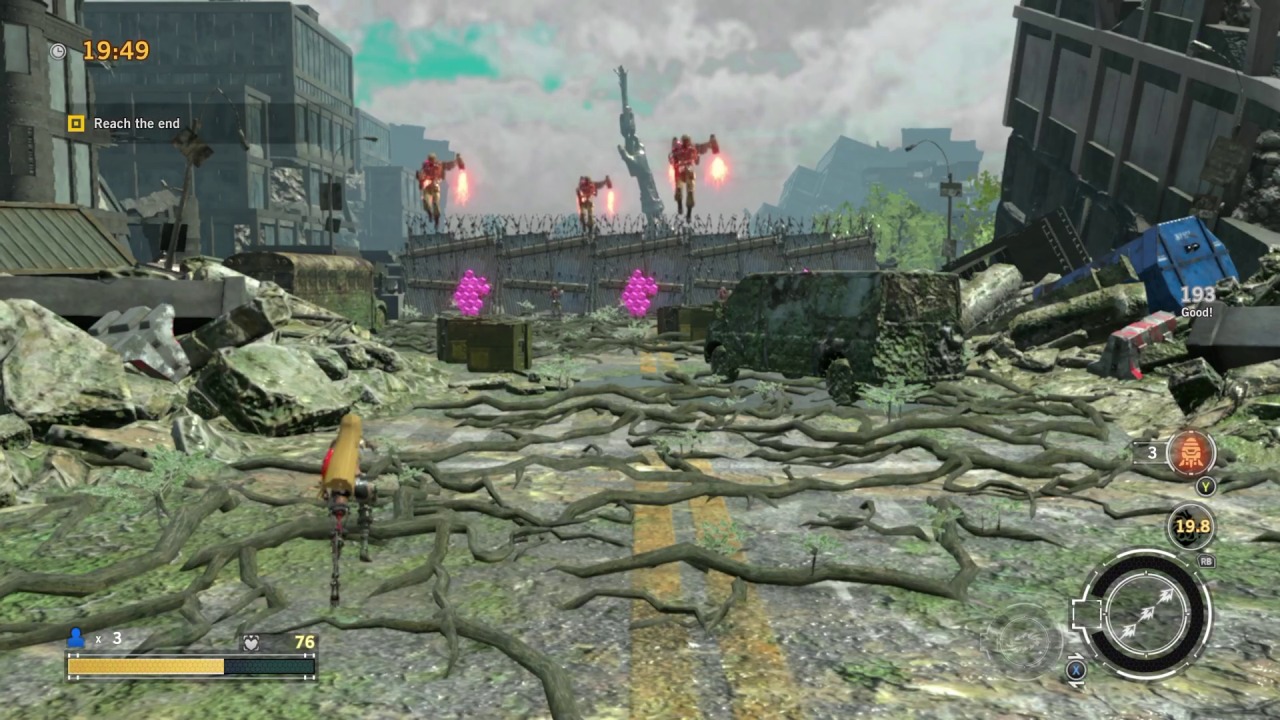
Rogue Corps shares the overhead perspective of Neo Contra and the PS1 entries, but diverges from there. It’s a combination of a twin stick shooter and a loot-driven action RPG that emphasizes a variety of missions to grind through. Objectives consist of reaching goal points, defeating specific targets, and defending against waves of enemies in a confined space. To aid in your battles, you get to bring two guns, ranging from machine guns and blades to more bombastic weaponry like drills, homing missiles, gauss guns, and mines. You get some other useful options as well, including a dash that knocks enemies away, a supply of bombs, and a character-specific skill. Even with a loot focus, Rogue Corps expects consistent and skillful play; you have limited lives and most enemies are capable of killing you in a few hits or less regardless of your HP, so you can never count on numbers alone to carry you.
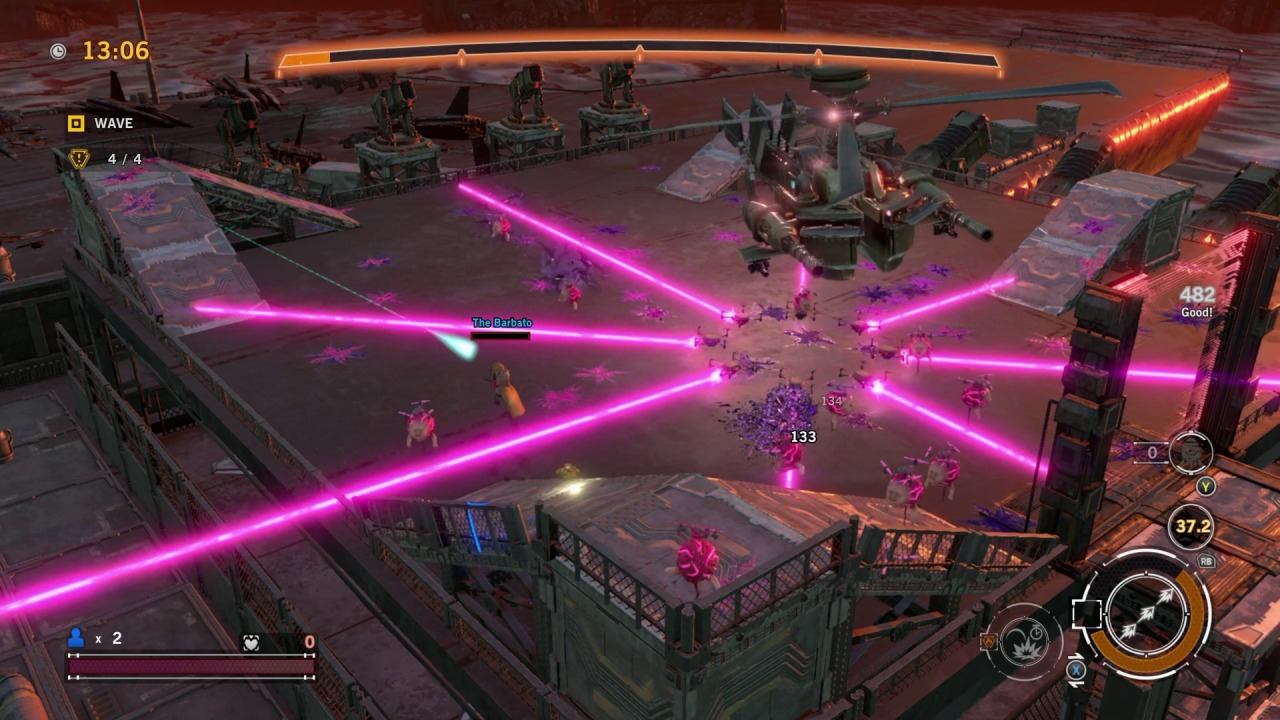
The weapon system is easily Rogue Corps’s greatest strength, evoking the likes of Borderlands in that every new weapon has the potential to change your primary verb. Some gun effects are so dramatic that they defy conventional categorization; a shotgun that shoots energy balls, a homing missile that launches a massive fiery serpent, a machine gun that sprays insects instead of bullets, and a permanent version of the iconic spread gun are just the tip of the iceberg in terms of what you can find. To balance out these absurd weapons, you’ll have to deal with them overheating. Some weapons last a while, but others overheat after one or two shots, leaving you defenseless if you’re not careful. Thankfully, Rogue Corps offers customization in the form of B.A.Ds, which are parts you can attach to guns to adjust their stats. You can make them stronger, cool down faster, increase their firing rate, give yourself various conditional bonuses, and even add extra shots. The potential of this system is immense, but taking advantage of it requires grinding out capacity upgrades for your guns, which requires a combination of leveling, money, and B.A.Ds you’re willing to sacrifice. Many weapons are also rare drops from specific missions, so you’re going to have to put in the time to really see the system at its peak.
Rogue Corps also has a novel take on equipment beyond the guns. Instead of armor or accessories, you can swap out each character’s organs for new ones, all of which offer various benefits. Brains, eyes, skeletons, and hearts can be inserted into your character to boost their health, give them specific defenses, and grant you more lives and bombs to complete missions with. It’s expensive to do, but it’s also possible to hire different surgeons to alter the properties these organs have at random, providing yet another thing to grind for the dedicated. This system is refreshingly unusual and thematically appropriate, but it and the B.A.D system are held back by some lacking UI design that makes it difficult to understand what B.A.Ds and organs do. You’ll accumulate hundreds of items as you play, so you’ll be scrolling through tons of similar looking things every time you want to sell or upgrade something, which tacks on unwanted time to an already slow burn of a game.
Ultimately, the biggest issue Rogue Corps faces is that it’s incredibly repetitive. Within a couple of hours, you’ll have seen the majority of the enemies and environments on offer. Many missions reuse level layouts, only making changes to where enemies are distributed. Said level layouts are never interesting to walk through either, consisting mostly of dilapidated sections of the city. Bigger enemies are thrown at you in bulk, especially towards the end, making missions drag to the point that they can take around 15 minutes or more. Even when you’ve made it into the post-game and are working on the extra-challenging expedition and chaos missions, you’re still fighting the same handful of enemies you’ve been fighting the entire game. Rogue Corps doesn’t allow you to pause the game at all, even when playing solo, so it expects commitment in every moment of play. Because of all this, most people are going to tap out well before they encounter any of the game’s better qualities, which is certainly understandable.
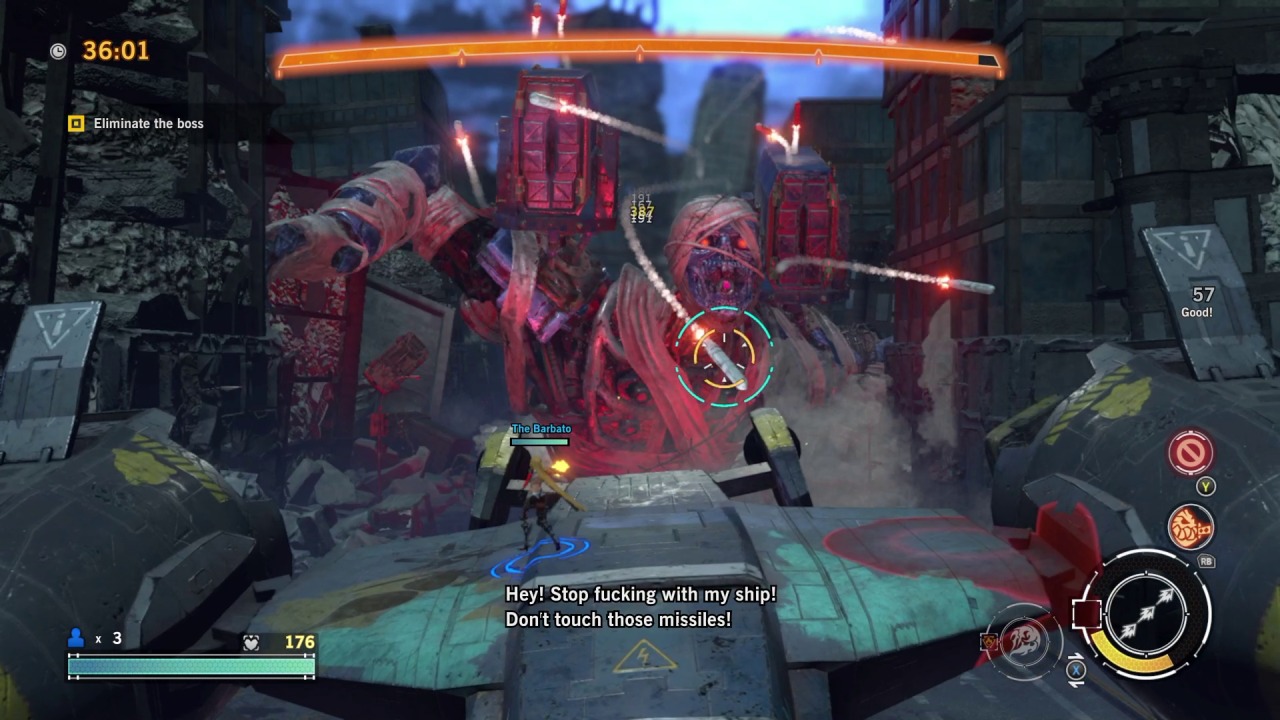
Those who do stick with it will get to appreciate some solid boss fights that pit you against massive monstrosities. These fights are the highlight of the game, providing a fair level of challenge that’s reminiscent of previous games. One boss fight has you shooting at a demonic train, only for it to transform into a creepy baby that crawls along the ceiling and gives chase. Another fight has you fighting against a robot mummy atop the Guillotine, which will fly around and make sharp turns to throw the monster off your back, all the while forcing you to dodge its onslaught of missiles and lasers. These fights mostly utilize a behind the back shooting gallery approach, which makes the action easier to follow while also framing it in a more stylish light. There isn’t a single weak boss in the bunch, but asking players to grind their way through a dozen hours or more of repetitive missions just to reach these brief flickers of glory is a big ask.
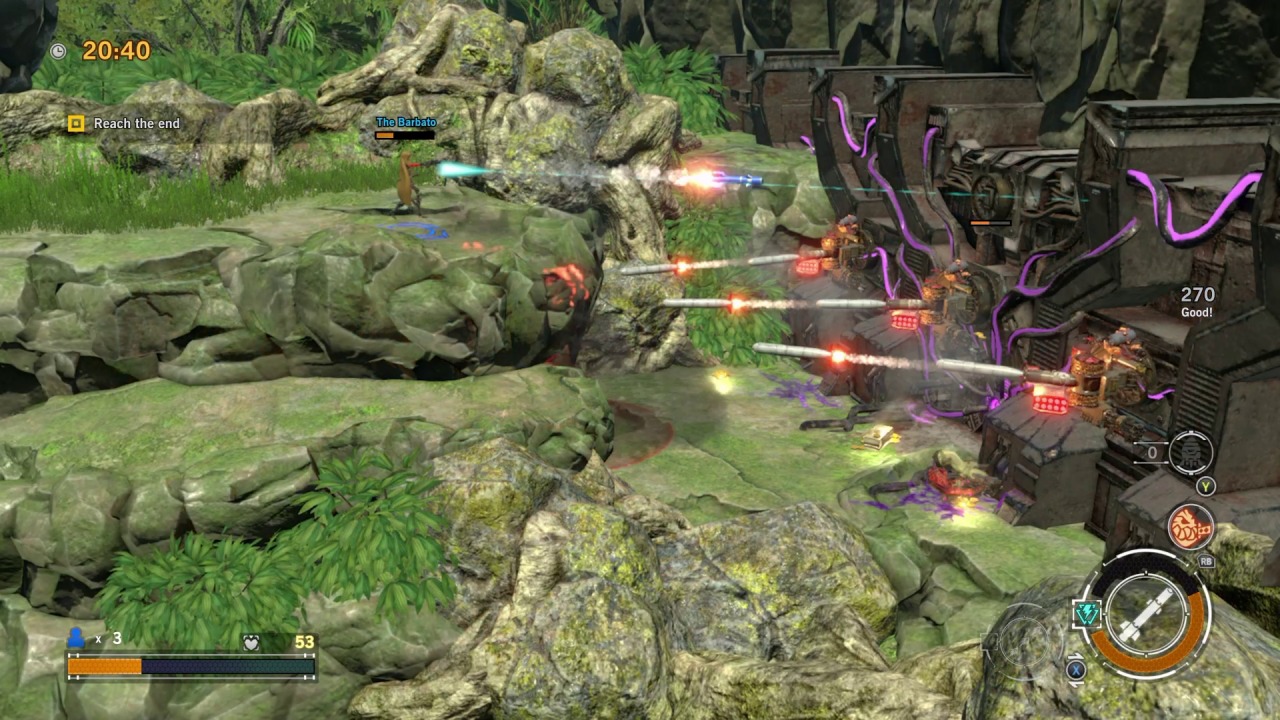
Multiplayer is here as you’d expect, but it doesn’t offer the conventional Contra experience by any means nor is it as easy to set up. It’s possible to play through the main missions with up to four players online, but if you’re playing locally, you’re limited to the expedition missions. Local players can borrow player 1’s items, but since expedition missions are meant to be tackled post-game, this mode will be pointless unless the owner of the save file can handle those missions. Rogue Corps also has full-fledged competitive multiplayer, offering ranked play and rewards for continued play. This team-based mode has eight players killing each other through the use of grinders or competing to knock balls into said grinders, offering a nice change of pace from the usual action, but as you’d expect at this point, finding a game organically will prove extremely unlikely.
Rogue Corps is commonly criticized for not feeling like a Contra game and while there is some truth in that, it does manage to capture the spirit of the series in its best moments. The weapon system is a joy to mess around with, the boss fights are the spectacles you’d hope they would be, and the game’s core mechanics lend themselves to an experience that captures the aggressive nature Contra is known for while offering something different in a mostly iterative series. The framework surrounding the gameplay is responsible for much of the derision and confusion Rogue Corps receives; it’s more likely that people who enjoy games like Borderlands, Destiny, and Housemarque’s Alienation will have the stamina to stick with it than the longtime Contra fans, which is an unusual situation indeed. Like Metal Gear Survive, though, Rogue Corps is ultimately a game made by different people for different people in a different era, which can be a tough pill to swallow, but if you can leave your expectations at the door, it’s not the travesty it’s made out to be.