
This article first appeared in HG101 Digest Vol. 4: Star Fox and F-Zero. Check it out!
After the release of the original Star Fox, Nintendo and the Argonaut team quickly went to work on its successor, using the more advanced Super FX2 chip. Unfortunately, while the game was completed, Nintendo canceled it before entering production. Why? It was 1995 and both Sony and Sega had released the PlayStation and Saturn respectively, and apparently Nintendo felt their 3D on the SNES looked bad in comparison. Plus at the time, they wanted to focus on the upcoming Nintendo 64 (though the system didn’t end up being released for another year anyway). Star Fox 2 was essentially lost until two prototypes were leaked onto the internet, in various states of completion, giving gamers a taste of what they had been denied. In an unexpected move, Nintendo officially released the game as part of the SNES Classic microsystem in 2017 (then later as part of the Nintendo Switch Online SNES library), presenting it in a final state that had been previously unseen.
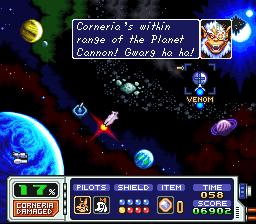
Star Fox 2 is fundamentally a very different game from its predecessor. It completely tosses out the on-rails stages, replacing it with a mixture of strategy and dog-fighting. Each game begins with a map of the Corneria system, with the homeworld in the lower-left and Andross’ mothership in the upper right. The enemy then immediately invades a few of the neighboring planets, positions a few of their battleships, and begins their assault, sending both missiles and fleets of ships. You pick from two (out of six) characters to intercept these attacks, protecting anything from reaching Corneria, as well as destroying the battleships and liberating the fallen planets. Naturally, your eventual target is to take down Andross’ base.
The strategy comes from figuring out the best way to handle multiple threats, alternating between offense and defense. Technically the segments don’t progress in real time, as enemies only move when you do. This at least gives you the opportunity to plan a bit. Corneria has a defense station that can shoot down some small attacks, but won’t do much against larger ones, plus it can be taken over by the enemy if you’re not careful. You also have access to your mothership, which can restore your shields and warp to any planet that isn’t occupied by enemies. Time passes when you’re in battle, so if you take too long, something might slip by you. Furthermore, if Corneria takes too much damage, it’s game over.
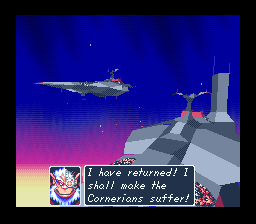
As you fight, Andross releases various stronger enemies. These include the members of Star Wolf, a mercenary team that’s like an evil version of Star Fox. Their ranks include their leader, Wolf O’Donnell, the chameleon Leon Powalski, and Pigma Dengar, the traitorous swine. You also have to deal with the Mirage Dragon, a robotic creature dramatically shown tearing some hapless Arwing fighters apart in the introduction.
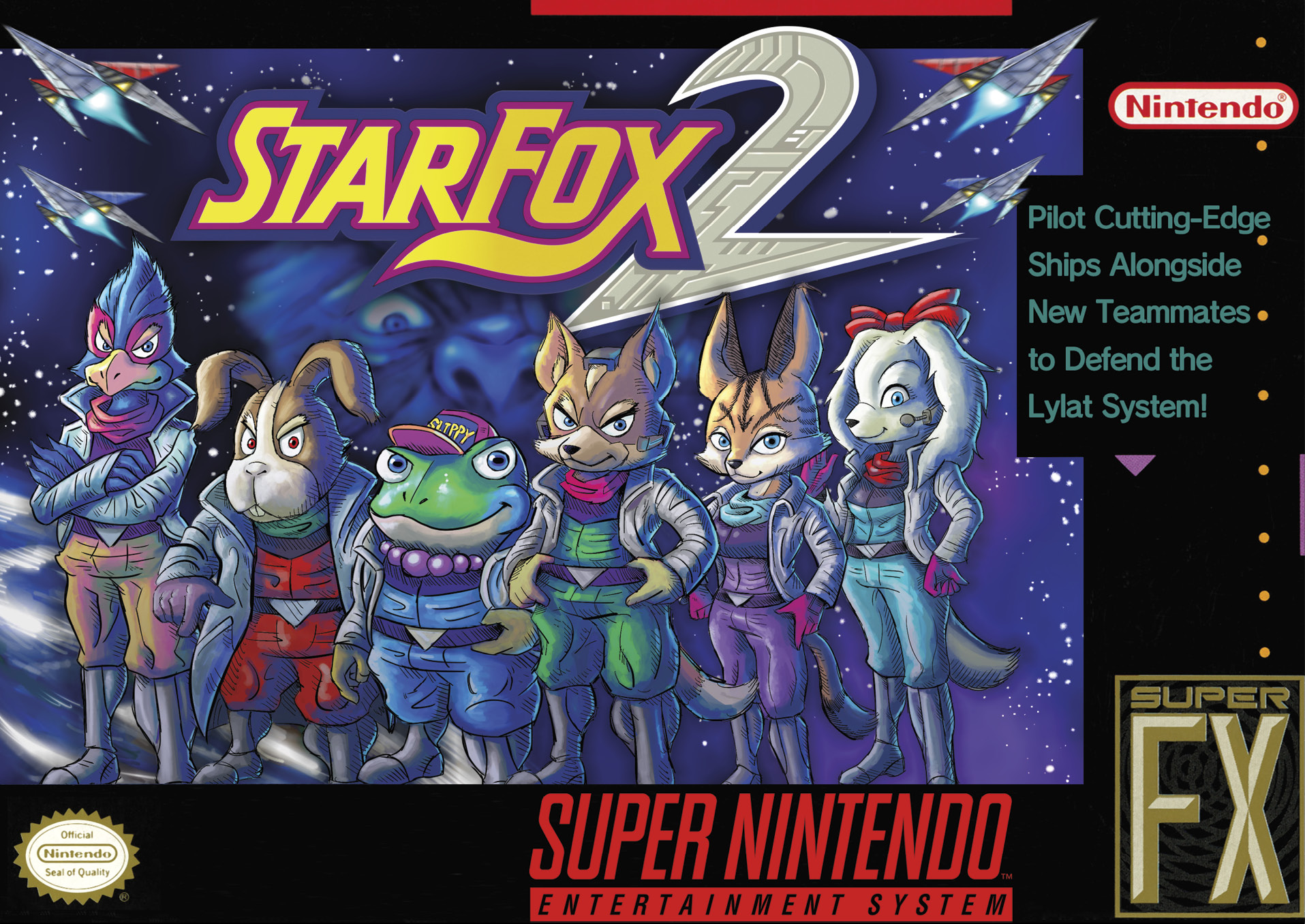
Regarding your own crew, Fox, Slippy, Peppy, and Falco return. This time they’re joined by two new characters: Miyu, a lynx, and Fay, a dog (who looks like a white Cocker Spaniel with a red bow in her hair). Each has different capabilities, including the type of special weapon they’re initially equipped with (bombs, shields, or health restoratives). You only control one character in combat at once, though you can switch between them after encounters, which is helpful when one of their shields run low. If a character is destroyed, you can switch to the other. If that one goes down, then you lose the whole game.
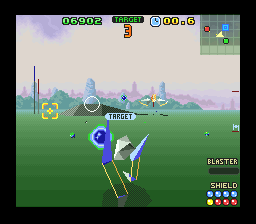
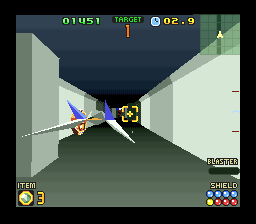
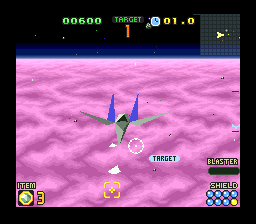
There are basically two types of encounters: dogfights and base invasions. The former take place in outer space, where you fly around in a 3D arena and destroy all of the enemies. Functionally, these are similar to the Wing Commander games; they’re presented in the third-person by default (though you can switch to first-person), and you have a radar as well as a helpful “target” indicator that shows the location of one of the enemies. Thankfully, a targeting crosshair has been added for the third-person view, making aiming much easier than in the original game.
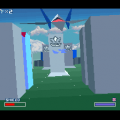
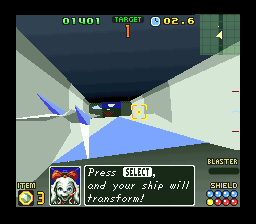
Base invasions can either take place on a planet’s surface or in space. On a planet, you need to look for a way to disable its shields before you can enter, while you simply need to fly near the battleship in the space encounters. In these segments, you can change your Arwing into a “walker” formation, which turns the ship into a biped and lets you amble around the scenery as opposed to just automatically barreling forward. The bases themselves usually consist of a few rooms connected via corridors, requiring that you beat some enemies to unlock them, before reaching the central core and destroying the whole place. It’s a little tough to control at first, since you strafe by pressing Left and Right on the D-pad, and turn by using the L and R buttons.
In both forms, you also have access to a charge laser. Scattered around the various planets are General Pepper tokens; if you manage to collect all of them, you’ll unlock a secret base where you gain access to an upgrade that grants this homing capabilities. Otherwise, it’s not terribly useful on its own.
By its very nature, Star Fox 2 gets a little repetitive – there’s not much in the way of mission variety, with the only bosses being the Mirage Dragon and Andross at the end, who is a little too similar to his incarnation in the original game. There are the three Star Wolf fights, if you count those, though these are easily beaten if you manage to bring enough bombs along. Playing a full campaign takes about as long as a single six-stage run through of the original game – about 30-40 minutes. The default difficulty level isn’t hugely tough once you get a grasp on it, but the hard mode requires both smart micro management techniques and proficient dogfighting skills. Only by beating and getting a high enough score on this can you unlock the final difficulty setting, which is a huge challenge. In other words, it might not seem like much at the outset, but truly mastering Star Fox 2 will take a ton of devotion.
Visually, the Super FX2 chip allows for smoother, slightly more complicated polygonal models. However, it still suffers from a choppy frame rate and significant slowdown, especially in the interior base sequences. Unfortunately, the music isn’t particularly memorable here either, outside of the victory fanfare.
The leaked prototypes are interesting, as they show how some of the game’s design progressed. The first version actually had a split screen two- player mode, which was totally removed in later renditions. The characters were also changed – early versions had Faye Phoenix, a fennec fox from the Nintendo Power comic, plus an Andross-like monkey, plus early screenshots also showed a goat. These were later replaced by Miyu and Fay. The second prototype (the one that was the most feature-complete before the SNES Classic version was released) is also missing some stuff, primarily the randomization, where Andross’s battle plans – what planets he invades, etc. – change each game, plus the balance is tweaked. Noticeably, all of the stuff that needs to be unlocked in the final version is available from the state in this build of the game.
If Star Fox 2 had been released at the time, it probably would’ve caused some disappointment, since it’s such a departure from the original. Still, even though it could’ve used more variety, it’s actually a really interesting game, one that takes notes from older space combat games like Star Raiders and Star Luster. Plus, many aspects were carried forward to later games: the dogfighting was implemented in Star Fox 64 (called All-Range mode) plus Star Wolf was reused. Star Fox Command for the DS is basically a spiritual successor to Star Fox 2, as well, and the walker made an appearance in Star Fox Zero for the Wii U.