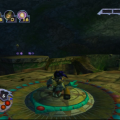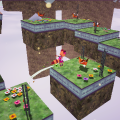

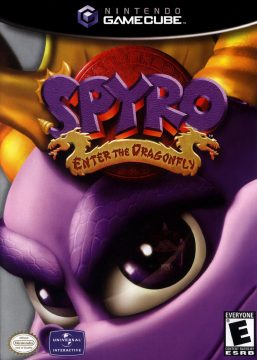
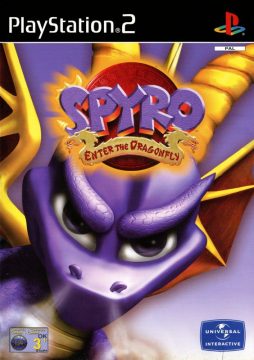
While Insomniac Games went off to create the Ratchet & Clank series, Universal Interactive kept the rights to Spyro and handed the next console game off to fledgling studios Check Six Studios (who would handle programming and design) and Equinoxe Digital Entertainment (who would handle the art). This was their first big project, and it would unfortunately be their last due to a protracted development cycle full of issues, disagreements with Universal who frequently flip-flopped on the game’s direction, and weeks of unpaid crunch.
It’s a miracle that Check Six and Equinoxe managed to release anything, but it’s a shame that it ended up being Spyro: Enter the Dragonfly. While it contains just enough of the classic Spyro gameplay to be moderately playable, it’s an uninspired buggy sequel that doesn’t live up to the original trilogy, and makes for a tough recommendation.
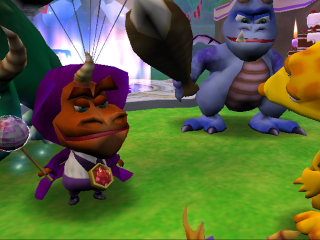
The story kicks off shortly after Year of the Dragon, with all the baby dragons now rescued and ready to receive dragonflies to protect them during childhood like Sparx protects Spyro. However, the festivities are interrupted by the return of Ripto and his henchman Crush and Gulp! Ripto casts a spell that ends up scattering the baby dragonflies throughout the land, so it’s up to Spyro to rescue them all and defeat Ripto once more.

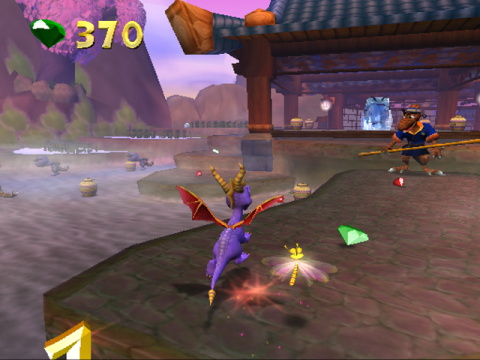
Enter the Dragonfly retains the same freeform 3D platforming from the previous games, asking you to glide, charge, and flame your way through large worlds in search of the dragonflies. You retain your standard moveset, but can acquire new powers by finding magic runes and bringing them to the Dragon Statue in the hub world. These powers include new breath types, such as bubbles to capture the dragonflies, ice to freeze enemies, and electricity to activate switches, along with a Wing Shield that blocks enemy projectiles.
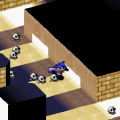
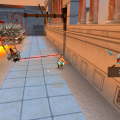
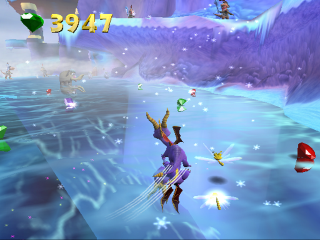
Although they try to add some variety, the new breath types aren’t fleshed out enough to feel meaningfully different from your flame breath, the Wing Shield is an underused pace-breaker that stops you in your tracks, and chasing after dragonflies to capture them in bubbles is quite tedious. Some dragonflies are out in the open, and others are earned by completing missions located in the main level, or in sub-areas where you’ll play a minigame. These mainly rely on a handful of recurring types like Speedways, tank stages, and slides, with a few level-specific scenarios scattered about. The Speedway stages are fine enough albeit hampered by overly sensitive controls, while the rest vary between unremarkable and annoyingly clumsy.
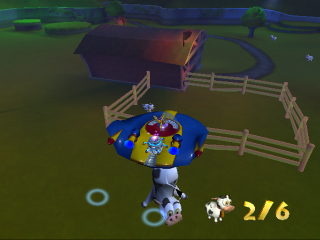
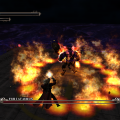
They’ll have to be beaten whether you like them or not, since most levels are unlocked by earning increasingly substantial numbers of dragonflies. This also applies for the single boss fight at the end, where you’ll need to collect nearly everything if you want to see anything past the very easy opening phase, let alone any kind of an ending cutscene. These tight restrictions also mean you likely won’t be able to choose from multiple stages unless you’re diligent, which reduces the sense of freedom.
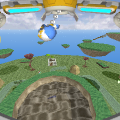
Perhaps that’s to hide the fact that there’s are only one homeworld and eight levels available. It’s a paltry offering compared to the PlayStation titles, even if worlds individually take much longer to beat due to their massive size. But that size often works against it, where stages are full of repetitive open fields and winding corridors without offering much in the way of memorable designs or gimmicks.
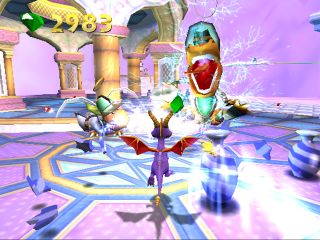
This isn’t helped by the controls feeling considerably more sluggish than before. Moving and turning is cumbersome, and charging is much slower which takes out the thrill of speeding around the place. Even the simple act of collecting gems is made a hassle, since you don’t automatically pick up gems from destroyed pots or defeated enemies, and you have to get very close to pick up any lying around. (Not that collecting gems matters beyond completionism, since Moneybags appears just once in the entire game.)
Enter the Dragonfly is generally lacking in a good deal of polish. Some of this results in technical issues, like struggling to talk to NPCs, voice lines and music tracks cutting off abruptly, long loading times in the PS2 version, and geometry that briefly disappears. But there’s also a keenly felt absence of details and features, such as very few checkpoints per stage, only four cutscenes in the entire game, returning characters who completely disappear after you first meet them, and a barren emptiness which permeates the whole adventure.
The worlds lack the striking artistry of their predecessors, with levels consisting of basic themes like beaches, snowy mountains and farmyards that are muddily coloured and textured. Apart from neat details like water ripples and Spyro’s breath lighting up the surrounding area, it’s a very bland looking adventure. Not even the framerate can keep up, aiming for 60fps but often dropping erratically to 30 and resulting in an even more unwieldy game.
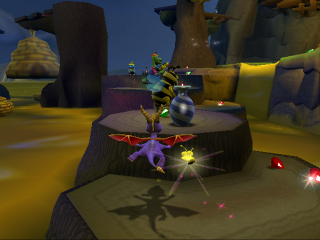
At its heart, Enter the Dragonfly is simply more of the same, and sometimes that works in its favor. Levels are considerably more linear, but sometimes give you multiple objectives to complete at once. The basic interplay between exploration, platforming and combat still exists enough that the game is never outright awful. A couple level ideas try to stand out, like the skybound temples of Cloud 9 and the dark treasure caves in the Thieves Den. It carries over a lot of the soundwork from the PS1 games, being the last console game to feature its original voice actors and sound effects, which lends the gameplay some baseline satisfaction.
It was also the last Spyro game to feature Stewart Copeland on the music, though he acted more as a music director this time around. The game’s soundtrack was primarily composed by Emilio Kauderer, Kenneth Burgomaster, Peter Neff and Emiliano Almeida (though they all went uncredited), with Copeland coming in to refine their work and insert more typically Spyro elements in the instrumentation and percussion. As such, it has that Copeland sound but with its own distinct flair, even if some tracks feel a bit too different in their use of sampled vocals and instruments.
Although it sold well enough to earn various milestone re-releases, Enter the Dragonfly has since gone down as a notorious disappointment. It isn’t as bad as its reputation suggests, but it certainly doesn’t measure up to the original Spyro games it so closely imitates, or the variety of standout 3D platformers it was competing with. In the end, it wasn’t enough to save Check Six and Equinoxe from closing down shortly afterwards, while Universal searched for another developer to take the baton and shake things up.
LINKS:
A very good retrospective from Bad Game Hall of Fame that dives into Enter the Dragonfly’s development, citing numerous sources – https://www.badgamehalloffame.com/spyro-enter-the-dragonfly/
Mr. FO1, a YouTube channel that has done extensive research on Enter the Dragonfly in the form of documentaries, interviewing many of its developers, detailing many minor differences between its PS2 and GameCube releases, and posting the complete soundtrack with its original composers credited – https://www.youtube.com/@MrFO1