|

Page 1: Megami Tensei I & II
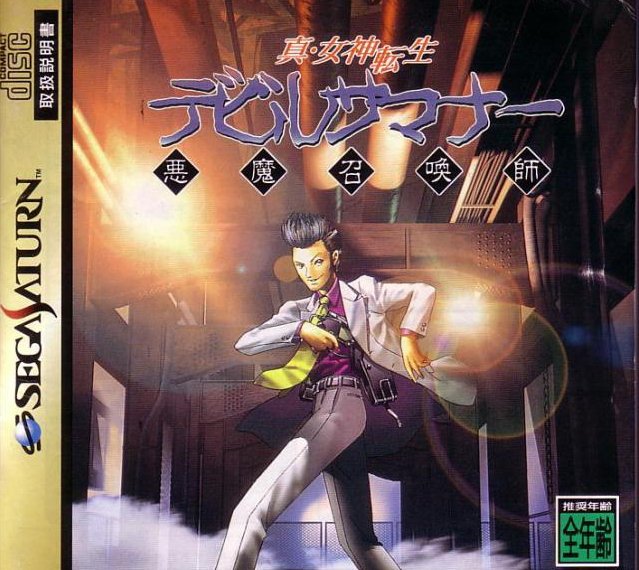
Shin Megami Tensei: Devil Summoner - Sega Saturn / PSP (1995)
Japanese Saturn Cover
Main Characters
Devil Summoner
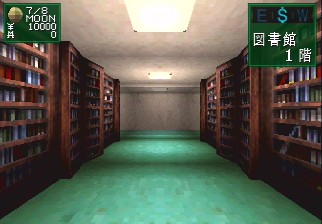
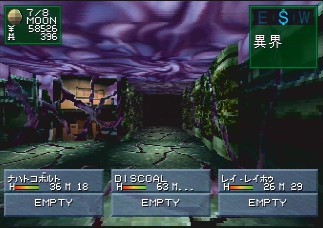
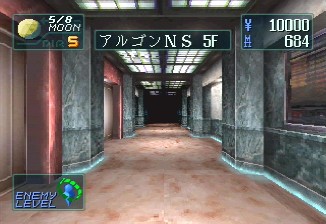
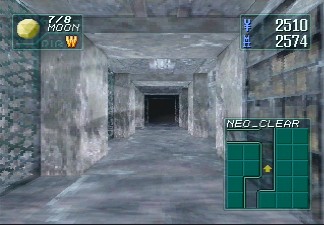
The 3D dungeons are now full screen and now possess a lot
more detail, making them look much better than any of
the previous games. This being the Saturn, however,
the movement is pretty choppy and the draw distance is
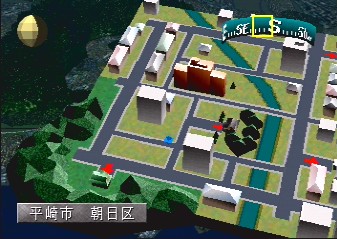
pretty low. The maps are now polygonal, and not
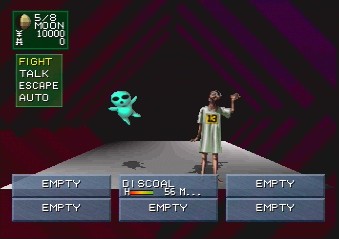
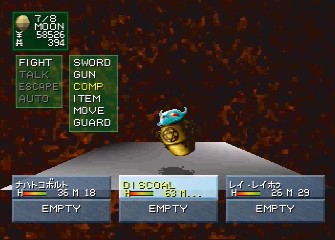
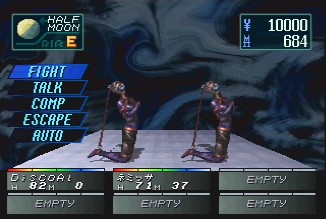
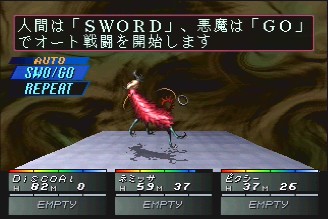
particularly impressive looking. The battles have
changed a little bit, as you now have a front row and
back row, with only the characters in the front able
to directly attack. The general flow of the battles
are slower than the previous games, especially the
plodding pace of the auto-battle. The enemy graphics
are lacking, as they tend to look like barely
animated, blurry masses of pixels. and the backgrounds
are weird psychedelic clouds of color. The battle
transitions are rather cool, as the floors and walls
fly off into the distance before you face your
opponents.
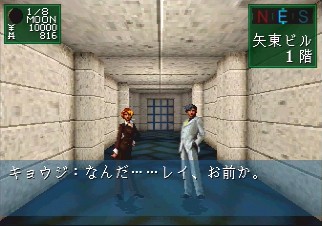
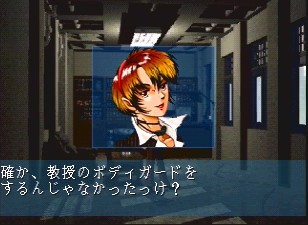
The conversation system has been changed slightly, as
the monsters now will ask specific questions. More
questionable is the introduction of the demon loyalty
system. You need to keep your demons happy, otherwise
you won’t be able to directly control their attacks.
In the worse cases, they’ll ignore your commands
altogether or even leave your party. It's an attempt
to give depth to the game that adds more aggravation
than fun. The multiple pathways and endings are also
gone, as your alignment only determines what monsters
can join your party. The dungeons can also grow to be incredibly difficult. It's a decent enough game, in
spite the loyalty system and slow pace, although it
feels very unpolished overall.
A few months after release, Atlus released "Devil
Summoner: Akuma Zensho" or "Devil Dictionary", a fan
disc that includes data and extra artwork about all of
the monsters included in the game. Some of it is
interesting, as it details the mythological origins
behind all of the creatures, although more character
artwork would have been nice, since it's pretty
useless unless you can read Japanese. Devil Summoner
was popular enough to warrant a reissue under the
Saturn's "Sega Collection" label. A "Devil Summoner
Special Box" was also released that included the game,
the Akuma Zensho, a thick instruction manual that gave
extra bits about the game's characters, and an 8 cm
audio CDs that have a few arranged music tracks and
commentary from the developers.
Devil Summoner was also ported to the PSP, with reduced difficulty and
other minor conveniences. According to sources, Atlus was interesting
in translating the title, but was apparently blocked by Sony America for not having
enough new content added.
Devil Summoner
Devil Summoner
Devil Summoner
Devil Summoner
Devil Summoner
Devil Summoner
Japanese Saturn Cover
Soul Hackers
Soul Hackers
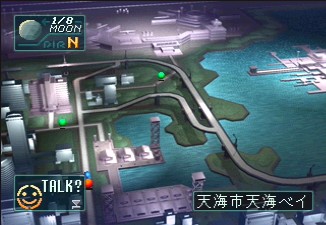
And this is saying nothing of the plot. Taking place
in the near future, you hack your way into a virtual
reality world called Paradigm X. While it seems like
your normal MMORPG, things get a bit wonky when you
get creepy messages from an unknown source, threatening to steal your
soul. Before you’'re sucked dry, you’'re saved by a
fellow named Redman, who takes the form of various
animals. For some reason, you have the souls of
several other people trapped inside yourself. As you
progress through the game, you’'re sent on several
Native American-like vision quests, where you live the
final moments of these trapped souls, most of whom
were demon hunters before they were killed. Using the
information you learn in taking on the roles of these
people, you investigate the mysteries in the real
world, and learn more about shady Algon Software
Corporation, who created Paradigm X, as well as the mysterious Phantom Society.
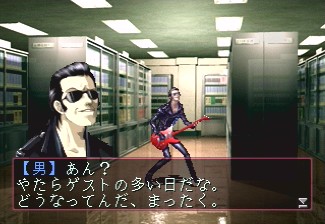
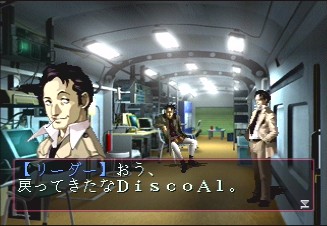
Even though the number of player characters is limited (as usual), there are plenty of personalities
abound in Soul Hackers:
One of the central bits of technology at the heart of
Soul Hackers is the GUMP. Having nothing to do with
Tom Hanks, GUMP stands for "Gun COMPuter", and allows
for both demon summoning and old fashioned shooting.
While your primary party is sparse, your investigation
is aided by the Spookies, a group of hackers who are
also none too pleased about the outbreak of demons on
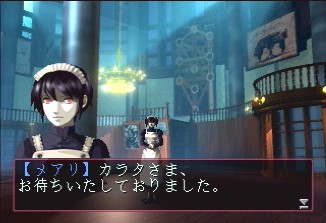
your fair island. Certain characters, from the first
Devil Summoner, like Rei Reiho, and Victor and his creepy
maid, make a return as well.
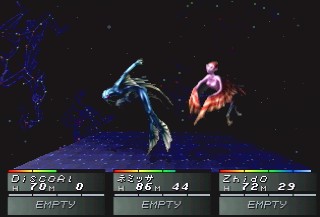
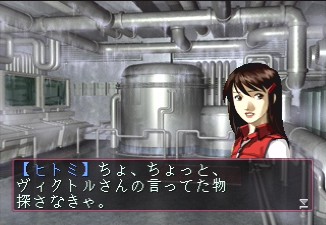
While the battle system is still somewhat dull, the
incredibly cool story and characters (the
Hitomi/Nemissa combo is one of the coolest female
characters in all of video game-dom) elevate Soul
Hackers to a level of awesomeness that make it one of
the Saturn's best RPGs.
Like Devil Summoner, an Akuma Zensho disc was also
released separately. Soul Hackers was also ported to
the Playstation, although it is mostly the same as the
Saturn original, with a few additions. One of the major differences is a bonus demon called the P-Mecha, which you can raise with your
Pocketstation and take into battle. Near the end of the Saturn game, one of the secondary characters is killed. In the PlayStation version, it's possible
to avoid their death, though only during a second playthrough. The Saturn version also has an extra dungeon, which was only accessible by mailing a flyer to Atlus,
who would send back a bonus disc that would unlock it. It is regularly available in the PlayStation version. There is also a Digest Mode, which lets you replay key cutscenes after restarting the game, and there are a few extra story scenes as well. It also has a playable demo of Persona 2: Innocent Sin. At one point, Atlus considered Soul Hackers for English localization, although for whatever reasons, it never came to be.
Soul Hackers
Soul Hackers
Soul Hackers
Soul Hackers
Soul Hackers
Soul Hackers
Soul Hackers
Soul Hackers
Soul Hackers
Soul Hackers
Soul Hackers
|