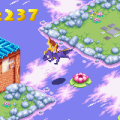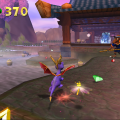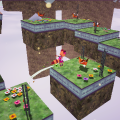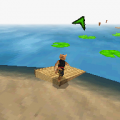

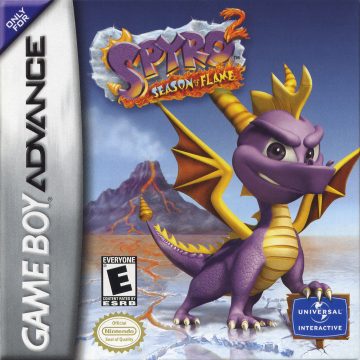
Work began on Spyro‘s second GBA adventure not too long after Season of Ice‘s completion, with plans to make numerous improvements based on the developers’ and fans’ feedback, and even to make it more akin to an RPG. However, a tighter production schedule and staff forced the folks at Digital Eclipse to create a more traditional sequel. But this also allowed Season of Flame to retain much of its predecessor’s appeal while fixing many issues, resulting in a considerably improved platformer.
Spyro, Hunter and Bianca return from yet another vacation, only to find that the Dragon Realms have become inexplicably cold. It’s so freezing that all the dragons have lost the ability to breathe fire, even Spyro, and will stay that way unless the fireflies who heat up the worlds are rescued. But Spyro can breathe ice now, which should allow him to freeze the fireflies and catch them as he travels the realms!
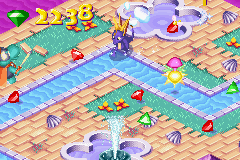
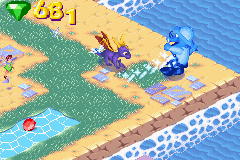
Season of Flame keeps the same isometric gameplay and structure, but with various changes in both areas. Spyro now breathes ice by default, although you’ll soon recover your flame breath and can swap between them using the Select button. There’s a handful of gates dotted about that briefly grant you electricity, superflame and lake-freezing breaths for completing specific tasks. You’ll also earn the ability to destroy boulders by charging into them, which only helps with uncovering rooms that hide a few extra gems and very rarely a firefly.
Spyro doesn’t move as quickly, so he’s not as likely to fall off edges as before, which is further helped by barriers being placed at edges to stop you going somewhere you shouldn’t. Even if you die, fairies now appear as mid-level checkpoints which is a much-appreciated convenience. Special portals will take you to Challenge Areas where you can indulge in a variety of extra missions like chasing thieves, catching cheeky sprites, and playing hockey.
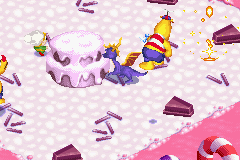
The most notable change is that you now have a map, activated by holding L and pressing Select, that shows how much of the level you’re explored. This helps keep you oriented and curious to see where you haven’t yet gone. It makes for a more welcoming game than Season of Ice, combined with a generally stronger sense of level design that guides you through the world using memorable landmarks. The Atlas also shows you which fireflies haven’t yet been rescue, if they’re out in the open or attached to specific missions, and allows you to instantly transport between levels once you’ve beaten the final boss.
The Sparx and Speedway levels have been replaced by brand new stages where you play as Sheila and Agent 9 from Year of the Dragon. Sheila’s levels are more methodical, having you move about on a grid as you jump, kick enemies, and ground pound important objects to open up the level. Meanwhile, Agent 9 plays as a run and gunner where you can duck into special doors to obtain more ammo and restore your health. Both of these are okay, but are a bit too slow and one-note compared to the main stages.
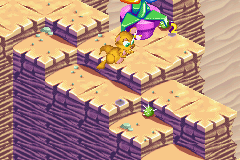
Thankfully they only have one firefly each to collect compared to the six or seven in any Spyro level, so you’re free to ignore them. The biggest improvement overall is that you don’t need to do absolutely everything to see the end. You only need 50 fireflies out of 100 to reach the last homeworld, and taking on the final boss requires just 75 of them. There’s extras to be found, like the checkers game Dragon Draughts and the top-down shooter Sparx Panic, but it’s great that you’re allowed to go at whatever pace feels most comfortable.
Throw in a larger variety of mission objectives, a handful of decently challenging boss fights, and NPC dialogue that manages to be quite charming, even cheeky at times, and Season of Flame looks like an easy recommendation for anyone wanting the classic Spyro experience on the go. However, there’s a handful of issues holding it back. For whatever reason, you don’t automatically collect gems from smashed pots and enemies like before, forcing you to backtrack and breaking the game’s flow.
Lives are surprisingly rare to come by, with butterfly jars hidden in far-off areas and fodder rarely granting you them despite the game telling you it’s supposed to happen more often. This forces you to play a bit more carefully, except that it’s common to accidentally plummet off ledges due to a delay in jumping once you start moving. You can also lose lives in Challenge Areas, making them a bigger risk than they should be. This especially becomes a problem in the final set of Spyro stages, where most of the barriers are removed and they’re full of enemies that can easily overwhelm you. It’s strangely mean in a way that doesn’t gel with the rest of the experience, and an unfortunate sting to an otherwise pleasantly solid adventure.
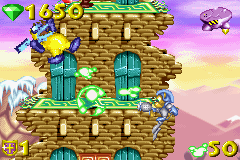
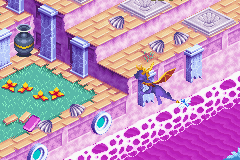
At the very least, the presentation manages to stay consistently solid. The graphics remain as readable as ever with cute character models and plenty of unique worlds, although the colours use purples and pinks a bit too often that they become repetitive. The sound effects have a little extra oomph with noises for Spyro’s footsteps and the dialogue, while Robert Baffy (with additional music by Ed Cosico) provide a fittingly energetic if mellow sounding selection of tracks.
It’s hard not to notice how Season of Flame acts as a handheld counterpart to Enter the Dragonfly, with its multiple breath types, predominantly pink/purple colour schemes and freezing small important creatures to catch them. While a much better take on those concepts, it’s perhaps not surprising that Digital Eclipse’s final Spyro game would (deliberately or otherwise) end up mirroring the next console game A Hero’s Tail…
LINKS:
A page on programmer Darren Schebek’s website where they discuss working on various games from 1983 through 2020, including the GBA Spyro games: http://www.schebek.ca/projects.htm
A YouTube playlist by Robert Baffy, containing enhanced versions of his Season of Flame soundtrack using the original MIDI and SoundFont files – https://www.youtube.com/playlist?list=PLudR0fCOl3Tw7_wJ1D4KdDAF-X94j2ouj