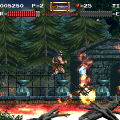

Capcom is a company with a long history in the industry, full of hits and innovative ideas that end up spawning numerous sequels if they’re successful enough. Mega Man introduced the idea of gaining weapons from defeated bosses. 1943 had an upgrade system for your airplane that allowed you to choose which stats to raise in the order you wanted. Resident Evil was actually Capcom’s take on Alone in the Dark, so not fully a new idea, merely one they popularized. But the company frequently innovated, much like other big companies whose new ideas ended up becoming long-running franchises.
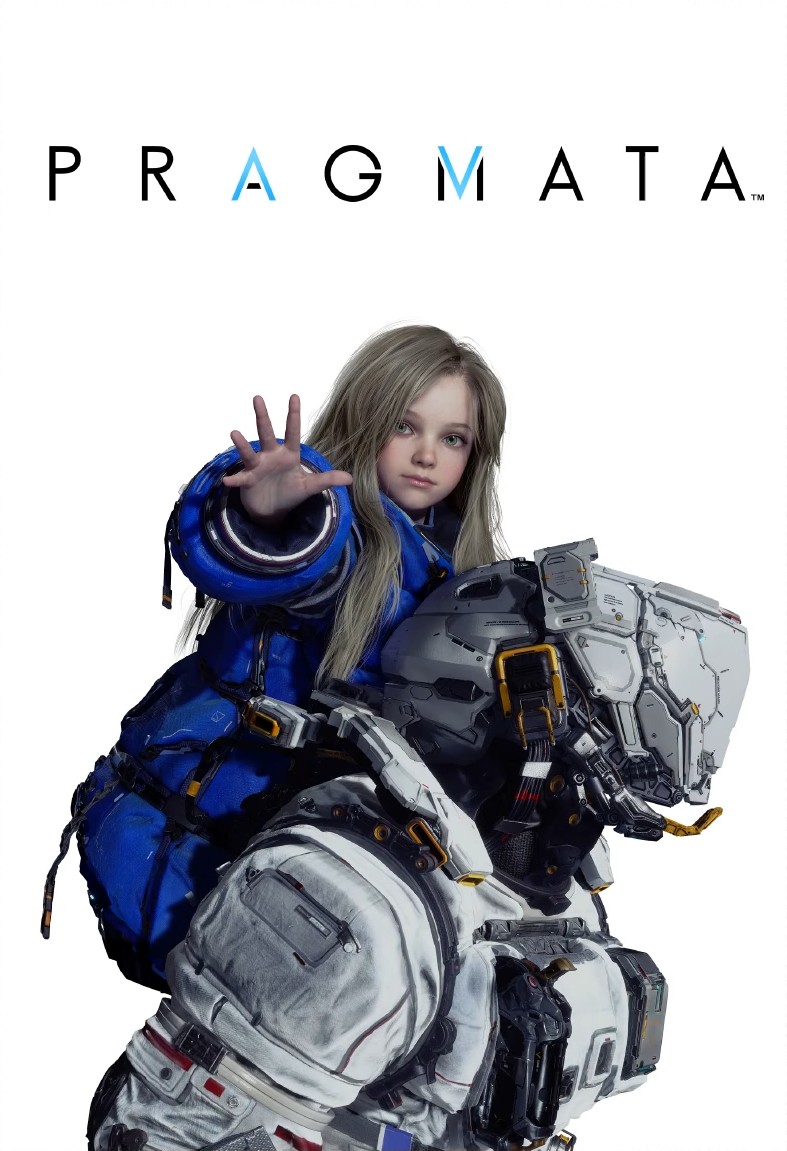
Pragmata is another new Capcom idea that is likely to become a franchise. Neither a sequel to any previous games nor a spinoff, it is a fully new gameplay concept with new characters and a new theme that immediately impressed and resonated with many people.
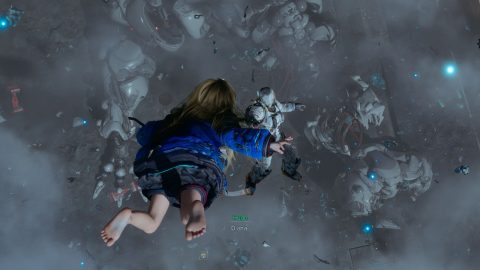
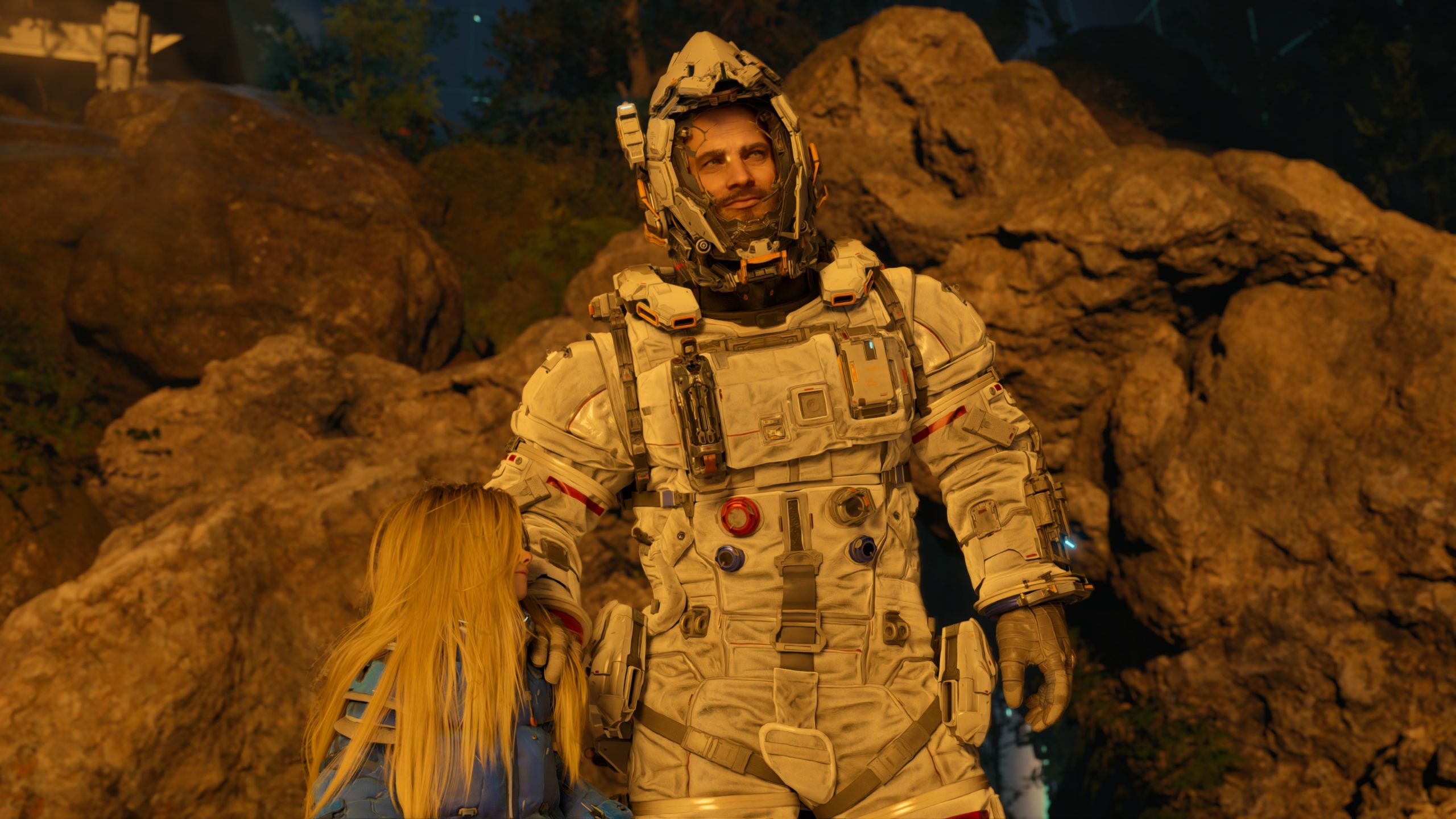
There’s multiple ways to describe this game. Its main concept involves a big strong man who has a talkative young barefoot girl riding on his back, helping him with his mission using her special powers, as he gradually levels up his abilities, and the two get to have many bonding moments together. Oh wait, that entire description also perfectly fits Donkey Kong Bananza. But Capcom’s take on the idea goes in a wildly different direction, as the girl is an android, the man is a human who ironically looks more robot-like in his face-covering spacesuit, and the setting is outer space in the future.
But the bigger difference is the new gameplay style.
Capcom’s official description for the game on online storefronts says it has a combat system that engages both sides of your brain at once. What do they mean by that? Having a combat system that combines rapid puzzle solving with quick movement, aiming and shooting, all at once, and forcing you to switch back and forth between the two.
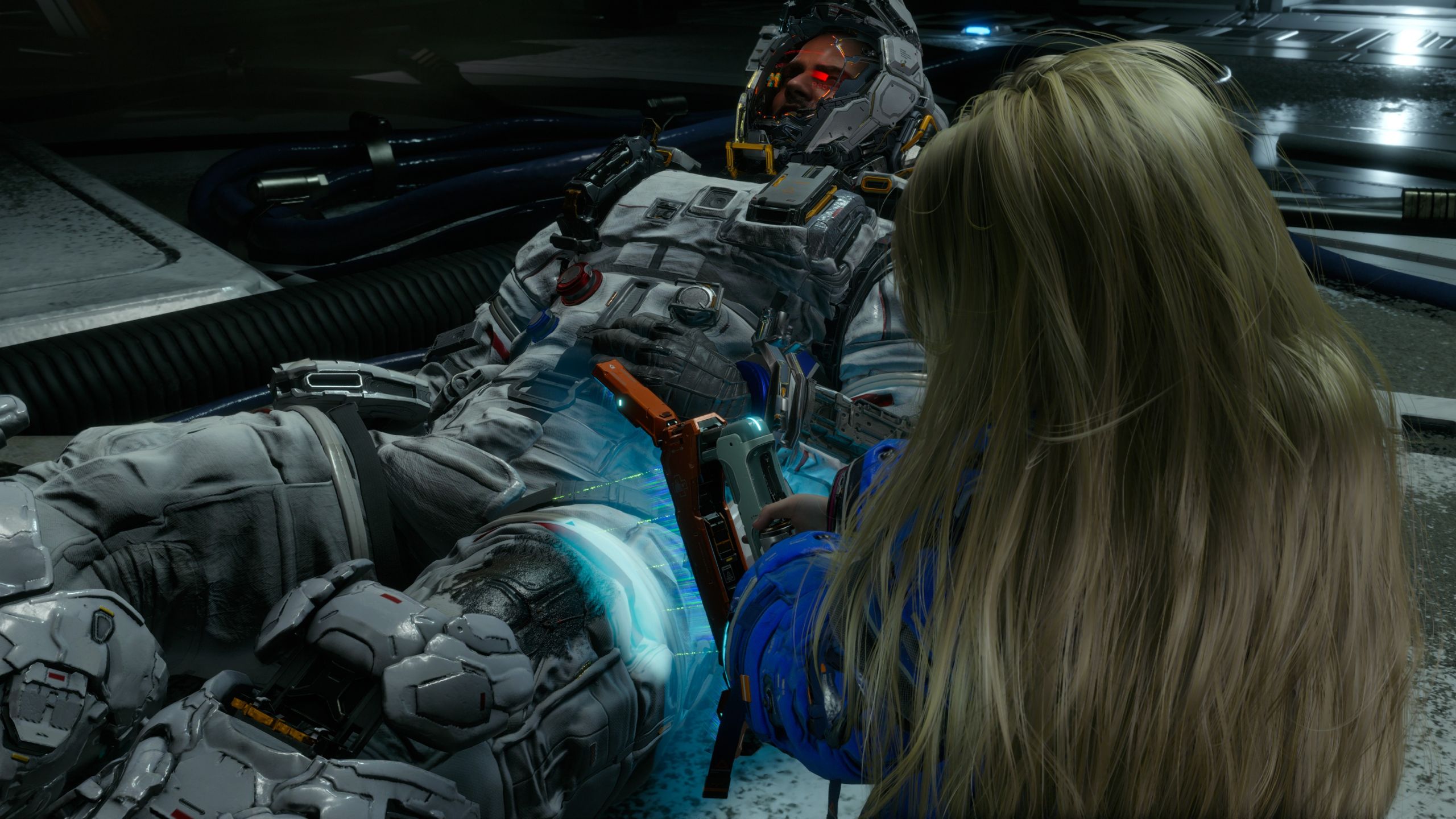
The game’s first fifteen or so minutes quickly set up the story and explain the gameplay. Hugh Williams works at a moon base along with a few other men on his team. Suddenly, things go horribly wrong, and Hugh is separated from his team, who are all killed. Hugh nearly dies as well, but wakes up to find what appears to be an approximately 6-year-old girl has fully healed his injuries. Soon, the two are attacked by a robot. Hugh happens to have a service weapon on hand.
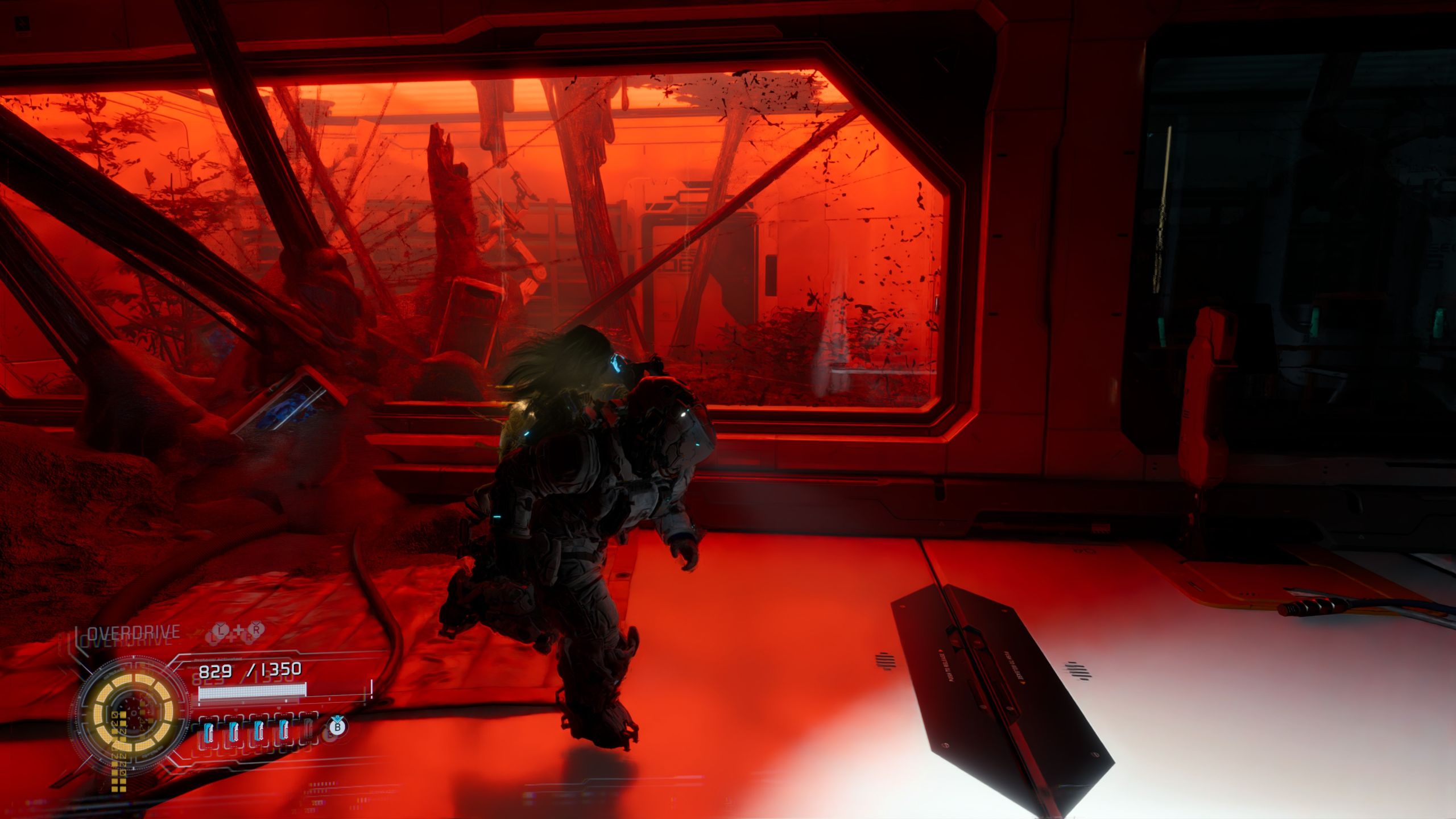
As the player attempts to shoot the robot using a “hold one button to lock in place and activate aiming mode, and use the right stick or mouse to aim and shoot” method a la Resident Evil, Hugh notes that his bullets do no damage. The girl says that she can help, and after jumping onto Hugh’s back, triggers a hacking minigame in which you must move a highlight through a maze-like grid without crossing over any repeat squares (similar to playing Snake), passing through blue nodes, and reach a green exit at the end. This causes the enemy to open up its armor, exposing its vulnerable blue parts, which allow it to take damage. After that, it’s time to shoot it and take it out for real.
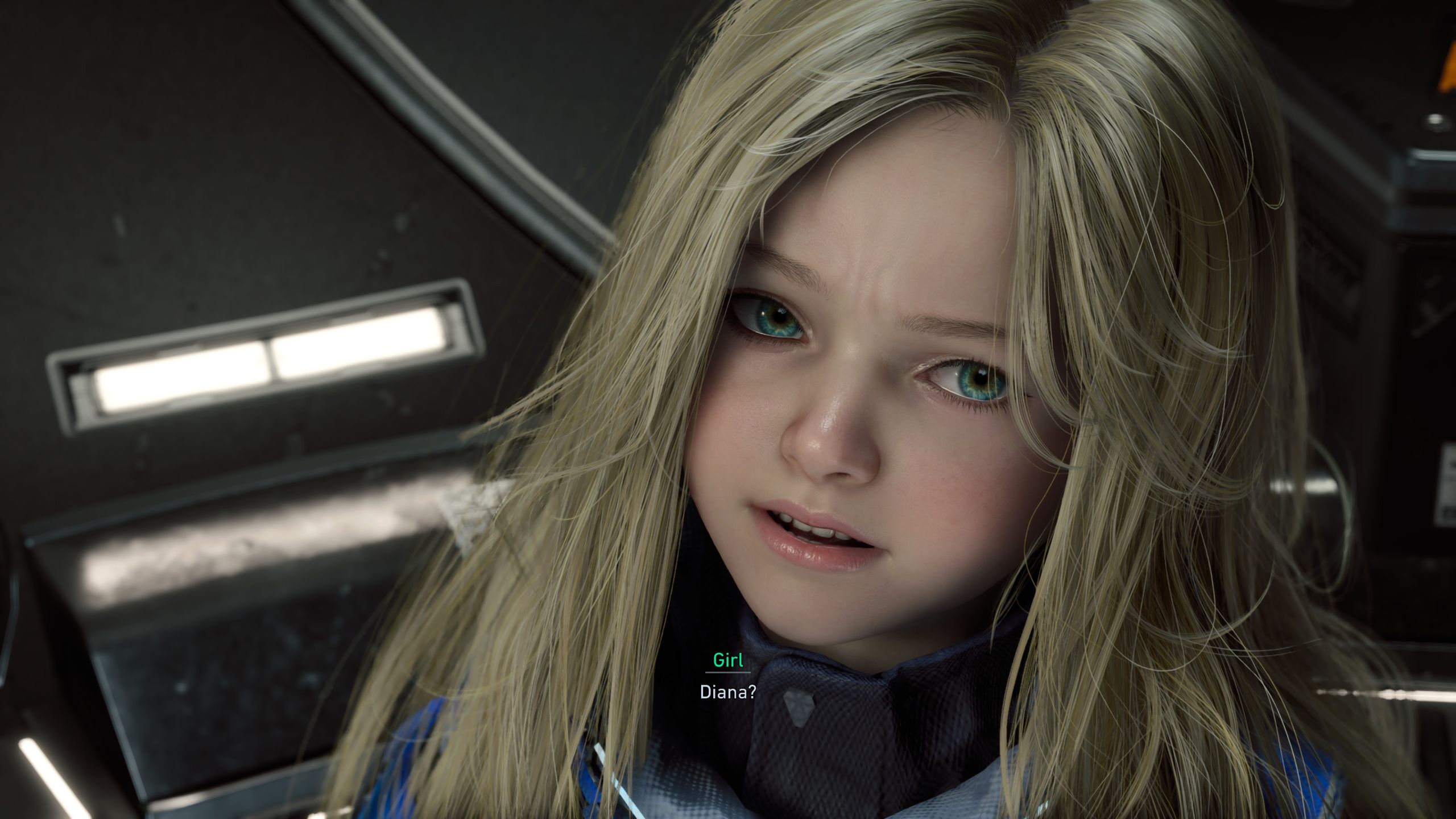
It doesn’t take too long for the duo to introduce themselves to each other. The girl introduces herself as a “pragmata,” a type of advanced android, and gives her name as D-I-0336-7, causing Hugh to decide to name her “Diana.” Diana acts childishly excited about her new name, and joins Hugh. And thus begins an adventure in which the two get to know each other better, while also trying to find out what’s going on at the moon base. And why a surprisingly realistic acting childlike android is even on the base to begin with.
Hugh is not your typical action hero. He’s a man in his late 30s who never asked to be in a situation like this, but has to fight robots in order to survive. And truthfully, while Hugh fires many guns, he never kills anyone, as all enemies are robots. Even Hugh does not truly die, as “death” for him means collapsing to the ground as his “suit integrity” runs out, then waking up fully healed by Diana. All deaths that did occur are related to the story instead.
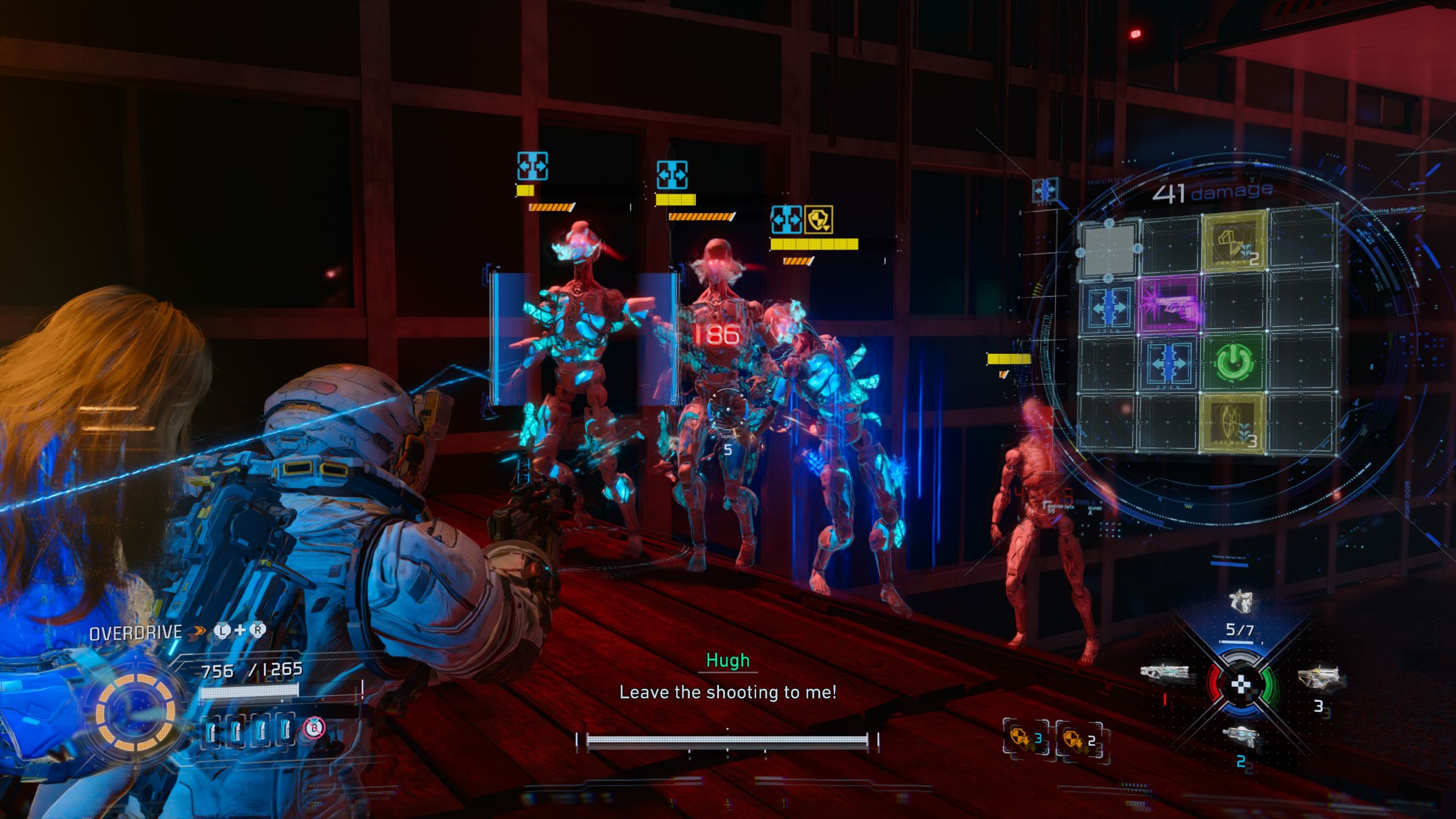
Is it really true that it engages both sides of your brain, though? Especially since reflexes are located in neither half! What they’re probably referring to is the game’s combination of puzzle solving and reflex-based action that occur during combat. There’s plenty of that, and both aspects of that gameplay only get more challenging and evolved as the game goes on.
You can both aim your gun and shoot, and hack at the same time, since the aim button triggers both at once, revealing the hacking grid even if you’re currently focused only on shooting. You can even hack an already hacked enemy to keep it open longer or do some additional damage.
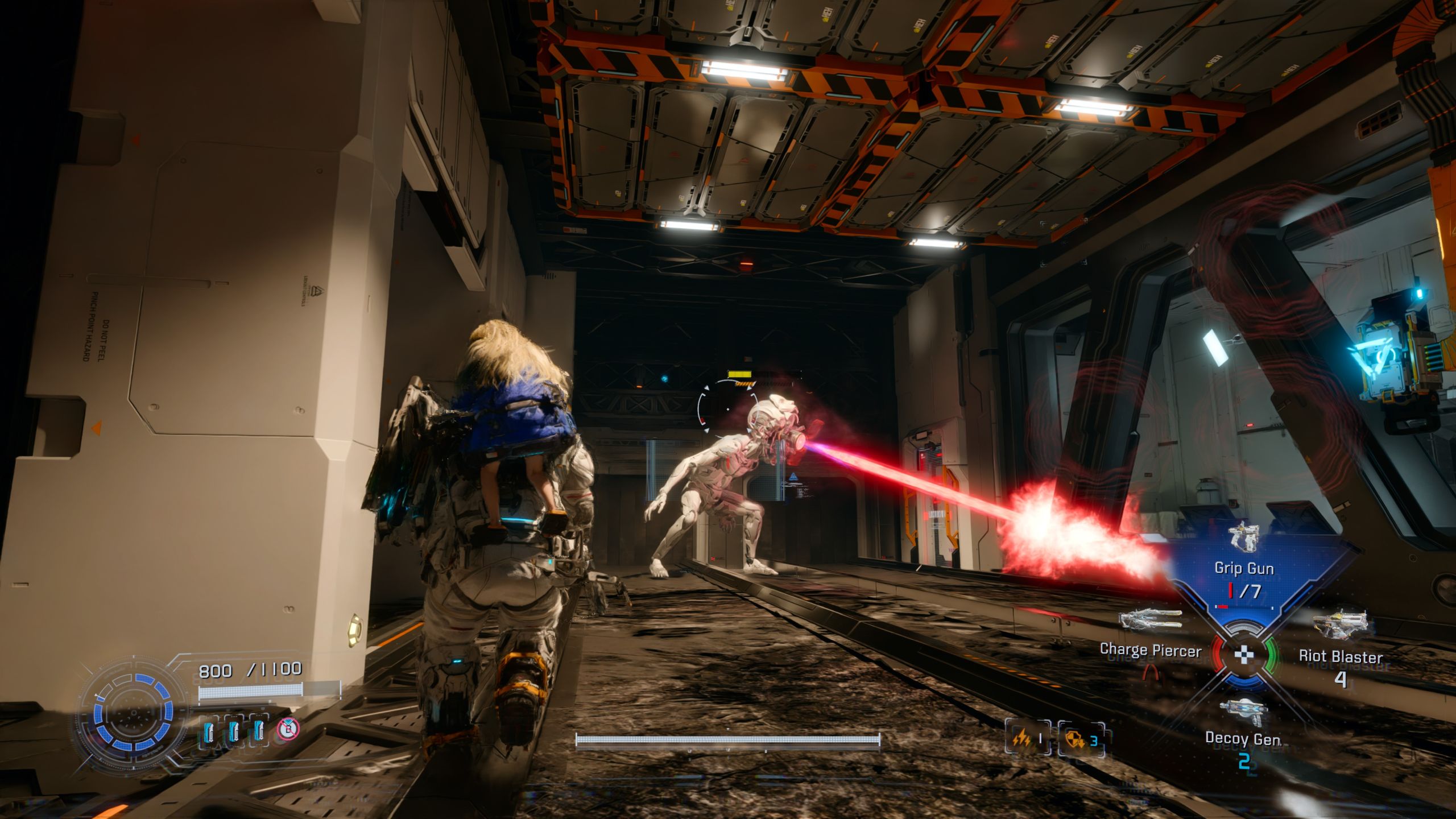
At first, fights start out very simple. One or two shambling zombie-like robots that you can easily quickly hack by moving through the grid and passing through the nodes to reach the exit, and then quickly switch to shooting to take the robot out.
It doesn’t stay that simple for long. New enemy types, such as a flying enemy that will automatically shoot at you with high accuracy after a set amount of time, are introduced, creating the need to assess enemy situations and decide when to take them out. And if you get attacked while hacking an enemy, the hack restarts! Fortunately, you can “pause” a hack by letting go of the aim button, move to avoid attacks, then resume the hack. And you’ll be doing that a lot as the action heats up.
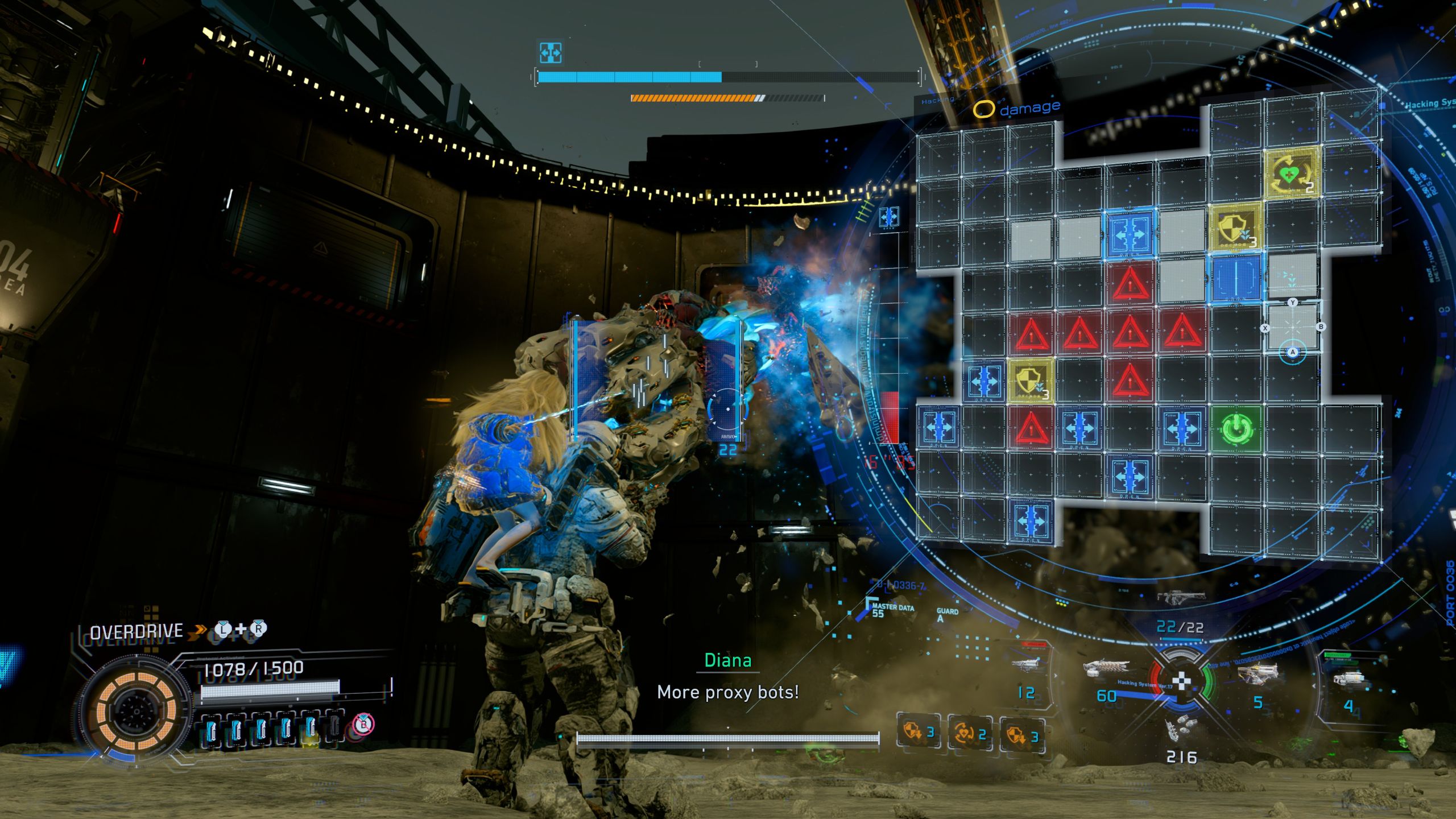
Aim and shoot at weak point? Hack? A little bit of both? Hack quickly and just reach the end, or try to pass through a bunch of nodes first? Dodge attacks and run? Split-second decisions like this need to be made all the time when things get heated.
Hacking gets more complex as the game goes on. Additional types of nodes start to appear in the grid, such as special abilities like linking multiple enemies together (so if one is hacked, the others are too), making enemies engage in friendly fire, stunning enemies or even siphoning life from them. These can be combined, such as using the friendly fire node and link node in a single hack, resulting in multiple enemies being both open for damage and fighting each other! There’s more strategy in using these nodes, as they run out when used up, and you can’t use them again unless you find more.
Other types of nodes show up such as “walls” that block your movement, or “alarm” nodes that end the hack in failure. Outside of hacking, there’s also a fair amount of weapon variety. Weapons do more than just cause damage, but even do things such as create temporary holograms of yourself to lure enemies away, create a temporary forcefield that enemies can’t pass, trap enemies in a kind of temporary “net” so they’re stuck and can be hacked more easily, or even shrink the hacking grid! Even outside of hacking, there’s a lot of strategy in the gameplay. Hugh can also do quick dodges to avoid attacks, and can slow time a little bit by aiming his gun in mid-air.
In fact, this game does a lot with its gameplay concepts. New enemy types, new hack types, new hacking situations, all keep showing up as you progress through the game. As an example of this variety, one enemy type is a large robot that can turn invisible, and it can grab Hugh, knocking Diana off his back, starting a hacking minigame where she must navigate a simple maze quickly in order to force the robot to let him go.
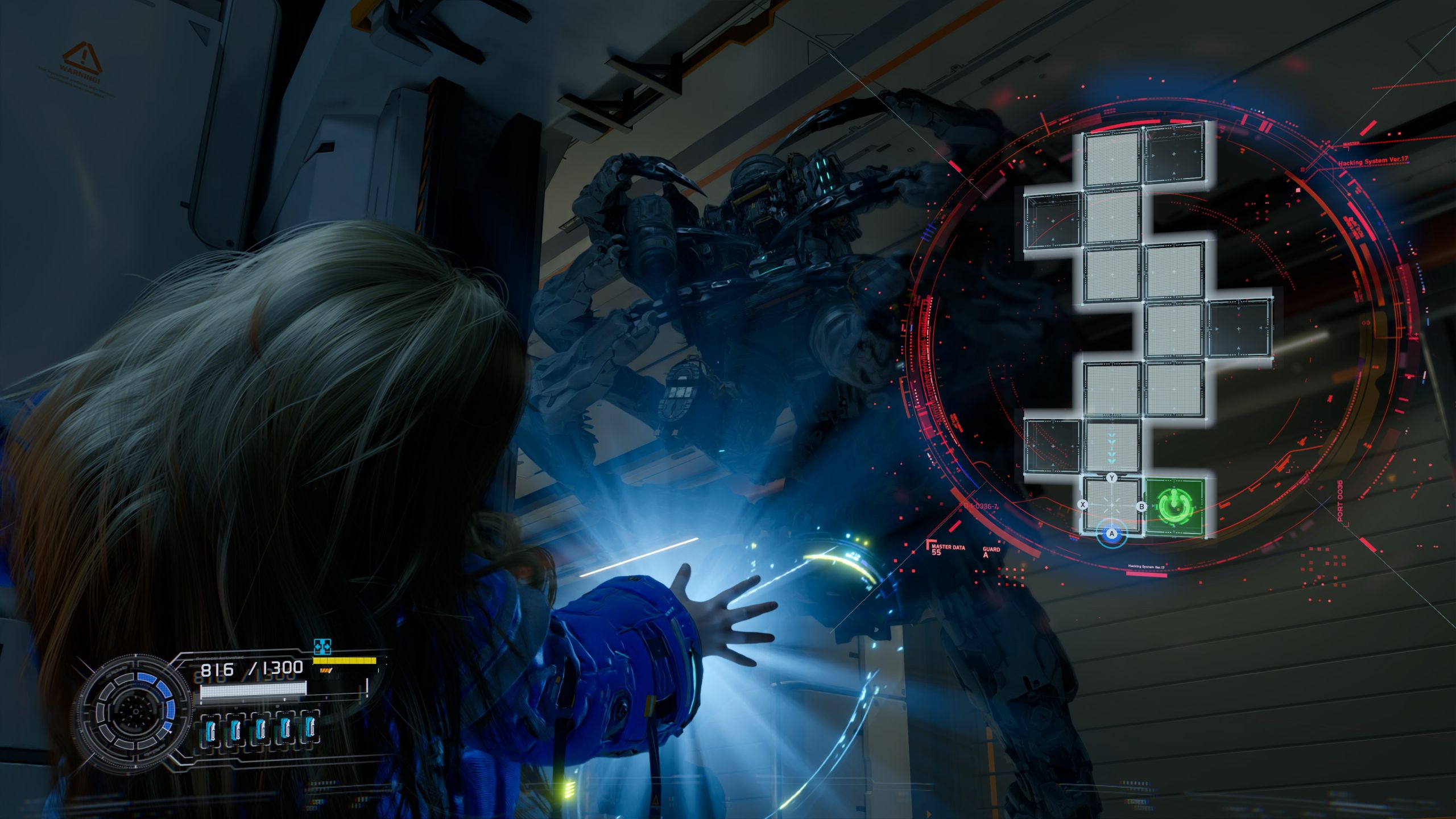
Moments like this, when Diana needs to rescue Hugh, are a reminder that they are a team and you control both of them.
In fact, Hugh and Diana are very much a team. Since you hack enemies and locks as Diana, and do walking, jumping and shooting as Hugh, you are literally controlling both at once. And the relationship between the two is a huge focus of not just the gameplay, but the story. Aside from battle exclamations (e.g. “Look out, it’s going to jump!” when an enemy prepares to stunlock you with its powerful jump), Hugh and Diana have many conversations, almost all of them brief. You can manually trigger them at your home base, or they trigger automatically during breaks between combat, such as when you’re navigating through the place or trying to collect hidden items. These automatic conversations are short enough to not be interrupted by sudden enemy attacks, and they deliver a mixture of story details, character moments between the two, and thoughts on the current goings-on.
Now, about the home base that was just mentioned. There’s a place called the Shelter, which you visit in between levels, and you can also stop by any time you want to save your game and refill your life. While there, you can trade in things you’ve collected for upgrades to everything from your weapons to your abilities. Living there is a simple robot named Cabin. He asks only that you play bingo with him, or do training. But the Shelter is where you can also play dad with Diana.
Diana separates from Hugh, and you can talk to her there and have short conversations about topics ranging from silly to serious. Read Earth Memories, little collections of things from Earth that can be 3D printed, can be placed here, and Diana will play with them. You can even play hide and seek with her, but there aren’t many places to hide in that 60 second time limit! Keeping in line with the game’s pacing, all of the “dad things” you can do are brief.
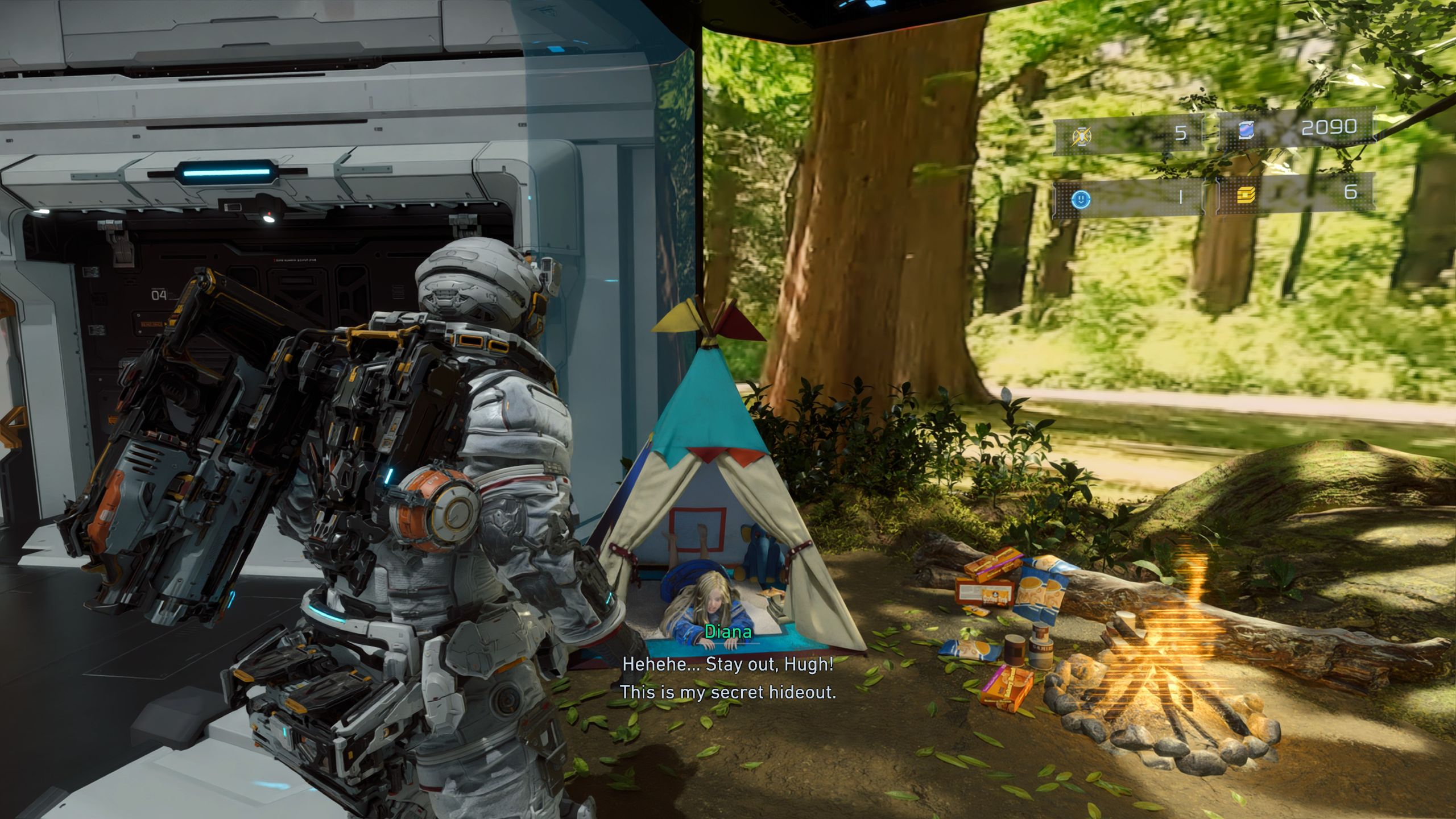
“This camp is for android kids only!”
Hugh accepts the dad role rather quickly for a man who started out skeptical about AI, and complaining about it, even saying, “You can’t trust a bot” to his coworkers. Early on, when Diana is unable to answer his pressing questions about what’s going on, Hugh tells her, not in an angry tone but more as an observation, that she’s no better than a chatbot. However, over time, he warms up to her, while the conversations they have, and moments in the story, reflect this growing change in their relationship.
The story is very much a product of the early 2020s, with a portrayal of the future that extrapolates from trends occurring during the time of the game’s development. It’s about outer space, AI, and 3D printing. Specifically, a special material has been discovered on the moon that can be used to 3D print a huge variety of things very quickly. Many AI-run machines are working at the moon base alongside humans. All this is happening before things go sideways. And what do we see then? Incomplete 3D printed things that look uncanny. Human-like robots that just look wrong. And AI that comes in a range of forms, from simple to complex, harmful to helpful. The people who used to work at this place have left computers with e-mails and personal diary entries behind, and they have a lot of opinions on the kinds of things going on there.
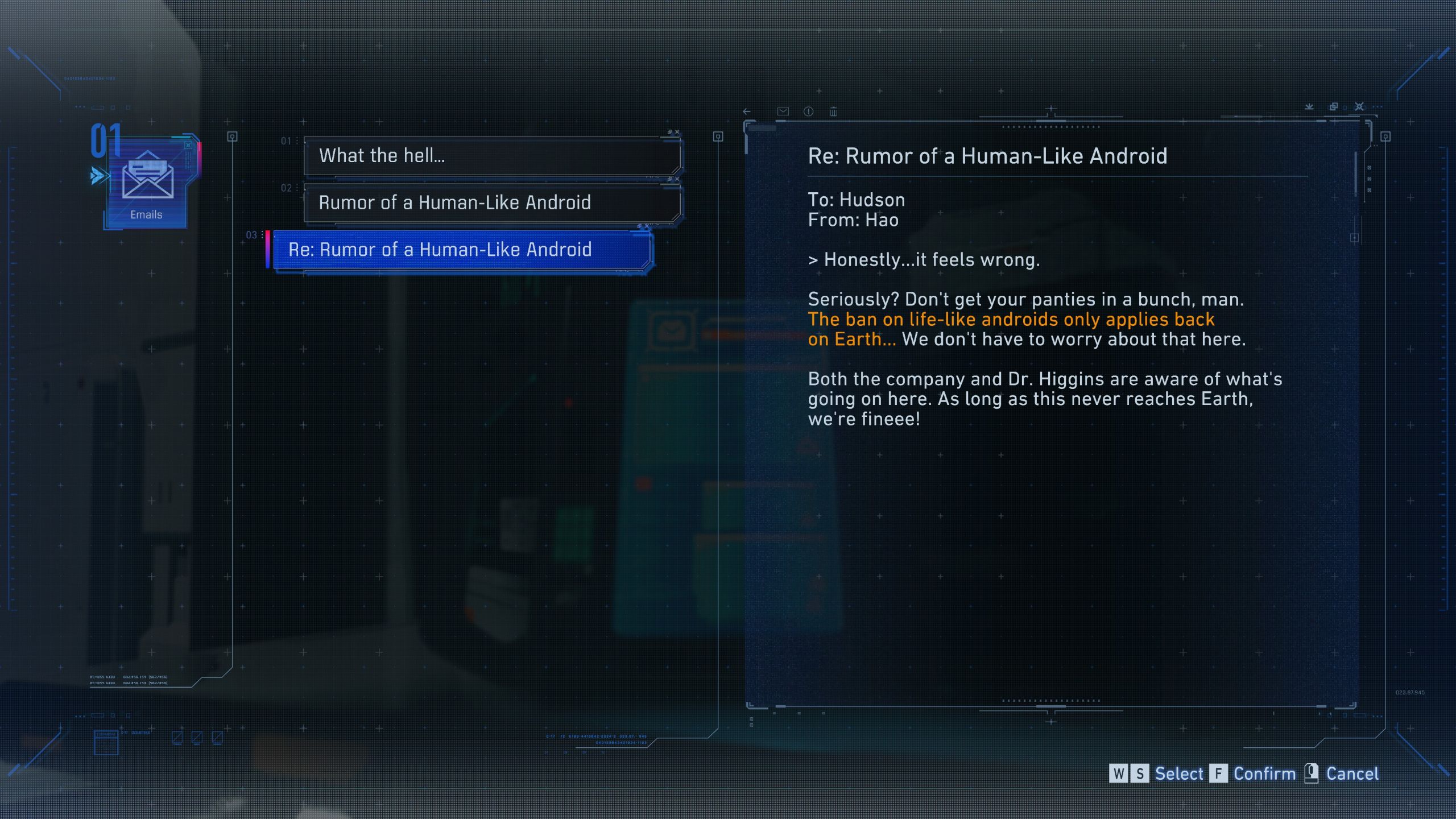
What’s this about a ban on life-like androids again?
In fact, the game’s storytelling is both multi-layered and well-paced. The rather tropey story is given in many forms: conversations between Hugh and Diana, e-mails and diary entries you can read, holographic video recordings of conversations, and cutscenes. Everything from gameplay variety to story crumbs to character interactions are doled out at a pretty consistent pace, keeping things moving along, so no matter your motivation for playing, you’ll keep getting more. More of the mysteries uncovered – including the question of why anyone would design an android patterned after a small child – more of the growing bond between Hugh and Diana, and more ideas mixing up the gameplay. Some plot twists even directly affect the gameplay!
Though even with that growing bond between Hugh and Diana, there are also a handful of story moments that seem designed specifically to remind you that D-I-0336-7 is, in fact, not a human, and some are more explicit about that than others. In an age where people have genuinely fallen in love with AI chatbots and have even died for them, and there are even schools considering putting robot teachers in classrooms, it raises serious questions about the ethics or mental health issues of developing warm, parental-like feelings for an extremely convincingly human-like machine. There’s probably a good reason why, as one e-mail puts it, human-like androids are illegal on Earth. And when you consider what Hugh went through at the beginning of the game – seeing his friends die, then being rescued by an android, and realizing that it’s just the two of them versus every bad thing they encounter – you can see why he might feel inclined to develop some kind of feelings for what is literally a machine. The game never directly raises these issues, but instead just tells its core story straightforwardly.
Despite Pragmata’s movie-like presentation, it is very much a “video-gamey” video game. You travel through the base’s sectors, further divided into areas, literally in exact numerical order, no different than “world 1-1, world 1-2, etc.” in an old-school game. Each sector ends in a boss fight. You can obtain and equip “mods” for Hugh that give him special abilities such as regaining health if he uses his dodge thrusters immediately after being hit. You explore and find optional hidden things.
Things are paced so that while there’s plenty of story, it doesn’t get in the way of the gameplay. The game avoids falling into pitfalls such as the “slowly walk from point A to point B for several minutes while a long conversation plays out” trope that’s popular with movie-like games. Pragmata is an action game with a story in it, not a thinly disguised movie with action moments in between the story. The pacing makes this very clear, but so does the existence of “training data” (which of course is simply side challenges with rewards) and things like playing bingo with a robot to earn journal entries from an investigative reporter. The latter being the kind of thing that would only ever happen in a video game.
The game clocks in at around 12-13 hours for most people, though it would depend on if you make some effort to explore and collect upgrade components, revisit past areas with new abilities to find a few additional upgrades, do the side challenges, or do the post-game content. There’s also a New Game+, an unlockable hard difficulty and additional challenges that result in a slight change to the ending.
For parents wondering about the game’s content, it’s basically a low end PG-13 movie. Profanity is the lower-end words for the most part, with only one use of “shit” in a journal entry. Death is a big part of the backstory, but as mentioned before, Hugh shoots robots, robots attack Hugh’s spacesuit instead of his covered body, and Hugh simply collapses before waking up in the Shelter if his suit takes critical damage. Some corpses are seen in the story, but never any blood. For an action game made by Capcom, with a serious story, it’s surprisingly tame in the content department.
Pragmata is the rarest of beasts in the video game industry: a truly new gameplay idea, attached to an original theme, with movie-like production values that avoids falling into “movie game” traps by having video-gamey pacing throughout while still feeling like you’re playing both a game and a movie. That’s quite an accomplishment, and it took Capcom, an industry veteran, to pull it off.