Different eras of gaming are defined by very particular types of game design. Early 1980s games were mostly “beat your score” contests if they were single player, usually going forever until you lost. Then games moved into short adventures with a clear ending, typically taking about a half hour to reach, provided one had the skills to reach it. Eventually, they evolved into super long adventures with save features, long cutscenes, long tutorials, complicated mechanics, upgrade systems and more.
As games grew larger, there seemed to be more of an attempt to give players value for their money. The indie scene, meanwhile, allowed for lower priced games to try different things, be they shorter experiences more in line with what games were like in the late 20th century, intensely personal experiences that reflect the creator’s personal tastes, broad nostalgia, or bold and experimental ideas that big companies wouldn’t touch.
Rogue Flight is a game that combines elements of modern game design with the basic shell of retro game design circa late 1980s/early 1990s. It contains gameplay elements of modern games but puts them in a short adventure which takes 20-60 minutes to blast through (not including cutscenes) while also adding in some innovations of its own.
Despite its name, Rogue Flight is not a roguelite or roguelike. It does have some mild things in common with that genre, such as being able to keep upgrades after failing and restarting the game, and there’s a special gameplay mode which is only available on weekends that randomizes things (more on that later).
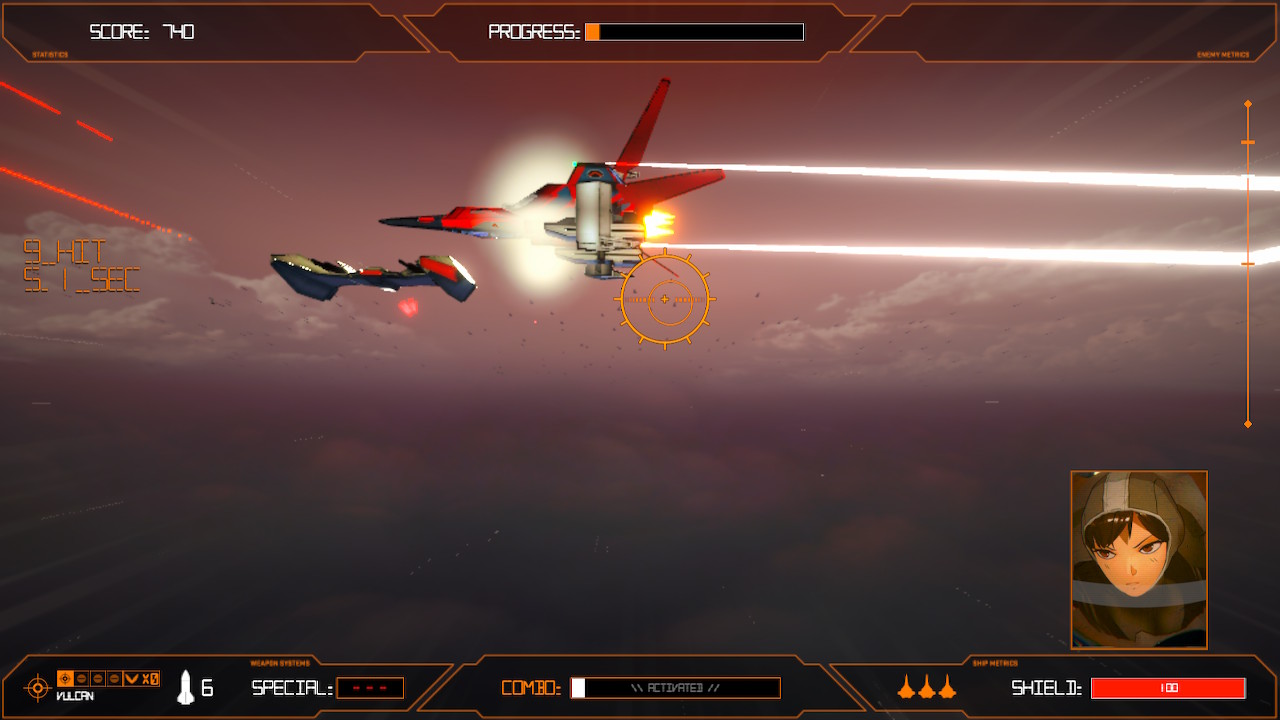
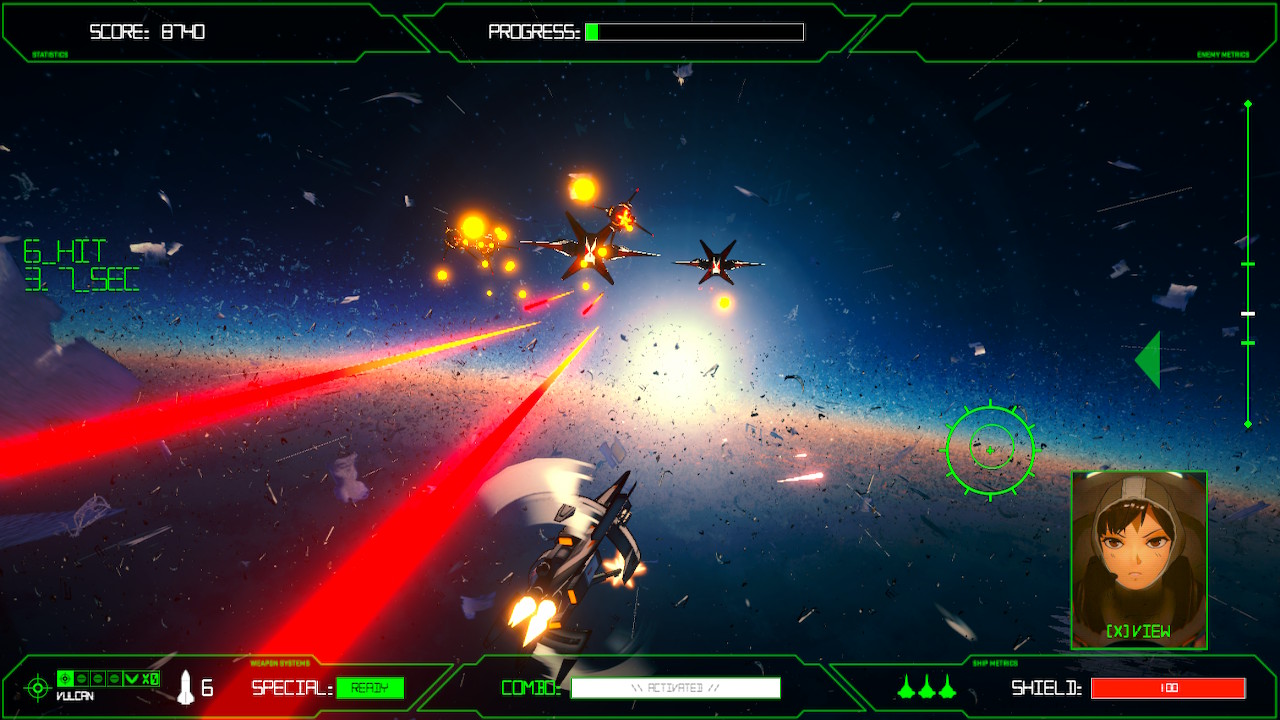
Instead, the game is a rail shooter a la Star Fox. Think of it as a hyperactively paced Star Fox with humans and angst. Your spaceship moves forwards along a set 3-dimensional path as you move up, down, left and right to dodge attacks, enemies and obstacles and try to shoot enemies down. You can press a button to change to a cockpit perspective as well, though that’s probably harder to manage.
The game’s hyper pacing defines it. This game is fast. And with that speed comes challenge. The hyperactive rail shooter gameplay style definitely does take some getting used to for those not accustomed to the combination of flying a ship and making sure your targeting reticle is on the enemy, all while dodging threats at a very high speed. Basically, if you sit still for ten seconds, consider yourself dead.
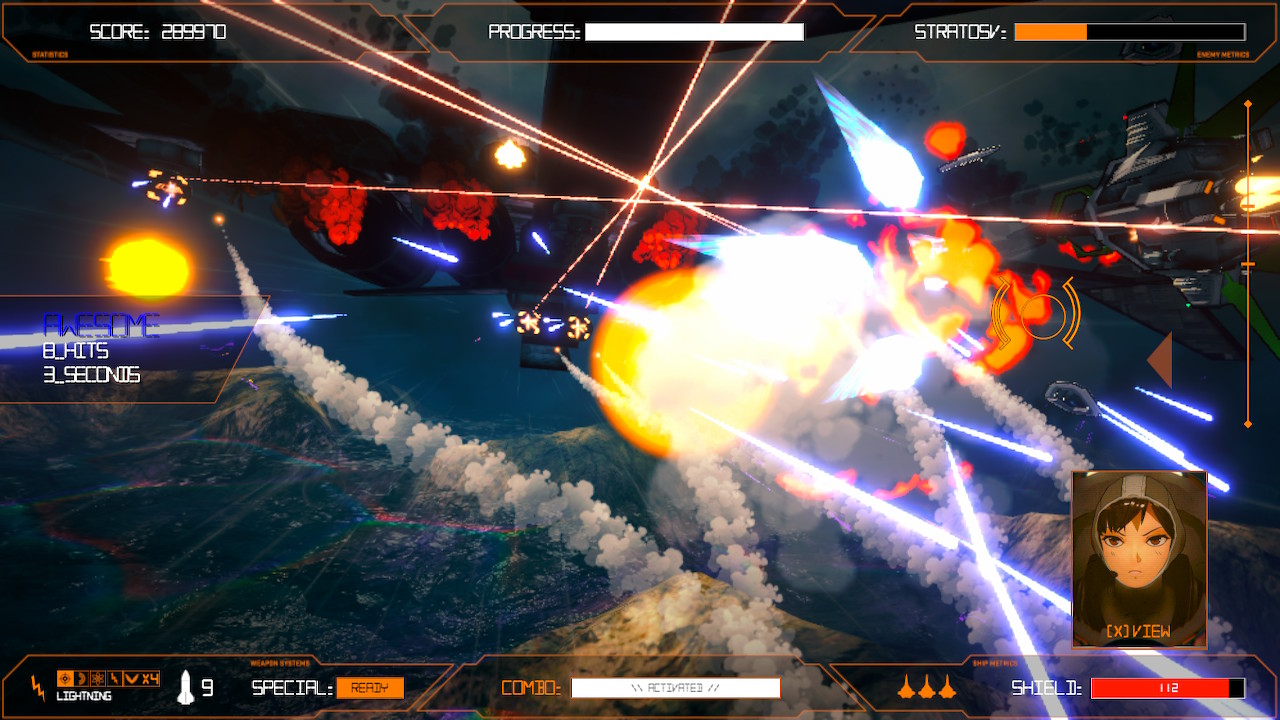
Especially in moments like this.
Besides regular movement, the gameplay mechanics include some of the things you’d expect, like changing weapons when possible, obtaining satellites that fire along with you, firing multiple lock-on homing missiles at once and doing barrel rolls to deflect enemy shots. There are a few other features, such as the ability to perform a move in which the ship flies to the side, time slows down, and you can target multiple enemies and fire off a volley of shots. Despite the slowed time, you are not invincible, and running into enemy attacks still does just as much damage. This ability recharges very quickly and can honestly be abused, especially with an upgraded ship, where it can be used nearly continuously.
There is one other feature that sets this game apart from other shooters: a life-restoring combo system. If you shoot down four enemies within a brief amount of time, this starts a combo counter. A meter quickly depletes on the bottom of the screen as you shoot down more enemies to fill it. As long as you can keep the combo going, your life keeps filling. The instant the combo stops, the life restoration stops as well.
The combo feature adds a massive push and pull to the gameplay. You can be on the brink of death, then pull off a long lasting combo while under heavy enemy fire and recover over half your life. It’s part of the game’s frantic pacing – you can die quickly, and you can recover not quite as quickly, if you’re willing to try. That can mean sending off homing missiles you were planning to save for later, because you just need to keep that combo going to refill your life right now.
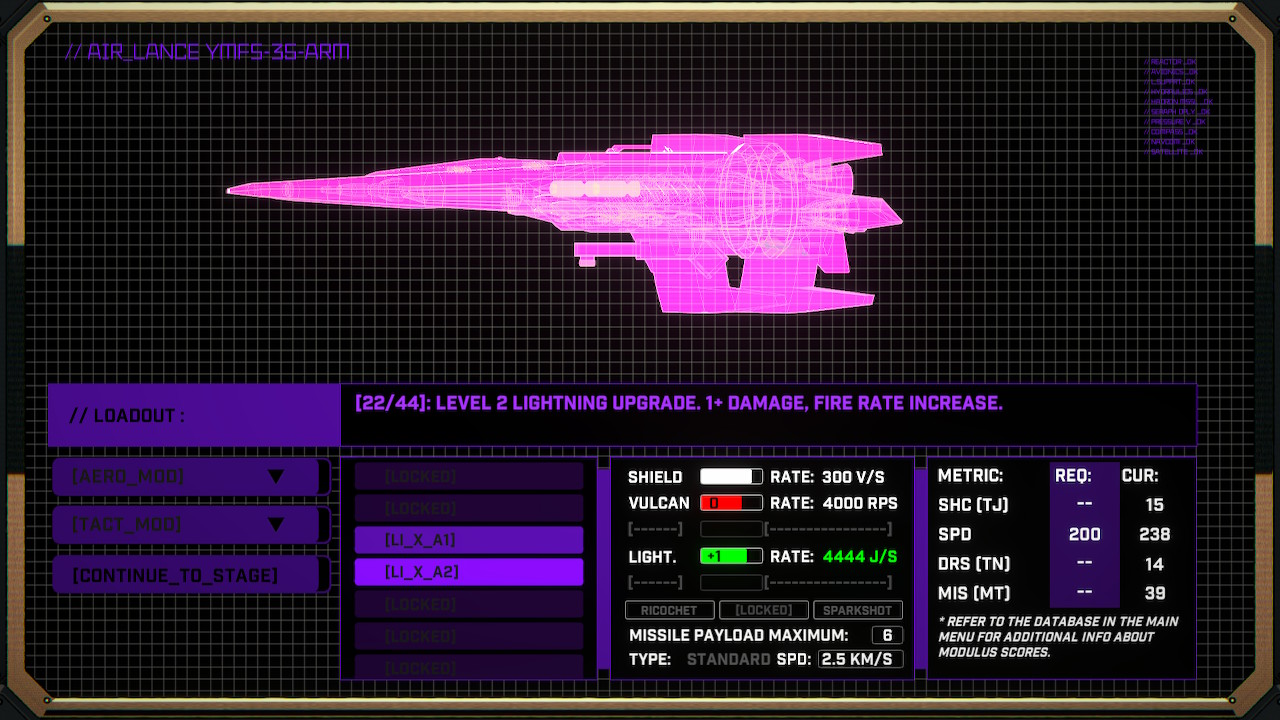
There’s also an upgrade feature. You earn different kinds of upgrade points over time, multiplied based on difficulty level. You can choose to upgrade your ship in between levels or before starting your mission, which also allows you to change colors and decals. Your upgrade points and upgrades carry over between playthroughs, so a failure on one playthrough can result in an upgraded ship that moves more quickly, shoots more powerfully or has more shield on the next playthrough. That’s essentially the game’s roguelite element, as level designs are not randomized, and failure does not mean restarting the game. Well, not after a patch which added the ability to continue after losing all three lives, which is turned on by default.
The loadouts you can get for your ship are not sacrifice-based, but instead things like “do you want this weapon to be more powerful, or this one instead?” where one of the weapons is your default shooter, and the others are ones you might or might not earn later in the game. Aside from this, each loadout also changes the physical appearance of your ship in terms of its shape and design.
No upgrade makes you actually lose anything your standard ship had. Eventually, you earn enough upgrade points to get ships which are all pros and no cons, with fully powered weapons, more missiles, and a faster movement speed. You can earn ships that turn the current difficulty into a joke, but the game has five difficulty levels to try to compensate.
In addition to this, there’s a gameplay mode called Rogue Flite. This mode randomizes your loadout and forces you onto the second-highest difficulty, with only one life. It’s still not a roguelite mode as actual level design isn’t randomized, but the randomized loadout can still slightly alter the experience. Storywise, this mode is treated as just as legitimate as the main gameplay mode, as the story still plays out the same and you still receive whatever ending you were going to get.
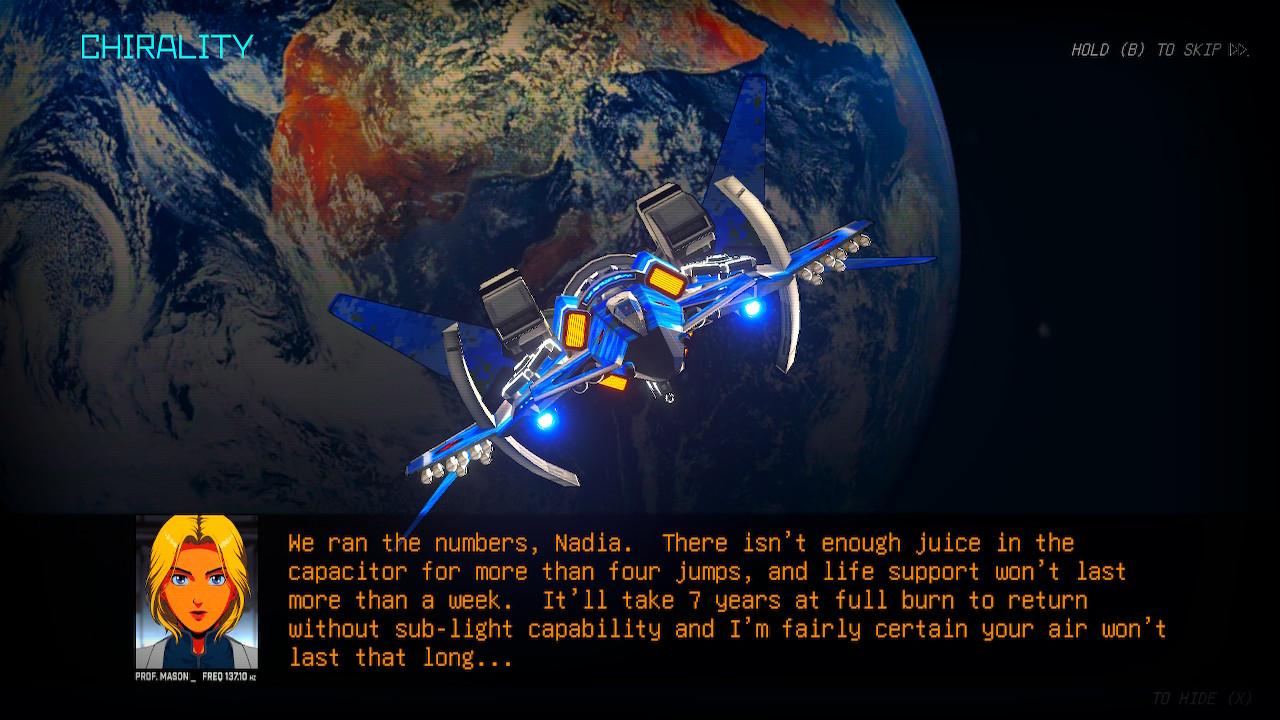
Let’s talk about that story now.
Many space shooters have the usual story of “aliens are invading, and you are the best pilot on Earth/Gradius/Darius/Whatever, so you need to stop them using the most powerful ship we built.” Here, things are a little different. No made up planets, and no alien invaders. Instead, humanity built an artificial intelligence system meant to protect Earth. The AI changed its mind and decided to do what AIs in fiction always seem to do. Have we learned nothing from Terminator, Mega Man X, WarGames, Bucky O’Hare, Code Lyoko, Digimon Tamers, and Horizon Zero Dawn?
The remaining humans were forced to hide and scavenge to survive, and eventually, one such group happened to find a hidden lab, known as Bow, with a powerful spaceship, known as Arrow, waiting to be used. Only one member of that group, Syrian-born former delivery pilot Nadia Sawas, has any flight experience whatsoever and zero combat experience, so after being given combat training using a combat flight simulator, she’s given the controls of the ship.
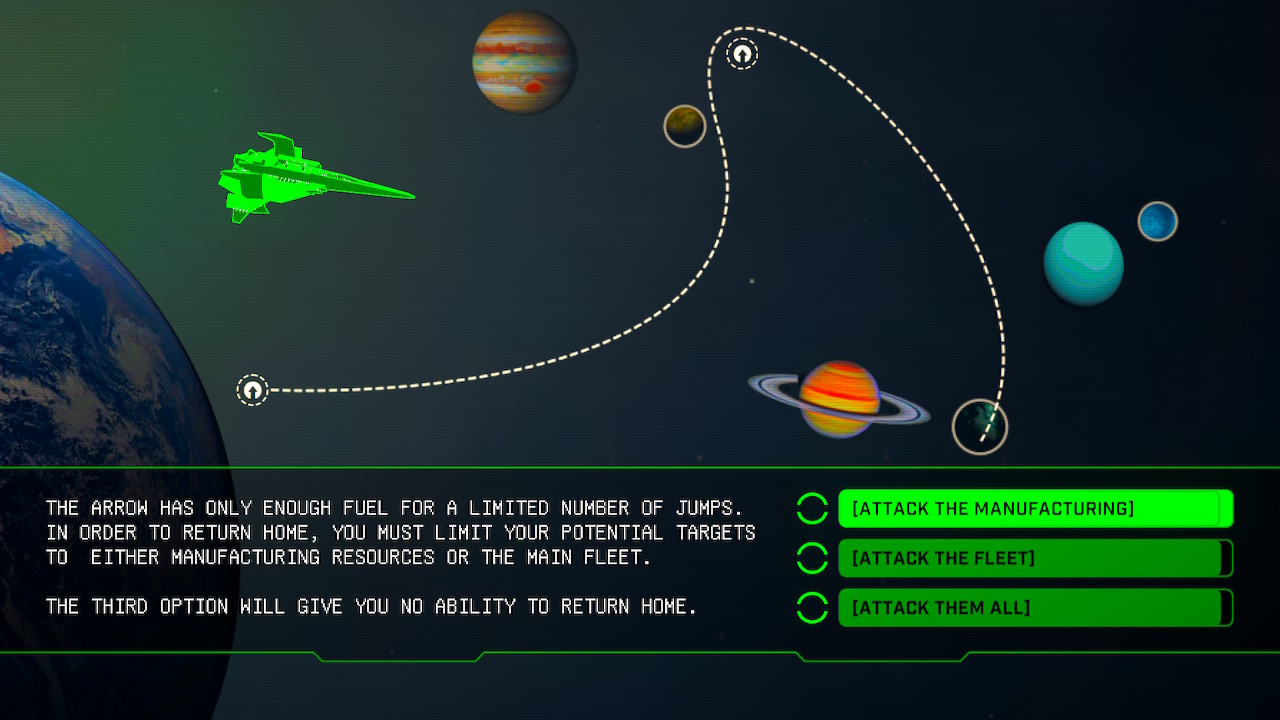
Cutscenes play out between levels, and there’s also in-game dialog during the combat. There’s also one moment where the story intersects with the gameplay, and you must make a choice.
After completing the second level, you are told your ship only has enough power to “jump” (basically, warp drive) a certain number of times. So, which set of levels will you go to? Attack the manufacturing so more enemy ships can’t be built? Attack the enemy fleet to do the most damage? Or attack them all and risk not coming home due to running out of power and risking dying of starvation out in space after you save the Earth?
As it turns out, all three choices lead to bad endings! After each bad ending, Nadia wakes up, as it turns out the whole thing was just a dream.
Once you’ve seen all three bad endings, you earn the New Game+ feature, and along with it, Rogue Flite+. You can now start the game with all weapons and the ability to get the game’s good ending. This also results in changes to the game’s levels, such as different enemy placement, more aggressive enemies, tougher enemies showing up in earlier levels and changes to the appearance of the levels such as time of day or color scheme.
Starting the game with all the weapons heavily reduces the difficulty, as every weapon is more powerful than the starting weapon, sometimes by a lot, giving you no reason to bother with your default weapon. Rogue Flite+ puts you on the game’s highest difficulty to compensate.
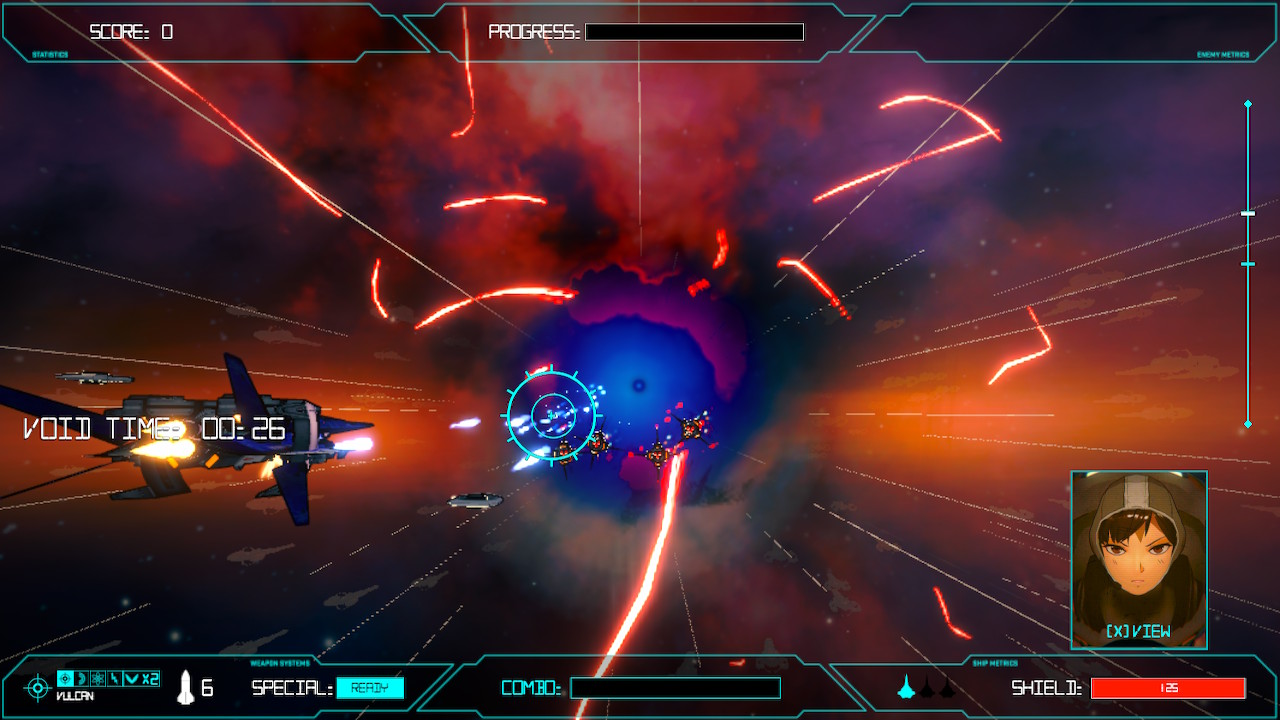
There is one other gameplay mode disconnected from the story. Void Challenge is a special challenge only playable on weekends, and it’s a combo-based score attack. How long can you keep your combo going? The timer freezes when your combo timer is going, but once the timer runs out, that’s it. You check your score, and that’s all there is to it. It’s the game’s score attack mode.
While the game design is a mixture of modern and retro, so is its presentation.
The Ohio-based developers described their game as being inspired by anime from the 1980s and 1990s. The game is definitely anime-influenced, and even has Japanese voice acting as an option, and a few lyrical songs in both languages. In motion, the game is very colorful and chaotic, with huge colorful lasers and small shots and cel-shaded ships constantly moving around the screen at a high frame rate. Screenshots don’t do it justice.
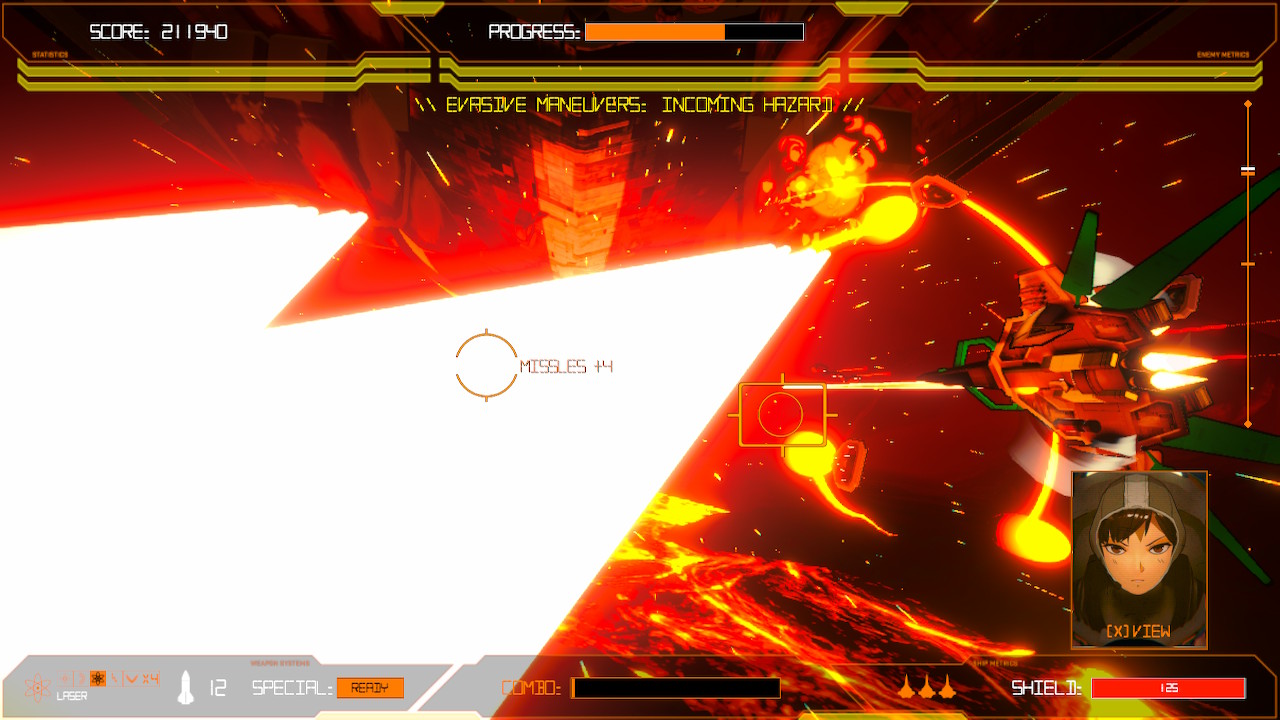
Besides its anime style, the game also has a very arcade-like presentation. While some games try to cut down on HUD elements for a more immersive experience, Rogue Flight has a score counter, a combo meter letting you know how close you are to starting a combo, a combo counter and compliments for the combos you obtain, and even a progress meter that shows how far you’ve gotten through the current level.
That said, the game comes with a flashing lights warning for those with epilepsy or photosensitivity – which then transitions into an intro animation full of them. There is an option to disable them, though it seems to reduce them rather than disable them outright. Keep that in mind if you have, or are considering buying this game for, someone with either medical condition.
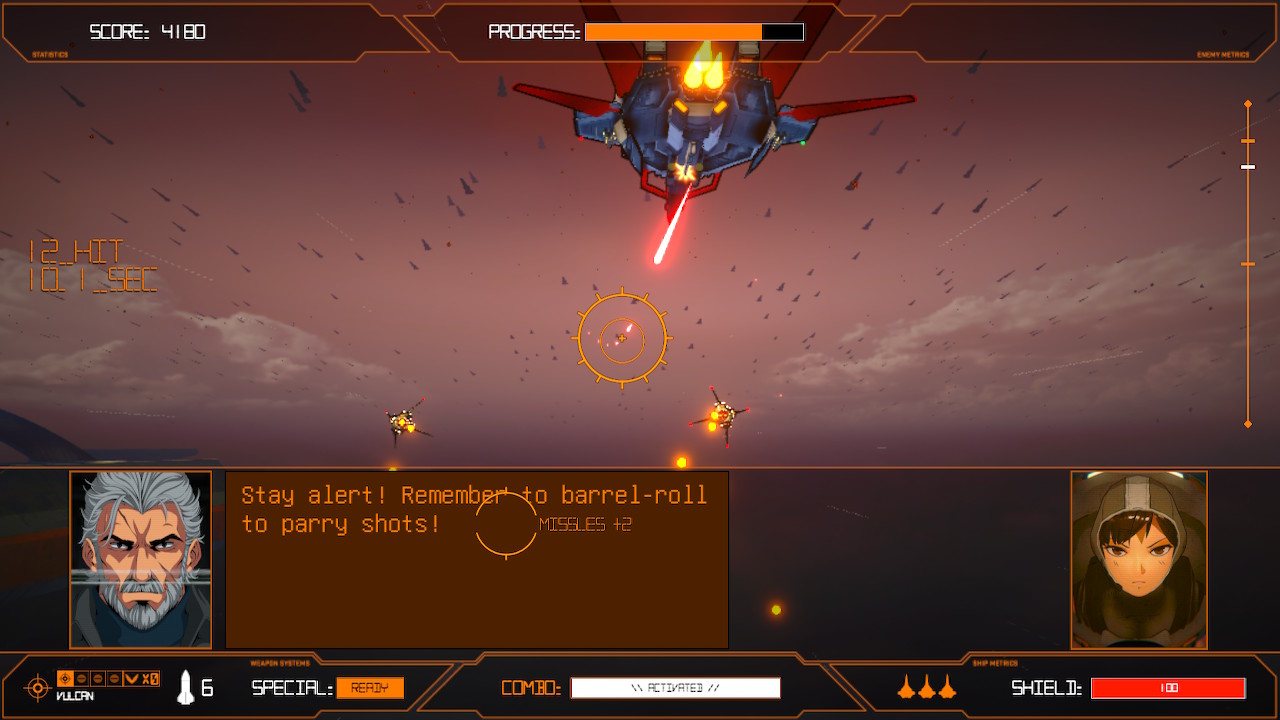
While the graphics are detailed and modern, the game has a style that can be described as “inconsistently retro.” There’s a VHS-style filter and film grain applied to the graphics by default that can be disabled – and are disabled in these screenshots. Character portraits during dialog as well as the dialog text itself use a color scheme similar though not identical to the EGA colors of old computers during many of the cutscenes, but both have colors more in line with a TV cartoon during gameplay dialog. The “digital clock” font is used for HUD elements. Dialog is shown in a pixelated font reminiscent of old VCRs. These touches don’t fit a single theme but appear to be a grab bag of intended nostalgia of the late 20th century.
Adding further to that “randomly retro” feel is the addition of a literal Retro Mode which can be earned. That adds pixelated character portraits and a dithered title screen, PCM synthesized music, and changes the voice samples to be much lower quality, while keeping most of the other graphics identical. Thing is, these elements don’t add up to any specific era – the pixelated character portraits are low resolution with a high number of colors, while the retro title screen is high resolution with a low number of colors, and heavy use of dithering (similar to old PC games using high resolution VGA). Meanwhile, the character portraits are displayed over top of the modern 3D cel-shaded graphics, and the PCM music sounds like something that could have come from arcade machines from the late 1980s, while the voice sample quality is much lower than even what the Sega Genesis/Megadrive could produce. All of the retro elements of this game, both in and out of Retro Mode, have no unified theme.
Even with all the work put into it, Rogue Flight is still a budget indie game, and it shows. The game is short, as in, roughly the length of a Super NES space shooter. Depending on the path you take through the story, the game can range from about 20 minutes to under an hour, not including cutscenes. For those looking for a quick pick-up-and-play game that provides an entire gameplay experience in the span of a single play session, this is one of the rare modern games to do so.
Aside from that, the game’s budget mainly shows in its lack of enemy variety, and small soundtrack. The game uses the same boss music for every single boss, even the final boss!
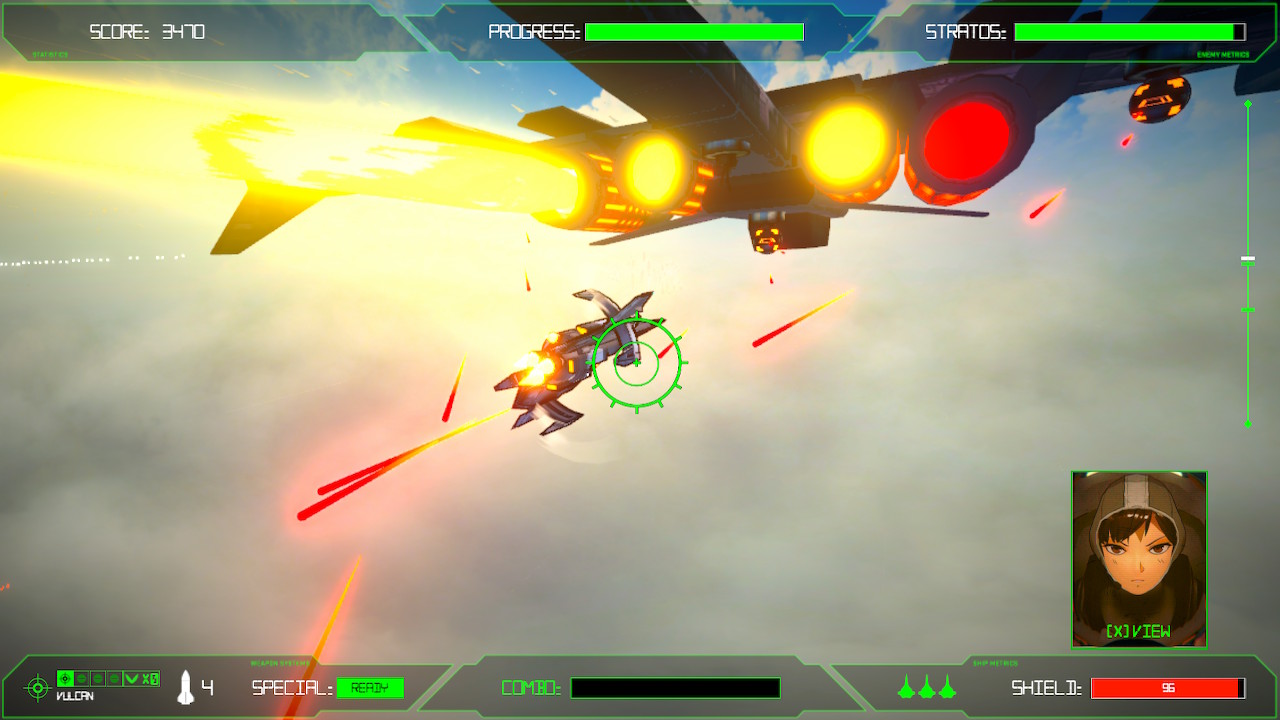
This boss’s thrusters can damage you very quickly without the game necessarily making it obvious what’s causing the damage.
For the parents thinking of buying this game for your kid, a couple things you might want to know about. Profanity in the dialog is limited to the occasional “damn” and “hell.”
The first boss has a design issue that might throw off early players of any age. Its jet stream can reduce your life without you even realizing you’re in it due to it not being drawn if it’s going directly through the camera in the center of the screen (though the engine the thruster is coming from is right in the center of the screen at that point, so some players will figure it out). Since it’s not communicated real well that you’re taking damage from the boss’s thrusters, there could be that “How did I die?!” moment. Even besides that, it’s quite the Wake-Up Call Boss.
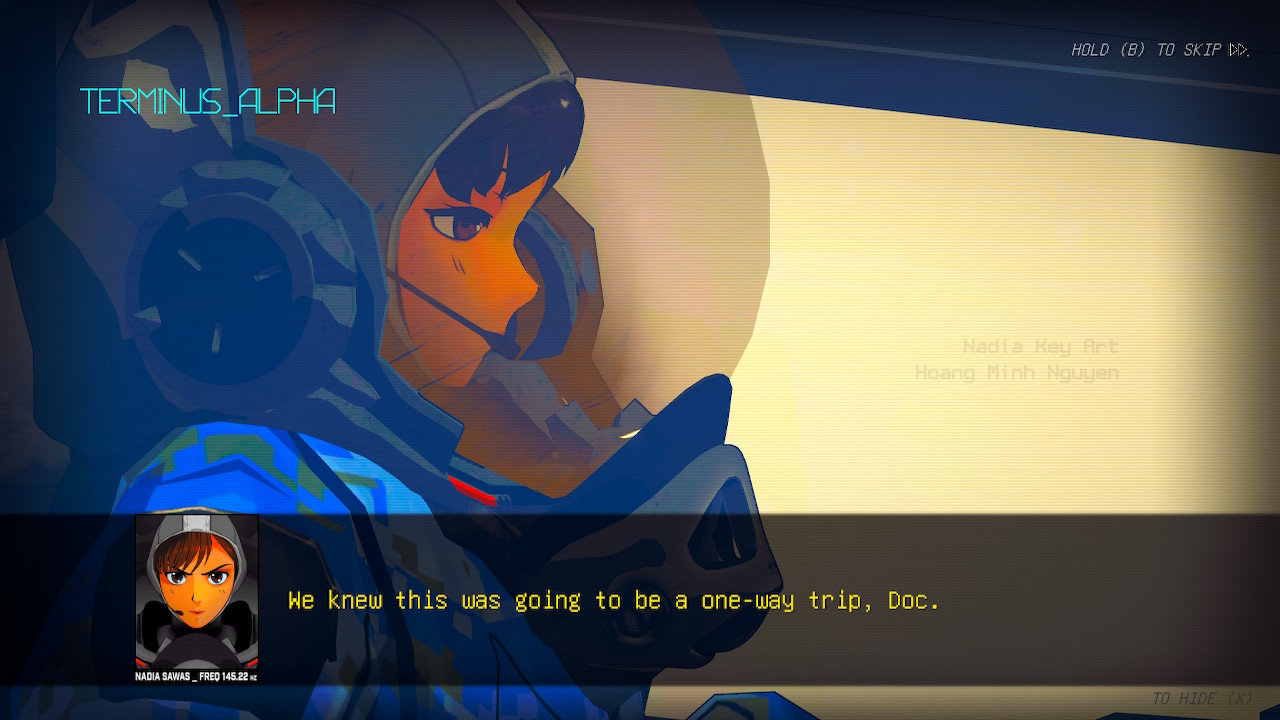
Finally, the serious mood and depressed sounding protagonist are definitely tonally different from gung ho upbeat “let’s save the world” stories, but then, many modern kids are growing up with serious anime, so maybe this isn’t too out of their wheelhouse.
Rogue Flight is a rarity in modern games: a complete story from beginning to end that can be played in a single sitting that’s essentially as long as games from the late 1980s/early 1990s, without resorting to retro pixel art graphics. It lacks the polished balance of some older space shooters, but it also provides a quick burst of gameplay that actually reaches an ending in much less than the length of a movie while also sporting mid-budget production values. In an era of super long games, for some players, this could be a breath of fresh air.