
Table of Contents
Page 1: Megami Tensei I & II
Revelations: Persona / Megami Ibunroku Persona: Be Your True Mind - Playstation / PSP (1996)
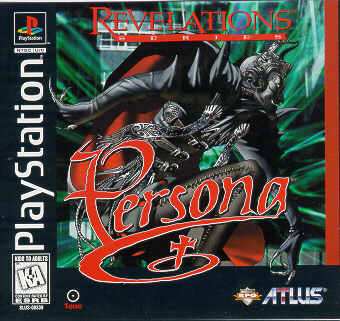
American PSOne Cover
Japanese PSOne Cover
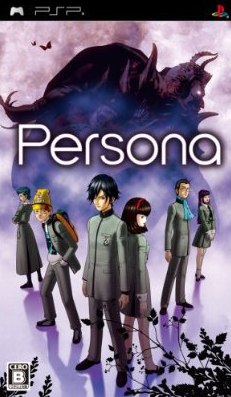
Japanese PSP Cover
Characters
The game begins with the characters playing game called Persona - an
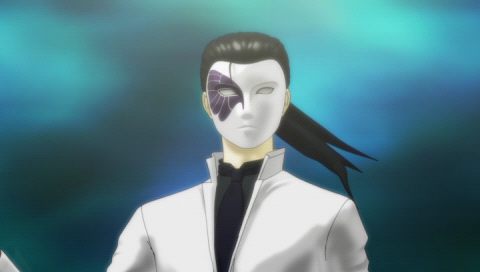
urban myth that will apparently conjure spirits - when they see an image of a small crying girl. They all pass out and dream of butterflies - a recurring image in the Persona games. Then their Personae are awakened by masked fellow named Philemon, who explains
that there are multiple selves living within them, and these selves happen to be ass kicking monsters. Everyone awakens and are just mildly weirded out, but things get stranger when the gang visits their hospitalized friend, Mary. All of a sudden, demons start attacking, and it's up to you to save your town. This all somehow ties into an evil corporation named Sebec, the evil president named Guido, and Mary's mother, an employee of the Sebec company.
Each your character wields a "Persona", which the game describes as a Latin word meaning "mask". Similar to the Guardians from SMT If..., a Persona allows your characters to cast different spells, as well as determining their elemental affinities. They level upseparately from your character, and can be created through cards you get from enemies. Visually, they look very similar to the Stands from Jojo's Bizarre Adventure, being an ethereal spirit that arises from a characters back to cast spells.
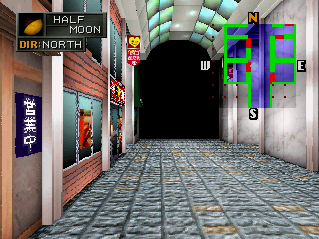
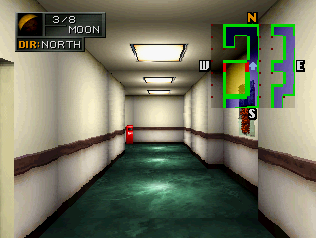
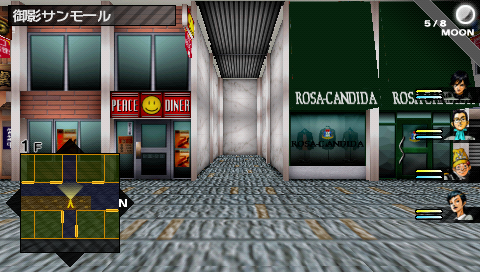
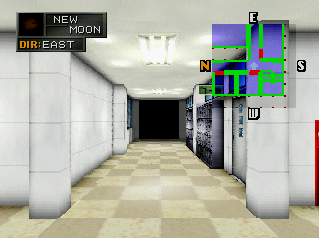
Persona is quite an odd mish-mash of gameplay concepts. The dungeons are all first person like Devil Summoner, although the scrolling is quite a bit smoother.
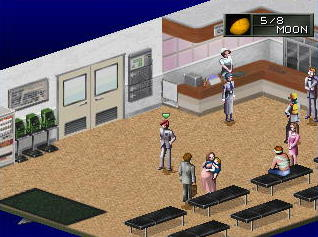
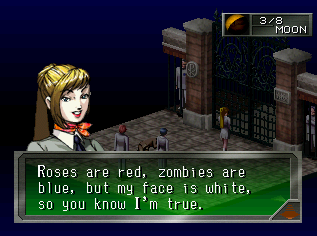
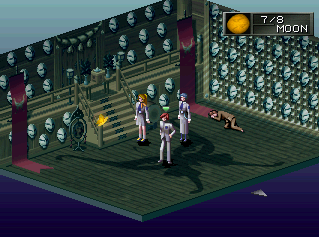
However, certain scenes, like walking around in rooms, are viewed from an isometric perspective. This lets you investigate rooms, as well as talk amongst
your party members.
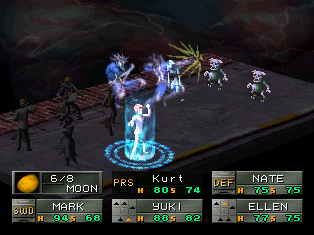
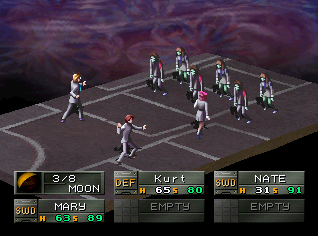
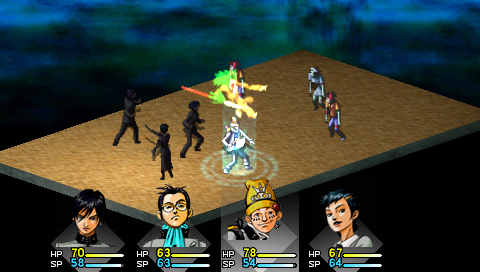
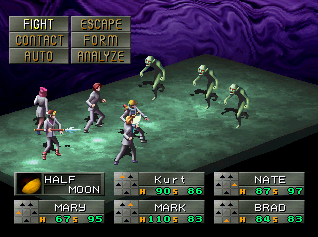
The battle scenes are now third person as well, although they are undoubtedly the
worst part of the game. You position your characters
(up to six) on a tiny grid, and their location
determines what enemies they can attack. Unless they
have a ranged weapon, that means you can only attack
what’s directly in front of you. So a party member on
the left side can’t attack an enemy on the right side.
As a result, characters will often lose their turns
because they aren’t in range to attack anyone. You can
alter formations during battle, but this is incredibly
cumbersome. Not only that, but attacking takes far too long, which is a
little sad considering they didn’t bother to add any
walking animation to your characters - they merely
glide next to an enemy and hit them. It reeks of cheapness.
The conversation system has changed a little bit - each
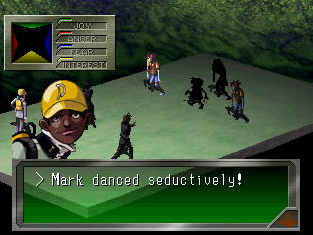
character has four different skills that they can use on an enemy, whether it be praising them, chastising them
or singing a song. The demon's reactions are clearly shown via an onscreen meter, so getting what you want from
them is fairly easy - you just have to find the right skill and keep doing it, while answering the occasional
bizarre question. Conversing with demons can yield you items, the most important being tarot cards to make better Personae.
None of the conversation system really makes much sense - it doesn't help that the options are so poorly translated that
you may as well be playing in a different language - but what can you expect from a game with demons who attack
by dancing the hula?
This being an early Playstation game, you’ll encounter constant loading times. And since rooms are no longer
identified before you enter them, you’ll often waste
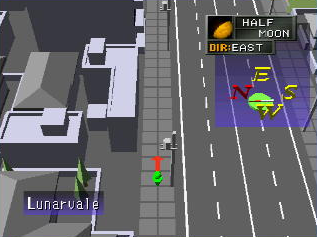
time running in and our doors. The city has been expanded beyond a small map screen, and you’re given full
freedom to explore Lunarvale. Everything is 3D
rendered, filled with untextured polygons, and somehow still moves at an incredibly choppy frame
rate. While it gives the city a sense of scale, it feels like an unnecessary way to stretch out every
segment, because you’ll be running back and forth across town a lot.
Other than the sluggish battle system, Persona’s problems are
largely technological in nature. Even compared to most
of the RPGs that come out today, Persona has a highly
original plotline and setting, along with some
excellent music. But time has not been kind to it, and
the other SMT games (including Persona 2) are quite a
bit better.
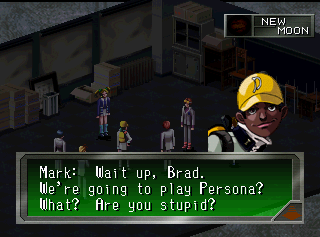
Persona was released in 1996, making it one of the few RPGs to be published before the boom started by Final Fantasy VII. It also features a somewhat infamous localization, which changed most of the character art and mangling much of the text, in addition to other somewhat aggravating issues. Atlus was a different company back in the day, and North American wasn't nearly as familiar with anime and other elements of Japanese pop culture, so the English script does as much as possible to convince the player that the game totally doesn't take place in Japan. Almost all of the major characters have been
renamed to sound American and given a makeover - some
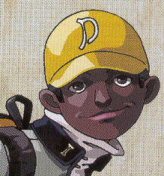
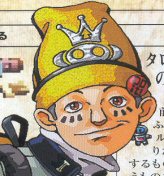
are pretty minor, but one character, Mark, a strange guy with a rather eccentric fashion sense, was changed to an African-American for some reason.
All of this
in spite of the fact that Persona is obviously a very
Japanese game - where do you find Shinto shrines in
America? Some odd things slipped through, as the
Pharmacy song is still intact. If this butchering
wasn’t enough, a whole chunk - the Snow Queen
plotline, a huge alternate storyline, worth several hours of gameplay - was completely
removed from the English version. Why? One story says there wasn’t enough time for Atlus to translate the dialogue - another says it would have been too hard
for Western gamers. The American game in general has been toned down from the Japanese version, with fewer random battles and easier enemies. Regardless, Persona stands as one
of the most atrocious translations in American RPG history, and while it doesn’t completely ruin the game, it does notably hinder it.
One of the more amusing parts of Persona is the Satomi Tadashi Pharmacy. Playing in the background is an oddly infectious,
upbeat little tone with a funny little Japanese man singing. While the lyrics aren't anything too important - it just
lets you know what items to use in order to cure various illnesses - it lends a lot to the bizarreness of Persona, especially since real life Japanese pharmacies tend to use annoying jingles like this. The song appears in various forms in Persona 2. Well worth checking out is Dale North's Northside Remix, complete with redone hilarious English lyrics.
Although the Persona titles did well in Japan, their popularity didn't really explode until the release of the third title in 2006. Due to this resurgence, Atlus remade and published the original Persona on the PSP in 2009. It might be a shocking change for fans who jumped on with the third and fourth games, because they don't share much in common beyond the monster recruiting and school setting, but it's still interesting to see how the series evolved.
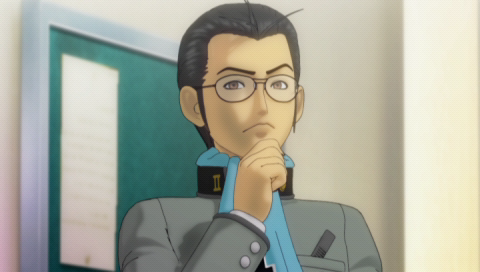
Unlike many Playstation to PSP ports, Atlus did a lot of retooling to modernize Persona. There's a brand new interface, multiple difficulty levels, and many more save points. The game itself is significantly quicker, with a faster walking pace in dungeons and much speedier battles. There are new CG rendered cutscenes for key plot events, although nearly everyone "speaks" with subtitles - only Philemon is voiced, like the original game. A couple of the dungeons have some extra floors too. The soundtrack is almost completely new, in the style of later Persona games, which is a bit of a shame, because the original's soundtrack was pretty excellent. It still looks and feels a bit dated, but it's also signicantly more accessible than the PSOne game. And since it's also scheduled for North American release, English speakers can expect a more faithful localization.
MP3s
Awakening Legend
Battle
PSP Version - Download here
A Lone Prayer
Persona
Persona
Persona
Persona
Persona
Persona
Persona
Persona
Persona
Persona
Persona (PSP)
Persona (PSP)
Persona (PSP)
Persona (PSP)
Artwork Comparison
Page 2: Shin Megami Tensei I & II
Page 3: Shin Megami Tensei If... & III
Page 4: Devil Summoner / Soul Hackers
Page 5: Persona
Page 6: Persona 2: Innocent Sin & Eternal Punishment
Page 7: Persona 3, FES, and 4
Page 8: Digital Devil Saga
Page 9: Devil Summoner: Raidou Kuzunoha
Page 10: Devil Survivor / Strange Journey
Page 11: Other Megami Tensei games
Page 12: Majin Tensei
Page 13: Last Bible
Page 14: Devil Children / Demikids
Page 15: Anime

Persona is an offshot of the Shin Megami Tensei series, which shares many of the same systems of the original series while trying to make it more appealing to newcomers. Much of it is derived from the schoolyard setting of Shin Megami Tensei If..., focusing on a group of high school students in modern day Japan. There's a much great emphasis and characterization, with your party always consisting of human characters. That's right - monster recruiting is completely gone, although you can still talk to them to get items or let them leave you alone.

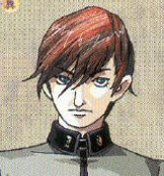
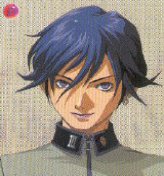
Hero
Known as the "Boy with the Pierced Ear" in the Japanese version, except they took that out
in the American release, so one assumes he is simply "Boy". Or maybe "Boy with Kind of a Stupid Haircut". The Persona
manga calls him Naoya Toudou.

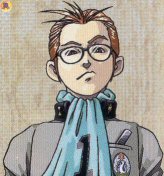
Mark (Masao Inaba)
Mark's a loudmouth idiot. He says something stupid and/or amusing every time he talked. He does,
however, start out the game wielding an axe.

Nate (Kei Nanjou)
Nate is somewhat of a stuck up rich boy, and has a strange father-like bond
with his butler. He's always yelling at Mark and
reaming him out for being a jackass. The death scene of the butler early in the game is goofily tragic.

Brad (Hidehiko Uesugi)
A sneering, arrogant bastard.

Alana (Yuka Ayase)
A ditzy, irritating kogal, the Japanese equivalent of a valley girl.

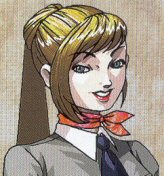
Ellen (Eriko Kirishima)
A glitzy yet somewhat smart blond girl. She has a sword, and isn't massively annoying.

Yuki (Yukino Mayuzmi)
One of the only characters not butchered in the localization, Yuki doesn't say much, but she's
calm, collected, and her distance attack is one of the most useful in the game.

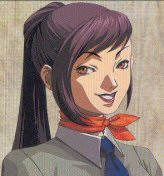
Mary (Maki Sonomura)
Mary was hospitalized for over a year due to mild dementia, but during the demon invasion, she appears
with no knowledge of her illness (and a tenuous grasp on some basic English vocabulary.) She may be involved
somehow with all of the trouble going on.
Elly
Main Theme
Satomi Tadashi Pharmacy Song
Let the Butterflies Spread Until Dawn
Satomi Tadashi Pharmacy Song 2009

 |
 |
 |
 |
|
 |
 |
 |
 |
Screenshot Comparisons
|
PSOne
|
PSP
|
|

|
|

|
|

|
PSP Cutscenes

|

|