
Have you ever played a gamebook? Perhaps a ‘Choose your own adventure’? If you have, which ones? Have you tried Fighting Fantasy, or GrailQuest perchance? If you have, then you will be in familiar territory. Released internationally in 2026, written, illustrated and primarily developed by VanillaWare alumni Yoshio Nishimura; his take on the digital gamebook is Veritas Tales: Witch of the Dark Castle.
A six-year project of passion, Witch of the Dark Castle is Nishimura’s return to his roots, having been on record to have claimed to learn to read from the Japanese versions of the above-listed gamebooks. For those unfamiliar with gamebooks, imagine a tabletop RPG. Now imagine that scheduling for one can be an absolute nightmare. A gamebook allows the reader to enact their own agency in a story in much the same manner. The British variety of gamebook in particular would often include a character sheet to track statistics and other such things to accompany combats and other situations that would arise, much like tabletop games from the 70s to the modern era.
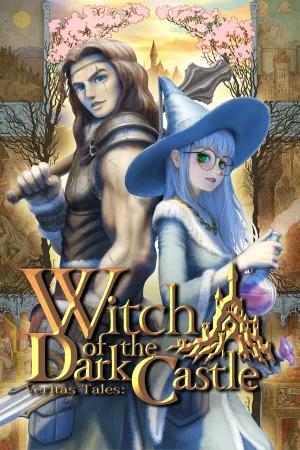
The game opens with a very pretty illustration and a declaration that this is a Virtual Adventure Book, followed by a depiction of what the cover of said Virtual Adventure Book would look like in paperback format. This cover even resembles that of Akuryoutou no Hihou’s cover, and is likely a nod to Nishimura’s inspirations. This transitions to a statement that sets the tone: “This is a game where you wield a pencil and some dice as your weapons, and journey through a world of swords and sorcery. You become the hero of the tale, setting off on an adventure to the Dark Castle where a mysterious witch resides. Along the way, dreadful monsters and deadly traps will be waiting for you. With good judgment and a bit of luck, you might just make it back alive. Now then–steel your courage and set out!”
Then one is presented with the option of one’s ‘Other Self’ for the purpose of experiencing the story. One has the choice between two extraordinary adventurers: Havelock, the merciful former-gladiator who purchased his own freedom; or Paneri, a bespectacled amnesiac mage who was nursed back from dire wounds by a nunnery. The titular witch is one Ingeborg, a mythical forest witch who has incited an insurrection in Erishing, the royal capital of the nation of Yuran. Havelock is drawn forth because in his early years he was raised by the witch. Meanwhile Paneri is in search of her mentor who in her last contact was in the capital attempting to change Ingeborg’s course of action. This is not a cosmetic choice either, as there are a number of circumstances that will resonate differently with the personal histories of the characters. Once completing the adventure with one, the player is prompted to see through the adventure from the other’s perspective. This is necessary to understand the entirety of the game’s story. When performing the ‘second quest’, the actions taken by the first character will be consistent with how they were taken in the first run. This can even create situations where the second character may find themselves short on resources of situations with which to experience and strengthen themselves.
For indeed, choice is the name of the game in Witch of the Dark Castle. As much as in life, one must make choices and sometimes the consequences of our own actions do not manifest immediately. Not every tragedy can be prevented. We can but take what we have learned from our experiences and use them to drive ourselves forward with greater wisdom. As Nishimura has said in an interview: “It’s the joy of being able to choose. Not zero options, and not just one.”
The two characters are capable of navigating most matters with the same level of adeptness. Rare is it that one will find a situation where Havelock can accomplish something that Paneri can not, and vice versa. The exceptions to this generally revolve around situations where one would acquire equipment, as while they share availability with some items such as cloaks, or simple daggers; predominantly Havelock will not have much value in having a staff and Paneri wouldn’t much benefit from having a shield.
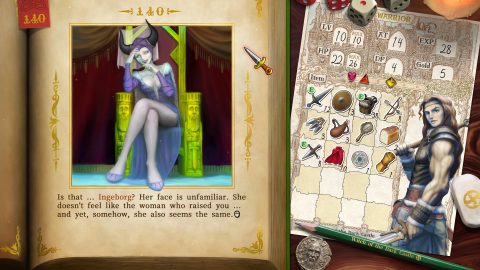
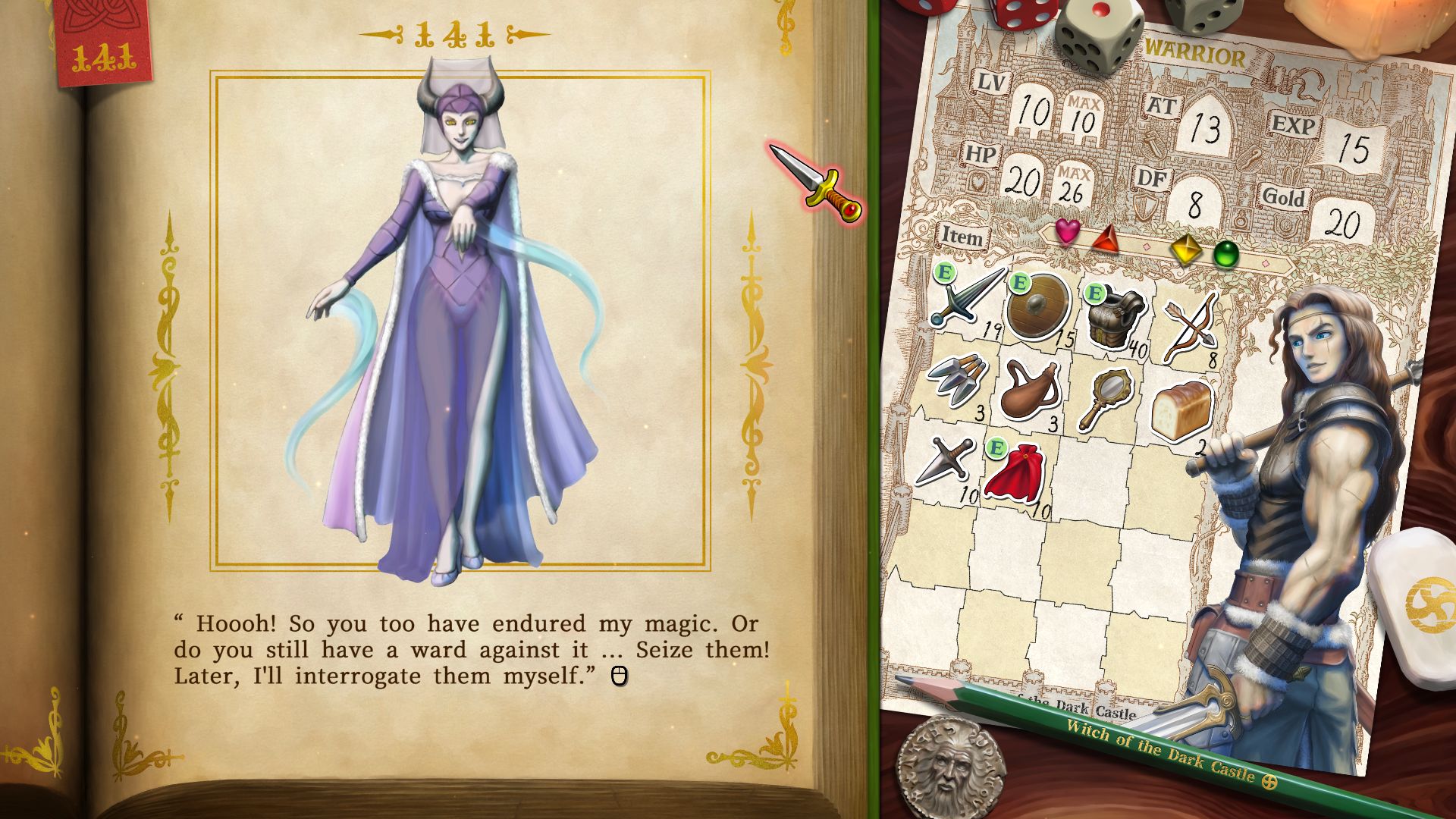
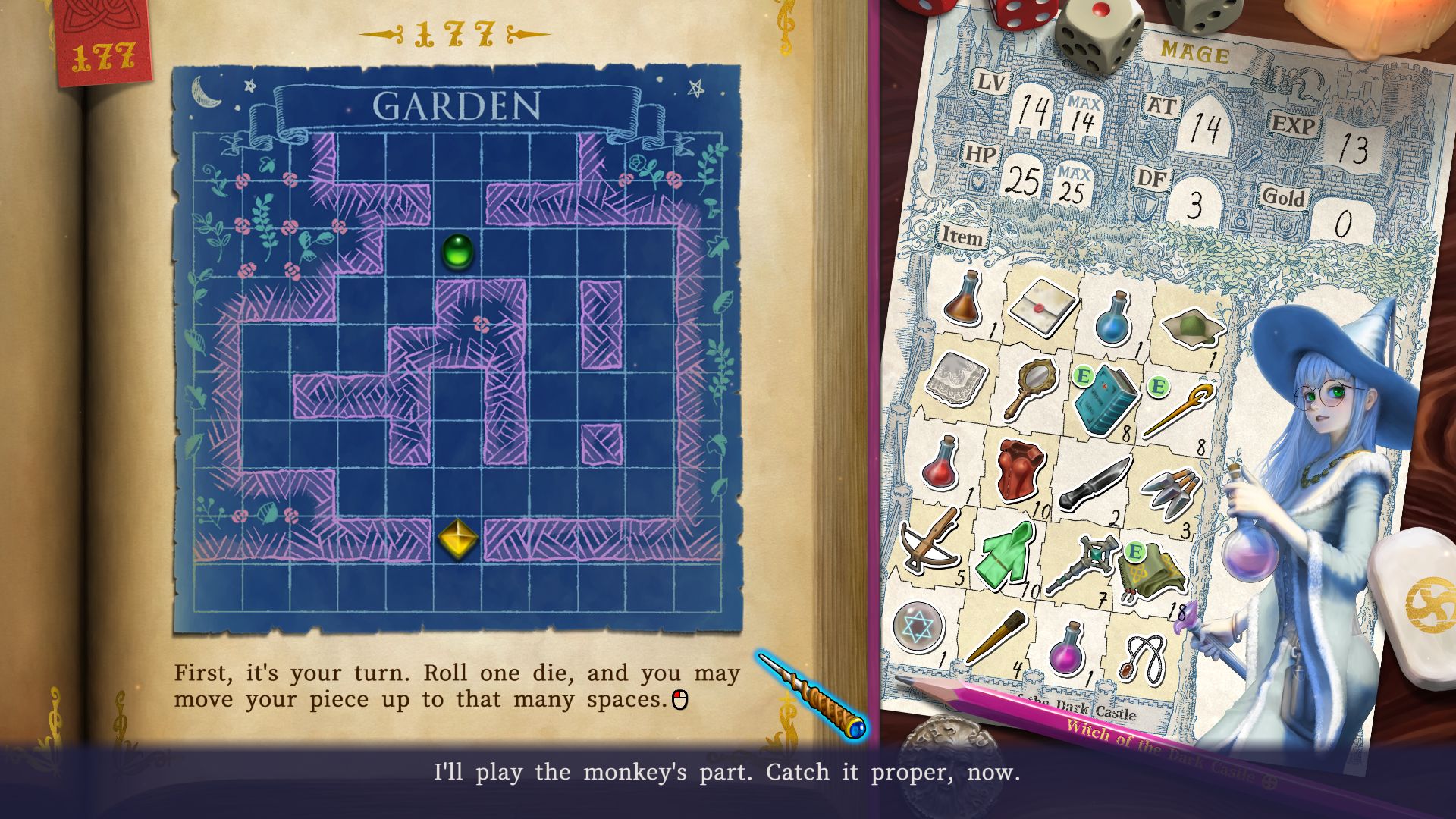
Combat is a fairly simple affair, owing to the framework of the gamebook heritage. The player characters each have a character sheet that will present their Level, Attack, Defense, and Stamina (hit points). An Attack action will involve the player rolling two white dice for themselves, and two red dice for the opponent. The respective dice will be totaled up and then added to the level of the character and the opponent. If one total value is larger than the other, they check their Attack against the smaller’s Defense and reduce the victim’s Stamina by this difference. In the event of a tie, no damage is incurred by the other side. If there are allies present, each will get a singular die of damage that ignores the defensive score of the opponent. This continues until either side hits zero Stamina, though some opponents will surrender or have something up their sleeve at certain health thresholds. Equipment can modify the character’s attack, defense, and some particularly powerful or cumbersome gear can even modify level. The sheet will also track one’s gold and experience, with a delightful touch of a pencil erasing and scribbling in the numbers as changes occur.
While the gameplay of both characters is similar, there are sufficient differences to cause one to reconsider their approach to a similar situation. Havelock tends towards having more readily effective armor and is capable of using basically any martial weapon or shield, even being able to dual-wield weapons. This is further bolstered by different weapons and shields being capable of various combat maneuvers, such as targeted attacks and counters. Paneri meanwhile makes use of staves and spellbooks to present rather consistently high offense, while benefiting from a higher starting level to more reliably succeed in exchanges to compensate for her less impressive defensive options. The repertoire of spells to manipulate battles and contextual situations provides Paneri with no shortage of capable means of survival.
One can even mouse over a number of highlighted words, inventory items, and even opponents in combat to learn more about them and the world at large to see how a bunch of things fit together. This benefits the worldbuilding greatly, and helps provide context in situations where otherwise one might be lost. There are even items in the game that can provide information that would otherwise not be spoken of or other learnable elsewise. A treat for those curious about how a number of things fit together, or how some things came to be.
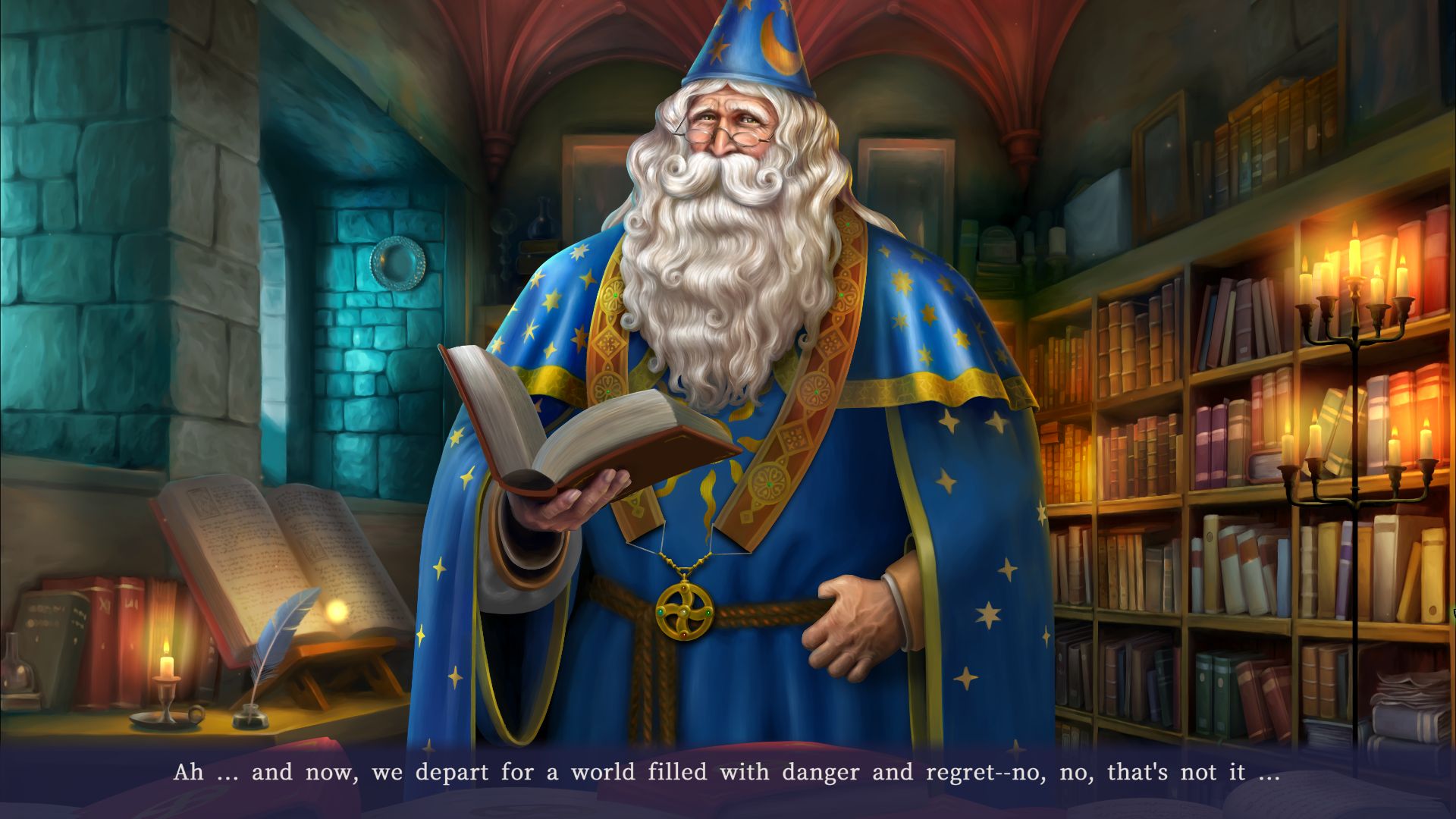
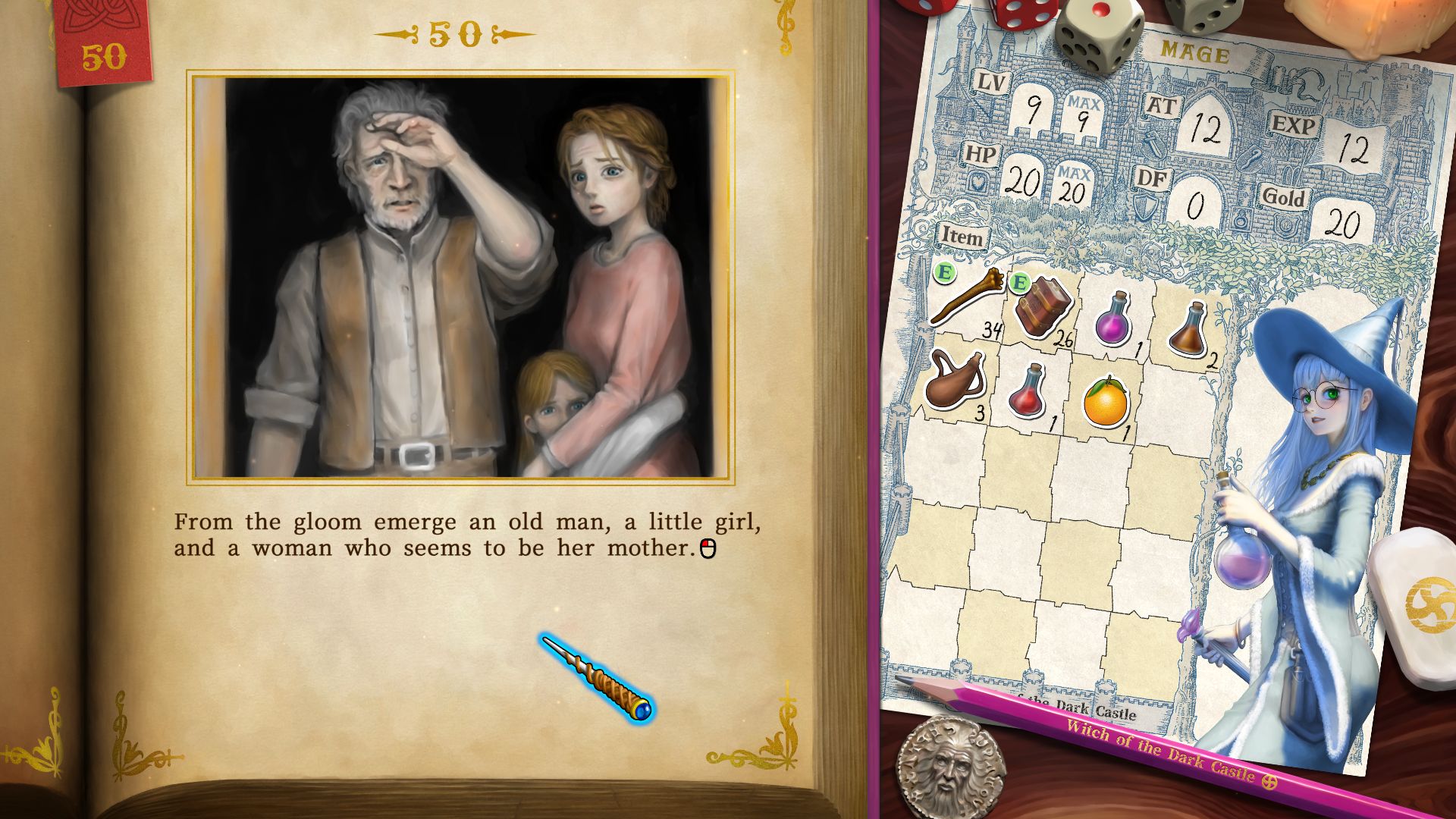
The visuals of Witch of the Dark Castle are as beautiful as one would expect coming from someone with a VanillaWare pedigree. Every landscape, object, character, and incidental detail is lovingly crafted; often bringing together a consistency that is only readily apparent when one is more informed and paying attention. Unsurprising, since Nishimura contributed as a background artist to Odin Sphere, Muramasa, and was the lead background designer for Dragon’s Crown. Several areas of the game are presented with a map showing the local part of town or the current facility, represented with numbered locations that anyone who has ever played a published tabletop adventure will be very familiar with. Most of the gorgeous illustrations are static images, though the Player Characters on the character sheets are rendered with the kind of visual morphing technique that was often used in the likes of Odin Sphere and Dragon’s Crown. The Wizard serving as host to this novel adventure also embraces this kind of animation.
The audio of the game is chiefly represented by the music of Basiscape’s Hitoshi Sakimoto, who wastes absolutely no time in arresting the attention of the player as the game’s opening plays out. The score is vibrant and fantastical when providing a sense of mystery or wonder for the player; inspiring urgency during the heat of battle and other moments that inspire a call to action, or utter dread when things are at their most grim. Leveling up is accompanied by a triumphant jingle. (Though given its non-discerning nature, this can result in it playing immediately after a low moment, which can be unintentionally hilarious.) For the quieter moments, simple soundscapes will accompany the turning of pages. A number of audio cues and sound effects accompany the events of the story, and help to draw out the story being told. The dialogue of the game is vocalized from the main cast, though incidental or minor characters do not receive such treatment.
The world building present in Witch of the Dark Castle is compelling, presenting the idea that the region where the adventure takes place is only a small part of the larger world. Indeed, grand-scale lingering plot threads, systems of magical lore that are merely touched upon as well as maps depicting the entire broad geographic region suggest that there is far more to be seen in this world than is shown within the game. Considering the “Veritas Tales” part of the title speaks to an intention to continue a series of stories set in this world, teasing an offering of more. Who knows? Perhaps one day Veritas tales will be available in a print format as well.