

- Fire Emblem (Introduction)
- Fire Emblem: Shadow Dragon and the Blade of Light
- Fire Emblem Gaiden
- Fire Emblem: Mystery of the Emblem
- Fire Emblem: Genealogy of the Holy War
- Fire Emblem: Thracia 776
- Fire Emblem: The Binding Blade
- Fire Emblem (GBA) – The Blazing Sword
- Fire Emblem: The Sacred Stones
- Fire Emblem: Path of Radiance
- Fire Emblem: Radiant Dawn
- Fire Emblem: Shadow Dragon
- Fire Emblem: New Mystery of the Emblem
- Fire Emblem Awakening
- Fire Emblem: Fates
- Fire Emblem Echoes: Shadows of Valentia
- Fire Emblem (Misc)


Co-authored by Ethrin
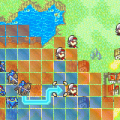
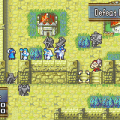
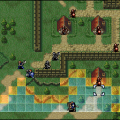
Barely a year after Fire Emblem first forayed onto handheld consoles, Nintendo and Intelligent Systems released the next game in the series: Fire Emblem: Rekka no Ken, retroactively localized as The Blazing Sword, in March of 2003. But more importantly, later that year the same game reached American shores known simply as Fire Emblem. After receiving substantial exposure through Super Smash Bros. Melee, Fire Emblem was at long last prepared to test the strategic mettle of western audiences.
Blazing Sword looks and plays almost identically to its predecessor, Fuuin no Tsurugi a.k.a. The Binding Blade, as it should: both games are set in the same fictional world, on the same continent, just a few decades apart. Having already experimented with both a traditional sequel (Monshou no Nazo) and a “mid-quel” (Thracia 776), the powers that be decided this follow up would be a prequel to the previous entry. After all, this would be the first time that most of the world would have access to Fire Emblem, and it wouldn’t make much sense to create a story where the player is expected to have some understanding of The Binding Blade.
That’s not being overly presumptuous concerning Intelligent Systems’ regard for western players; this game is loaded with evidence to suggest that it was indeed developed with worldwide gamers in mind. Most prominent is the game’s extensive tutorial, which while not a series first, was still clearly designed for the western newbies. Binding Blade featured a tutorial as well, but it was extremely bare bones and hidden away in the options menu where many first-time players might not even find it. Blazing Sword’s tutorial on the other hand is 10+ levels and houses a considerable self-contained plot that compliments but is not entirely necessary to the game’s main narrative. This tutorial is Lyn Mode.
Lyn Mode, as the name might suggest, follows Lady Lyndis, a former noble of House Caelin who was born and raised on the plains of Sacae, a nearby country. Lyn is approached by Caelin knights who inform her that her grandfather is being usurped by his brother Lundgren. With her parents already dead, Lyn embarks on a journey to save what little family she has left and reclaim her place as her household’s rightful heir. This tale is a simple coming of age story that never tries to be any bigger than it really is. This mode is mandatory upon the creation of a new save file, much to the chagrin of series veterans playing Blazing Sword for the first time.
This is also the first game in the series in which the player is not simply assumed to be the Lord and main character, but is instead a non-combatant named Mark (although the player can change the name), who serves as the army’s tactician. The integration of the Tactician into the story is on the whole rather sloppy, as characters will sometimes turn towards the camera and address the player, particularly during the game’s prologue and epilogue, but for about 90% of the game the characters converse purely amongst themselves, meaning the player/Tactician is either not present or is eavesdropping and staring awkwardly at them. There’s also a ‘Tactician bonus’ given to characters who share the same affinity as the Tactician (based on the entered birthday), but the bonus is largely negligible. This concept was elaborated on more with playable avatar characters in later Fire Emblem games, starting with the 3DS entries.
The core plot is known as Eliwood Mode. Named after the titular character, Eliwood is a young noble from House Pherae on a quest to find his missing father. After meeting up with his longtime friend Hector from the neighboring House of Ostia, and eventually Lyn too, the three begin to unravel a conspiracy that threatens not only their country of Lycia but in fact the entire continent. The evil lord Nergal wants to open the Dragon’s Gate – a portal to the realm where the Manaketes were sealed. He has powerful human-like creations called Morphs aiding him by creating chaos in the world.
The game’s narrative thrives independently of The Binding Blade, and in fact, The Binding Blade is supplemented by The Blazing Sword’s plot much more significantly than the other way around. In particular, Blazing Sword gives players a look at its predecessor’s antagonist Zephiel in a way that humanizes him, cutting down on the melodramatic edge from his first appearance. Many family members of other units in The Binding Blade appear, too.
In addition to Lyn Mode and Eliwood Mode is a third mode named after the game’s third protagonist: Hector Mode. Hector Mode is essentially a remixed version of Eliwood mode that’s riddled with minor adjustments that ultimately add up to a surprisingly unique experience. Hector Mode includes two alternate chapters, two new chapters, two exclusive sidequest chapters, and two unique characters not available in Eliwood’s tale. Furthermore, several scenes that centered on Eliwood focus on Hector instead, which ends up revealing new plot information. Both Eliwood and Hector’s Modes act as “sequels” to Lyn Mode. Every character that appears in Lyn Mode will eventually reappear in Eliwood and Hector Mode, and they’ll keep the levels, experience, and stats they gained in Lyn’s campaign.
Characters
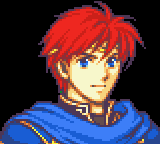
Eliwood
The son of Pherae’s Marquess, Eliwood sets off to find his father, who has vanished alongside his trusted squadron of knights. Calm and polite, Eliwood’s composure will be tested as he uncovers terrible things afoot in his country.
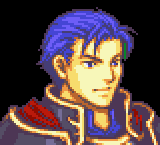
Hector
Brother of Ostia’s Marquess, Hector is both Eliwood’s foil and trusted friend. He’s brash and reckless, but loyal and trustworthy. He joins his friend in a fight bigger than either can possibly imagine, all while quietly bearing his own burden.
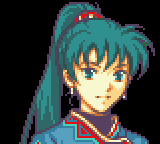
Lyn
Born and raised as a simple girl on the plains of Sacae, Lyn carries a royal bloodline that calls her into action. She meets Eliwood on her own journey to retake Caelin, and later rejoins him on his own fight when Caelin becomes wrapped up in a larger conflict.
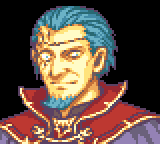
Nergal
A practitioner of the dark arts who has somehow become the leader of the Black Fang, a vigilante group once known for punishing evildoers and helping the poor. Under his leadership the Fang are hardly recognizable.
Ninian
A mysterious dancer who roams the lands with her brother Nils. She’s clearly gifted with otherworldly powers, but to what end?
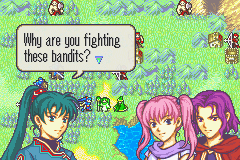
Each of the three lords’ modes also include a hard mode variant, unlocked upon completion of Normal. This Fire Emblem is one that was designed primarily with replay value in mind, and it places an extremely heavy emphasis on unlockables and other alternate gameplay experiences. Returning are “gaiden” chapters, a.k.a. sidequests that are unlocked by fulfilling certain secondary objectives. These chapters with the most deliberateness and care: nearly every gaiden chapter is worth visiting, but the game is beatable in its entirety without unlocking a single one.
Blazing Blade tends to be more creative with its implementation of most ideas, not limited to but certainly including the unlock requirements of gaiden chapters. Most of Binding Blade’s gaiden requirements boiled down to keeping certain playable characters alive and beating certain chapters within a generous turn limit. Blazing Blade’s are a bit more creative: in the game’s desert chapter, for instance, the player must keep a powerful allied NPC from defeating too many enemies in order to unlock the sidequest.
This entry brings back the variety of mission objectives. In addition to the seize objective, there’s also rout (defeat all enemies), defeat the boss, defend (keep enemies from reaching and/or attacking a certain point), and survive (last a certain number of turns against unyielding waves of enemies). Also returning and further refined is the ranking system, which ranks players and combines them into a one-to-five star ratings. Each chapter has a recommended benchmark for each category, and if the player can stay ahead of these requirements then he/she will have five stars when checking the ranking page. This system allows for flexibility, since players can fall behind in an area as long as they catch back up by the time the game ends. However, due to a programming oversight, some of the requirements were not properly implemented in Hector’s Hard mode chapters. The turn limits are set to zero, which is obviously impossible to meet, but gold and experience requirements were set to zero too, meaning you have to pull off some creative things to get a decent ranking.

Other mechanical changes are few. Hit rates are higher, which is a welcome adjustment. New is the Assassin class for the Thief, which gives up the ability to steal but now gives a one hit KO attack, activating roughly half as often as a normal critical hit. Merlinus appears in the game as well, but since this takes place a number of years before the events of the previous game, he does not yet have a wagon, and instead spends most of the game as a stationary tent placed on a random tile of the map.
Trial maps and unlockable characters are absent here, Nintendo probably supposing that three separate character quests and unlockable hard modes for each would suffice. The game also includes a multiplayer battle arena, in which players can construct a team of five characters and pit them against either computer controlled teams or against fellow players via the link cable.
When Fire Emblem was localized into English, the game was made a bit easier through some minor tinkering of the game’s numbers and mechanics. Bosses had their stats lowered a bit, and two late game chapters were slightly altered in other ways to make fighting the bosses easier. Gates and thrones, two terrain types that almost every boss character resides on, had their defense and avoid bonuses lowered. Effective weaponry (i.e. the Horseslayer lance) only double the wielder’s attack in the localized version of the game, while in Japan it’s tripled. Most notably, Lyn was given a unique animation when using her unique endgame weapon, likely to go along with her two counterparts who were given the same treatment originally. Most of these changes were likely responses to issues from Binding Blade, where certain bosses could be obnoxiously tough to kill. And since most bosses just kind of sit there and wait to die, giving them lower stats more just streamlines the game rather than making it necessarily easier. When the game was released in Europe, a few character names were changed, plus the post-credit ending sequence that ties in with The Binding Blade was removed.
In an attempt to boost either Fire Emblem sales or Mario Kart sales, those who pre-ordered Mario Kart: Double Dash were given a bonus disk that contained, among other things, a set of exclusive bonus items that could be transferred from the GameCube to the Fire Emblem GBA cart, and then given to the party on any given playthrough. The items range from stat-boosting relics to special weapons, although none of them were particularly useful, other than that they tended to last longer than most weapons. Transferring from the bonus disk also unlocks two songs in the sound room, both of which were remixes from older Fire Emblem games.

Since this is an iterative sequel, Intelligent Systems was able to use its time to experiment with ideas the go a bit deeper than its predecessor. While it can still be considered barebones compared to what came after, it still did a stellar job introducing international gamers to the series, and it’s still worth experiencing for all fans of strategy games.