Pre-Street Fighter II Fighting Games
|
Page 1: |
Page 2: |
Page 3: |
Page 4: |
Page 5: |
|
Page 6: |
Page 7: |
Page 8: |
Page 9: |
Page 10: |
|
Page 11: |
Page 12: |
Cover
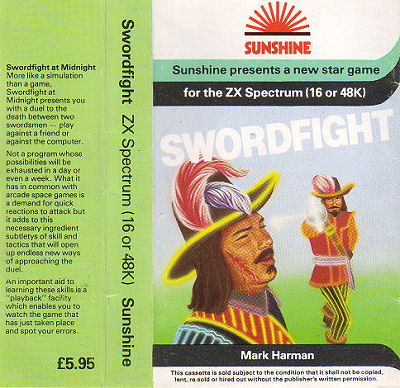
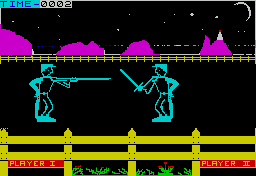
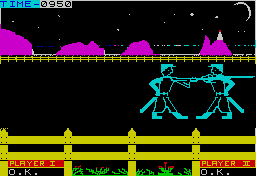
The first British contribution to the fighting genre is quite a bit simpler than the preceding fencing games. With three buttons, players switch between a defensive stance, an attack and a "prepare" position, which prepares a powerful cut, but leaves the fighter open for greater damage. Health is only displayed as a general status information like "O.K." or "poor".
The game is a terrible mess, though. If one of the combatants just keeps running forward with the sword extended - which is what the CPU always does - there's really nothing the other player can do about it, other than doing the same, so no one ever hurts anyone. If someone gets bored and tries anything else, they end up as a sparkling tombstone. Afterwards its possible to watch the duel again, making this the first fighting game with a replay option.
Quick Info:
|
Developer: |
|
|
Publisher: |
|
|
Designer: |
|
|
Genre: |
|
|
Themes: |
Swordfight at Midnight (ZX Spectrum)
Swordfight at Midnight (ZX Spectrum)
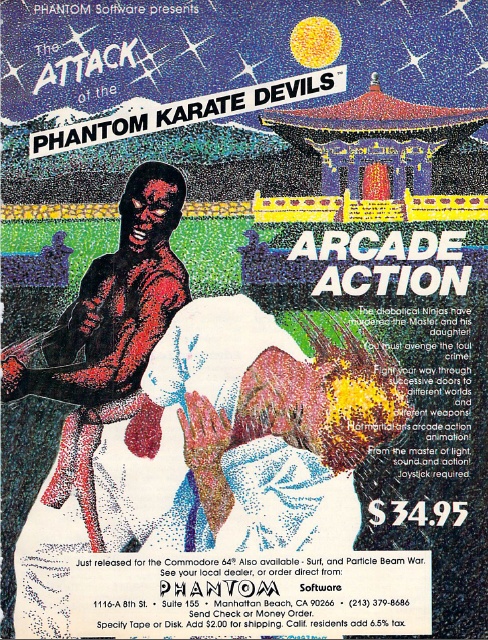
Advertisement
The Attack of the Phantom Karate Devils is certainly on the fence genre wise. It barely meets the requirements for a fighting game, so here it is. The plot involves a "karate guy" fighting invisible ninjas. After killing a mostly invisible ninja a door to the next screen will appear. Then a trek across a bridge and other terrain will occur with the same gameplay.
This game is as bad as it gets, and probably the worst fighter ever. The gameplay, graphics, audio, and whatever else are among the worst in video games of all time. No joke. Getting a move to work effectively might as well be impossible. The playable character walks forward during certain attacks, and looses health for each attack, or for walking. The controls are as bad as they could get in a video game, and nothing is reliably effective in the entire game. This game is simply absolute trash. Not even worth playing as a curiosity.
Quick Info:
|
Developer: |
|
|
Publisher: |
|
|
Designer: |
|
|
Genre: |
|
|
Themes: |
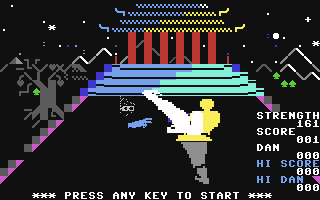
Phantom Karate Deviles (Commodore 64)
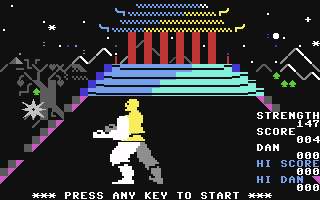
Phantom Karate Deviles (Commodore 64)
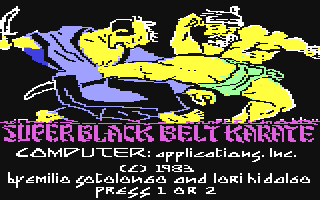
Super Black Belt Karate (Commodore 64)
Super Black Belt Karate is a curious bit of software. The title screen bears a 1983 copyright. If that is accurate of the game's release, then it is one of the formative efforts in the genre and an important part of its history, but nothing else is known about its developers, or whether it was even published at that time. The cracktro in some of the available disk images is from 1986, which would put the game in a very different context.
If we go with the 1983 theory, then this game would be the originator of the formula seen later in Way of the Exploding fist and its many imitators: Two Karate Guys stand facing each other, and a variety of martial arts moves can be executed by holding the fire button in combination with the joystick directions. The controls are terribly unresponsive, though, making this game nearly unplayable. Even though there is no score displayed on screen, it takes seven hits to move on to the next stage, something that's hardly ever going to happen without cheating.
The animations are very sketchy as well, the jump kick looks like it slices off the enemy's head clean at the neck. Some of the backgrounds are drawn rather nicely, though.
Quick Info:
|
Developer: |
|
|
Publisher: |
|
|
Designer: |
|
|
Genre: |
|
|
Themes: |
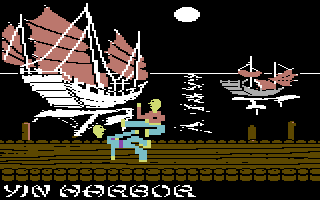
Super Black Belt Karate (Commodore 64)
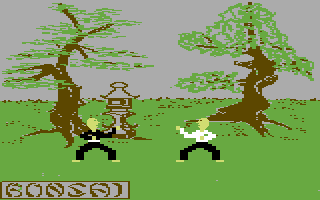
Super Black Belt Karate (Commodore 64)
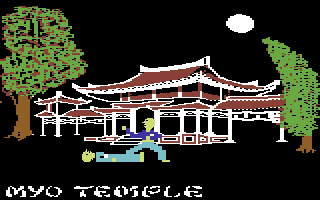
Super Black Belt Karate (Commodore 64)
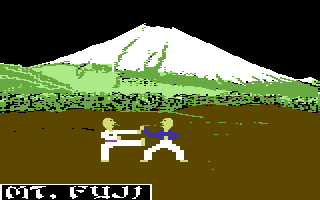
Super Black Belt Karate (Commodore 64)
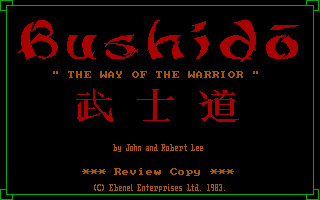
Bushido (IBM PC)
Bushido is another game whose release status is obscure - the version that is floating around the web is marked as a "review copy", and no box scans or advertisements can be found. Yet it seems certain that it was around in the early 1980s - just under exactly what conditions remains uncertain.
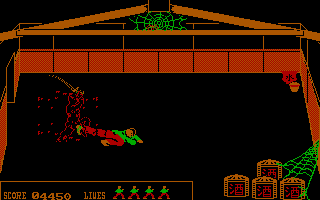
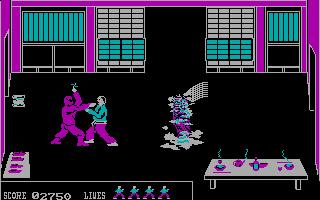
The controls in Bushido are actually quite advanced for the time. The player moves around with the numerical pad - pressing the downward diagonal directions executes a save roll - and can press "F2" or "F4" in combination with the directions to execute a variety of attacks. (It should be noted that on original IBM keyboards, the function keys where positioned at the left, so it made more sense then.) It's also possible to turn around manually with the "5"/center key, which becomes necessary soon.
The protagonist faces off against a sword-wielding ninja, who also can throw shuriken's at range. Avoiding the enemy's attacks, the player only has to land one single hit to cause him exploding into a thousand little pieces. In the first stage it's enough to destroy a couple of ninjas in this way, but from the second screen onwards it's necessary to hit an item that keeps appearing and disappearing in the corners. Sometimes when the ninja throws a shuriken, it will land on the floor and spawn another ninja from a cloud of smoke, and the player now has to deal with two opponents at once! In certain stages, snakes and spiders also attack. After five stages, the game loops with a higher difficulty level.
Unfortunately, due to the game's programming not taking into account faster machines, the controls are messed up when playing the game in DOSBox, even when throttling it down to an appropriate number of cycles. Even when pressing an attack input for just half a second, the game tends to save the command in an input buffer for half a dozen times, and often the controls just go crazy, rendering the game very much unplayable.
Quick Info:
|
Developer: |
|
|
Publisher: |
|
|
Designer: |
|
|
Genre: |
|
|
Themes: |
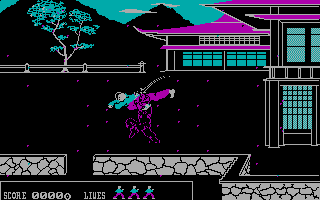
Bushido (IBM PC)
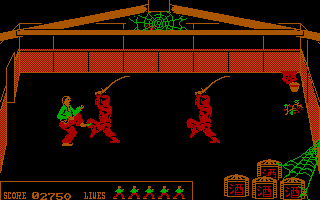
Bushido (IBM PC)
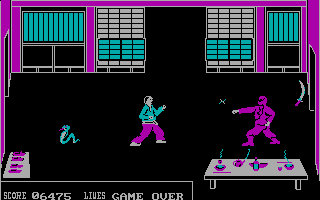
Bushido (IBM PC)
Bushido (IBM PC)
Bushido (IBM PC)
Cover
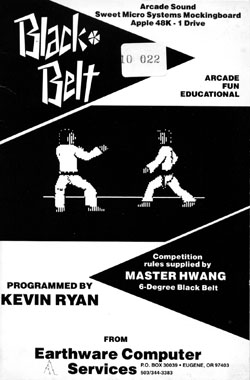
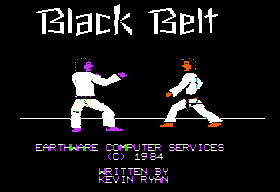
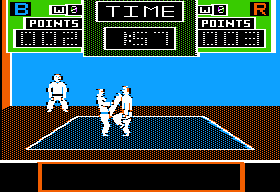
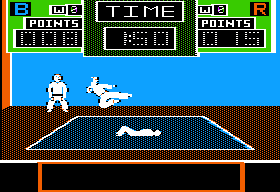
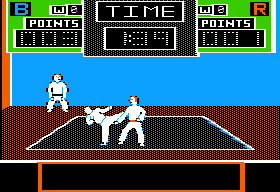
Between all the karate games of the early days, it's nice to see another sport getting some attention, and here is the first title based on Taekwondo. Black Belt is notable as the first game to be made with expert input from a real martial artist, as programmer Kevin Ryan apparently consulted with his Taekwondo teacher, "Master Hwang." All extant copies of the game bear a 1984 copyright, but it has been told that it was originally sold the year before.
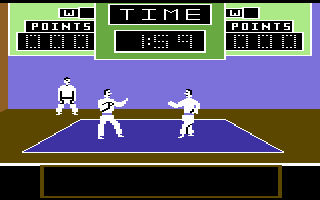
The angled view is not just for show - other than in most later games, the combatants can move up and down, although it is limited to three levels, similar to later Fatal Fury games. Using the joystick in combination with the fire button, players can execute 8 different moves, mostly kicks of course, giving the discipline, and a low block (the default stance blocks high attacks automatically). Another factor that distinguishes Black Belt from most later genre entries is its insistence on strict competition rules. If a player stalls the match by avoiding confrontation, leaves the mat or turns around, this is punished with a warning. Six warnings result in a disqualification, but even a single one can decide the match. Otherwise the winner is determined by score. Each hit gives a point, but missing gives a point to the opponent. It's also possible to knock down the opponent, upon which he will be counted out.
The controls are much more responsive and intuitive than in all the games that precede it, although the super fluent match shown in "Demo" mode is still nearly impossible to reproduce in actual gameplay. The option menu also offers a "Practice Session", which is technically the first fighting game tutorial, although it only contains the animations of the different moves to look at, without instructions how to execute them.
Black Belt was first developed for the Apple II. The Commodore 64 adds some synthesized speech and replaces the dithered graphics for more individual colors, but it actualy looks a bit cheaper for it.
Black Belt (Commodore 64)
Quick Info:
|
Developer: |
|
|
Publisher: |
|
|
Designer: |
|
|
Genre: |
|
|
Themes: |
Black Belt (Apple II)
Black Belt (Apple II)
Black Belt (Apple II)
Black Belt (Apple II)
Karate Champ / Karate Dō (空手道) / Two Player Karate Champ / Karate Champ: Player vs Player / Taisen Karate Dō (対戦空手道) - Arcade, NES, Famicom Disk System, Apple II, Commodore 64, PlayStation 2, iOS (1984)
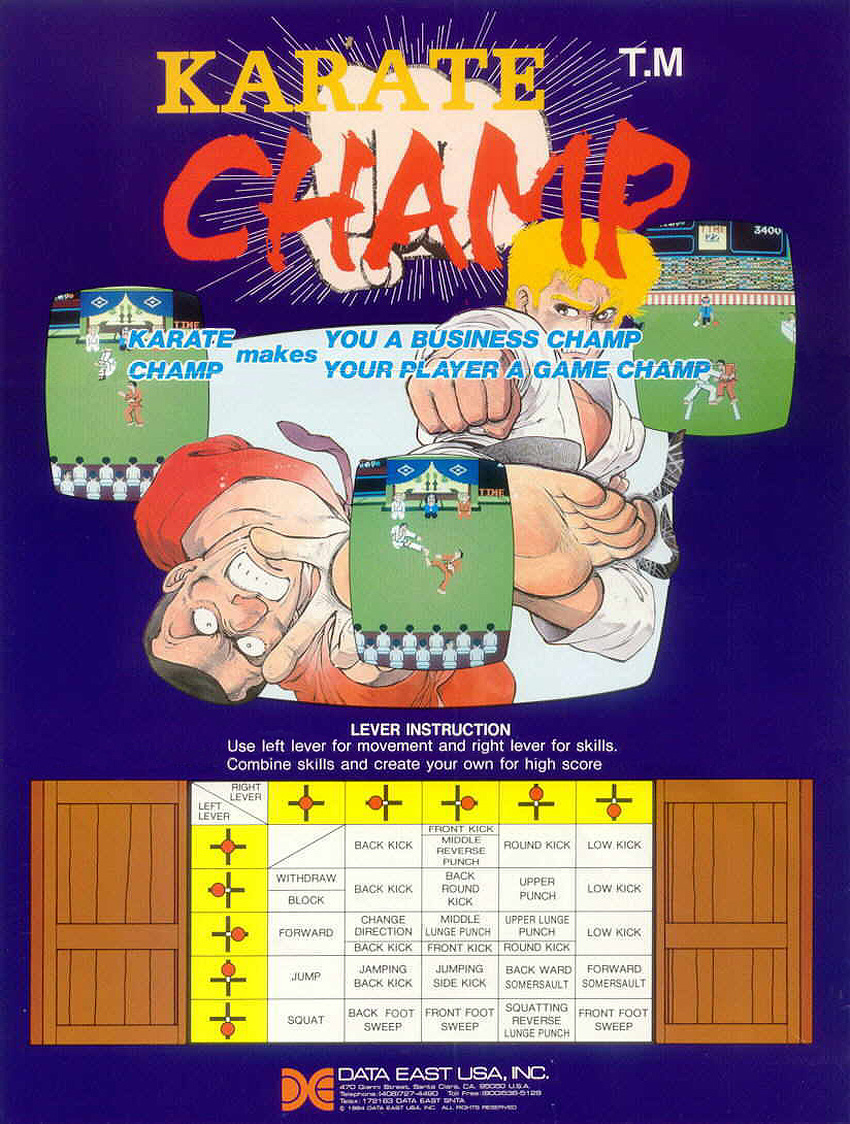
American Arcade Flyer
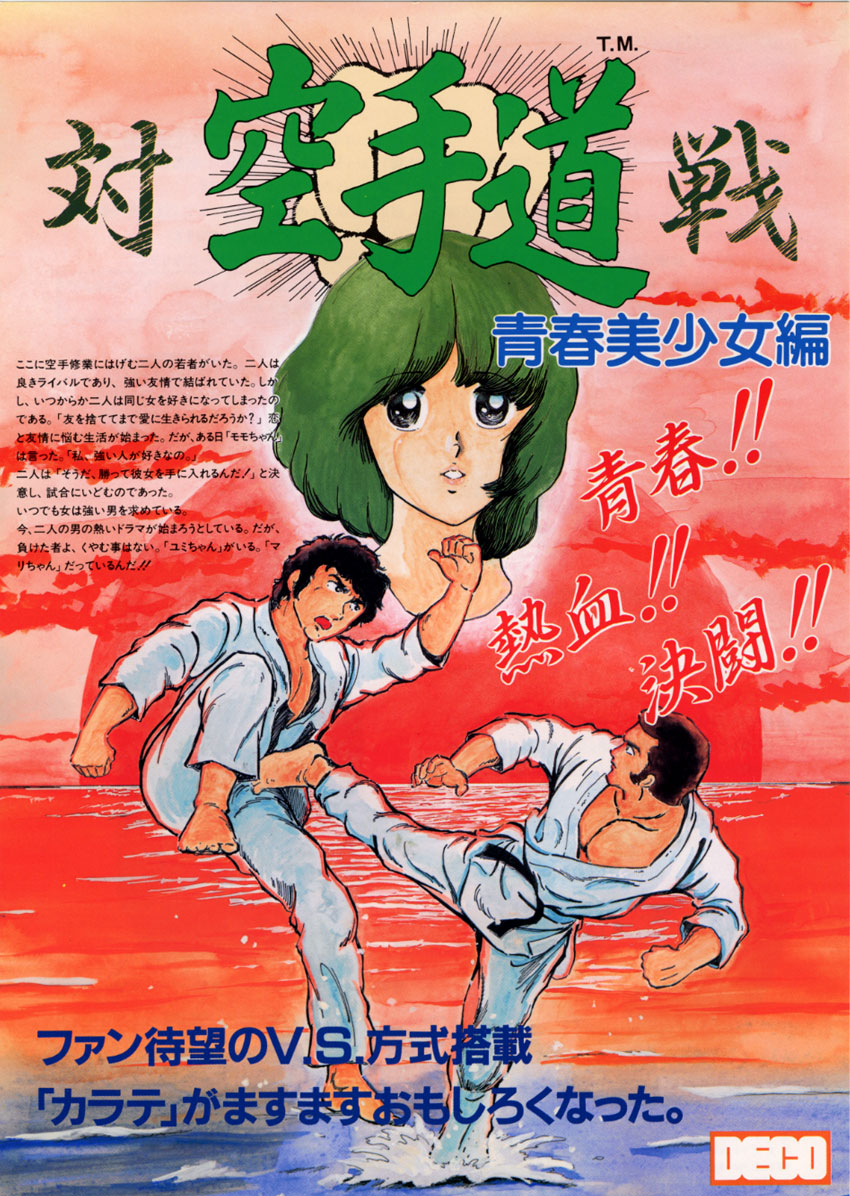
Japanese Arcade Flyer (Taisen)
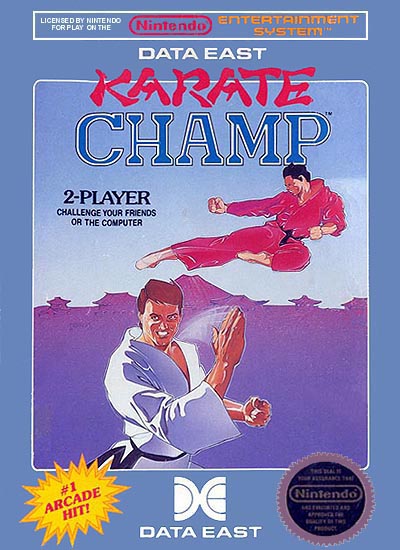
American NES Cover
American Computer Cover
Developed by Technos and published by Data East, Karate Champ is kind of like the Virtua Fighter to Yie Ar Kung-Fu's Street Fighter II. Or vise versa. Karate Champ and Yie Ar Kung-Fu are more or less responsible for establishing the basics of the genre in Japan and are both directly influencial to what came after them and before Street Fighter II. However, Karate Champ was even more primitive than Yie Ar Kung-Fu.
The game is controlled with two joysticks and no buttons. The left joystick is for movement. Holding a direction on the right joystick or both joysticks will perform attacks. The joysticks must be held down for the whole animation, or else the character reverts to his standing animation. Technically this makes it the first game with a form of move cancelling, but it does not allow moves to be cancelled into other moves, so it is not what the term refers to nowadays. Technically this is the first fighter where blocking is done by holding back on the left joystick, but it is difficult to get it to work and not reliable. Rather than a health meter or health points, each attack that makes contact scores either a half point or a full point. The first character who reaches two points is the winner of the round. The first to win two rounds is the winner of the match.
After each match follows any of three challenges: evade objects that fly across the screen, break every wood board/ice block/cement block, or knock out a charging bull. There is a proper tutorial that demonstrates moves and allows them to be practiced before the first fight begins.
The two karatekas are identical to each other, and merely generic "karate guys," but one of them has a white karate gi, while the other wears red. This pattern is found in many later fighting games, up to Street Fighter's Ryu and Ken. The graphics are merely mechanical and are there simply to do what they need to do. Like the C64 version of Black Belt, it has some bits of digitized speech, so the judge tells the characters to fight and verbally declares a winner at the end.
Karate Champ: Player vs. Player marked the first time a fighting game got an upgraded revision. The main feature, as foretold in the subtitle, is the new two player mode. Otherwise, there is slightly different hit detection and the computer A.I. is slightly different. The game has a few new backgrounds, and a woman whom the characters seem to be fighting over(?) appears before and after each match.
The two Karate Champ games are so similar otherwise that they are generally mistaken for each other. Data East even released the ports of Player vs Player simply as Karate Champ. All of the contemporary home ports are terrible. The Commodore 64 version is yet the most faithful of them, although of course the controls are changed to the direction+button system of other home computer fighting games and the hit detection is off. It also loses the announcer speech samples. The Apple II version has none of the bonus rounds, a fact it proudly announces on its startup screen. The NES version is the only one that retains the speech samples, but the only bonus stage is the one with stuff flying over the screen. The control scheme using both of the NES' action buttons is a bit counter-intuitive, especially there's hardly any animation left and everything feels choppy. All the backgrounds in this version are new.
An arcade-perfect variant appeared in Japan in the Oretachi no Gēsen Zoku line for PlayStation 2, and the game has two versions on the iOS appstore.
After every previous game was either somewhat of an obscurity or still insecure about its genre, Karate Champ was an international success and the title that really put fighting games on the map. It was also played in the movie Bloodsport by actors Jean Claude Van Damme and Donald Gibb.
Quick Info:
|
Developer: |
|
|
Publisher: |
|
|
Genre: |
|
|
Themes: |
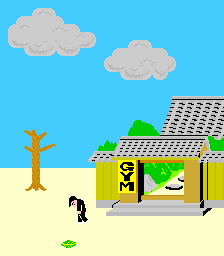
Karate Champ (Arcade)
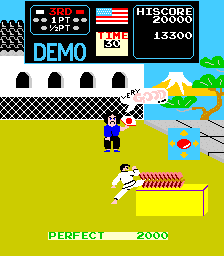
Karate Champ Player vs Player (Arcade)
Additional Screenshots
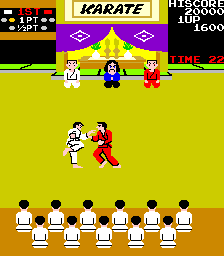
Karate Champ (Arcade)
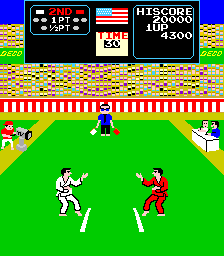
Karate Champ (Arcade)
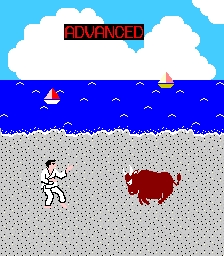
Karate Champ (Arcade)
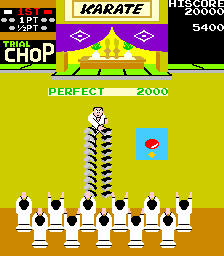
Karate Champ (Arcade)
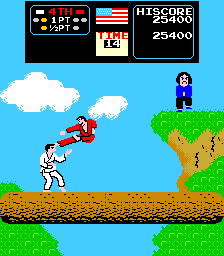
Karate Champ Player vs Player(Arcade)
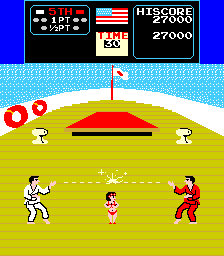
Karate Champ Player vs Player(Arcade)
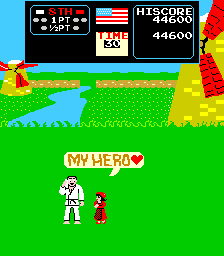
Karate Champ Player vs Player(Arcade)
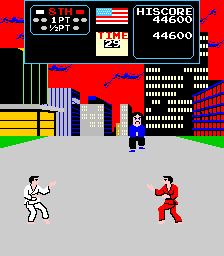
Karate Champ Player vs Player(Arcade)
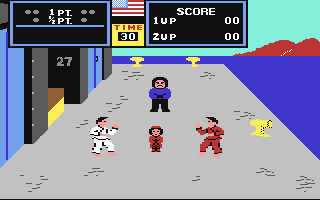
Karate Champ (Commodore 64)
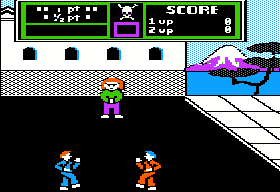
Karate Champ (Apple II)
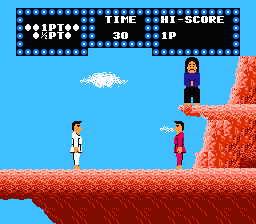
Karate Champ (NES)
|
Page 1: |
Page 2: |
Page 3: |
Page 4: |
Page 5: |
|
Page 6: |
Page 7: |
Page 8: |
Page 9: |
Page 10: |
|
Page 11: |
Page 12: |