|
By Arshad Abdul-Aal
Before
the late 90's, 3D mission-based mecha action games were mostly associated
with PC series like MechWarrior or Heavy Gear, and even those leaned more
towards complex simulation than arcade action. Sure,
Virtual On is nice and all, but
there's not much of an objective beyond just pummeling your opponent. A
company called From Software changed all that when it brought out Armored Core on the Playstation.
Combining deep yet accessible customization with solid controls, the series
became a cult hit with mecha fans and continues to be well into the new generation
of consoles despite its aging and slow-to-evolve gameplay. Another
milestone came in 2001,
when Konami released Zone of the Enders for the Playstation 2. While most
people considered it as little more than a tech demo (to say nothing of
its unfortunate status as the courier for the Metal Gear Solid 2 demo),
Hideo Kojima's little side project effectively raised the bar skywards with a swift kick to the nuts, proving
that mecha don’t have to be bulky and ground-bound for the game to be fun.
Four years and a sequel later, no other game (mecha or otherwise) came close
to matching the blistering speed and intense free-flying gameplay of the
ZOE games. I’m rather puzzled why no one considered using the engine for
a Dragon Ball Z game. Finally Banpresto, developers of the popular Super
Robot Wars series of strategy RPGs, saw the potential for an incredible
licensed mecha action game and turned towards From Software, fresh off of
releasing their tenth Armored Core installment, to realize that idea. The
result of this collaboration is Another Century's Episode, and the bar for
licensed mecha games was just raised a lot higher.
|
Another Century's Episode
Another Century's Episode
|
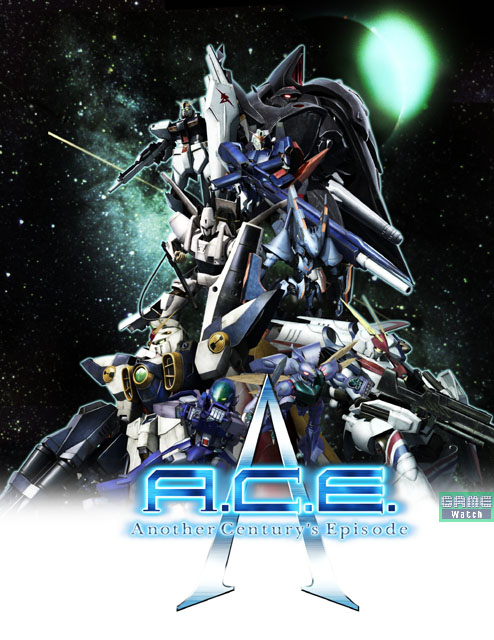
Another Century's Episode - Playstation 2 (2005)
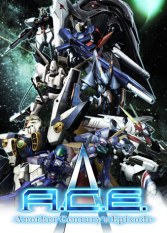
Japanese Cover
|
Another Century's Episode
|
Another Century's Episode
|
ACE
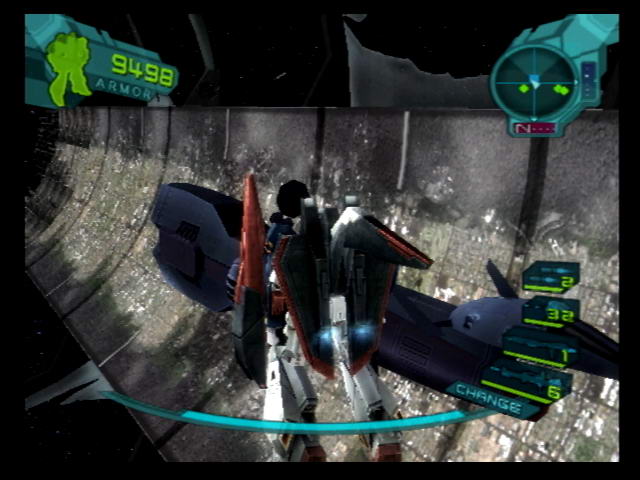
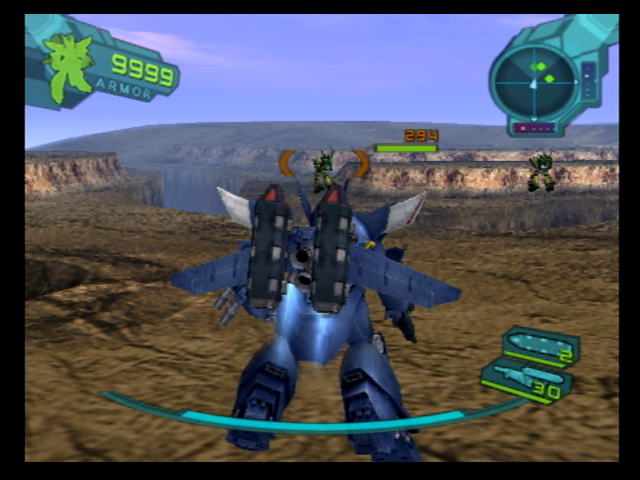
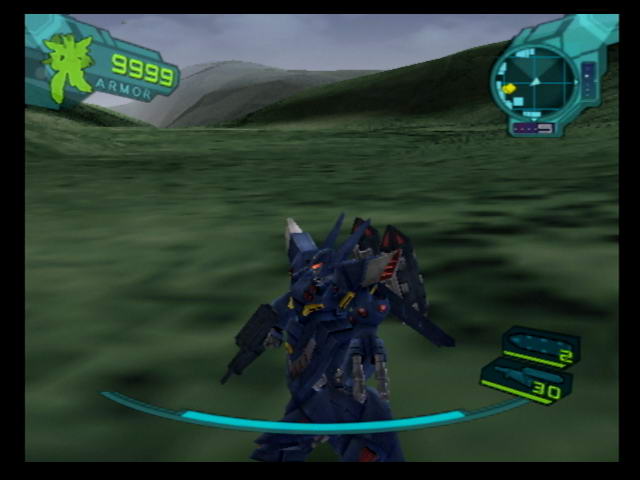
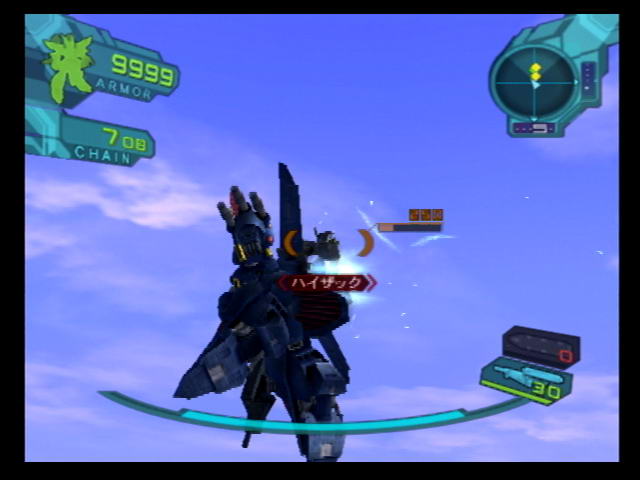
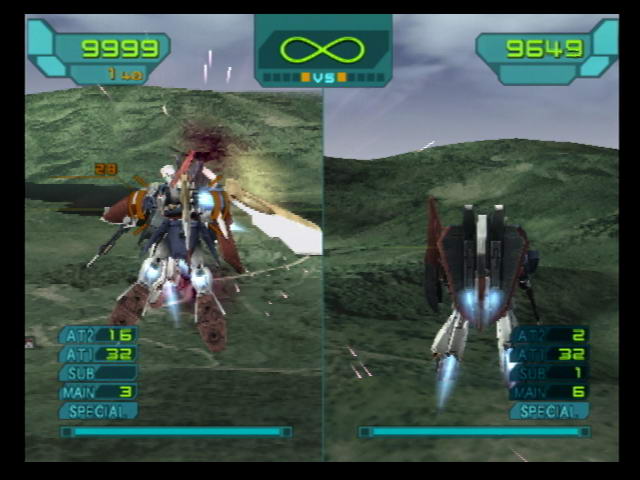
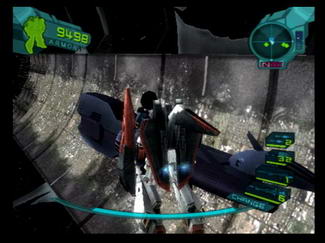
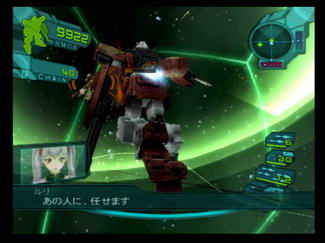
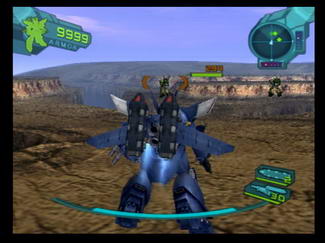
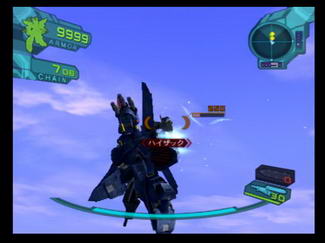
plays almost exactly like Zone of the Enders. You control a mecha in a large
cubic 3D environment with transparent red boundaries. Since you’re indefinitely
flying, the left analog stick controls your horizontal movement while two
other buttons are used to adjust your altitude. Unlike ZOE, all mecha except
heavy metals can boost in only one direction, and continually boost-dashing
to dodge drains the finite but generous boost bar quickly, after which you must wait for it
to recharge. Each mecha can have up to five different weapons or abilities.
Once an attack is used or a weapon's ammo is depleted, you must wait an
amount of time proportional to the weapon's power for it to recharge. In
a few rare cases, however, some weapons will not reload once used up. Pressing the main weapon's button
in close proximity to the target results
in a melee attack, with subsequent presses generating combos of varying
lengths depending on the mecha. Also, alternate combos are possible by pressing
the sub-weapon button right after any but the last possible hit in a normal
chain, similar to the Dynasty Warriors beat’em-ups. There's also a simplified
alternate control scheme that assigns all your weapons to one button and
switches between them depending on the distance between you and the target.
Destroying multiple enemies in succession starts an attack chain. The higher
it gets, the better your score. Not a terribly important mechanic but some
secrets
will require getting a certain amount of attack chains.
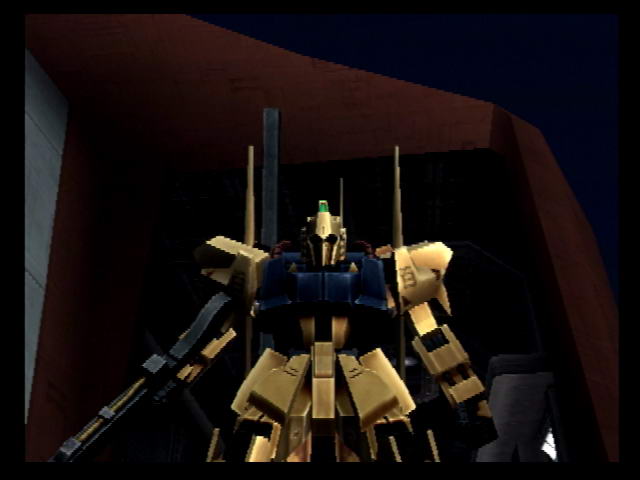
The best way to describe ACE is Zone of the Enders with an emphasis
on substance over style, the bulk of the former is the 38 unique playable mecha
from the nine anime licensed for the game.
|
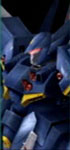
Mass
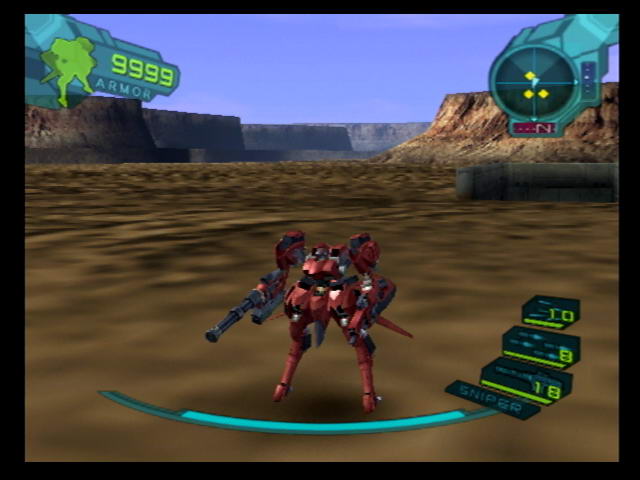
Production Gespenst Mark II
The Gespenst is the staple grunt unit of the Super Robot Wars series.
Most original Banpresto characters piloted a variation of
this at some point. It packs a submachine gun, plasma stakes and
a pair of non-reloadable split missiles. It's one of the weakest
playable mecha in the game. You start the game with it and the Cloud
Breaker. |
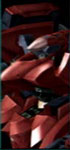 |
Cloud
Breaker Mass Production Type
The Cloud Beaker is from a From Software Xbox game called Murakumo:Renegade
Mech Pursuit. It has more weapons and versatility than the Gespenst
to tide you over until new mechs become available. |
|
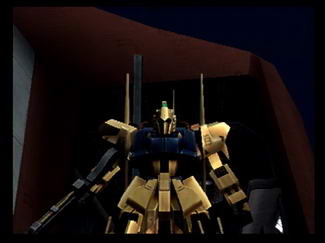
Another Century's Episode
Another Century's Episode
Another Century's Episode
|
|
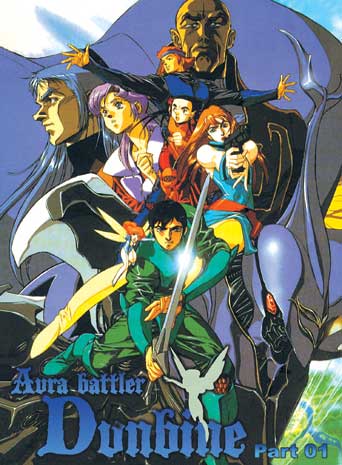
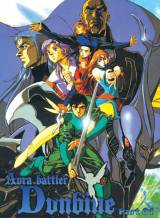
Aura Battler Dunbine
Plot Summary:
Motocross racer Sho Zama is suddenly transported to the mysterious world
of Byston Well located in another dimension, where he is forcefully drafted
into the military under the ambitious lord Drake Luft. Drake seeks to unify
the entire land under his rule, even if it means shedding the blood of most
of the population.Mecha:
Despite the show's medieval settings, it features mecha in the form of insect-like
fighting suits called aura battlers. The smallest of the mecha types featured
in ACE, aura battlers are very agile and excel at close range combat using
swords and grappling hooks but suffer in gunfights due to somewhat weak
projectiles and low ammo counts.
|
|
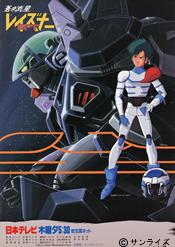
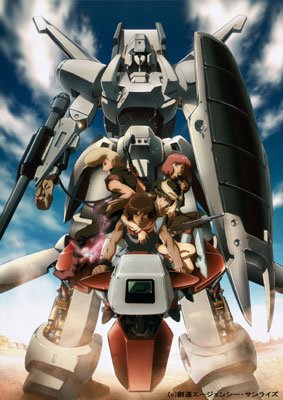
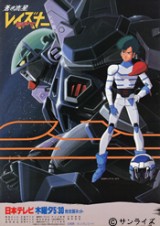
Blue Comet SPT Layzner
Plot Summary:
In an alternate 20th century, mankind has developed space colonies as far
as the planet Mars. However, Earth will soon come under siege by an alien
race known as the Grados. It's up to half-Earthling half-Gradosonian Eiji
Asuka, his stolen SPT Layzner and the six survivors from a UN-promoted culture
exchange program on Mars to warn the Earth's nations before it's too late.
Mecha:
SPTs (Super Powered Tracers) are the second smallest mecha featured in ACE.
Their main armaments are rapid-firing photon laser rifles. The titular SPT
and its rival are also equipped with something called the V-MAX system.
This surrounds the SPT with a magnetic barrier and allows it to slam repeatedly
into the enemy causing great damage (hence the comet moniker in the title).
|
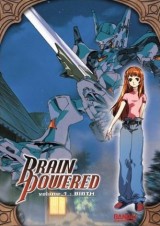 |
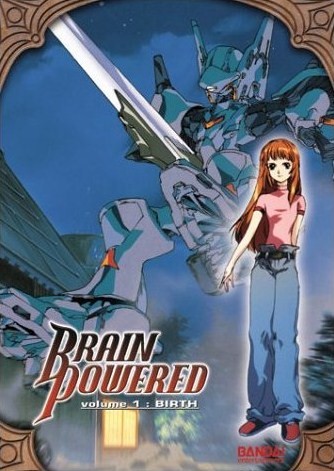
Brain Powered
Plot Summary:
In a post-apocalyptic world, the human population is devastated by natural
disasters, while an ancient ruin known as Orphan is attempting to leave
the planet and possibly wipe all life on Earth in the process. A group called
the Reclaimers is intent on stopping anyone who gets in Orphan's way, and
caught in the middle of the conflict is Yuu Isami; a young boy torn between
obeying his controlling family (complete with a sister suffering from MPD)
and following his feelings.Mecha:
Grand Chers and Brain Powereds are organic mecha known as antibodies. While
not terribly powerful, they’re agile, can teleport and their main weapon
has slight homing capabilities.
|
|
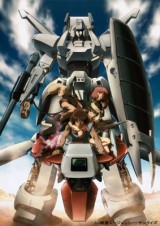
Heavy Metal L-Gaim
Plot Summary:
Far away in the Pentagona system, immortal emperor Oldan Poseidal has conquered
all five of its planets. Daba Myroad, the last surviving heir of the Yaman
clan and owner of the legendary white heavy metal L-Gaim, leads a rebellion
in order to free the planets from Poseidal.Mecha:
Heavy metals are the largest playable mecha in the game, and they also pack
the heaviest firepower. Most of their armaments consist of energy-based
weapons. As mentioned above, they are the only mecha capable of multi-directional
boosting.
|
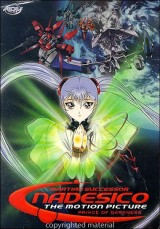 |
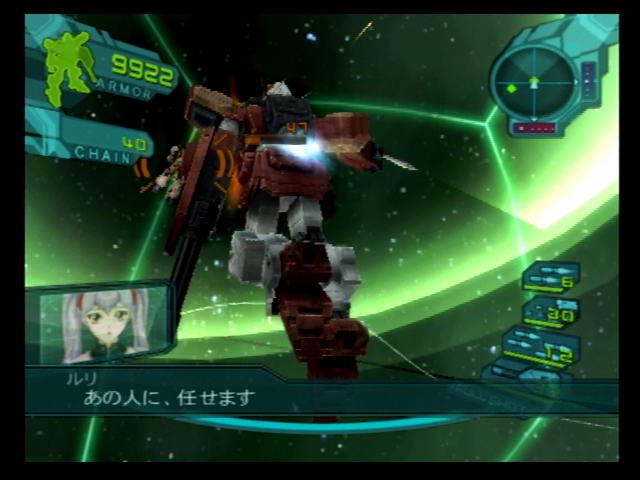
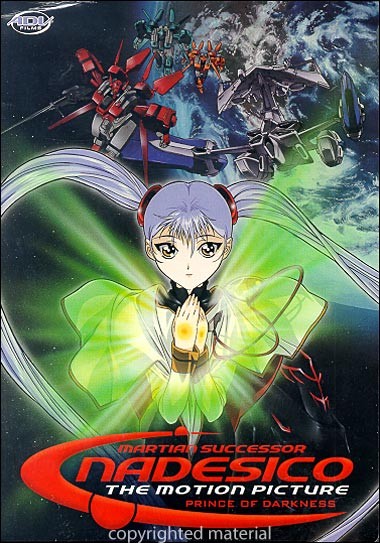
Martian Successor Nadesico: Prince of Darkness
Plot Summary:
Three years after the events of the TV series (which isn’t in ACE but
rather confusingly appears
in the sequel), the uneasy peace between Earth
and Jupiter is about to end thanks to an uprising by a rebel group called
the Martian Successors. Ruri Hoshino, former crewmember of the Nadesico
and now captain of the Nadesico B, must gather her old comrades and set
out to stop the conflict while solving the mysteries surrounding the string
of boson jumper kidnappings.Mecha:
Aestevalis fall somewhere a bit below the middle in terms of size, and have
moderate long-range weapons. Their true strength, however, is in their damage-reducing
barriers and powerful melee attacks which involve ramming the enemy with
their distortion fields. A boson jumper pilot can also teleport his/her
mecha to better evade attacks.
|
|
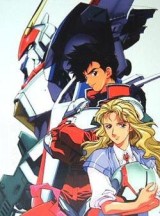
Metal Armor Dragonar
Plot Summary:
The Lunar Empire of Giganos chases a refuge ship carrying stolen metal armor
prototypes to a neutral colony. Caught in the crossfire, three friends and
pilot trainees stumble across the metal armors and pilot them in a desperate
attempt to protect the colony. Much destruction and hilarity ensues.
Mecha:
Metal armors are pretty similar to mobile suits, with the distinction that
most of their weapons are solid-based instead of energy-based. The titular
Dragonar is actually a trio of metal armors instead of just one. Dragonar-1
is a general-purpose type metal armor with strong beam saber attacks. Dragonar-2
is an artillery unit with heavy firepower and Dragonar-3, while weaker then
even the Gespenst, has a jammer that deflects missile attacks. The Dragonars
are the only mecha in the game with different forms for ground and space
missions.
|
|
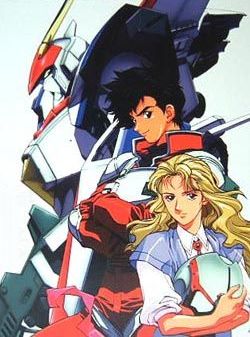
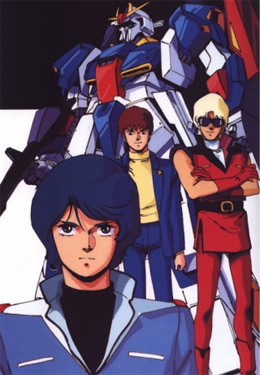
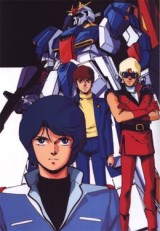
Mobile Suit Zeta Gundam
Plot Summary:
Seven years after the end of the infamous One Year War depicted in the original
Mobile Suit Gundam TV series, an elite military division of the Earth Federation
known as the Titans slowly begins to establish its rule over the Earth.
Only the two rebel groups AEUG (Anti-Earth Union Group) & Karaba stand in
their way. Former Zeon ace Char Aznable, under the ridiculously-sounding
alias of Quattro Bajeena, infiltrates a Titans base to discover the Federation's
new Gundam mobile suit. Young teenager Kamille Bidan helps him steal it
in the now common Gundamjack plot. Eventually, Kamille designs his own Gundam
and aids the AEUG in putting a stop to the Titans' ruthlessness.Mecha:
The Universal Century Gundam shows are known for some pretty cool (and sometimes
bizarre) mobile suit designs, and Zeta is no exception. The most balanced
of the bunch, they have a good mix of energy and solid-based weapons.
|
|
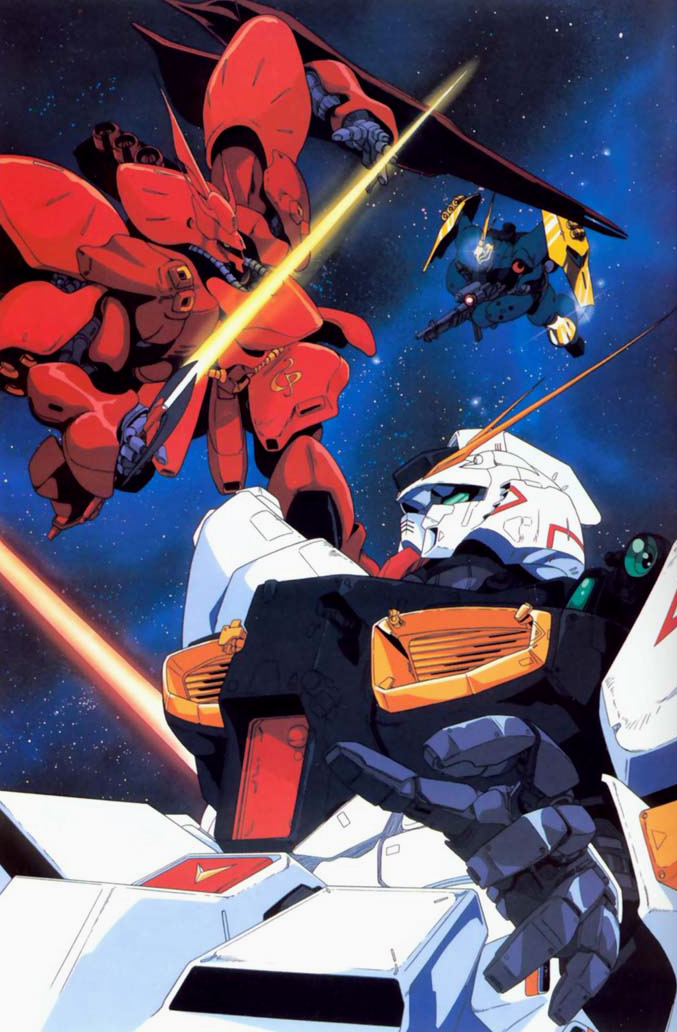
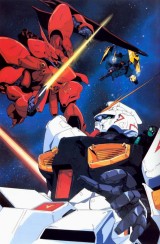
Mobile Suit Gundam: Char's Counterattack
Plot Summary:
Everyone's favorite colony dropper Char Aznable returns for one last attempt
at freeing humanity from the clutches of Earth's gravity by dropping the
giant mining colony Axis on it and bringing about another ice age. Only the Earth
Federation's special unit Londo Bell and One Year War veteran Amuro Ray
stand in his way. Amuro and his personally designed Nu Gundam must put a
stop to Char's homicidal scheme and end their heated rivalry once and for
all.Mecha:
Fourteen years of mobile suit development shows its fruits here. The Nu
Gundam is a powerful unit. In addition to the standard vulcans and beam
rifle, it sports a beam bazooka, a beam barrier and the ever deadly funnel
weapons. The Londo Bell battleship Ra Cailum serves as your flagship and
launch pad throughout the game.
|
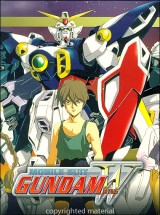 |
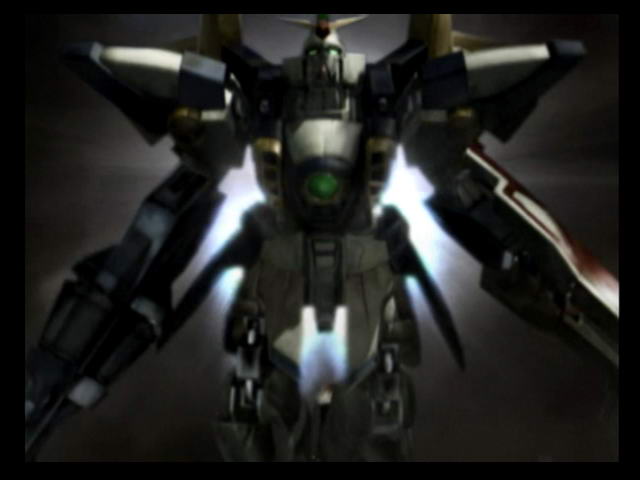
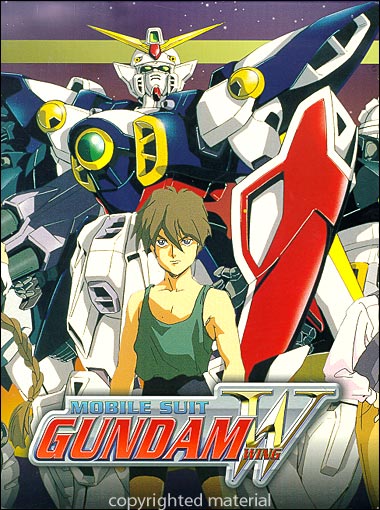
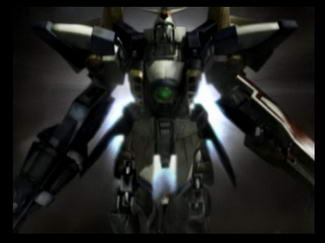
New Mobile Report Gundam Wing
Plot Summary:
In the future, mankind has colonized space. However, the colonies are being
oppressed by the governments of Earth, who rule over them by force. Sick
of this tyranny, the colonists, with the help of five rouge scientists from
Earth, construct and send five powerful Gundam mobile suits & their pilots
down to Earth in order to wage guerilla warfare against the Organization
of Zodiac, one of the Earth's most powerful military factions.Mecha:
Mobile suits are average-sized mecha in general. After G Gundam, some of
the themed design fever carried over to Wing, which is why we have a Grim
Reaper-ish black Gundam complete with a scythe and a Gundam with flame-throwing
claws shaped like a dragon's head. Each of the five Gundams specializes
in specific combat roles and thus they aren’t terribly balanced for use
in every situation.
|
The
general plot holding all these series together is pretty basic compared
to later installments. You’re an unnamed pilot working for a peace-keeping
taskforce belonging to the United Community of Earth (UCE). The UCE developed
a powerful and volatile substance called E2 to deal with an energy shortage,
and of course all the bad guys want some of it for themselves. It's your
job to keep it out of their grubby metallic mitts. The multiple plots unfold
over the course of 45 missions, which makes ACE longer than both ZOE's put
together. Upon completing a mission, you’re graded and then awarded with
Ace points. Ace points are spent on three things. You can buy new mecha
once they are available. You can also upgrade your ship by increasing its
storage capacity (you can only have as many mecha as your ship can hold),
increasing its repair points (used to fix damage incurred after a mission), or increasing repair
efficiency (lessens repair points consumption). The last and almost completely
useless option is upgrading the mecha itself. You can do things like increase
its defense or speed, increase a specific weapon's power or lower its reload
time and so on, but there are a couple of catches. First, any stat you upgrade
lowers an opposing stat, so increasing a weapon's power means increasing
its reload time and vice versa. Second, each mecha has a limited number
of upgrade slots. It's a bit awkward to get used to, but fortunately it's
also completely unnecessary. The whole game can be finished without ever
touching the mecha upgrade option.
One of the biggest liberties taken with the licenses is that all mecha
can fly indefinitely regardless of whether they could do so in the show
or not. This places the game under scrutiny by mecha anime purists (and
morons in general) who decry this as unrealistic, but it's an insignificant
quibble in lieu of the great attention given to other details. On top of
the incredible graphics, all the mecha are modeled up to scale. Play as
a heavy metal in a stage full of aura battlers and you’ll tower over them,
or take the Dunbine itself and attempt to tackle one of the many large bosses
to really get a sense for the difference in size. It's a great testament
to the care the developer took in keeping the presentation as faithful to
the shows as possible. The boost mechanic also lifts a strategic element
from the Armored Core games: Just as it's hard for your enemy to hit a
moving target, it's hard for you to hit them accurately while moving at
high speeds.
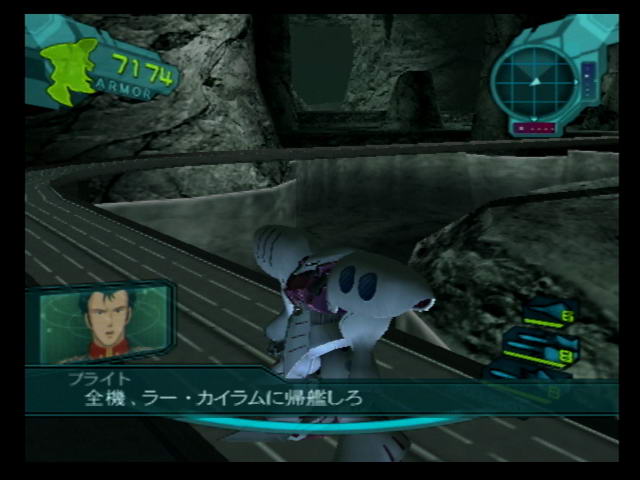
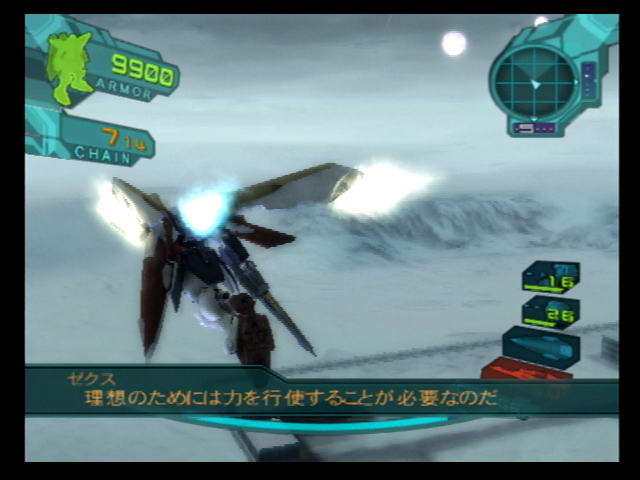
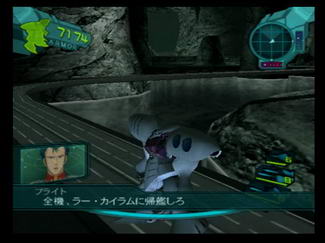
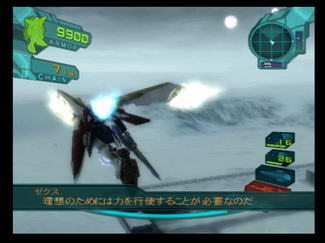
Like the recent Ace Combat games, there's radio chatter among your wingmen
and supporting cast. Unlike Ace Combat, however, it doesn't get so obnoxiously
consistent and melodramatic that it blocks out the music (then again, I
don't understand Japanese, and there's something pleasing about having the
late great Hirotaka Suzuoki as Captain Bright Noa yelling his head off at
you). The text sometimes blocks the lower part of
the HUD, but it's not very obstructive.
Speaking of music, the soundtrack is naturally composed of tracks from
the featured shows plus some original material, topped off with the beautiful
opening song "Garnet Moon" by Hitomi Shimatani. The anime themes were given
awesome rock remixes, which unfortunately weren't retained in later installments.
Thankfully From Software didn't just stop at good gameplay mechanics
and called it a day (i.e. the Eureka 7 games). The missions are extremely
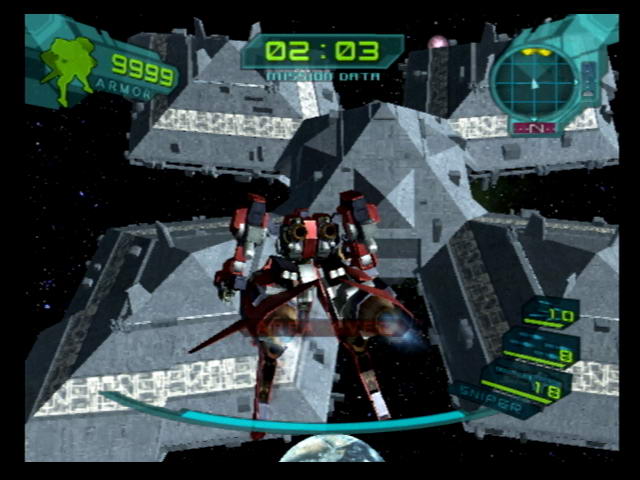
fun and varied, like sniping space mines to clear a path for a shuttle or
using a sonar to find sunken cargo underwater. In one cool mission, you
have to protect a conference hall from enemies without being seen by media
helicopters lest the TV ratings drop! Like most games based on licensed
properties, you have missions that take place during set pieces from the
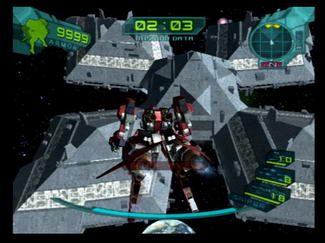
shows like facing the giant space station Libra from Gundam Wing or fighting
inside the barrel of the giant colony laser from Zeta Gundam. Of course
there's the usual "blow everything up" and the requisite protect missions,
but thankfully apart from the first protect mission they never degrade into
pointless frustration.
Like the recent console Super Robot Wars games, every mission contains
a secret objective. These include finishing the mission in a certain amount
of time, finding hidden targets or getting a specified attack chain. Every
five secrets unlocks a new mech to purchase. Some of the secret objectives
are pretty challenging, and that's when the upgrade system becomes somewhat
necessary, as having shorter reload intervals and faster verniers is the
key to success.
Once you finish the main game, a free mission mode opens up. Here the
limitations of your ship no longer apply so you can stockpile mecha and
upgrade them as you please. You can see your best rank for each mission
as well as the secret objective and whether you achieved it or not. You
also unlock Extra Mission 1 & 2, which are basically 1-on-2 boss rushes. Extra Mission 2 also has an exclusive boss which doesn't
appear in the main game.
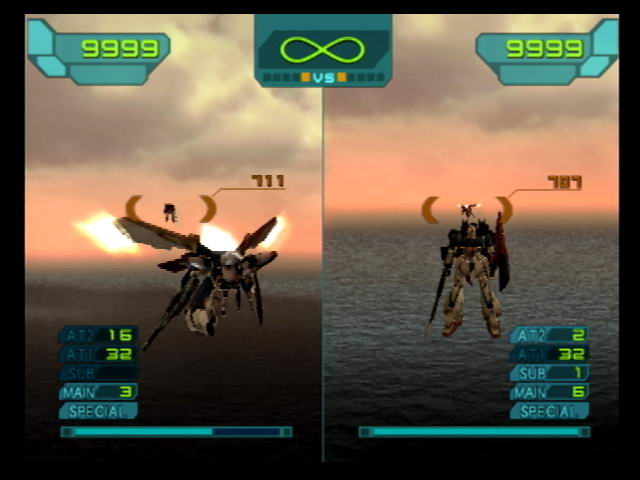
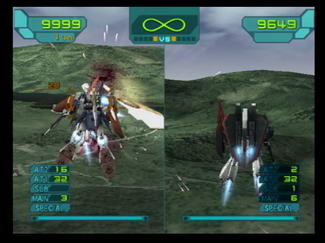
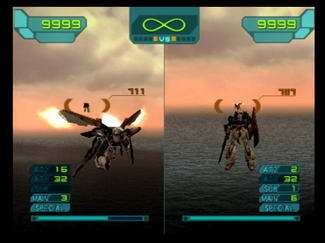
A 2P versus mode is available if you want to pit your favorite mechs
against each other in vertical split screen, but good luck finding someone
to play it with.
Unfortunately, nowadays ACE gets an undeserved bad rep in the light of
the many refinements made to its sequels, which are only a year apart each.
But it's still a solid game on its own, plus it has two series (Zeta & Wing
TV) unique to it and better mission variety than its sequels. If I had to
nitpick, I'd mostly complain about the absence of the upgraded mecha from
Gundam Wing and Dragonar. ACE was re-released as part of the Playstation
The Best line.
|
Another Century's Episode
Another Century's Episode
Another Century's Episode
Another Century's Episode
|
|