Logo by MP83

Articles | Features | Blog | Forums | Writers Wanted

Books on Video Games

<<< Prior Page    

    Next Page >>>

Page 1: History/Biographies
Page 2: Reference Books
Page 3: Essays/Lifestyle
Page 4: Fiction & Game Lore
Back to the Index


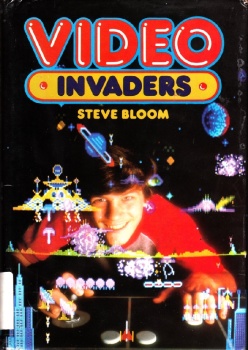
Video Invaders

Author: Steve Bloom
Publisher: Arco
Date: September 1982
Pages: 240
ISBN: 0-668-05518-9
Review: derboo

Video Invaders may not be the oldest monograph on video games. In fact, there were literally dozens of books out before. All of them, however, were guide books of all sorts; most would teach the reader how to get the highest scores at recent arcade games, others provided maintenance aid for machines. By 1982 even the first self-help books for "arcade addicts" appeared in bookstores. Steve Blooms however, was the first (to our knowledge) who attempted to write a thorough history of the still young medium.

The book opens with a very personal introduction, a very lively description of the authors childhood/youth experiences in the 1960s-'80s arcade scene. History truly comes to live on these first couple of pages, and it almost holds up better than the rest of the book. The following three chapters are a bit more dry and make up the straight history portion of the book, "Who Really Invented Video Games" reminds us how old the dispute between Nolan Bushnell and Ralph Bear really is, and it even goes into the making of Spacewar!, which predates both their efforts. "The Games: A Chronology" gives a rundown of the most important arcade game releases up to 1982, while the third chapter focuses entirely on the Pac-Man phenomenon, which swept over America in the early 1980s. With hilariously outdated assessments like this description of Defender "With its joystick and five control buttons, it's about as close to a cockpit as amateur video pilots will ever get, these chapters are now more enjoyable for their entertainment value.

Perhaps most impressive is chapter 4, which as a collection of ten interviews with video game developers and producers is one of the biggest journalistic efforts in that field for its time. Of course Steve Bloom had no access to Japanese designers back in 1982 (although he speaks with the spokesman for Namco in America in chapter 3), but David Crane and Alan Miller, founders of Activision, Morgan Henry (Battle Zone), Donna Taylor (Centipede) and Ed Lodge (Asteroids, Centipede), Edward Rotberg (Battle Zone), Eugene Jarvis (Defender), Tim Skelly of Cinematronics (Star Castle, Star Hawk, Rip-Off), Dave Nutting of Nutting Associates, and Gary Shannon of (Sega-)Gremlin all give insights into their trade that no one had heard of before. In the case of Gary Shannon, who had programmed and published home computer versions of Othello and Chess before joining Gremlin, the book even gets subtly critical at the state of the industry: "As a hobbyist he received credit for his work (disks and cassettes are by-lined), but as a professional he must remain anonymous." Shannon even hints at his work on what might have become the first rhythm game, if only Sega-Gremlin didn't close up shop soon after:

Personally, I thing rhythm is a major factor. We have two games in development that will make players respond rhythmically to the sound pattern. If you can figure it out, then you'll be able to go for more targets, for instance. You'll almost have to be a musician to play the game well."

Chapter 5 and 6 show the less enviable tasks of video game journalism: Bloom visits the major console manufacturers (Atari, Magnavox and Mattel) as well as the first and biggest third party game publishers, Activision and Imagic, were he tries persistently to get past all the PR talk.

"The Great Debate" is an odd, but no less interesting one. It talks about various attempts of governments to try and get rid of those "non-useful commercial enterprises." For that the book goes back to as far as the 1920s, were billiards used to be the target for the war on entertainment. It is further described how more recently Mesquite, Texas banned the chain of coin-op establisments Alladin's Castle and the playing of arcade-type games. However, the bright side of the argument is also shown:

More startling news, however, was this recent development in two Milwaukee schools: Wauwatosa and Nicolet High Schools each reported earnings over $400 a month during the 1980-81 school year after installing video and pinball machines in the schools' commons.
(...) "one principal contended that the in-house arcade contributed to a decline in student vandalism and loitering at nearby stores, noting: "As educators, we're providing for the total student and part of his life is socializing and recreating. I don't know any concrete educational value in the games, but I do believe they are a good supplement to a well-rounded education."

Chapter 8 is once again reeks of nowadays involuntarily comical content, as it deals with the future of the medium. On the other hand there's a truly prophetic statement by Harold Vogel, who basically predicts the 1984 video game crash. It also contains a review of the then-recent movie Tron. For the sequel to that film author Steve Bloom has recently made a brief return to writing on video game related matters.

The remaining 60 pages all deal with winning strategies for popular arcade games, which are illustrated by nice hand-drawn representations of the game screens, followed by 20 pages with brief reviews of console games, text only. Home computer games were still an entirely different world to the arcade crowd, so the book all but ignores that phenomenon.

Video Invaders has long been out of print and might be hard to come by nowadays. Prices can range from less than a dollar for discarded library copies to high double digits from collector's treasuries. Since there's no way anyone who did any work on the book is still going earn money with it, we're providing a full scan for everyone who might be interested in reading the whole thing. It also features some very trippy illustrations throughout, which alone are worth a look.

Steve Bloom was also an editor for Video Games Magazine, and worked for the marijuana activist magazine High Times from 1989 to 2007. Nowadays he keeps a blog on celebstoner.com.


Browse on Amazon.com


Game Over: How Nintendo Zapped an American Industry, Captured Your Dollars, and Enslaved Your Children

Author: David Sheff
Publisher: Random House
Date: June 1993
Pages: 445
ISBN: 0-679-40469-4
Review: derboo

If someone would have asked for video games-related books to recommend during most of the 1990s, the first answer would have been almost invariably: Game Over. Maybe the most seminal monograph in the history of video game journalism, David Sheff for the first time dug deeper than anyone would have thought possible into the affairs of one of the most seclusive companies within a seclusive industry. Maybe one of its biggest strengths was the fact that David Sheff wasn't a video games journalist—his previous monograph was titled The Playboy Interviews With John Lennon and Yoko Ono—making it much easier for him to draw to him the attention of the general public; the parents, the competitors, the politicians. With tons of interviews of people that must have seemed unreachable to the general gaming press, it offered an unseen insight into a the history and day-to-day workings of Nintendo Co. Ltd., from its very beginning as a local card game manufacturer, through Hiroshi Yamauchi's reign and the transformation into the world's major video game company, to its conquering of the United States (which ultimately is the focus of the book) and its first steps into the rest of the world.

But how relevant is Game Over in 2012, almost twenty years after its initial release? Well, looking back from a nowadays' perspective, with several great books on video game history available, the first disappointment with Sheff is clearly: he is not a video games journalist. He proves that whenever he descends to actually talk about games and their history. Actual assessments of games' quality, for example, are rarely longer than one or two words ("awesome," "bad"), and sound like he just casually asked his son to fill them in for him. Worse are explanations of technology, which seem like they're either written with a lack of understanding, or with the fixed assumption that they wouldn't be understood by the readership, anyway. In the end these passages read like tech babble from Star Trek, even if the matter isn't all that complicated. The comparisons applied here limp, too. Putting up the NES against the antiqued Atari VCS to demonstrate its technical prowess is the most harmless fumble here. It gets worse when Gilette razors are deployed to explain the implications of the NES' lock-out chip.

Game Over is also riddled with factual errors that show Sheff either wasn't too much concerned with detail, or how much he was at the mercy of his interviewees. He attest's Nintendo's R&D teams the achievement of developing carts with 8 megabytes of memory for the original Famicom (an amount barely reached with the largest SNES cartridges), introduces Enix, a mildly successful publisher of home computer games before their first Famicom game made the market, as "a start-up formed specifically to create Nintendo games," writes about the 1984-released The Black Onyx that its creator "Rogers sold 100,000 copies in 1980."

These errors appear minor when accepting the fact that Game Over is not a book about video games, not even unconditionally about a company named Nintendo. What Sheff is really interested in are people, Nintendo just the thread that ties all their fragmental biographies together. Often he goes on chapter-long tangents when he traces Nolan Bushnell's career through Atari, draws a picture of the working climate of EA under Trip Hawkins or describes (much briefer) the Teenage Mutant Ninja Turtles phenomenon. (Where he also doesn't know jack about the actual franchise. "Numchucks" and "mutigant," anyone?)

But even in his drawings of the lifes and carreers of personalities such as Bushnell, Hawkins, the Yamauchi clan or NOA vice president Howard Lincoln, there's always that certain uneasyness when processing the information.

Despite drawing most of his material from interviews, Sheff only occasionally attributes sentences, he's much more concerned in delivering a fluid narrative, often assuming the stance of an all-knowing third person narrator. Sometimes it's possible to deduce who his source is, like when he goes out of his way to name the secretary that served the tea during Yamauchi's first meeting with Henk Rogers—Reiko Wakimoto—while oftentimes people remain nameless. There's just "a Nintendo employee," "one distributor" or "a reporter for a for a consumer-electronics trade journal." Even goddamn Akira Toriyama (whom he doesn't interview, only mention) is just "a well known illustrator" to him. About Namco's Pac-Man, he notes that "Nakamura awarded the engineer who came up with the game a piddling $3,500. Disgusted, the man left the video-game business," without even naming Tooru Iwatani, who as we know today should stay with Namco for a long time.

Occasionally the well-read (and -podcasted) reader nowadays might get bored over all the "reveals" that are pretty much common knowledge—until one realizes, they are only common knowledge thanks to Game Over. Yet the many errors, were we simply know better now, leave one wondering what facts we still can't easily check are off, too. What about the details on the many litigations around Nintendo of America, with Atari and others? What about the mess with the licensing of Tetris and the shady deals with the Russian copyright owners? Often the author fails to hide the fact that he's secretly cheering for his major interview partners at NOA, although he doesn't simply gobble up all their words. When it comes to report on the possible positive or negative influences video games may have on the development of children, he is wise enough to simply state the different standpoints in the debate, and makes a point of the fact that he's just quoting others, with his own judgement never going beyond chastising Nintendo for some "lame" arguments in the matter. Despite the slightly sensationalist subtitle and cover of the first edition, he never sets out to condemn the games themselves, though.

This here review is about that first edition, a second with a new preface on the recently-emerged debate on violence in games followed a year later. In 1999, there was a third edition, which not only adds some photos to the previously plain text, but also some chapters not written by David Sheff himself, but one Andy Eddy. The original book was written at such a convenient time, though: Back then the Sony PlayStation was still an upgrade to the Super Famicom (and Nintendo had won back licensing sovereignty after first stumbling over a too lose agreement with Sony, which would have made it a true Sony console with the added bonus of Super Nintendo compatibility), and Game Over dilligently tries to conclude by building up Nintendo as the vanguard for the future of multimedia home entertainment. Too sweet is the irony that Nintendo soon after turned to be the only console manufacturer that would abnegate the pursuit of becoming the center of the living room.

Game Over ends (in the original edition at least) on a borderline surreal epilogue that describes Tetris creator Alexey Pajitnov's move to the united states and a strange experience he had that inspired him to a game concept. And it is sections like this where Game Over still shines, and is still unequaled in all of video games writing. The best parts of the book are where it conveys the dreams, hopes, feelings and emotions of the people its is ultimately dealing with. We don't need to be perfectly sure about the exact details of the Yamauchi family when we learn what it was like to be a Yamauchi, what it felt like for Arakawa to enter his father-in-law's company and bring it to the states, and how it felt for Atari and Tengen engineer Dan Van Elderen to go against the behemoth that was Nintendo in the early 1990s.


Browse on Amazon.com (revised 3rd edition; 2nd edition ebook)


Down From the top of its Game: The Story of Infocom

Author: Hector Briceno et al.
Publisher: Rolenta Press
Date: July 2010 [first edition 2000]
Pages: 70
Review: Kurt Kalata

Down From the Top of Its Game: The Story of Infocom was published by Rolenta Press (which has put out a couple of other cool video game books like Phoenix: The Fall & Rise of Videogames) in 2010, but is actually a reprinting from a college paper back in 2000.

The central thesis of the book is that Infocom's downfall was not solely caused by the development of Cornerstone, the database software that massively flopped and drained substantial resources from the company. Personally, I didn't even know that was an argument—I guess maybe some interactive fiction fans were incredibly annoyed that the company was diverting so much of its resources away games and putting them towards boring business software, but I think in retrospect, most people realize that text adventures were simply falling out of fashion, and Infocom was doing a poor job adapting to new marketplace. Of course, there are many more reasons than that, which this book handfully illustrates. Indeed, the executives seemed to realize that Infocom's games might eventually go out of fashion and sought to diversify, which was where the idea for Cornerstone came from. Of course, that didn't quite work out in practice, for reasons which are, again, well explained. The best bit is this advertisement, teasing the likes of Sierra and other adventure game developers for their awful graphics.

It's a great read, but with a few fundamental issues. Mostly, much like GET LAMP, it does a fantastic job illustrating the history of the business and (to a lesser extent), why the genre is so fascinating...but it largely glosses over the games themselves. It talks about the creation of feelies for Deadline and a bit of about Floyd in Planetfall...but barely mentions any of the rest of their titles, other than that they exist. What about Trinity? A Mind Forever Voyaging? The collaboration with Douglas Adams on The Hitchhiker's Guide to the Galaxy, and the drama behind its failed sequel? While this was initially a history paper and such criticism would have originally been beyond the scope, but the result is that the book is just way too short, considering it's only 50 pages worth of content and sold for $10. The Zork article in the HG101 adventure game book is almost as long as this entire production. The font type is also large and the layout is rather amateurish. It's a great topic and what's there is good, but it feels like it's only half done.

You can view a sample at the Rolenta Press homepage.


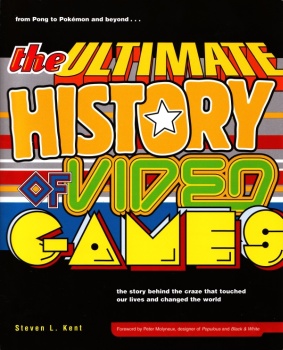
The Ultimate History of Video Games: From Pong to Pokémon and beyond— The Story Behind the Craze That Touched Our Lives and Changed the World

Author: Steven L. Kent
Publisher: Three Rivers Press
Date: October 2001
Pages: 624
Review: derboo

The Ultimate History of Video Games is a bold title for a book to carry, and as if determined to keep that promise, author Steven Kent starts his book at the very beginning—the Pinball industry. The entire first chapter is dedicated to these forefathers that paved the way for an arcade industry to blossom in their wake. Another chapter deals with those pre-industry pioneers that didn't really get the recognition they deserved until much later, Space War und Ralph Baer's Odyssey console. Then the book really kicks of with the rise of Nolan Bushnell and the founding of Atari, following the history through the crash and its revival, courtesy of Nintendo. This era is no doubt the strongest focus of the book, by the time we reach the 1990s, we're already a good 400 pages in. After that, it gets a bit more spotty. The book tells about the 16- and 32-bit console wars fueled by Sega's and Sony's ambitions, respectively, but also spends an entire chapter on Mortal Kombat, Night Trap and the debate around violence in video games. It ends a bit on a low on Sega's departure and Microsoft's entry into the industry. Those final chapters seem a bit less interesting than the rest of the book, for the sole reason that video game history had become a bit less interesting.

The biggest strength of The Ultimate History is no doubt the sheer magnitude with which Kent makes the voices of the makers heard. The man must have conducted hundreds of interviews. A page without a blockquote is a rare sight, up to three citations per page quite common. Over the almost 600 pages one learns how Ralph Baer had the first prototype for his console engineered in secret at his position as a division manager at the defense contracter Sanders; how a filthy young good-for-nothing named Steve Jobs (RIP) makes his first couple thousand bucks in the games industry by exploiting other people's work; or finds out what's the story with Shigeru Miyamoto's grudge against Donkey Kong Country (apparently his first draft for Yoshi's Island got rejected because it didn't look as good as DKC).

To fulfill the claim on an "ultimate history" inside a single volume is frankly impossible, but Kent's book doesn't just fall short on that goal, it doesn't even try. When Kent writes "video games," he has in his mind the old, more narrow definition that distinguishes coin-op and console software from home computer games, and thus safe for very few, arbitrary exceptions the latter are rarely even mentioned, disregarding the fact that many are much more inseparable from the history of video games than the generously covered pinball industry.

There's also a strong US-centered point of view. Even developments in Japan are only taken into account when they had an immediate impact on the US. Dragon Quest, for example, is only ever mentioned in passing when talking about people standing in line for the release of the seventh iteration. Rare is the only European company that gets some spotlight, and only so because it became Nintendo's second party flagship with Donkey Kong Country. Former editions of The Ultimate History of Video Games were titled The First Quarter. While that in fact would sell the book in its current form very short, it at least showed some modesty and was mildly poetic. A more accurate title would be "A mostly anecdotal history of arcade and console games, as perceived in the United States," but naming the book as such of course would be quite insane. False advertisement aside, Kent nonetheless has produced an invaluable resource of anecdotes all would-be historians should have sitting on their shelves. Though not as overarching as the title claims, it still remains by far the most ambitious work of its kind to this day.

For all readers suffering from ADD, it should be noted that it is not a very illustrated history, though. There is a collection of black&white photos on 18 pages in the middle of the book, but safe for those, the book is carried by its text alone. The strong focus on quotations and the structure broken down to very short subchapters make for an easy read, though. I also gotta nitpick about a pet-peeve of mine, namely the source notes, which are compiled at the very end. If one actually cares for them, it's really annoying to jump through the book each time a reference comes up. Even less understandable as there are frequent footnotes on the bottom of pages, only they are reserved for editorial annotations.


Browse on Amazon.com


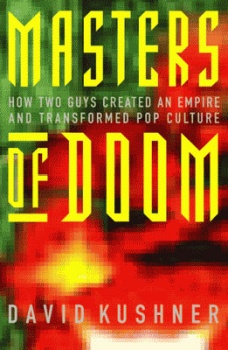
Masters of Doom: How Two Guys Created an Empire and Transformed Pop Culture

Author: David Kushner
Publisher: Random House
Date: May 2003
Pages: 352
Review: Wild Weasel

Masters of Doom is a notable departure from the majority of books that discuss the history of video gaming. Rather than documenting video gaming as a whole—understandably a very broad, massive subject, especially taking into account every region and every platform—Masters of Doom instead focuses on being a biography of sorts, following John Carmack and John Romero as they work for software company SoftDisk, found id Software, and eventually have their fallings-out and go their separate ways.

This book is, in a way, about the games industry itself, albeit from the perspective of Carmack and Romero. The author, David Kushner, paints the Johns as polar opposites of each other—while their interests are similar in some ways, their personalities are as distant as they get, with Romero (the "rock star," as the book puts it) being more outgoing, somewhat aggressive, and generally a proud man, while Carmack is the hyper-intelligent, quiet, almost creepy "rocket scientist" (a title that rings true, since John Carmack does actually build rockets in his spare time). Throughout the book, the two Johns experience certain turns of the game industry, like the launch of Super Mario Bros. 3 for the NES, the Senate hearings regarding video game violence, and eventually even the Columbine High School shooting.

Kushner's writing does a remarkable job of capturing each time period in such a way as to not only provoke nostalgic flashbacks for those who remember them, but also to inform those people who might not know of some of the events that are described. Given that latter point, though, it should be said that Masters of Doom does not patronize its readers by stating the obvious, nor does it leave curious subjects unexplained. I like to consider myself well-learned on the topic of games like Wolfenstein and Doom, but there are some facts in this book that even I hadn't heard of before. The book puts a great amount of detail into the guys playing Super Mario Bros. 3, only for them to wonder how cool it would be if the game ran on their "borrowed" IBM-PCs. From that point, they set to work on recreating the entire first level of SMB3, complete with smooth multi-plane scrolling (something John Carmack put a great deal of effort into, as it had not previously been done on a PC at that point), with the resulting "Dangerous Dave in: Copyright Infringement" eventually being pitched to Nintendo as a PC port of SMB3—Nintendo actually sent a letter back in reply, stating their disinterest in entering the PC gaming market.

The time frame that Kushner covers in this book is actually quite expansive, from both Johns' childhoods and how they individually discovered video gaming, how they met, their time making shareware programs and games for Softdisk Publishing, leading into id Software's golden age, and even up to the point where Romero bails on id Software to form Ion Storm. There is even an Epilogue chapter that covers Romero and Carmack's inductions in the AIAS Hall of Fame, some years after the closure of Ion Storm.

Overall, I would consider Masters of Doom to be a highly entertaining and quite informative read. While most "video game history" books cover the perspective of the consumers, this is one of those that covers from the developer's perspective and beyond. When I read it, I feel as if I was there.

Browse on Amazon.com


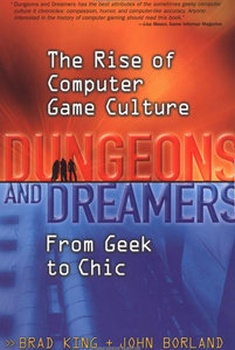
Dungeons and Dreamers: The Rise of Computer Game Culture From Geek to Chick

Author: Brad King & John Borland
Publisher: McGraw-Hill Osborne Media
Date: August 2003
Pages: 284
ISBN: 0-07-222888-1
Review: derboo

Dungeons and Dreamers is another book that doesn't quite follow up on it's title—actually, the fact that it doesn't include the name Richard Garriott alone is enough to constitute false advertisement. A good portion of the book is basically the Ultima inventor's biography. It begins with his school days and first contacts with both home computers and Dungeons & Dragons and first follows his career up to the foundation of Origin. A few anecdotes about other developers are thrown in for good measure, followed by a whole chapter on id and the Doom story. (Did you know Wolfenstein 3D was an Ultima Underworld clone? No, seriously, the book dramatically says about an early tech demo by the team that would eventually make Ultima Underworld: "Romero saw it, too.") Mostly to lead into the development of the LAN culture and online gaming, to set the stage for Garriott's Ultima Online as the revolution in gaming.

Then all of a sudden we are faced with a chapter focusing on the Columbine incident and the following shitstorm against violent video games, which is one of the more differenciated narratives on the matter, but by this point feels really tacked on regardless.

It's interesting to read some quotes by MIT professor Henry Jenkins, author of the book "From Barbie to Mortal Kombat" and participant in the hearings after Columbine, especially since his theories deal with video games from an old-fashioned but at the same time rather insightful viewpoint:

Exploration of the environment has long been a critical part of growing up, particularly for boys, and video games have become that space for urban children without access to forests and fields.
As the boys play these macho games, their parents—and particularly mothers—are suddenly exposed to the content of adolescent fantasies that traditionally have been kept well outside parental view.

It just doesn't gain the weight it deserves in a book where the last sentence of every third paragraph opens with "Just as Richard's..." or "Like Ultima..." Who's the father of video games? Bushnell? Baer? Russel? In the eyes of Brad King and John Borland, apparently it's Garriott.

The authors are also never quite explicit about this supposed transition "from geek to chic," or what this "chic" is supposed to mean in this context, for that matter. Sure, there is some babble about changing demographics of the people that play video games, but even the book itself concludes towards the end: "It's still a little geeky." The kind of games that Richard Garriott used to make still is, eight years later.

All that said, if you cut away some of the fat (and use it for books that concentrate on other subjects) it is a very good biography. At times it feels as if Garriott's voice is felt even more clearly than the authors', and that's the way it ought to be in a biography. The language can be somewhat pompous, with plenty of superlatives and more 4-syllable adjectives than you can shake a stick at, but there's also the humble moments of sincere awe, when Garriott talks about how his do-gooding Lord British was schooled about the ethics of his creation by a petty thief, or about players that seized "his" castle in Brittania during a demonstration against bad lag: "As unhappy they were about the game, they voiced their unhappiness in the context of the game."

It couldn't have come at a better time, too. In it's concluding chapter, Garriott is just working on Tabula Rasa in its early stages, his last big game project and the one whose failure marked at least a temporal halt in his exceptional career as a game designer. Nonetheless, the authors were working on a new edition as of summer 2011, but the project blog hasn't been updated in a while. The first chapters are also available for download as an audio book, although it is not a professional read and at times not that pleasant to listen to.


Browse on Amazon.com


Replay: The History of Video Games

Author: Tristan Donovan
Publisher: Yellow Ant
Date: April 2010
Pages: 516
Review: John Szczepaniak

We already covered The Ultimate History of Video Games, by Steven Kent, acknowledging both its excellence and its shortcomings. It's a fantastic book and absolutely worth owning, despite some glaring omissions. Tristan Donovan's Replay: The History of Video Games aims to fill the same niche, even starting its introduction with a quote from Michael Katz who asks: why another book on gaming history? Although Donovan never mentions Kent's work outright, he makes it explicitly clear that Replay is intended to provide more balanced global coverage; not just the history of US video games, but of Europe and Japan as well, covering computers, arcades, consoles, plus factoring in snippets on real world conflicts, comic books, films, censorship, and all else related. It's an all-encompassing holistic view of video game history.

Donovan actually manages to pull off such an ambitious goal, over Replay's roughly 500 pages. As a Brit he pays respectable attention to uniquely British games, such as Deux Ex Machina on the Spectrum, and there are two chapters dedicated entirely to European gaming (with a bit of Australia too). While it starts off strongly US-centric, which is understandable, it does branch out into chapters dedicated to Japan, South Korea, snippets of East Asia, plus online and indie games. While these individually don't offer the range of information that a dedicated website can (such as HG101's Korean History feature), to criticise Replay for this would be wrong. It still casts the widest net of any currently available book.

It uses a combination of fresh interview material, plus quotes from a range other sources, including old newspaper clippings and modern magazine interviews. This is significant, since while most games magazines have disdain for re-using old quotes, Donovan shows how important it can be to build on the work of others, doing it to great success. Furthermore he provides a meticulous list of sources (8% of total page volume) and footnotes, which is something every video game publication should contain though sadly almost never does.

For those wanting direct comparisons to Kent's book, Replay lacks its rival's ostentatious US swagger—there's no enlarged industry quotes which leap off the page and the layout is more understated. There's also a few grammatical errors and sometimes the prose is slightly stilted, but this shouldn't put you off. A single body of work of such length and scope on games is rare, with the effort and research required by Donovan evident on every single page. It's also a fantastic and fascinating read, filled with fresh trivia and anecdotes, and is wholly conscious of the wider context of the gaming world. Donovan also managed to secure some nice archive photographs, prefacing each chapter. Replay doesn't entirely make Kent's work redundant, but it takes the scope to a new level. If you're into gaming enough to own one book on its history, you'll probably want both of them.


Browse on Amazon.com


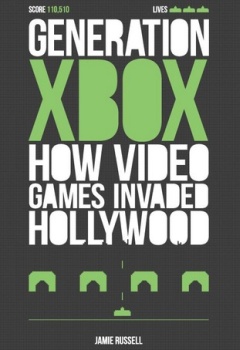
Generation Xbox: How Videogames Invaded Hollywood

Author: Jamie Russell
Publisher: Yellow Ant
Date: April 2012
Pages: 330
Review: Kurt Kalata

The title of this book is slightly misleading - Generation Xbox is author Jamie Russell's catch-all term for gamers aged 18-34, who grew up with games as a valid storytelling medium. Other than the "Generation X" pun, it references Microsoft's console as being the first to be powerful enough to tell a story on the level of a Hollywood movie. This isn't entirely true, and the whole term ends up as something of a vaguery, but the subtitle, How Video Games Invaded Hollywood, does a better job of stating what the book's all about. It's not a criticism or analysis of storytelling in video games, but rather a history about how the two industries have intertwined, beginning with licensed games, working up through full motion video games and movies based on games, and finally ending up on motion capture.

The thesis of the book may as well be about the gigantic gaps between the movie and the game industry. As one of the interviewees puts it: "Hollywood is a culture of personality where people with strong personalitys can convince you even if they don't know what the fuck they're talking about...The game industry sells systems. We don't trust those types of personalities. It's an engineering culture where you have to know what you're talkibg about. You can't be a bullshitter." Players on both sides on are in conflict - those on the gaming side are drawn to the fantasy life styles afforded by the movie industry, while Hollywood is largely scared of the profits that the game industry was raking it, as they try to corner and exploit it for their own gain.

Some of the stories have been featured elsewhere - the book opens with the famously distastrous E.T. for the Atari 2600, along the way telling the story of the Raiders of the Lost Ark game for the same system (which was also by the same programmer, then moves onto Don Bluth, Dragon's Lair, and the advent of the laserdisc arcade games. This segues into the tale of the NEMO, Digital Pictures, and Night Trap, before moving onto the disastrous production of the Super Mario Bros. movie, the most amusing bit being how Shigeru Miyamoto seemed to respond to the film with little more than indifference. They are still excellent stories, however, and are more accessible here than in the Retro Gamer or Game Informer magazines that previous stories were published in.

Even for those with near encyclopedic knowledge of thse subjects will find plenty of new material and fascinating stories. It discusses the beginning of Lucasfilm Games (later LucasArts), established by George Lucas despite him having little interest in gaming itself, while telling stories of how fascinated Steven Spielberg was with the medium, to the point where he would call up the developers to get walkthroughs over the phone. Adventure game fans will find tidbits about Spielberg's involvement with The Dig(which most are probably familiar with) as well as the inception of Indiana Jones and the Fate of Atlantis (which is brief but fascinating.) It also tells of Spielberg's own studio, Dreamworks Interactive, talks of ambitious but cancelled projects, like filmmaker's Nora Ephron's game, which sounds remarkably like a prototype for The Sims, as well as the origin of the Medal of Honor series and how it connects to Saving Private Ryan. It also recounts the failure of the Halo movie in great detail. (Republished at Wired. Short story: Microsoft was entirely too demanding.) The book finishes up with the modern era, discussing the movie-making ambitions of Quantic Dream and their games The Indigo Prophecy and Heavy Rain, before revealing how Acclaim's motion capture studio helped spark a revolution in motion capture, leading to the development of Gollum in The Lord of the Rings, as well as Avatar.

With 330 pages, it's fairly detailed and all well written, despite an occasionally jarring odd criticisms sprinkled through the otherwise objective fact reporting. As with any subject, the well goes quite deep, and some topics beg for further elaboration. It makes no mention of Sierra's The Dark Crystal, largely believed to be the first licensed game ever made. It also misses the opportunity to discuss the company's The Black Cauldron adventure game as an early example of a licensed game that wasn't just a cynical cash-in. Early gaming-themed movies like WarGames, The Last Starfighter and Cloak & Dagger are mentioned only in passing. There are short pieces about the development of the Mortal Kombat and Tomb Raider movies, but the story of the fundamentally ridiculous Street Fighter film still begs to be told. Cinemaware, the developer of such film-inspired titles as It Came from the Desert and Defender of the Crown, is only discussed for a few pages as part of the larger story of Tom Zito and Digital Pictures. Nonetheless, the topics covered are thoroughly researched and well presented, making it an essential read to video game history buffs.


Browse on Amazon.com


<<< Prior Page    

    Next Page >>>

Page 1: History/Biographies
Page 2: Reference Books
Page 3: Essays/Lifestyle
Page 4: Fiction & Game Lore
Back to the Index