|

Page 1:
Intro
Temple of Apshai Trilogy
The Datestones of Ryn
|
Page 2:
Morloc's Tower
Hellfire Warrior Trilogy
Sorcerer of Siva
|
Page 3:
StarQuest Series
Crush, Crumble & Chomp!
Gateway to Apshai
|
|
Back to the Index
|
Related Games:
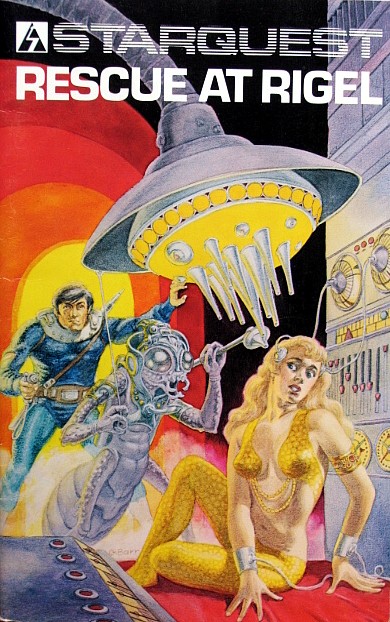
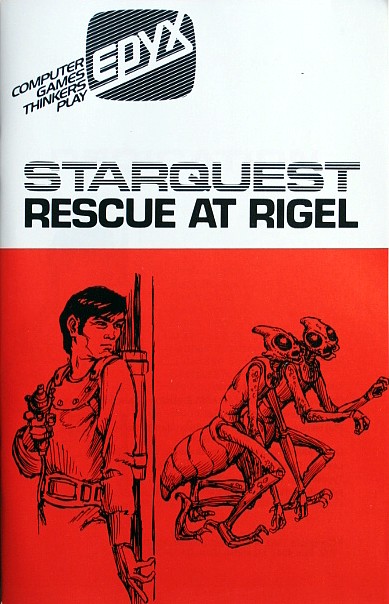
StarQuest: Rescue at Rigel - TRS-80, Commodore PET, Apple II, Atari 400/800, VIC-20, IBM-PC (1980)
Cover Artwork
|
Manual
|
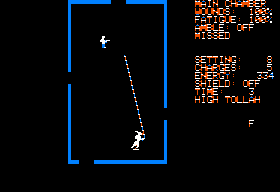
Rescue at Rigel (Apple II)
|
|
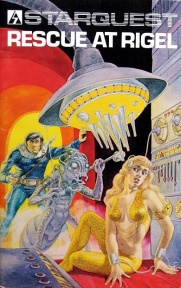
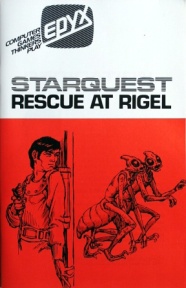
Fantasy role playing is great and all, but after a while it can grow monotonous. This was apparently what Connelley and Freeman were thinking when they made Rescue at Rigel in between the third and fourth DunjonQuest. The first game in a new science-fiction offshoot to their popular series, Rigel was introduced under the label StarQuest. (Incidentally, Space Crusade, the Warhammer 40,000 equivalent to Milton Bradley's Hero Quest, was also called Star Quest in some regions.)
Based on the same game system (on the TRS-80, there's no telling apart the game from DunjonQuest by the graphics alone), StarQuest ties in with yet another Automated Simulations franchise, as it takes place in the same universe as their early Orion games. The hero is Sudden Smith, who already served as the protagonist in the flavor material to those two strategic war games. Sudden himself is of course a nod towards classic space heroes like Flash Gordon and Buck Rogers, which the game is officially dedicated to, next to dozens of other SF characters, from Lazarus Long to Han Solo.
In this game he is not yet a space fleet admiral, but sent as an operative to rescue 10 human prisoners who have been captured by an ant-like alien race called the Tollah (in another Warhammer parallelism, it just takes the main enemies of Temple of Apshai into space), after a renegade leader of them defected to the Stellar Union. Sudden Smith has only one hour left to find them and prevent the horrible experiments that they are about to endure.
The alien base hidden in an asteroid orbiting the planet Rigel consists of six floors with aproximately 60 rooms. While movement is mostly the same as in DunjonQuest, getting around inside of the station is a bit more difficult. There are two lifts, each of which either goes only down or only up. But not all floors can be accessed by them — large portions of the space station are only connected with teleporter fields. Those unfortunately look exactly like doors, only after going through they reveal their true nature. Add the fact that many floors use almost the same layout, and you know you're in for a cartographer's job, or else you'll get hopelessly lost. But be surre to use a pencil to note down those prisoner locations, for they change with each new game. The room descriptions are back, but here each room refers to a type like "lab", "dropshaft" or "sanctum", with an explanation as towards their general purpose on the station or in Tollah culture, rather than individual observations.
The special commands have of course been adapted for the new setting, especially combat is much more focused on ranged attacks. You have your standard laser gun, which, other than the bow in the fantasy counterpart, doesn't need a straight line to hit enemies. For tougher enemies, there is also a special blaster gun that can be set between 9 charge levels. In case of an ammunition shortage, Sudden Smith can also attack with what looks like a flying Karate kick, but it is clearly of secondary nature here, as many foes attack from a distance themselves.
Upon finding each of the hostages, Smith has to beam them out of the complex with his transporter, which also serves as his only way out after he accomplishes his mission. The device, however, uses the same energy units as his laser gun, and if he doesn't take care, he might find himself stuck on the station until the very end (which is after 1 hour in real time or whenever he dies). Also dependent on this energy is a shield, which of course protects from laser damage.
The most interesting of agent Smith's gadgets is the AMBLE (short for "accelerated movement through bio-electronic enhancement") system, which works like steroids do in so many other games. Whith the AMBLE system activated, the player gets two moves in each round, also dealing more damage with melee attacks. The AMBLE system doesn't draw from energy reserves, but it causes rapid fatigue, so careless space adventurers can quickly find themselves immobile between an alien's mandibles.
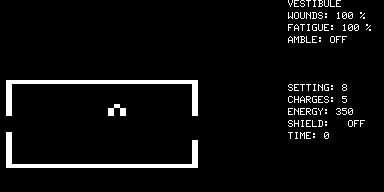
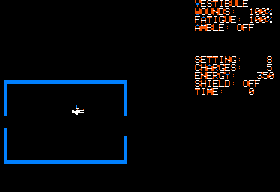
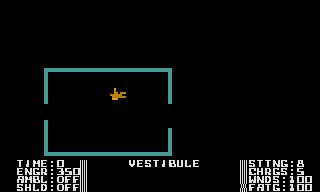
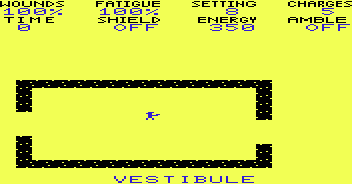
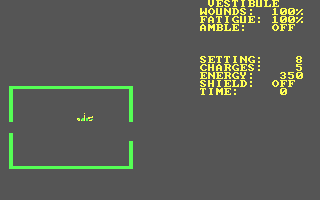
The versions for the TRS-80, PET and Apple II are uniform with their DunjonQuest counterparts for these systems. On the Atari platforms Rescue of Rigel uses the same engine variant as Datestones of Ryn, with the 90-degrees rotated main character. On the VIC-20 the game uses a weird aspect ratio for the graphics, wich makes them look warped, with a tiny main character that seems almost comical. On the other hand it scores with musical cues and more versatile sound effects than any other version. Despite a weird color palette, the IBM-PC version is the winner in the graphics department, thanks to huge, well defined alien sprites. It has to be throttled way down on modern machines, of course, even in DOSBox.
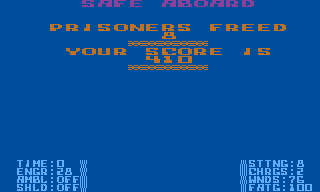
With the forgoing of character stat development and concentration on one single quest, Rescue at Rigel is close to MicroQuest standard, although it is significantly bigger than Morloc's Tower, thus filling in kind of an in-between space like Sorcerer of Siva, luckily without the more frustrating elements of that game. The task of course is once again very simple, and also a bit on the easy side, despite the three difficulty levels to chose from. In best DunjonQuest tradition, the display of your score in the end has to suffice as a reward, further nourishing the hybrid board/arcade game spirit.
|
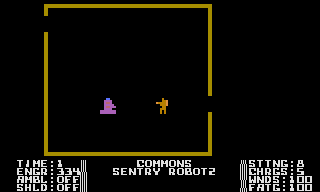
Rescue at Rigel (Atari 400/800)
|
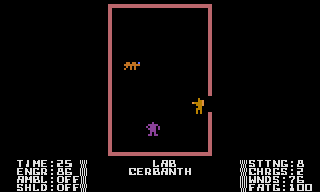
Rescue at Rigel (Atari 400/800)
|
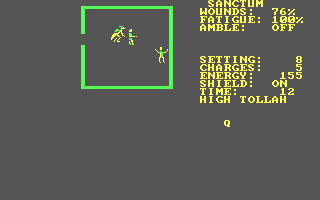
Rescue at Rigel (IBM-PC)
|
Rescue at Rigel (Atari 400/800)
|
|
Comparison Screenshots - Rescue at Rigel
TRS-80
|
Apple II
|
Atari 400/800
|
Commodore VIC-20
|
IBM-PC
|
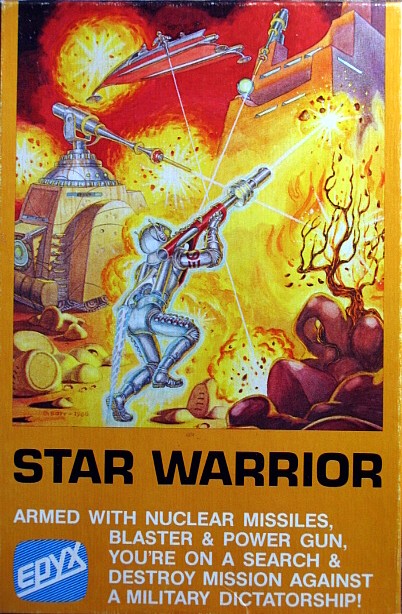
StarQuest: Star Warrior - TRS-80, Apple II, Atari 400/800 (1980)
Cover
|

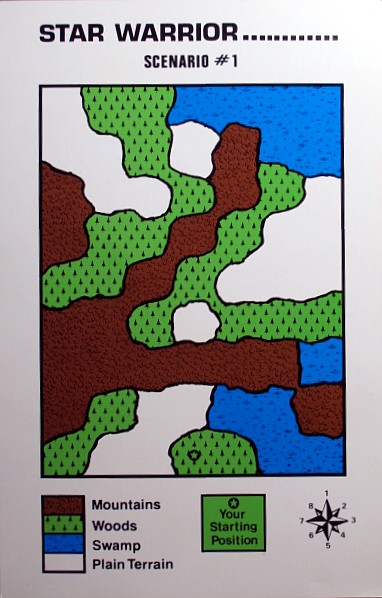
Scenario #1 Map
|
Star Warrior (Apple II)
|
|
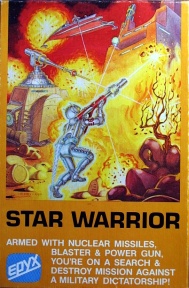
Star Warrior, the second StarQuest, departed from the established formular more than any other entry before. Instead of claustrophobic hallways and rooms it took the action to open terrain. (It came before the Upper Reaches of Apshai expansion, whose outdoor environments also felt more like dunjons with an unconventional color pattern.) It also differs from a storytelling perspective. Instead of building upon an established character from the previous game, it introduces īPurvis Youngblood, member of the mercenary organization The Furies. They're no ordinary guns for hire, though, as they call themselves "agents of retribution". Now they're hired for a querilla operation to free planet Fornax, formerly an independent human colony but now annexed by the Stellar Union.
The player can take part in this war in one of two possible tasks. The target in scenario is it to cause as much wanton destruction as possible while proceeding to the far north. This is meant as a maneuver to distract from the actual target in Scenario 2, the military commander in control of the occupation.
At the beginning of each scenario comes the choice between three combat suits, which differ in attack strength, shield power, special options and the like. Disk versions (as opposed to those released on tape) also allowed to create custom suits. The options on the battlefield are actually more resembling a war game, although there is but one character to control. Most importantly, each suit comes with a jetpack, as walking by foot quickly becomes tedious with the new world scale. Different kinds of terrain like swamp and plains are not just for show, as they inluence movement speed. Trees, mountains and other obstacles are even taken into account in simulating true line-of-sight.
In accordance with the setting, enemies are now mostly tanks, infantry appears in bigger units. Not only the enemies but also the player can move in 8 directions now. Besides moving targets, the desctruction of several immobile structures greatly raise your score. Most of them don't fire back, but they're much more sturdy than the war machines, and require multiple rockets to tear them down.
Those rockets are among the more strategic simulation-like of your suit's powers, as you have to chose direction and range manually when firing. Also more tactical in nature are decoys and the suit repair function to reinstate damaged systems. The power gun and force shields from Rescue at Rigel are back, too.
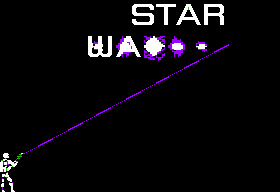
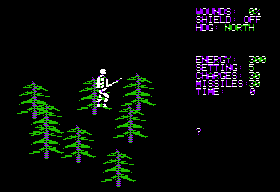
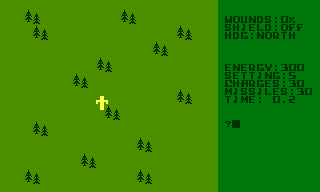
For the first time the original TRS-80 game was blessed with "real" graphics (of which we unfortunately couldn't get any better screenshots than the one below). The Apple II version is extremely zoomed in with a huge sprite for the player character, but it is always to the upper right, which is very irritating. The best overview offers the Atari version, but it reacts very slowly. Combined with a seemingly infinite input buffer, all but the most patient players will probably have typed the input for half of the game before even the first move is executed. (There supposedly was also a port to the Commodore VIC-20, but that couldn't be acquired for this article, either).
Star Warrior is one of those games whose main problem is that they don't manage to figure out what kind of game they actually want to be. For an RPG the area is much too monotonous and boring, for a strategic war game it is much to limited with only one player-controlled unit, and the turn based DunjonQuest engine doesn't lend itself to action games at all. Trying to offer a little of everything, in its released state, it suceeds at neither. Back to the drawing board, Mr. Connelley! (is what they should have told him 30 years ago.)
|
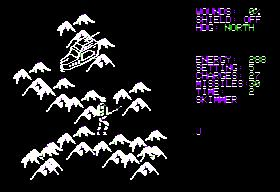
Star Warrior (Apple II)
|
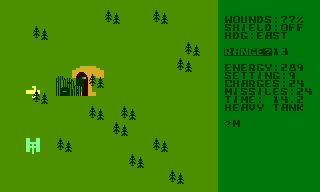
Star Warrior (Atari 400/800)
|
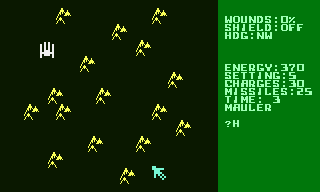
Star Warrior (Atari 400/800)
|
|
Comparison Screenshots - Star Warrior
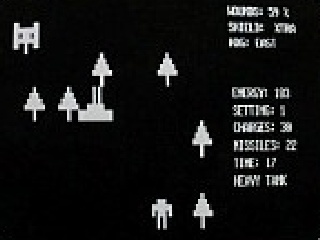
TRS-80
|
Apple II
| <
Atari 400/800
|
Crush, Crumble & Chomp! - TRS-80, Apple II, Atari 400/800, VIC-20, IBM-PC, Commodore 64 (1981)

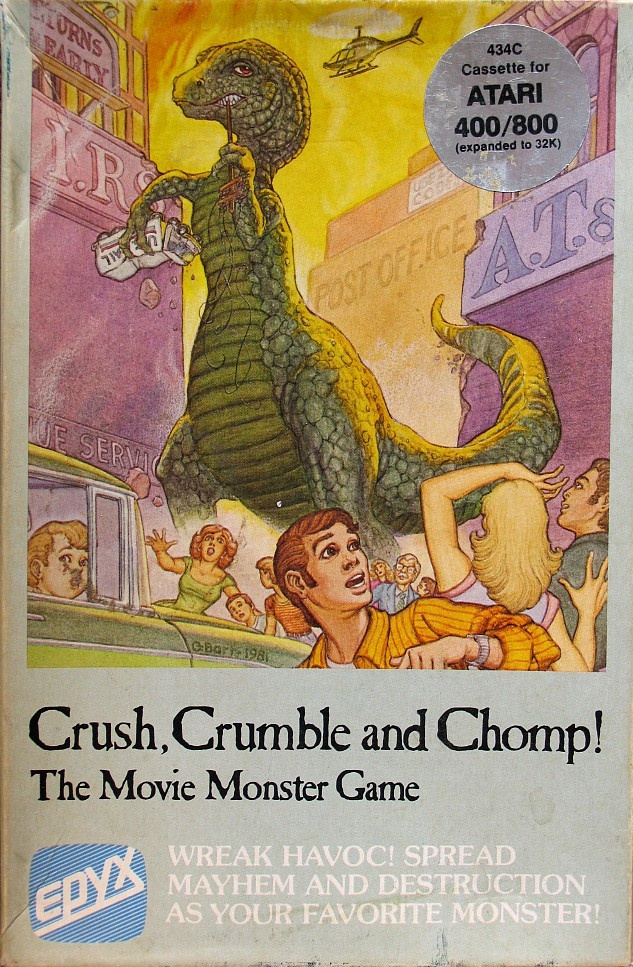
Atari 400/800 Cover
|
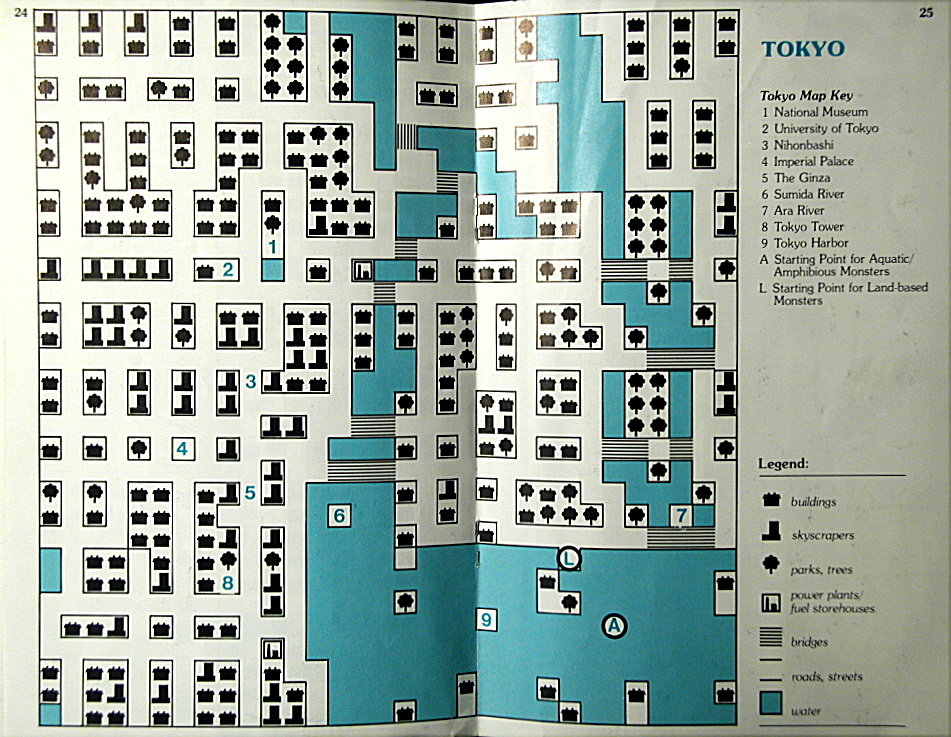
Map of Tokyo
|
Crush, Crumble & Chomp! (C64)
|
|
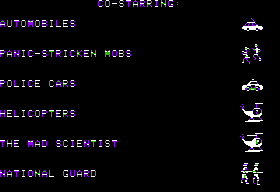
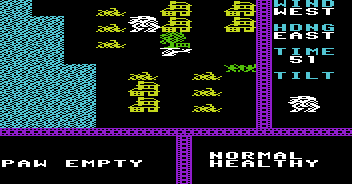
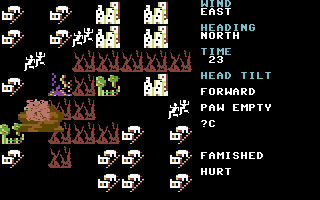
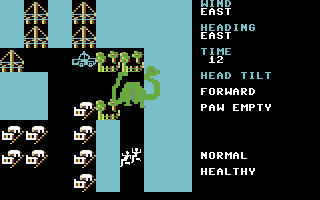
And now for something completely different! Crush, Crumble and Chomp: The Movie Monster Game puts you in the shoes of one of six gargantuan monstrosities, to crush, crumble and chomp everything that moves and then some. Obliterate skyscrapers with your sheer weight, breathe fire upon the infantry as it marches out to stop you, grab the fleeing mobs and eat them alive! CC&C is the most awesome game of destruction ever — in theory. The actual representations demand a lot of imagination from the player, as not too much of all this is actually recognizable on screen.
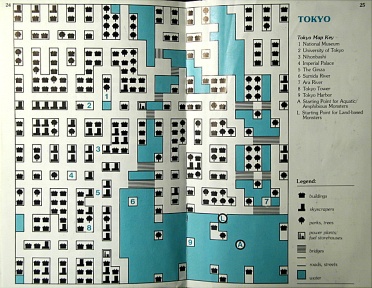
The game takes "inspiration" from many of the monster movie classics (which means it steals their monsters) to give each monster its unique appearance and powers. Goshilla is of course the bipedal lizard, Arachnis catches victims in its spiderwebs. The Glob's slime is highly inflammable, which destroys everything in its trail, but also blocks the way back for the monster itself. Kraken can only move in water, while Mantra as a Pterodactyle-like creature tikes off into the air. Mechismo, finally, is a little too similar to the AT-AT walkers from Star Wars. The cities are also taken from typical movie locations: New York, San Francisco (refered to as "Golden Gate"), Washington D.C. and Tokyo are clearly recognizable on the maps, but in close up don't actually look that much different from each other.
The fun of CC&C comes from all the monster's crazy abilities: Doing a strafing run with Mantra by tilting your head to the side and setting each building you pass on fire, lashing about with your tail as Goshilla and zapping laser blasts with Mechismo brings memories of all those classics to life, although mostly in your mind. All monsters get hungry with varying speed, except for Mechismo, of course, who doesn't need to bother with capturing humans to feed upon them. The game also allows to grow new monsters, based on 8 different carcasses (in addition to the featured monsters a brontosaur and a giant snake), and a selection of abilities (limited by a fixed amount of skill points).
There are five different goals to select from, like killing as much civilians as possible or destroying the whole city, but it is almost impossible to win for the monster, as stronger units of military are dispatched the more damage you cause, and a mad scientist is out to kill the mosnster from his helicopter with paralyzing poison, too. When it finally succumbs to its hunters or starves, you'll be shown your final score, which once again represents the actual "goal" of the game — scoring better than your friends.
A single monster has no sex life. (How could it?) However, if you are interested in scoring, you may find out your current score any time during play by pressing #.
- Jon Freeman, Crush, Crumble & Chomp manual
CC&C's big problem stems from its use of the antiquated DunjonQuest engine. Since now a lot of characters can be on screen at a time, the wait for turns is nerve-wrackingly long, and the way commands are input don't encourage patience at all. For example, the last input of a turn isn't executed before the beginning of the next, after all enemy units' moves are completed. It could have been such an awesome game, but its pace is hardly bearable anymore for a modern gamer's ADD-deranged mind.
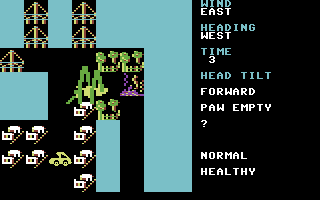
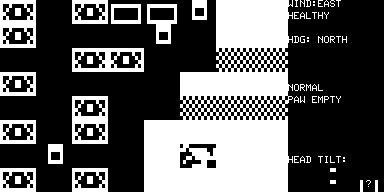
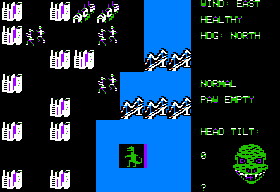
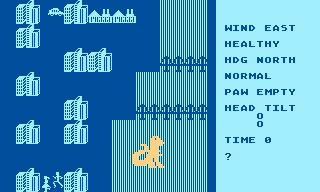
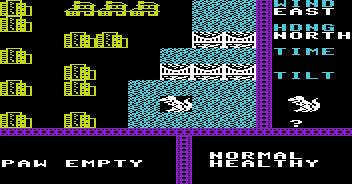
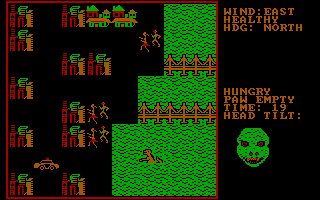
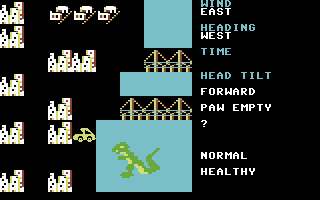
Most of Automated Simulations' games before they officially became Epyx started on the TRS-80, and CC&C was no exception. The graphics are nice compared to previous games, but still very barebones. The Apple II game looks much more natural and is the only version that displays the head tilt, except for the IBM version, which is obviously based off that one, though not without a few graphical improvements. Head tilt is important for breath attacks and the like, with a portrait of the monster's head. On Atari computers, the feedback for the controls feels most intuitive, but it is also rather ugly, especially lacking in colors. The VIC-20 version actually looks pretty decent, despite having the biggest frame for the on-screen display and thus the smallest playing field. For some reason it is the only version that lacks custom monster creation. Unsurprisingly, the game is the most beautiful on C64, with huge monsters that are actually displayed according to the direction they're looking at (the monsters in the other only had one single side-view sprite, mirrored for two of the directions at best). It has the most aggravating input, however, not only with weird effect timing but also sometimes unreliable.
In 1986, Epyx remade CC&C, now just titled The Movie Monster Game. Interestingly, the company purchased the official licensing rights to use the Godzilla, but otherwise stole its monsters just as impudently as the older game, if not more so. Alas, it even ripped off the Marshmallow Man from Ghostbusters, AKA Mr Meringue and Transformer's Megatron, oh-so-cunningly disguised as Mechatron. New cities are Moscow, Paris and London, complete with their distinct landmarks to crumble, but smaller in scope. The game runs in real time, with input done directly with the joystick, but the monsters still retained an array of special abilities, selectable with the space key. Overall it lacks the depth of its antecedent, but feels a bit more playable, thanks to it running in real time. The game was received rather well, although not exactly effusively. Jon Freeman, however called it "a terrible game", as Epyx failed to "adjust the scale" of the gameplay to the monsters' size, rendering some scenarios pointless.

The Movie Monster Game (C64)
|
Crush, Crumble & Chomp! (Apple II)
|
Crush, Crumble & Chomp! (VIC-20)
|
Crush, Crumble & Chomp! (C64)
|
Crush, Crumble & Chomp! (C64)
|

The Movie Monster Game (C64)
|
|
Comparison Screenshots - Crush, Crumble & Chomp
TRS-80
|
Apple II
|
Atari 400/800
|
Commodore VIC-20
|
IBM-PC
|
Commodore 64
|
Gateway to Apshai - Atari 400/800, Commodore 64, ColecoVision (1983)
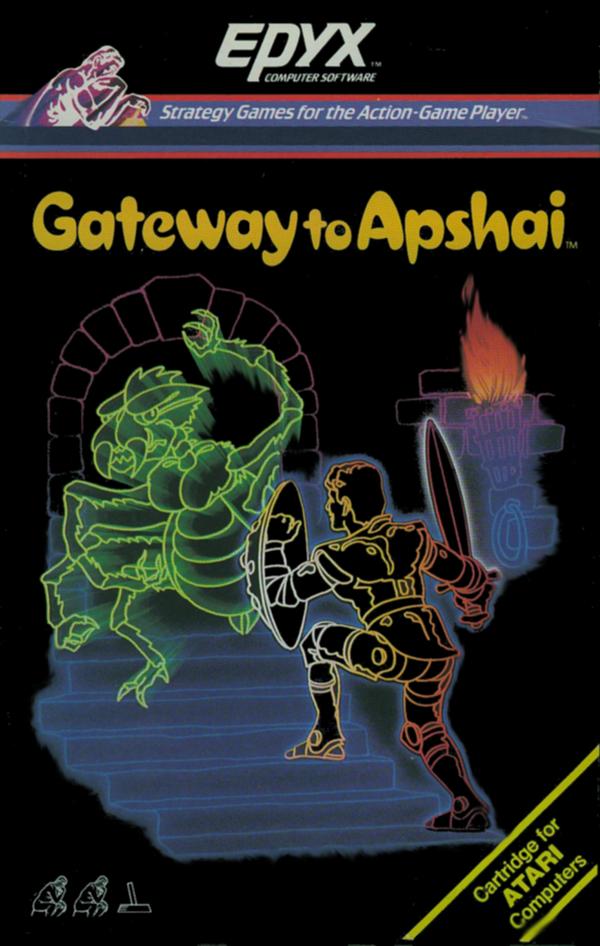
Atari 400/800 Cover
|
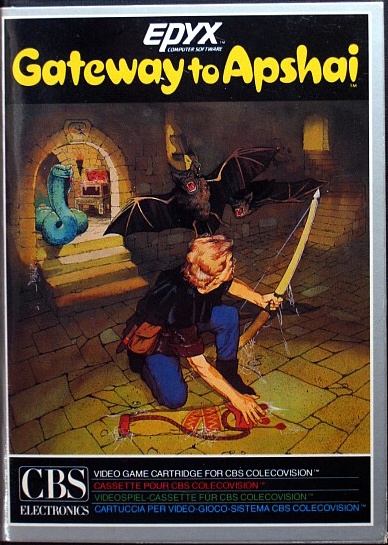
Colecovision Cover
|
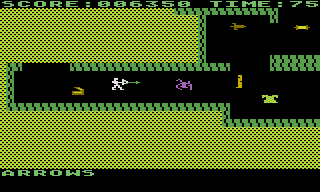
Gateway to Apshai (Atari 400/800)
|
|
While Freeman had already moved on in 1981, Connelley's last words in the matter of Dunjonquest came about two years later. Gateway to Apshai doesn't run on the old Dunjonquest engine, anymore, in favor of an action-based real time combat system. It is, however, linked to the first in the series through its name. It is often considered as a prequel to Temple of Apshai, as it deals with a young adventurer fighting his way through the caverns that lead to the temple, while the ant god's sanctuary itself is never reached. Yet considering how the game twists around the lore established in the first game, this connection has to be taken with a grain of salt.
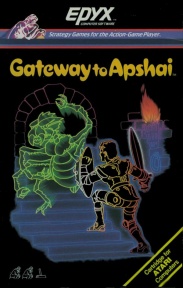
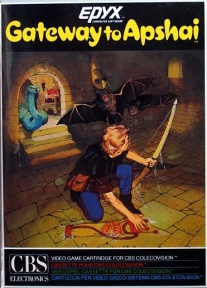
Now all of a sudden there are legends telling about the "Apshai's Greatest Warrior", only whose blood can save the country from imminent destruction by rediscovering the lost Temple of Apshai. So after the ant god has been established as a somewhat villanous but definitely dark deity before, it is now depicted as a savior without further explanation. It is also no longer refered to as related to ants. Although the threatening image of an ant man still decorates the cover in most releases of the game, you'd be hard pressed to find it again in the dungeons (yep, the spelling dunjon is also gone). Anyway, you're the only left kin of "Apshai's Greatest Warrior", so your task is to head out into the ruins, not to second-guess historic accounts.
Even after the success of Rogue and Epyx' own Sword of Fargoal, Gateway of Apshai favors designed dungeons instead of random generated content, but this time it's 128 individual dungeons, so it doesn't make much of a difference, as "normal" players are not likely to visit most of them more than once. What the game takes from Sword of Fargoal, however, is the "fog of war", to use that anachronistic name for areas conceiled under a more or less mist-like cover until they're explored by the player. By traditional ARPG conventions (which are conveived for the first time right now with this game), the protagonist is controlled directly with the joystick, the fire button executes the currently selected action. One of three F-keys (on C64) switches between melee and ranged weapon use, another cycles through the inventory. The most important one handles everything else, from lockpicking over searching for secret doors or traps, up to several status menus. The latter ones are especially vital as the game for whatever reason never display's the hero's current constitution on the main screen.
More important for that space it seems was the score display, as if to emphasize that this is an arcade-like experience to a company management dead-set on focusing on action games. The other "RPG elements" have been retracted a bit, too. Of six main attributes in the Dunjonquest series only three are left, strength, agility and luck. There is no counter for experience points, but there are nonetheless ways to raise those three, as well as the maximum amount of hit points, however concealed to the player they may be. The innkeeper's store was also nixed, so you're stuck with whatever gear you find in the depths.
Fortunately, treasures are found in abundance, more often you'll deal with a full inventory than a deficiency of needed items. Weapons and armor are a given, as well as the score-relevant gold and jewels, Gateway also sports an array of different spells. Most are all too familiar to the experienced RPG player now, like protection, teleport, stun and death, but there are also some more particular ones, for example reflect, which redirects any inflicted damage back to the enemy, thus equalling temporary invincibility. The most interesting spell by far and probably never used again in any later game is the "Blast" spell, which instantly drives a tunnel through masonry and stone, creating a new passage to whatever lies beyond.
The combat system is simple enough with little surprises. One just runs near enemies, tries to strike them without getting hit, and then it's most wise to retreat, as all enemies constantly charge at the nameless hero, dealing damage as soon as they touch him. Still, many enemies are almost impossible to beat without taking some hits in turn, so it's important to make sure one has reached an appropriate level.
Usually it's best to explore as much of a dungeon as possible for maximum stat increase, but each stage can be played as often as one desires, so there is no real pressure behind the time limit that's running at each raid. All dungeon's have no exit, so there's only three ways to get out: Death, running out of time and progressing to the next level, which opens a new set of 16 dungeons, up until level 8. There's no way to go back a level, so it's best to wait with ascending until one is sure to be ready. After reaching and completing level 8, there's nothing else to do, although the game never ends and just waits for the player to repeat the last 16 dungeons indefinitely or just turn off the computer in frustration. The dungeon crawling is also only fulfilling until one grows too strong for the challenge, making this lack of an ending (which of course stems from Dunjonquest roots) all the more unsatisfactory.
Gateway to Apshai was released on Commodore 64, Atari 8-bit computers and the ColecoVision. While the home computer versions are identical safe for a few minor visual differences and key mappings, the console port is a very different beast, with all new dungeons and faster gameplay. This in consequence also makes the game much harder than the other versions. Thanks to the numerical keypad on the ColecoVision controller, seperate keyboard input is gone. No version looks as good as the "screenshots" on the back of the box, making an early example for false advertisement through retouched screenshots.
While the above run-down tends toward a slightly negative tone, Gateway to Apshai is still pretty fun while it lasts. It does have a few design decisions that seem inappropriate even for 1983 (not hit points on screen!), but in other aspects it is groundbreaking. Its historical meaning as the first proper action RPG, an innovation DunjonQuest has always hinted at during its run, cannot be overstated.
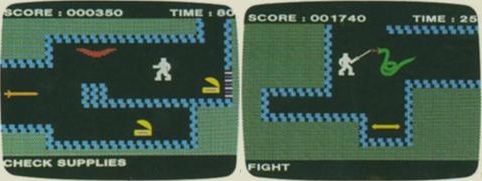
Gateway to Apshai Fake Screenshots
|
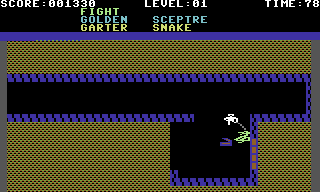
Gateway to Apshai (C64)
|
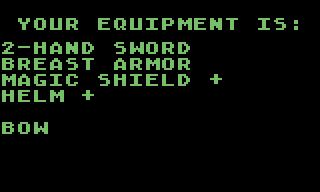
Gateway to Apshai (Atari 400/800)
|
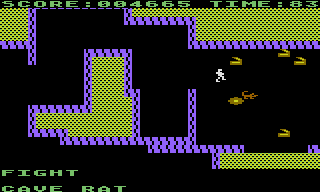
Gateway to Apshai (Atari 400/800)
|
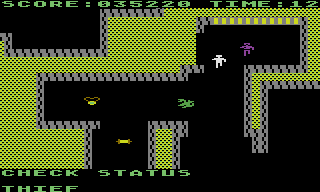
Gateway to Apshai (Atari 400/800)
|
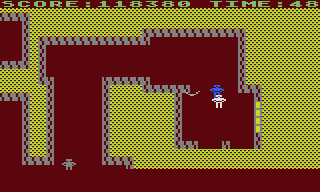
Gateway to Apshai (Atari 400/800)
|
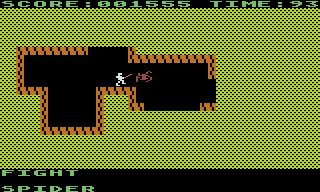
Gateway to Apshai (Atari 400/800)
|
|
Comparison Screenshots - Gateway to Apshai
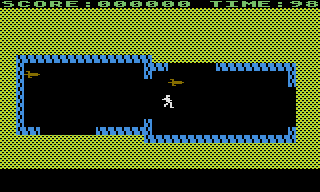
Atari 400/800
|
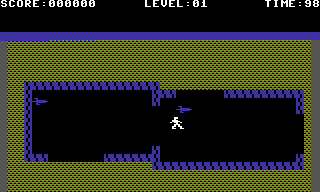
Commodore 64
|
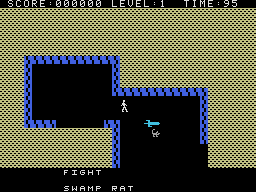
ColecoVision
|
[Rip-Off?] HeroQuest - Board Game (1989)
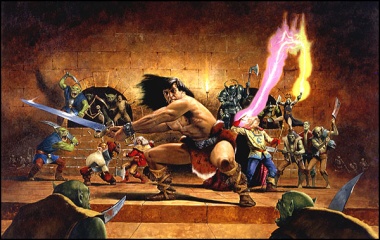
Cover Artwork
|
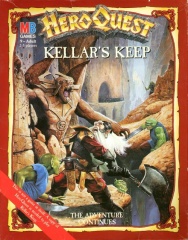
Kellar's Keep Expansion
|
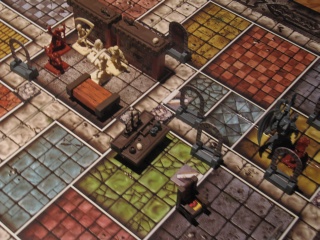
HeroQuest
|
|
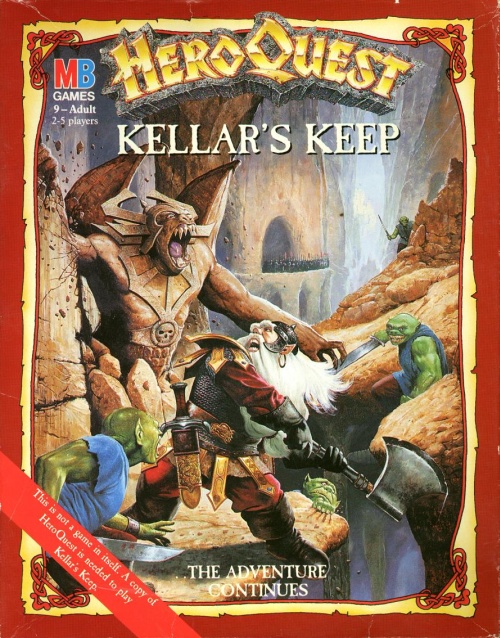
Preceding any conception about what a role playing game for computers is supposed to be like, DunjonQuest and most its spin-offs live and breathe pen&paper as well as board game conventions. So it doesn't come as a surprise at all that the game that resembles the series the most isn't (originally) on computers, either.
Published in 1989 by Milton Bradley UK, Hero Quest was based on Games Workshop's Warhammer setting, but instead of the large scale wars fought in the miniature war game, the board adaption focused on dungeon crawls — just like DunjonQuest. It is impossible to discern whether Stephen Baker, the designer of the game, ever even played Epyx' games, as both games draw from similar roots in p&p and war games, but the similarities are quite astonishing.
The general game progression was almost the same between the two. HeroQuest of course determined the walking speed of each round by dice rolls, and its combat system was much simpler (though it featured spells for two of the characters). Room descriptions where replaced with cardboard furniture and resin miniatures. (They were supposed to get custom-painted, which the owner of the depicted set never bothered to do.) HeroQuest didn't win the Origins Award for "Best Graphic Presentation of a Boardgame" for nothing. But any treasures, traps and equipment was documented on cards and descriptions in the dungeon master's book.
Much like DunjonQuest, the board game was also expanded with several add-on packages, and a SF spin-off called Space Crusade (or, in a hilarious coincidence(?), StarQuest in most European countries). Space Crusade, as well as a revised edition of the original game called Advanced HeroQuest replaced the static board with a modular structure that allowed for more versatile dungeons. As a board game, HeroQuest was created for up to 4 players in cooperative play (vs one dungeon master), an option that certainly would have reserved DunjonQuest a much more lasting place in gamers' minds.
Both HeroQuest and Space Crusade were also remade into video games, the former even got its own computer-exclusive sequel unrelated to any board game prototype (but still harboring elements typical for board games). The most pompous board game of its time was incredibly successful, so it would soon spawn legions of imitators on its own, like Mighty Warriors (Games Workshop 1991), Warhammer Quest (Games Workshop 1995), Dungeons & Dragons: The Fantasy Adventure Board Game (Hasbro/Wizards of the Coast 2003) or Descent: Journeys in the Dark (Fantasy Flight games 2005).
It's not like there wasn't enough inspiration for Baker in other board games, though. A similar game, but not as close to Automated Simulations' series was actually released years before, in 1985. Also published through Games Workshop in English, a title like DungeonQuest should have rung alarm bells over at Epyx. The game, however, actually started life in Sweden as Drakborgen (Dragon's Fortress). Here the cave of the dragon is generated randomly as the game progresses.
Dungeon crawler board games started even before DunjonQuest, with Terence Peter Donnelly's (funny how even the names of the creators are similar, isn't it?) The Sorcerer's Cave in 1978. Like in the DungeonQuest board game, dungeons are created randomly. Many years later Donnelly also created a computerized version for Windows, which is now free for download on his home page.
So is HeroQuest a rip-off of DunjonQuest? Probably not, but for a DunjonQuest fan longing for more even after finishing all its episodes, it may be just the right fix.
|

Sorry, wrong door!
|
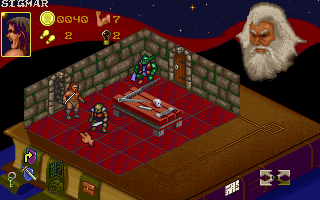
HeroQuest (PC)
|
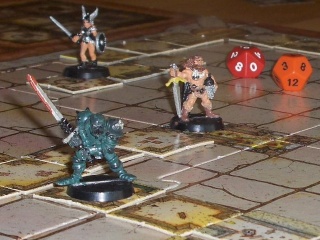
DungeonQuest/Drakborgen
|
|
Page 1:
Intro
Temple of Apshai Trilogy
The Datestones of Ryn
|
Page 2:
Morloc's Tower
Hellfire Warrior Trilogy
Sorcerer of Siva
|
Page 3:
StarQuest Series
Crush, Crumble & Chomp!
Gateway to Apshai
|
|
Back to the Index
|
Back to the index
|